Android Users Settlement Eligibility 2026: Claim Status, Payouts, and How to File
Quick Answer
- Multiple Google Android settlements are real. The most notable involves claims that Google tracked cellular data usage without consent.
- Per-person payouts are modest. Similar Google privacy settlements have paid $10 to $50 per valid claim in recent years.
- Most filing deadlines have passed. If you did not file, check the official settlement website to confirm whether any window remains open.
If you use an Android phone, you may have received an email or seen a notice about a Google class action settlement. The core claim across several related cases is that Google collected cellular data and location information from Android devices even when users believed such tracking was disabled. Google settled these claims to avoid trial. The settlement is real, it is court-approved, and it affects tens of millions of Android users nationwide.
This article covers which Android settlements are paying in 2026, who qualified, how much individual payments are worth, whether any claim deadlines are still open, and how to spot fake settlement notices. One overlooked detail: there is no single “Android settlement.” Multiple cases exist. You may qualify for one and not another. Checking the right settlement website matters.
The Facts
| Case | In re Google Android Consumer Privacy Litigation (consolidated cases) |
| Status | Settlements approved. Payments being distributed. Some claims still in process. |
| Fund Size | Varies by case. The primary cellular data settlement fund is in the tens of millions. |
| Est. Per Person | Generally $5 to $30 per valid claim, depending on total claims filed and case specifics. |
| Claim Deadline | Most deadlines passed in 2024 and 2025. Check official sites for any open windows. |
| Administrator | Various court-appointed administrators; check the official settlement website for your specific case. |
| Proof Needed | Typically none. Most settlements allowed claims without proof of purchase or usage. |
Is the Google Android Settlement Real?
Yes, the Google Android privacy settlements are real. They are court-supervised class action resolutions, not internet rumors. Multiple cases have been consolidated or settled separately, all addressing allegations that Google collected and stored cellular and location data from Android phones without proper user consent.
The largest of these cases, In re Google Android Consumer Privacy Litigation, was filed in the U.S. District Court for the Northern District of California. The plaintiffs alleged that Google’s data collection practices violated state and federal privacy laws. Google denied all wrongdoing but agreed to settle to avoid ongoing litigation costs and uncertainty.
The settlement received final court approval. A claims administrator was appointed to process claims and distribute payments. Money has gone out. Some checks have been cashed. Others are still being processed. The settlement is not hypothetical.
Scams have followed these settlements closely. Fake notices, phishing emails, and fraudulent websites have tried to harvest personal information under the guise of “claim filing.” The real settlement never asks for your Social Security number, your bank password, or payment to file a claim. If you receive a notice, verify it against the official settlement website before entering any information.
Key Takeaway: The Google Android privacy settlements are legitimate and paying claims. Verify any notice you receive against the official settlement website. Never pay to file.
What Is the Google Android Cellular Data Lawsuit About?
The lawsuit accused Google of collecting cellular data usage and location information from Android phones even when users had disabled location history and other tracking settings. The plaintiffs argued this violated privacy laws and Google’s own representations.
Specifically, the lawsuits claimed Google used Android’s operating system permissions to access cellular data logs, network signal information, and approximate location data without clear disclosure. Users who had turned off Location History believed their movements were not being tracked. Google allegedly continued to collect and store location-linked data through other settings, including Web & App Activity.
The legal claims included violations of the California Invasion of Privacy Act, the federal Wiretap Act, and various state consumer protection statutes. The plaintiffs sought statutory damages, which under some privacy laws can range from $100 to $1,000 per violation. Class actions aggregate these statutory claims across millions of users, producing substantial settlement pressure.
Google’s defense centered on consent. The company argued its privacy policies disclosed data collection practices, and users consented to those policies when setting up their devices. The court did not resolve this dispute. The settlement means neither side proved its case at trial. Google paid to make the cases go away, not because a judge or jury found it liable.
How Much Will the Google Android Settlement Pay?
Per-person payouts in Google privacy settlements have been modest. The primary cellular data settlement is expected to pay between $5 and $30 per valid claim, with the final amount depending on how many claims were filed and administrative costs.
This range is consistent with other Google class action settlements. The Google Plus data exposure settlement paid approximately $5 to $12 per claimant. The Illinois biometric privacy settlement involving Google Photos paid roughly $95 per person, but that case involved a state law with high statutory damages. The Android cellular data cases do not have that statutory floor in most states, so payouts are lower.
The math is straightforward. A settlement fund of, say, $20 million sounds large. But after attorney fees (typically 25 to 33 percent), administrative costs, and division among millions of claimants, the per-person amount shrinks fast. If 5 million valid claims are filed against a $15 million distributable fund, each claimant receives $3. That is before any tiered distribution that might give more to longer-duration users and less to others.
Estimated Payouts by Settlement Type
| Settlement | Estimated Per-Person Range | Status |
| Google Android Cellular Data Privacy | $5 to $30 | Payments being distributed |
| Google Plus Data Exposure | $5 to $12 | Distribution complete |
| Google Photos Biometric (Illinois only) | $90 to $100 | Distribution complete |
| Google Location History Privacy | $10 to $40 | Varies by case stage |
These figures are estimates based on court filings and administrator reports. Your actual payment may be lower or higher. The official settlement website is the only source for your specific payment amount.
Reality Check: No one is getting rich from these settlements. If you file a claim, expect enough for a coffee or lunch, not a car payment. Anyone promising a large payout from an Android privacy settlement is either misinformed or running a scam.
Who Qualifies for the Google Android Settlement?
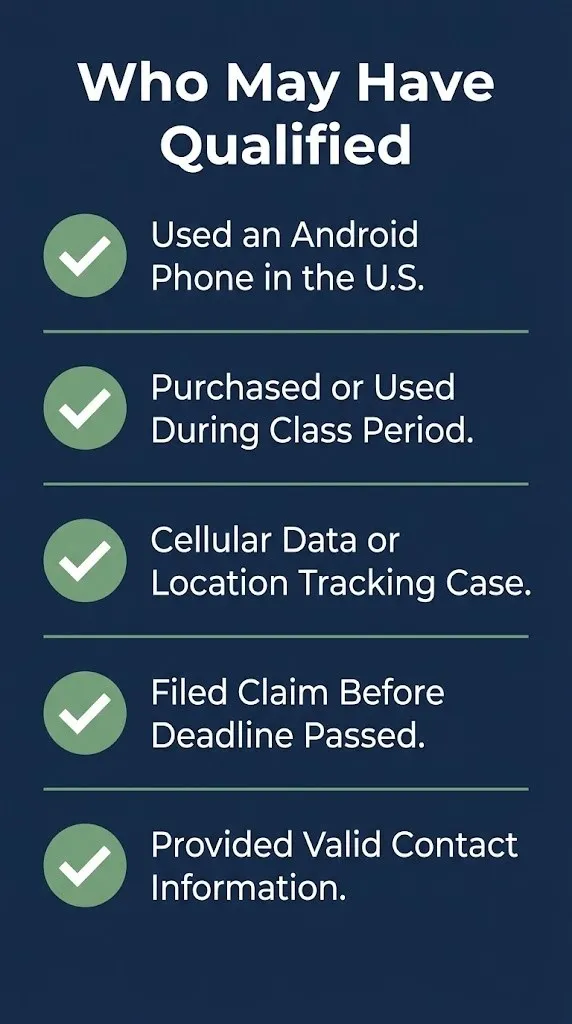
Eligibility varied by settlement. For the primary cellular data privacy settlement, you may have qualified if you owned or used an Android phone in the United States during the class period.
The class period typically covered several years of alleged data collection. Exact dates varied by case. One major settlement covered Android users from approximately 2014 through 2020. Another covered a narrower window. The class definition determined who could file.
Residency mattered. Most settlements covered U.S. residents only. Some covered all U.S. Android users regardless of state. Others were limited to specific states with stronger privacy laws, such as California, Illinois, or New York.
You generally did not need receipts, proof of purchase, or phone records to file. Most settlements allowed claims based on attestation: you stated, under penalty of perjury, that you qualified. Some required your Android device’s IMEI or serial number. Others asked only for the email address associated with your Google account.
If you received a postcard or email notice with a unique claim ID, that notice was sent because Google’s records indicated you may be a class member. Receiving a notice does not guarantee eligibility. It means you were identified as a potential member. Filing a claim was still required.
Key Takeaway: Eligibility was broad. Most U.S. Android users during the class periods qualified for at least one settlement. Proof was minimal. But filing deadlines passed for most cases.
How to File a Google Android Settlement Claim
Most claim deadlines have passed. The following steps describe the process that existed when claims were open. If a new settlement is announced, the same process will apply.
- Go to the official settlement website for the specific case. Do not search generally. Use the URL printed on your notice or found in the court’s settlement approval order.
- Locate the “File a Claim” link on the homepage. It is typically prominent.
- Enter your Notice ID and confirmation code if you received a notice. If you did not receive a notice, look for an option to file without one.
- Provide your contact information. Name, mailing address, and email are required. Phone number is typically optional.
- Confirm your eligibility. Answer a few yes-or-no questions about your Android device usage during the class period.
- Select your payment method. Most settlements offer Venmo, PayPal, Zelle, direct deposit, or a paper check. Digital payment is faster.
- Review and submit. Save your confirmation number. Screen-capture the confirmation page.
If the deadline has passed for the settlement you are interested in, check the official site anyway. Some settlements have late-claim exceptions or have reopened filing periods after appeals were resolved. Do not assume the door is closed until you verify on the official site.
What Is the Google Settlement Payout Date?
Payout dates vary by settlement. Some have already paid. Others are still processing claims.
The Google Android cellular data settlement began distributing payments in early 2025, with additional waves through 2026. Administrators process claims in batches. Your payment may arrive months after the first wave. Delays happen. Claims with incomplete information, duplicate submissions, or flagged for review take longer.
Payment method affects timing. Digital payments through Venmo, PayPal, or Zelle typically arrive within days of processing. Direct deposit takes a few business days. Paper checks can take two to four weeks from the mail date. Lost checks require a stop-payment and reissue, which adds months.
If you filed a claim and have not received payment, check the settlement website’s “Claim Status” tool. You will need your claim ID or the email address you used to file. If the tool shows your claim was approved and paid but you received nothing, contact the settlement administrator. If it shows your claim is still under review, you wait.
How to Check Your Google Settlement Claim Status
The settlement administrator for each case maintains a status portal. You can check your status without calling anyone.
Go to the official settlement website. Look for “Check Claim Status” or “Track My Claim.” Enter your claim confirmation number or the email address you used to file. The portal will show one of several statuses.
- Submitted: Your claim is in the system. No review has occurred yet.
- Under Review: The administrator is verifying your information.
- Approved: Your claim was validated. Payment is queued or has been sent.
- Deficiency Notice: Something is missing. Correct it by the deadline provided.
- Denied: Your claim was rejected. The reason will be stated.
If you received a deficiency notice, act immediately. Fix the issue. Resubmit. Ignoring a deficiency is the same as never filing.
If your claim was denied and you believe the denial is wrong, the settlement agreement may allow an appeal to the administrator or the court. The process and deadline will be in the denial notice. Appeals are rare and typically require a specific legal or factual error.
Key Takeaway: Use the official status portal. Contact the administrator only if the portal shows an issue you cannot resolve. Keep your confirmation number where you can find it.
What Is the Google Android Location Tracking Settlement?
This is a separate case from the cellular data settlement. It involved allegations that Google continued tracking users’ locations through Location History and Web & App Activity even after users had paused or turned off these settings.
Multiple states’ attorneys general pursued this case alongside private class actions. In 2023, Google reached a $391.5 million settlement with 40 state AGs over location tracking practices. That settlement was not a class action. It did not pay consumers directly. The money went to the states. A separate private class action on similar claims was filed and settled, with a claims process for consumers.
The private location tracking settlement has its own eligibility criteria, its own claims deadline, and its own payout schedule. It is not the same as the cellular data settlement. If you filed a claim for one, you did not automatically file for the other. Each required a separate claim.
What Other Google Class Action Settlements Exist?
Google faces a steady stream of privacy litigation. Several cases have settled in recent years. Each had its own claims process.
The Google Plus data exposure settlement resolved claims that Google exposed private profile data of hundreds of thousands of Google Plus users and failed to disclose the breach. The settlement fund was $7.5 million. Individual payments were under $15.
The Illinois biometric privacy settlement involved Google Photos’ face-tagging feature. Illinois has a unique biometric privacy law with statutory damages of $1,000 to $5,000 per violation. The settlement paid roughly $95 per valid Illinois resident claim. That is the exception, not the rule. Most privacy settlements pay far less.
The Google Play Store antitrust settlement involved claims that Google monopolized the Android app distribution market. That settlement created a fund for app developers, not consumers. Consumers are not eligible.
If you see an ad for a “Google class action settlement,” confirm which case it refers to. There is no master settlement covering all Google privacy claims. Each case has its own eligibility, its own deadline, and its own payout.
How to Spot a Fake Google Settlement Notice
Scammers exploit high-profile settlements. They send fake notices, often by text or email, that look official. Here is how to tell the difference.
Real settlement notices come from the court-appointed administrator. They include a specific case name, a case number, and the court where the settlement was filed. They never ask for your Social Security number, bank password, or credit card number. They never ask you to pay a fee to file a claim. They direct you to an official settlement website, typically ending in .com or .org with the case name in the domain.
Fake notices often use urgency. “Claim your payment now before it expires.” “Click here to verify your identity.” “Your payment is waiting.” They may include logos from Google, the FTC, or a court. They may link to a site that looks official but has a slightly wrong URL.
If you are unsure whether a notice is real, do not click any links. Open a browser and navigate to the settlement website directly by searching the case name with “settlement administrator” or by checking the court’s public docket. Enter your notice ID on the official site. If it works, the notice was real. If it does not, the notice was likely fake.
Reality Check: Legitimate settlements do not text you payment links. They do not call asking for your Venmo login. They do not require payment. If any of those things happen, it is a scam.
What Happens Next in the Google Android Settlements?
Most Android-related Google settlements are in their distribution phases. Here is the remaining timeline.
- Ongoing through 2026: Payment distributions continue for the cellular data and location tracking settlements. Administrators resolve deficiency claims and reissue returned checks.
- Late 2026: Most distributions are expected to complete. Remaining unpaid funds may be distributed pro rata to already-paid claimants or donated to a cy pres recipient as directed by the court.
- 2027: Any lingering appeals or disputes resolve. Settlement files close.
New lawsuits against Google over privacy practices continue to be filed. Future settlements will have their own eligibility, their own deadlines, and their own claims processes. Subscribe to the official settlement administrator’s mailing list or periodically check the court’s docket if you want to know about new cases.
Frequently Asked Questions
Is the Google Android settlement a scam?
No. The settlements are real and court-approved.
Scam notices exist and try to impersonate real settlements. Verify any notice on the official site.
How much will I get from the Google settlement?
Most Android privacy settlements pay $5 to $30 per valid claim.
Illinois biometric claims paid more. No settlement pays a large windfall.
Can I still file a claim for the Google Android settlement?
Most deadlines passed in 2024 or 2025.
Check the official settlement website. Some cases have late exceptions. Do not assume the window is closed until you verify.
How do I check my Google settlement claim status?
Go to the official settlement website for your specific case.
Use the Claim Status tool with your confirmation number or email address.
Will I get a 1099 for my settlement payment?
Probably not. Most payments are too small to trigger IRS reporting.
Payments under $600 generally do not generate a 1099. Check with a tax professional.
What if I changed my address after filing?
Contact the settlement administrator immediately.
Update your address through the claim status portal or by calling the administrator’s number.
Why is my payment taking so long?
Claims are processed in batches. Delays are normal.
Check your status online. If your claim is approved, payment is queued. If under review, documentation may be needed.
Can I file a new Google lawsuit on my own?
You gave up that right if you did not opt out of a settlement you were part of.
For future claims not yet settled, consult a class action attorney to evaluate your options.
The Google Android privacy settlements are real, but they are winding down. If you filed a claim, your money is likely on the way or already deposited. Check the official settlement website for your specific case using your confirmation number. If you never filed, most deadlines have passed. Verify on the official site for the specific case, not on a third-party blog.
The key lesson from these settlements is simple: class action privacy payouts are small. The real value of the litigation is in forcing companies to change their practices. The few dollars you receive are a byproduct, not the main event. File your claims when deadlines are open. Cash your checks when they arrive. And ignore anyone who promises that the next privacy settlement will pay your rent.