AT&T Settlement Claim 2026: Data Breach Compensation, Filing Deadlines, and Payout Status
Quick Answer
- AT&T has faced several data breach class actions, not one. Some settlements are paying. Others are still in court.
- Payouts vary by case. Recent data breach settlements have paid $10 to $50 per claimant, depending on documented losses.
- Most deadlines have passed for filed cases. Check the official settlement website for any case you received a notice about.
If you received an email or postcard about an AT&T data breach settlement, you are probably wondering whether it is real and how to get paid. AT&T has settled multiple class action lawsuits over the last several years, each involving a different data exposure. These are not one case. They are separate legal actions with separate claim deadlines, separate settlement funds, and separate administrators. Some have already paid out. Others are still pending.
This article covers the major AT&T data breach settlements, who qualified for each, the estimated payout amounts, how to check your claim status, and how to spot fake settlement notices. The most important thing to know: there is no single “AT&T settlement claim” that covers everyone. The notice you received refers to one specific case. Treating them as interchangeable is how people miss deadlines.
The Facts
| Case | Multiple AT&T data breach class actions (various case names and courts) |
| Status | Several settled and paying. Others in appeals or still active. No global settlement. |
| Fund Size | Varies by case. Recent settlements range from single-digit millions to tens of millions. |
| Est. Per Person | Typically $10 to $50 for undocumented claims. Documented losses may receive more. |
| Claim Deadline | Varies by case. Most filed cases have passed their deadlines. Check your specific notice. |
| Administrator | Varies by case. Kroll Settlement Administration and Epiq are common administrators. |
| Proof Needed | None for basic claims in most cases. Documented loss claims require receipts or statements. |
Is the AT&T Settlement Claim Real?
Yes, AT&T data breach settlements are real. They are court-approved class action resolutions. But the legitimacy of any specific notice you received depends on whether it matches a real settlement.
AT&T has been sued multiple times over data breaches. The cases have names like In re AT&T Data Breach Litigation, AT&T Customer Data Breach Class Action, and similar variations. Each case has its own case number, its own court, and its own settlement terms. A notice that references a specific case name, court, and claim deadline is likely legitimate. A vague message that says only “AT&T settlement” with a link to an unfamiliar website is suspicious.
Real settlement notices include a Notice ID and confirmation code. They direct you to an official settlement website with a .com or .org domain that contains the case name. They never ask for your Social Security number, your AT&T account password, or payment to file a claim.
The Federal Trade Commission has warned about scammers exploiting data breach settlements. Fake notices often arrive by text or email with urgent language like “Claim your AT&T refund now before the deadline.” Real notices arrive by mail or email from the settlement administrator, not from AT&T directly and not from a third-party “claims service.”
Key Takeaway: AT&T data breach settlements are real, but each case is separate. Verify any notice by navigating directly to the settlement website named in the notice. Do not click links in unsolicited messages.
What Is the AT&T Data Breach Class Action About?
AT&T has experienced multiple data breaches over the last decade. Each breach spawned its own class action lawsuit. The allegations are similar across cases: AT&T failed to adequately protect customer data, and that failure exposed personal information to unauthorized access.
The breaches varied in scope. Some involved customer proprietary network information, or CPNI, which includes call records, phone numbers, and account details. Others involved personal identifying information like names, addresses, Social Security numbers, and dates of birth. A 2023 breach exposed information for approximately 9 million wireless customers. A separate 2024 breach affected a different set of customers through a third-party vendor.
The legal claims in these cases include negligence, breach of contract, violation of state data breach notification laws, and violation of state consumer protection statutes. Plaintiffs sought damages for the increased risk of identity theft, the time and money spent on credit monitoring, and in some cases, actual financial losses from fraud.
AT&T settled most of these cases without admitting liability. The company maintained that its security practices were adequate and that customers were not harmed. The settlements were compromises: AT&T paid to end the litigation, and class members received modest compensation.
How Much Will the AT&T Settlement Pay?
Payouts vary by case, but the pattern across AT&T data breach settlements is consistent. Most class members who file a claim without documenting specific losses receive a flat payment, typically $10 to $50. Those who document actual losses from identity theft or fraud may receive more.
The fund size determines how much is available. A settlement fund of $10 million sounds large, but it must cover attorney fees (typically 25 to 33 percent), administrative costs, and division among millions of potential class members. If 2 million valid claims are filed against a $7 million distributable fund, each claimant gets $3.50. That is the math of consumer data breach class actions.
Some AT&T settlements included an alternative: credit monitoring instead of a cash payment. Class members could choose identity theft protection services for a period of one to three years instead of a cash payment. The credit monitoring option is often worth more than the cash payment, but it is a service, not money.
Estimated AT&T Settlement Payouts by Claim Type
| Claim Type | Estimated Payout | Requirements |
| Undocumented claim | $10 to $50 flat payment | File a valid claim form. No documentation required. |
| Documented loss claim | Up to several hundred or few thousand dollars | Receipts, bank statements, or fraud reports showing actual losses. |
| California subclass | Potentially higher due to state law statutory damages | Must be a California resident during the breach period. |
| Credit monitoring option | One to three years of identity protection services | Opt for monitoring instead of cash on the claim form. |
These figures are estimates based on prior AT&T settlements and data breach class actions generally. Your actual payment may differ.
Reality Check: Data breach class action payouts are small. The harm is often theoretical (increased risk of future identity theft) rather than concrete (money stolen from your account). Courts and juries value concrete harm more highly. That is why documented loss claims pay more. If you were not a victim of actual fraud, expect a modest check.
Who Qualifies for the AT&T Data Breach Settlement?
Eligibility depends entirely on which settlement you are asking about. Each AT&T data breach case has its own class definition.
Generally, you may have qualified if you were an AT&T customer whose personal information was exposed in a specific data breach during a specific date range. The class period is defined in the settlement agreement. It typically covers the date of the breach and sometimes a period before the breach if the alleged security failures predated the exposure.
Receiving a notice means AT&T’s records or the breach investigation identified you as a potentially affected customer. You do not need to prove you were affected beyond that. But you do need to file a claim, even if you received a notice. Receiving a notice does not automatically entitle you to payment.
Some settlements included a California subclass. California has stronger data breach laws than most states. California residents may be entitled to higher statutory damages or separate settlement treatment. If you are a California resident and were affected by a breach, you may have additional rights under the California Consumer Privacy Act or the California Customer Records Act.
How to File an AT&T Settlement Claim
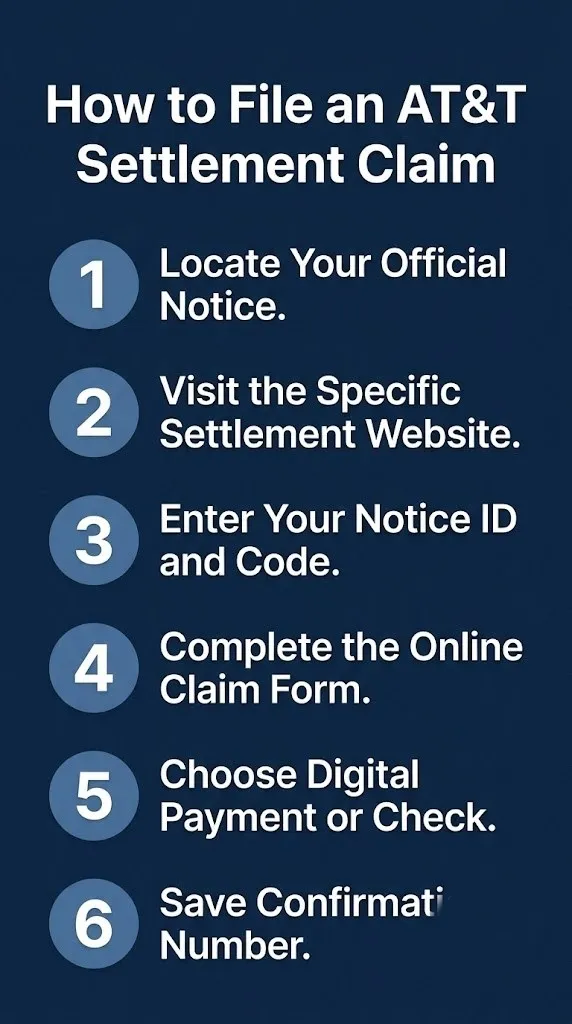
Most deadlines have passed for the AT&T settlements that have been filed and settled. If a new settlement is announced, the process will be similar to what existed for prior cases.
- Locate the official settlement website for your specific case. Use the URL printed on your notice or search for the case name with “settlement administrator.”
- Check whether the filing deadline has passed. The deadline is prominently displayed on the settlement website. If it has passed, you generally cannot file.
- If the deadline is still open, gather your Notice ID and confirmation code from the notice you received.
- Complete the online claim form. Enter your contact information and confirm your eligibility.
- Choose your payment method. Digital payment through Venmo, PayPal, or Zelle is faster than a paper check.
- If claiming documented losses, upload your supporting documentation. Acceptable documents typically include bank statements, credit card statements showing fraudulent charges, police reports, and receipts for identity theft protection services.
- Review and submit. Save your confirmation number.
If you did not receive a notice but believe you qualify, some settlements allow you to file without a Notice ID. You will need to provide your AT&T account information or other identifying details.
Key Takeaway: Most AT&T settlement claim deadlines have passed. If you received a notice, check the specific settlement website immediately. If the deadline is still open, file now. If it has passed, you cannot file.
How to Check Your AT&T Settlement Claim Status
The settlement administrator for your specific case maintains a status portal. You can check your status online.
Go to the official settlement website for your case. Look for “Check Claim Status” or “Track My Claim.” Enter your claim confirmation number or the email address you used to file.
Status descriptions vary by administrator but generally include submitted, under review, approved, deficiency notice, or denied. If you received a deficiency notice, your claim had a problem that you can fix. Respond by the deadline in the notice. If your claim was denied, the notice will explain why and may include appeal instructions.
If you cannot find your confirmation number, the portal may allow you to look up your status using your name and email address. If the portal cannot find your claim, contact the settlement administrator using the phone number or email address on the official settlement website.
When Will AT&T Settlement Checks Be Mailed?
Payment timing depends on the specific settlement. Some have already distributed checks. Others are still in the appeals phase.
The typical timeline after the claim deadline: the administrator reviews claims for several months, the court holds a final approval hearing, an appeal window of 30 days follows, and if no appeals are filed, the administrator begins issuing payments. The entire process from claim deadline to payment can take 9 to 18 months.
Digital payments arrive first, typically within a few weeks of payment processing. Paper checks take longer, sometimes 2 to 4 weeks from the mail date. If you opted for a digital payment and have not received it, check your spam folder for an email from the administrator. Digital payment emails often include a link that expires, so act quickly when it arrives.
If your address has changed since you filed, contact the administrator immediately. Checks sent to old addresses are not automatically reissued.
What Other AT&T Lawsuits Exist?
AT&T faces ongoing litigation beyond the data breach cases. These are separate actions with their own status.
AT&T has been sued over hidden fees. Plaintiffs alleged the company added administrative charges to bills without adequate disclosure. Some of these cases have settled. Others are active.
AT&T has faced throttling lawsuits. Customers on unlimited data plans alleged the company slowed their data speeds after they reached certain usage thresholds. The FTC brought an action over this practice. AT&T settled with the FTC, but that settlement did not produce consumer payments. It required AT&T to change its disclosures.
AT&T has been sued over lead-covered cables. Environmental groups and individuals near legacy AT&T infrastructure alleged that old lead-clad cables left in place for decades posed health and environmental risks. This litigation is active and has not settled.
The key point is the same as with the data breach cases: there is no single AT&T settlement. If you see an ad for an “AT&T lawsuit payout,” identify which case it refers to. Check the case name, court, and settlement status before providing any personal information.
What Is the AT&T CPNI Data Breach Case?
CPNI stands for customer proprietary network information. It includes data about your phone service: numbers you called, call duration, and similar details. Federal law requires telecom companies to protect CPNI.
One of the AT&T class actions specifically involved CPNI exposure. Plaintiffs alleged AT&T allowed unauthorized access to CPNI, violating the federal Communications Act and state privacy laws. The case settled. Class members included AT&T wireless customers whose CPNI may have been accessed without authorization during the class period.
The settlement in that case followed the standard data breach pattern: modest cash payments for undocumented claims, higher amounts for documented losses, and a credit monitoring option. The deadline for that case has passed.
How to Spot a Fake AT&T Settlement Notice
Scammers exploit high-profile settlements because they know millions of people are expecting payments. Fake AT&T settlement notices have been reported.
Legitimate notices include a specific case name and case number, the court where the settlement was filed, a Notice ID and confirmation code unique to you, a URL for an official settlement website, and no request for your Social Security number, account password, or payment. Fake notices often use generic language, demand immediate action, link to a website that does not match the official settlement domain, and ask for sensitive personal information that a real settlement does not need.
If you are unsure, do not click anything. Open a browser and search the case name independently. Navigate to the settlement website directly. Enter your Notice ID there. If it works, the notice was real. If it does not, the notice was likely a phishing attempt.
Reality Check: No legitimate settlement administrator will text you a payment link. No one from a settlement will call you demanding your bank password or Social Security number. Filing a claim is always free. If any of those things happen, it is a scam.
What Happens Next in AT&T Data Breach Litigation?
AT&T continues to face data breach litigation. New breaches produce new lawsuits. The cycle is ongoing.
- Ongoing through 2026: Previously settled cases continue distributing payments. Remaining claims are processed. Appeals in some cases are resolved.
- 2026 into 2027: Newly filed cases from more recent breaches work through the pretrial process. Class certification motions are filed and argued.
- 2027 and beyond: Newer cases may settle or proceed to trial. The pattern of modest per-person payouts is unlikely to change absent a major change in data breach law.
Congress has considered federal data privacy legislation that would create stronger consumer remedies for data breaches. No such law has passed as of mid-2026. Until it does, data breach class actions will continue to produce small per-person payouts.
Frequently Asked Questions
Is the AT&T data breach settlement real?
Yes, multiple AT&T data breach class actions are real and court-approved.
Verify any notice by checking the official settlement website for your specific case.
How much will I get from the AT&T settlement?
Most undocumented claims receive $10 to $50.
Documented loss claims may receive more. Each case has its own payout formula.
Can I still file an AT&T settlement claim?
Most deadlines have passed for filed cases.
Check the official website for your specific settlement. If the deadline is open, file immediately.
How do I check my AT&T claim status?
Visit the official settlement website for your case.
Use the Claim Status tool with your confirmation number or email address.
What if I lost my AT&T settlement notice?
You may still be able to file without a Notice ID on some settlements.
Check the settlement website for a “File without Notice ID” option. You will need your AT&T account information.
Will AT&T contact me about the settlement?
The settlement administrator may contact you by mail or email.
AT&T itself does not administer claims. Messages claiming to be from AT&T about a settlement are suspicious.
Can I get money from multiple AT&T settlements?
Yes, if you qualify for multiple cases.
Each settlement is independent. You must file a separate claim for each one.
What is the AT&T CPNI settlement?
It is a settled class action involving customer proprietary network information.
The deadline has passed. Payments have been distributed.
AT&T data breach settlements are real, but they are individual cases with individual deadlines and modest payouts. If you received a notice, check the official settlement website named in that notice immediately. If the deadline has not passed, file. If it has, you missed your window.
For future breaches, the pattern will likely repeat: a class action is filed, a settlement is reached years later, a claims process opens, and modest checks go out to those who file. The best protection is to file when you receive a notice and to freeze your credit with the three major credit bureaus, regardless of whether a settlement pays you.