Social Media Lawsuits 2026: Meta Settlement Impact, Payout Status, and How to File
Quick Answer
- Social media lawsuits target Meta, TikTok, Snap, and YouTube over addictive platform design that allegedly harms minors’ mental health.
- The Meta state settlement pays states, not individuals. Individual payouts are not yet determined and depend on pending trials.
- The next major trial date is October 28, 2026, in Los Angeles for two consolidated teen cases against Meta, Google, and Snap.
Introduction to Social Media Lawsuits in 2026
Social media lawsuits are legal claims alleging that platforms like Instagram, Facebook, TikTok, and YouTube were designed to be addictive and caused mental health harm to young users. The largest development in 2026 came on August 26, when Meta agreed to pay up to $18 billion to settle claims brought by 47 states, the District of Columbia, and three territories .
If your child struggled with depression, anxiety, an eating disorder, or self-harm after heavy social media use, you may be wondering if you qualify for compensation. The answer depends on which track you’re on. The state settlement money is not for individuals. Separate personal injury cases are still moving through courts.
This article explains the difference between the state settlement and individual claims, who may qualify, what documentation matters, and what the next trial dates mean for families waiting for answers. One number stands out: Meta’s guaranteed payment is $12.7 billion, with about $5 billion more contingent on other platforms adopting similar safety measures .
The Facts
| Item | Detail |
|---|---|
| Case Name | In re: Social Media Adolescent Addiction/Personal Injury Products Liability Litigation (MDL 3047) |
| Court | U.S. District Court for the Northern District of California, Oakland Division |
| Case Number | 4:22-md-03047-YGR |
| Status | MDL active. Meta state settlement finalized August 26, 2026. Individual claims still litigating. |
| Settlement Fund | Meta state settlement: up to $18 billion. Individual settlement fund: not yet confirmed. |
| Est. Per Person | Not yet determined. Only public individual verdict was $6 million in March 2026. |
| Claim Deadline | No universal deadline. Statutes of limitations vary by state, typically 2 to 6 years from injury. |
| Administrator | Not yet appointed for individual claims. |
| Proof Needed | Mental health records, usage data, age verification, and documented injuries. |
Is the Social Media Lawsuit Against Meta Legitimate?
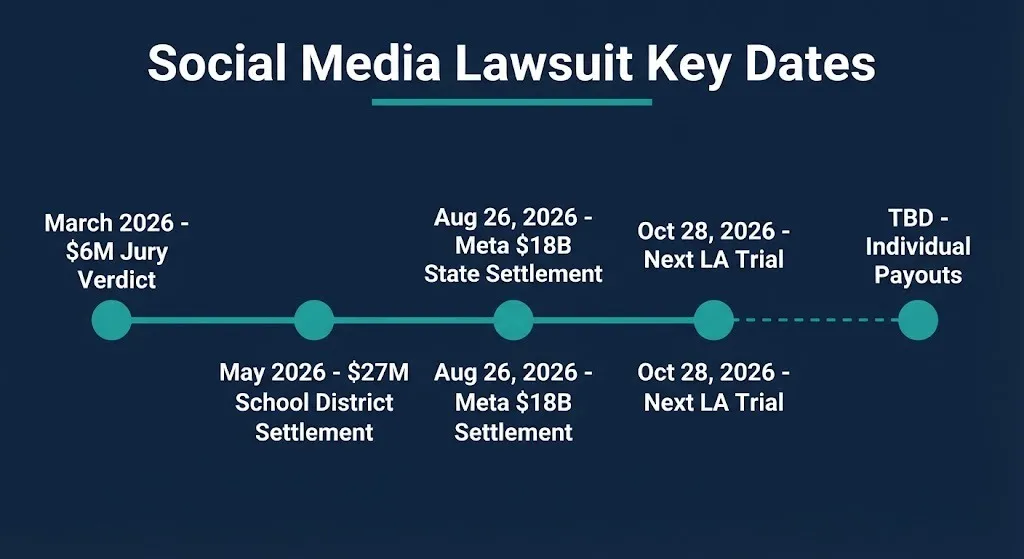
Yes, the social media lawsuits against Meta are legitimate and have produced real legal outcomes. In March 2026, a Los Angeles jury returned a $6 million verdict against Meta and YouTube in the first major social media addiction trial .
Meta spent two years arguing these claims had no merit. Then it paid up to $18 billion to settle the state attorneys general case rather than let a jury decide . That is not an admission of liability, and the settlement explicitly says so.
The state settlement came with significant conduct changes. For users under 18, Meta agreed to a two-hour default daily limit on Instagram and Facebook, a block from midnight to 6 a.m., no notifications during school hours by default, and no public like counts on minors’ posts .
For context on how to read that: a company that changes its product to settle a lawsuit is like a landlord who fixes the plumbing only after the city cites the building. The fix is real, but the timing tells you something about the motivation.
Key Takeaway: The lawsuits are legitimate and producing real results, but the Meta state settlement does not pay individual families, and the conduct changes show Meta was willing to alter features it previously defended.
How Much Can You Get from a Social Media Lawsuit?
There is no per-person payout figure for social media lawsuits, and anyone who quotes one is guessing. The only public jury award in an individual case was the $6 million verdict in March 2026 .
That case involved a plaintiff with documented psychological harm tied to addictive platform design. The jury found Meta and YouTube liable .
| Outcome Type | Amount | Status |
|---|---|---|
| First bellwether jury verdict | $6 million | Awarded March 2026 |
| School district settlement | $27 million | Settled May 2026 |
| Meta state AG settlement | Up to $18 billion | Goes to states, not individuals |
| Individual settlements | Confidential | Not publicly disclosed |
What will eventually set individual case values is the same thing that sets them in every mass tort: diagnosis, documentation, and trial results. A case with a documented eating disorder, self-harm, or psychiatric hospitalization tied to heavy platform use carries more weight than a case with vague anxiety and no treatment records .
The next individual bellwether trials on the 2026 calendar will give both sides real numbers to argue from.
Reality Check
The $18 billion Meta settlement does not pay a dollar to any individual family. That money goes to state governments for youth mental health programs and penalties . Individual claims are separate and still being litigated. Filing a case review with a mass tort attorney is free, and no legitimate firm will ask you to pay upfront.
Who Qualifies to File a Social Media Lawsuit?
You may qualify to file a social media lawsuit if you or your child suffered serious mental or physical harm after heavy social media use before age 18. The injuries recognized in these cases include depression, anxiety, eating disorders, body dysmorphia, self-harm, and suicidal thoughts or attempts .
The core eligibility requirement is that the addictive behavior started or occurred while the person was a minor. Parents and legal guardians can file on behalf of their children. Young adults who suffered harm as minors may also be eligible to file their own claims .
Here is a checklist of what most intake firms look for:
- Age during use: The person was under 18 when the harmful use occurred
- Usage pattern: Typically at least three hours per day on the platforms
- Documented diagnosis: Depression, anxiety, eating disorder, body dysmorphia, or similar condition
- Treatment records: Therapy notes, hospital records, or psychiatric care documentation
- Platform use: Instagram, Facebook, TikTok, Snapchat, YouTube, or WhatsApp
- Connection evidence: Provider notes that mention social media as a trigger or factor
The existence of the Meta state settlement does not establish that any individual family was harmed. Causation must be proven case by case .
How Do You File a Social Media Lawsuit?
Filing a social media lawsuit starts with a free case review, not a claim form. There is no public class action settlement with a single claim form for social media addiction cases. These are individual personal injury lawsuits coordinated in MDL 3047 .
Here are the steps:
- Complete a free case review with an intake firm handling social media addiction cases.
- Provide the minor’s age and timeline of platform use.
- Gather mental health records including diagnoses, treatment notes, and hospitalizations.
- Document usage patterns through screen time data, saved posts, or parental observations.
- Collect any reports made to Meta and the responses received.
- The firm evaluates whether the case meets current intake criteria.
- Records collection begins if the firm takes the case.
- Filing occurs in MDL 3047, California JCCP 5255, or another appropriate court.
Most state statutes of limitations give 2 to 6 years from the injury or discovery. Minority tolling often pauses the clock until the person turns 18, which can extend the window into their early 20s .
What Is the Status of the Meta State Settlement?
The Meta state settlement is final and approved, but it does not provide individual compensation. The $18 billion figure includes a $16.68 billion payment to 47 states, the District of Columbia, and three territories, plus a separate $1 billion settlement with Texas .
Of the total, guaranteed payments are $12.7 billion. The remaining approximately $5 billion is contingent on YouTube and TikTok adopting similar safety measures and making corresponding payments .
The settlement resolves claims that Meta violated state consumer protection laws and the federal Children’s Online Privacy Protection Act. Meta did not admit wrongdoing .
The conduct terms apply to users under 18 and include:
- Two-hour default daily limit on Instagram and Facebook
- Midnight to 6 a.m. block on notifications
- No notifications during school hours by default
- No public like counts on minors’ posts
- No cosmetic-surgery filters
- Feed option without algorithmic targeting
- Independent auditor with access to Meta’s internal data
What Happens Next in Social Media Litigation?
The remaining steps follow a predictable litigation sequence. Here is the expected timeline:
October 28, 2026: Consolidated trial for two teen plaintiffs (S.J. and K.D.B.) against Meta, Google, and Snap in Los Angeles Superior Court .
Expected late 2026: Additional bellwether trials may be scheduled to test different plaintiff profiles and platform combinations.
Expected 2027: If bellwether verdicts continue favoring plaintiffs, pressure increases on Meta, TikTok, Snap, and YouTube to settle remaining individual claims.
Ongoing: The approximately 3,200 personal injury cases in MDL 3047 continue through discovery and trial preparation .
The next Los Angeles trial will be the second bellwether in California state court. The first ended with a $6 million award to a plaintiff known as K.G.M. Another case was dropped before trial, and two more were consolidated for the October date .
Frequently Asked Questions
Does the Meta settlement mean my family gets money?
No. The $18 billion goes to state governments, not individual families. Individual claims are separate and still being litigated in MDL 3047.
How much can I get from a social media addiction lawsuit?
There is no per-person number yet. The only public jury award was $6 million in March 2026. Individual settlements have been confidential.
Who qualifies to file a social media lawsuit?
You may qualify if you or your child suffered serious mental health harm from heavy social media use before age 18. Documented diagnoses and treatment records strengthen a case.
Is there a class action claim form for social media addiction?
No. These are individual personal injury lawsuits, not a class action with a single claim form. Filing starts with a free case review through an intake firm.
Which platforms are named in these lawsuits?
Meta (Instagram and Facebook), Google (YouTube), TikTok, and Snap are the main defendants. Some cases also involve WhatsApp.
What injuries are covered in social media lawsuits?
Depression, anxiety, eating disorders, body dysmorphia, self-harm, suicidal thoughts, and wrongful death are among the recognized injuries.
What is the deadline to file a social media lawsuit?
No universal deadline exists. State statutes of limitations typically give 2 to 6 years from injury, and minority tolling may extend the window until the person turns 18 or later.
Does the Meta settlement cover TikTok, Snapchat, or YouTube?
No. Only Meta settled the state case. TikTok, Snap, and YouTube still face state attorneys general and personal injury claims.