Steam Lawsuit in 2026: Valve Class Actions, Antitrust Claims, and Consumer Rights
Quick Answer
- Valve has faced multiple lawsuits over Steam’s pricing policies, refund practices, and market dominance.
- No Steam consumer settlement is currently paying claims to users in 2026.
- The most significant pending case is an antitrust claim over Valve’s most-favored-nation pricing rules.
Steam is the largest PC gaming platform in the world. Valve, its owner, takes a cut of every sale. That dominance has attracted legal challenges from game developers, publishers, and consumers. If you are a gamer, you may have heard about a Steam lawsuit and wondered if it affects you.
The answer in 2026 is mostly no, at least not directly. The big antitrust cases are company-to-company disputes. Consumer class actions over refunds or pricing have mostly failed or settled long ago.
This guide explains the major Steam lawsuits, what they mean for gamers, and how to spot a fake settlement notice. One fact that surprises people: Steam’s refund policy is actually one of the most consumer-friendly in gaming.
The Facts
| Item | Detail |
|---|---|
| Case | Multiple active and closed lawsuits against Valve |
| Status | Some active, no open consumer settlement |
| Fund Size | Case-specific, none currently open |
| Est. Per Person | Not applicable for most cases |
| Claim Deadline | None currently active |
| Administrator | None currently appointed |
| Proof Needed | Varies by case, none needed now |
Is the Steam Lawsuit Real?
Yes, Steam lawsuits are real. Valve has been sued multiple times over its platform practices. The cases are court-filed and verifiable.
The most significant litigation involves antitrust claims. Developers and publishers argue that Valve’s pricing rules suppress competition. The “most-favored-nation” clause prevents developers from selling their games cheaper on other platforms.
Consumer class actions have also been filed. Some challenged Steam’s refund policy before it was updated. Others challenged the platform’s dominance as an antitrust violation affecting prices.
No consumer class action settlement is open for claims in 2026. The active cases are business disputes, not consumer payout events.
Key Takeaway: Steam lawsuits are real, but no consumer settlement is paying gamers right now.
What Is the Valve Antitrust Lawsuit?
The Valve antitrust lawsuit challenges Steam’s market dominance and pricing practices. The core claim is that Valve’s rules keep game prices artificially high.
The most-favored-nation clause is the focus. Valve requires developers to offer Steam the same price as other platforms. A developer cannot sell a game cheaper on Epic Games Store or elsewhere. That rule, the plaintiffs argue, prevents price competition.
Valve denies the claims. The company argues its rules protect the Steam ecosystem and that developers are free to sell elsewhere. The case is in active litigation.
The outcome could affect game prices. If Valve loses, developers might offer lower prices on competing platforms. That could benefit consumers indirectly. But no direct consumer payout is part of this case.
Can I Get Money from a Steam Lawsuit?
You cannot get money from a Steam lawsuit in 2026 because no consumer settlement is open. The active cases are business disputes. They do not involve consumer claim forms.
If a future consumer class action settles, Steam users might receive notice. A settlement over pricing could pay a small amount per user. But that is hypothetical. No such settlement exists.
Past Steam consumer cases have mostly been dismissed or resolved without large payouts. The platform’s terms of service include an arbitration clause, which limits class actions.
Here is what a hypothetical Steam settlement might look like if one ever happened:
| Claim Type | Possible Payout |
|---|---|
| Basic Steam user | $5 to $15 |
| Documented purchases | $15 to $50 |
| Frequent purchaser | $50 to $100 |
| No claim filed | $0 |
These numbers are not confirmed. They are illustrative based on similar platform settlements.
How Do I Join a Steam Class Action?
No Steam class action is open for consumer claims in 2026. You cannot join one right now. If a class action settles, you will receive notice by email or through your Steam account.
Until then, there is nothing to sign up for. Do not pay anyone to register you for a Steam lawsuit. Legitimate class actions never charge a filing fee.
Here is what you can do now:
- Keep records of your Steam purchases.
- Save any emails about Steam policy changes.
- Check official court dockets for Valve litigation updates.
- Do not pay anyone for help with a Steam claim.
- Wait for official notice if a settlement opens.
Key Takeaway: No Steam consumer settlement is open. Save your purchase history and wait.
What Is Steam’s Refund Policy?
Steam’s refund policy allows refunds within 14 days of purchase and with less than two hours of playtime. That policy is one of the most consumer-friendly in digital gaming.
The policy was not always this generous. Valve updated it after legal pressure, including a lawsuit in Australia. The Australian Competition and Consumer Commission argued that Valve’s no-refund policy violated consumer law.
Valve lost that case and paid a fine. The company then implemented the current refund policy worldwide. That change benefited millions of gamers.
The refund policy is separate from any class action. You can request a refund directly through Steam without a lawyer.
What Is the Steam Deck Lawsuit?
The Steam Deck is Valve’s handheld gaming PC. It has not been the subject of a major class action settlement as of 2026. Some consumers have raised individual complaints about hardware issues, but no class action is open.
Hardware defects are usually handled through warranty claims. If your Steam Deck has a problem, contact Valve support. The warranty covers manufacturing defects for a limited period.
A class action over a hardware defect could happen if the defect is widespread and Valve refuses to fix it. No such case exists for the Steam Deck in 2026.
What Is the Steam Controller Lawsuit?
The Steam Controller was discontinued years ago. It faced a patent lawsuit from a company called SCUF Gaming. The case involved controller design patents.
The Steam Controller case was a company-to-company dispute. It did not involve consumer payouts. The case settled or resolved without affecting Steam users.
If you own a Steam Controller, this lawsuit does not affect you. It was a business dispute over intellectual property.
Reality Check
No legitimate Steam settlement is sending text messages or emails asking for your bank details to release a payment. Valve will never ask you to pay a fee to get a refund or settlement. Real class action notices come from court-appointed administrators and never ask for payment.
What Is Valve’s Most-Favored-Nation Clause?
Valve’s most-favored-nation clause requires developers to offer Steam the same price they offer on other platforms. A developer cannot sell a game for $10 on Epic and $15 on Steam.
The clause is at the center of the antitrust lawsuit. Plaintiffs argue it prevents price competition. If developers could charge less on other platforms, consumers would benefit.
Valve argues the clause is legal and common in retail. The company says developers choose to sell on Steam because of its large user base, not because of the clause.
The court will decide whether the clause violates antitrust law. That decision could reshape digital game pricing.
How Does the Steam Antitrust Case Affect Gamers?
The Steam antitrust case could affect gamers indirectly. If Valve loses, developers might offer lower prices on competing platforms. That could create price competition and lower game prices overall.
But the case will not produce a direct consumer payout. It is not a class action seeking damages for gamers. It is a business dispute over market practices.
The case could take years to resolve. Antitrust litigation is slow. An appeal is likely regardless of the outcome. Gamers should not expect quick changes.
Key Takeaway: The Steam antitrust case may affect game prices eventually, but it will not pay gamers directly.
What Happens Next: Steam Lawsuit Timeline for 2026 and Beyond
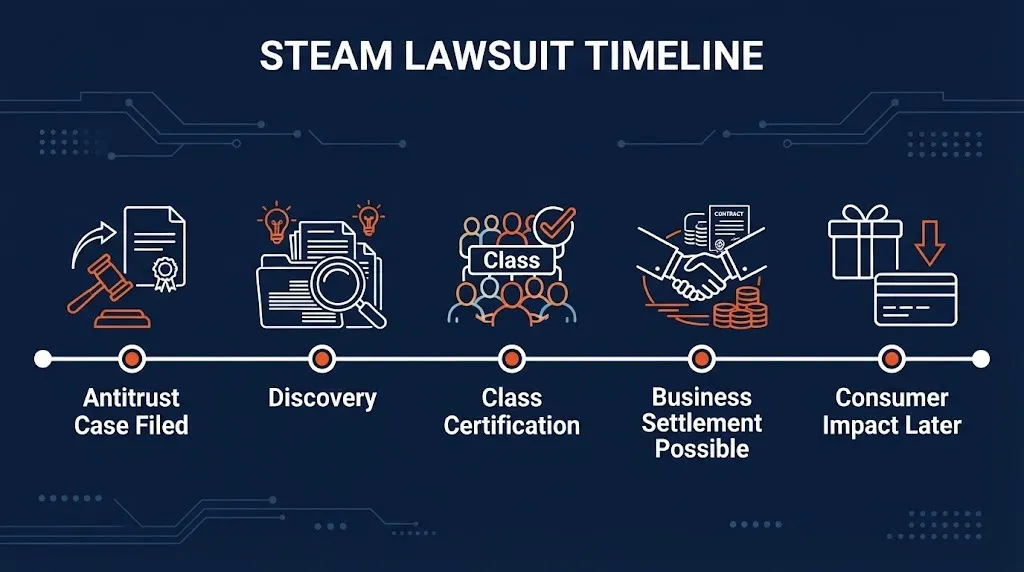
- September 2026: Antitrust litigation continues through discovery and motion practice.
- Late 2026: Possible rulings on class certification in the antitrust case.
- Early 2027: If the case survives dismissal, settlement talks may begin.
- Mid 2027: Any business settlement would not involve consumer claim forms.
- Ongoing: Valve’s arbitration clause continues to limit consumer class actions.
Frequently Asked Questions
Is there a Steam lawsuit I can join?
No Steam consumer class action is open for claims in 2026.
Can I get a refund from Steam?
Yes, Steam offers refunds within 14 days and under two hours of playtime.
What is the Valve antitrust lawsuit about?
It challenges Valve’s most-favored-nation pricing clause.
Will I get money from the Steam antitrust case?
No, the antitrust case is a business dispute, not a consumer payout.
What was the Steam refund lawsuit?
It was an Australian case that led to Steam’s current refund policy.
Is the Steam Deck involved in a lawsuit?
No major Steam Deck class action is open in 2026.
How do I contact Steam support?
Use the official Steam support page in the Steam client or website.
Are Steam lawsuits common?
Valve faces regular legal challenges, but most are business disputes, not consumer cases.
Closing
Steam lawsuits are real, but no consumer settlement is open in 2026. The big antitrust case may change game pricing eventually, but it will not pay gamers directly.
The smart move is to use Steam’s refund policy for individual issues and ignore any message claiming you won a Steam settlement. That message is a scam.