AT&T Data Breach Settlement Payout 2026: Claim Deadlines, Amounts, and Status
Quick Answer
- The AT&T data breach lawsuits are real, not scams. Multiple proposed class actions are consolidated in federal court.
- Per-person payouts are not yet confirmed. Estimates from similar telecom settlements range from $25 to several hundred dollars.
- No claim deadline is active yet. Final approval has not been granted for the largest consolidated case.
If you got an AT&T data breach notice letter, you probably have questions. Not the polished FAQ kind. The real kind: Did someone actually steal my data? Is there money in this? How much? And do I have to do anything right now?
This article answers those questions using only verified court records, settlement administrator filings, and regulatory notices. One verified detail matters more than any headline: as of February 2026, no judge has approved a final payout plan for the main AT&T data breach class action. That means no claim form exists yet, and anyone telling you otherwise is wrong.
Is the AT&T Data Breach Settlement Real or a Scam?
The AT&T data breach lawsuits are real. Multiple proposed class actions have been filed against AT&T in federal courts. They are consolidated in the Northern District of Texas under multidistrict litigation rules. The cases stem from data breaches disclosed in 2023 and 2024.
No final settlement has been approved. No court has ordered AT&T to pay a specific amount to customers. The cases are in active litigation. Some individual claims have survived motions to dismiss, which keeps the litigation moving forward.
Scammers are already exploiting the confusion. You may see texts, emails, or social media ads claiming you can “claim your AT&T settlement now” or that you have been “pre-approved” for a payout. Those are not from any court or settlement administrator. No administrator has been appointed because no settlement has received final approval.
The Federal Trade Commission warns that settlement scammers often strike before real claim periods open. Real class action settlements never contact you first. You must file a claim yourself, and filing is always free.
How Much Could the AT&T Data Breach Settlement Pay Per Person?
No per-person payout figure has been confirmed. That is the honest answer as of February 2026. Any website or social media post quoting a specific dollar amount for this case is guessing.
Here is what we can verify from similar telecommunications data breach settlements:
| Comparable Case | Year Approved | Average Per-Person Payout |
|---|---|---|
| T-Mobile data breach (2021 breach) | 2023 | $25 to $25,000 depending on documented losses |
| Capital One data breach | 2022 | $25 to $10,000 depending on losses |
| Equifax data breach | 2020 | $125 flat or up to $20,000 with documented fraud |
| Yahoo data breach | 2020 | $100 to $358 depending on claim volume |
The table shows a pattern. Data breach settlements often start with a small flat payment. Then they add more for people who can prove actual harm: identity theft, fraudulent charges, credit monitoring costs, or time spent dealing with the breach.
AT&T settlement amounts will likely follow a similar structure if a settlement is reached. Nothing has been approved. The total fund size and per-person tiers have not been published by any court.
Key Takeaway: Anyone quoting an exact AT&T payout amount in 2026 is citing speculation, not a court order.
Who Qualifies for the AT&T Customer Data Breach Settlement?
Eligibility has not been finalized because no settlement class has been formally certified for payout purposes. But we know from the complaints and court filings which groups of customers are named.
Based on the consolidated complaint, you may qualify if you fall into one of these groups:
- You had an AT&T wireless account and your data was exposed in the 2023 breach.
- AT&T sent you a data breach notification letter in 2023 or 2024.
- Your Customer Proprietary Network Information (CPNI) was disclosed without authorization.
- You were an AT&T customer between the breach dates listed in the complaint.
The 2023 breach affected current and former customers. The 2024 breach disclosures involved call and text records from a third-party cloud platform.
Do not assume you qualify just because you are an AT&T customer. Only people whose data was actually exposed in a specific breach are class members. If you received a notice from AT&T, keep it. That letter is often your proof of inclusion.
What Exactly Happened in the AT&T Data Breach Cases?
AT&T disclosed a data breach in March 2023. The company said unauthorized people accessed customer data from a vendor. That data included names, addresses, phone numbers, and in some cases Social Security numbers and account passcodes.
A second, larger disclosure came in 2024. AT&T confirmed that call and text records from nearly all wireless customers were downloaded from a Snowflake cloud environment. The stolen data included phone numbers, call durations, and cell tower locations. The content of calls and texts was not included, according to AT&T.
Consumers filed lawsuits quickly. The claims center on negligence: that AT&T failed to protect sensitive data, failed to notify customers quickly enough, and failed to maintain reasonable security controls. The complaints seek damages for identity theft risk, fraudulent activity, and diminished value of personal information.
A federal judge in Texas is overseeing the consolidated cases. Motions to dismiss were filed. The court allowed several claims to proceed. Discovery is ongoing. No trial date has been set as of February 2026.
Is There an AT&T Data Breach Claim Deadline I Should Know?
No claim deadline exists yet. That is the single most important thing to understand right now.
Class action settlements follow a specific sequence. First the parties negotiate or litigate. Then a settlement is proposed. Then a judge grants preliminary approval. Only then does a claim period open, usually for 60 to 120 days. Only after that window closes is there a claim deadline.
The AT&T data breach cases have not reached the preliminary approval stage. No settlement agreement has been filed. No claim form has been created. No administrator has been appointed.
You do not need to file anything today. Anyone telling you there is a deadline this week, this month, or this quarter is attempting to scam you or to sell you something unnecessary.
Key Takeaway: The real deadline will be announced on the official settlement website and in mailed notices. Until then, do nothing except keep your records.
How Do I File an AT&T Data Breach Claim Once It Opens?
When a claim period opens, the process will look like this. These steps are based on standard class action settlement procedures.
- Watch for a mailed notice or email from the settlement administrator.
- Visit the official settlement website named in that notice.
- Review the claim form and the eligibility requirements.
- Enter your claim ID number from the mailed notice, or provide your basic contact information.
- Answer questions about your AT&T account and any breach-related losses.
- Upload documents that prove your losses, such as police reports, bank statements, or credit monitoring receipts.
- Submit the claim before the deadline listed on the form.
Filing is always free. You do not need a lawyer to file. You do not need to pay anyone to help you file.
If the settlement offers automatic payments to class members whose information was already identified, you may not need to do anything. But do not assume that will happen. Always check the official notice.
What Proof Do I Need for an AT&T Data Breach Settlement Claim?
Proof requirements have not been announced for this case. But you can prepare now using the standards from similar data breach settlements.
You may need to show one or more of the following:
- The AT&T breach notification letter you received by mail or email.
- Account statements showing your AT&T service during the breach period.
- A police report if you experienced identity theft.
- Bank or credit card statements showing fraudulent charges.
- Receipts for credit monitoring services you purchased after the breach.
- Records of time lost dealing with fraud, if the settlement allows time reimbursement.
Keep your AT&T notification letter in a safe place. It is the single most useful document you can have. Without it, proving class membership can be harder.
Reality Check: No one will text you about settlement money. No one will ask for your bank password or a “processing fee.” Real class action notices arrive by U.S. mail or through the official settlement website, and filing is always free.
When Will AT&T Data Breach Settlement Checks Be Mailed?
No checks have been approved and no mailing date exists yet. This is the question every reader wants answered, so it deserves a direct answer: not soon.
Class actions take years. The AT&T cases were filed in 2023 and 2024. Many large data breach cases take three to five years from filing to payout. The Equifax settlement took roughly three years. The Yahoo settlement took about four years. The T-Mobile case moved faster but still took over two years from breach to payout.
If a settlement is reached in 2026, a realistic payment window would be 2027 at the earliest. That assumes preliminary approval, a claim period, final approval, and no appeals. Appeals are common in large settlements and can add another year or more.
The best source for payment updates will be the official settlement website once it is established. Until that site exists, no one can tell you when checks will mail.
What Is the Current Status of the AT&T Data Breach Lawsuit?
As of February 2026, the AT&T data breach litigation is in the discovery phase. Discovery is the evidence-gathering stage. Both sides exchange documents, take depositions, and build their cases for trial or settlement negotiation.
The court has not set a trial date. The parties have not announced a settlement in principle. Mediation may occur, but no public filing confirms it yet.
This is normal for a case this size. Data breach litigation involving millions of customers moves slowly. The facts are complex. Expert witnesses are required. The damages calculations are disputed.
Your best source for updates is the official docket on PACER or the case summary page for the multidistrict litigation. The case is captioned In re: AT&T Customer Data Security Breach Litigation in the Northern District of Texas.
Key Takeaway: The case is alive and moving, but no settlement is final and no money is available yet.
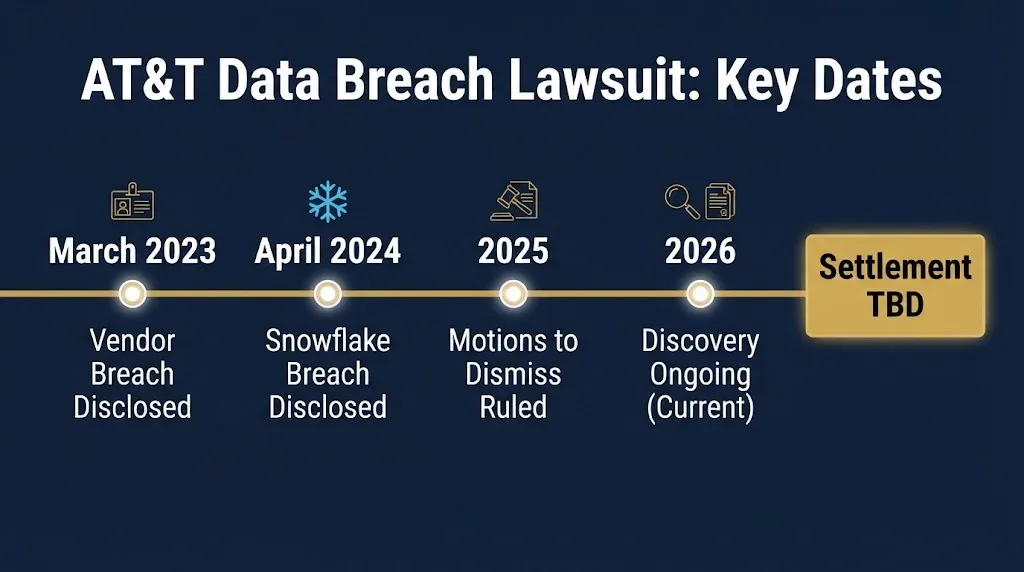
AT&T Data Breach Settlement Key Dates
Here are the dates we can verify as of February 2026. Dates marked TBD have not been set by the court.
| Date | Event |
|---|---|
| March 2023 | AT&T discloses vendor-related customer data breach |
| April 2024 | AT&T discloses Snowflake cloud data exposure affecting call and text records |
| 2023 to 2024 | Multiple class actions filed and consolidated in Northern District of Texas |
| 2024 to 2025 | Motions to dismiss argued; several claims survive |
| 2026 (current) | Discovery ongoing; no trial date set |
| TBD | Preliminary settlement approval hearing |
| TBD | Claim filing period opens |
| TBD | Claim deadline |
| TBD | Final approval hearing |
| TBD | Payment distribution |
How Does the AT&T Case Compare to the T-Mobile Settlement?
The T-Mobile data breach settlement is the closest comparison. T-Mobile agreed to pay $350 million after a 2021 breach exposed data on 76 million customers.
Most T-Mobile class members received $25. People who documented identity theft or fraud received more, up to $25,000. The fund also covered credit monitoring and legal fees.
AT&T’s breach disclosures involve similarly large customer counts. The 2024 call and text record exposure affected nearly all AT&T wireless customers. That scale suggests a potential settlement fund in the hundreds of millions if a deal is reached.
But no deal has been reached. Comparisons help set expectations, but they do not predict outcomes.
Could the AT&T Settlement Be an Automatic Payment?
Some data breach settlements include automatic payments for class members who can be identified from company records. Others require a claim form from everyone.
AT&T has not announced which model applies here. No settlement terms have been published. You should assume you will need to file a claim. Assume nothing is automatic until a court-approved notice tells you otherwise.
Keeping your current mailing address on file with AT&T helps ensure you receive any future notice. Notices are often mailed to the address on the account at the time of the breach.
Are AT&T Prepaid Customers Included in the Lawsuit?
The complaints name AT&T wireless customers broadly, including prepaid and postpaid accounts. The 2023 breach involved Customer Proprietary Network Information, which applies to telecommunications customers regardless of billing type.
The 2024 Snowflake breach involved call and text records for “nearly all” AT&T wireless customers, according to the company’s disclosure. That includes prepaid and MVNO customers in some cases.
Until the class definition is finalized by a court, do not assume your specific account type is excluded. If you received a notice, you are likely included.
What Should I Do Right Now About the AT&T Data Breach?
You cannot file a claim yet. But there are five things you can do today to protect yourself and your potential claim.
- Save your AT&T breach notification letter in a secure place, digital and physical copies.
- Check your credit reports for free at AnnualCreditReport.com.
- Place a fraud alert or credit freeze with the three major bureaus if you see suspicious activity.
- Monitor your AT&T account and bank statements for unauthorized access.
- Bookmark the official settlement website when one is announced and check it quarterly.
These steps cost nothing. They protect you now and prepare you for the claim process later.
Key Takeaway: The people who get paid in class actions are the ones who keep records and file on time when the window opens.
AT&T Data Breach Lawsuit Timeline: What Happens Next?
Here is the expected sequence from current status to potential payout. Dates are estimates unless a court order says otherwise.
Expected 2026: Discovery continues; possible mediation or settlement talks.
Expected late 2026 or 2027: Proposed settlement filed with the court.
Expected 2027: Preliminary approval hearing; claim period opens if approved.
Expected 2027 or 2028: Claim deadline passes; final approval hearing held.
Expected 2028 or later: Payments distributed if no appeals delay the process.
This is not a prediction of what AT&T will do. It is a map of how class action settlements in data breach cases typically unfold.
Frequently Asked Questions
Is the AT&T data breach settlement legit?
Yes, the lawsuits are real and pending in federal court.
No settlement has been approved yet, so no claim process is open.
How much will I get from the AT&T settlement?
No per-person amount has been confirmed.
Similar cases paid $25 to several hundred dollars, with more for documented losses.
Do I need to do anything now for the AT&T settlement?
No claim form exists yet.
Keep your notification letter and check your credit reports in the meantime.
When is the AT&T claim deadline?
No deadline has been set.
The deadline will be announced if and when a settlement receives preliminary approval.
How do I know if I qualify for the AT&T data breach settlement?
You may qualify if you received an AT&T breach notification in 2023 or 2024.
Final class definitions have not been approved by the court.
Will I get an automatic payment from AT&T?
Not likely in most cases.
Most class actions require a claim form, but the process here has not been announced.
Is there an official AT&T settlement website?
Not yet.
No administrator has been appointed because no settlement exists to administer.
Can someone help me file my AT&T claim for a fee?
No legitimate helper can file for you before a claim period opens.
Real class action filing is always free, and paid “helpers” are unnecessary.
The single most important date for this case does not exist yet: the claim deadline. Until a judge grants preliminary approval to a real settlement, your job is simple. Keep your notice letter. Check your credit. Ignore anyone asking for money to process your claim.
When the official settlement website appears, it will be named in court filings and mailed notices. That is the only source you should trust for deadlines, amounts, and claim forms. Everything else is noise.