Lopez v. Apple Inc. Settlement 2026: Is the Siri Payout Real and How Much Can You Get
Quick Answer
- Lopez v. Apple is a real, court-approved $95 million settlement over Siri allegedly recording private conversations.
- Payouts run from about $8 to $40 per device depending on total claims filed, capped at $20 per device before adjustment.
- The claim deadline was July 2, 2025, and it has already passed. Only people who filed by then are getting paid.
If you saw a deposit labeled “Lopez Voice Assistant” hit your bank account this year, you’re not imagining things. That payment traces back to a five-year legal fight over Apple’s Siri assistant and what it allegedly recorded without permission.
This case affects anyone who owned a Siri-enabled Apple device between September 2014 and the end of 2024 and filed a claim before last July’s deadline. The most important fact left to track now isn’t a deadline. It’s whether your payment has actually landed.
This article breaks down what the case was about, how much people are actually getting (not just the headline number), and how to tell a real Apple settlement deposit from a phishing attempt riding on its name. One detail surprised a lot of claimants: roughly 97% of the eligible class never filed, which is part of why some payments came in close to the $20 cap instead of a diluted fraction of it.
The Facts
| Case | Lopez, et al. v. Apple Inc. |
| Status | Final approval granted; payments distributing |
| Fund Size | $95 million |
| Est. Per Person | Roughly $8 to $40 per device, capped at $20 per device pre-adjustment |
| Claim Deadline | July 2, 2025 (closed) |
| Administrator | Angeion Group |
| Proof Needed | Sworn claim form confirming device ownership and unintended Siri activation during the covered window (already required for filing, no longer open) |
Is the Lopez v. Apple Settlement Legit? (VERIFY)
Yes, the Lopez v. Apple settlement is a real, court-approved case, not a scam. It’s the outcome of an actual class action filed against Apple in the U.S. District Court for the Northern District of California.
The case is formally titled Lopez, et al. v. Apple Inc., case number 4:19-cv-04577-JSW, before Senior U.S. District Judge Jeffrey S. White. Fact-checkers including Snopes and reporting from CBS News, BGR, and Yahoo News independently confirmed the settlement is authentic after readers flagged the payout emails and deposits as suspicious.
The confusion made sense. Bank statements showed payor names like “Lopez Voice Assistant,” “Lopez Voice Asst—Payout,” or similar labels that don’t obviously connect to Apple or a recognizable law firm.
Key facts that confirm legitimacy:
- Public court docket entries exist under case 4:19-cv-04577 in N.D. Cal.
- The named settlement administrator, Angeion Group, is a real, established class action administration firm based in Philadelphia.
- Judge White granted final approval of the settlement.
If the name “Lopez Voice Assistant” looked odd on your statement, that’s normal. It’s simply how the settlement’s payment processor labeled the transaction, similar to how a store refund sometimes posts under a processor’s name instead of the retailer’s.
Lopez vs Apple Settlement: What Was the Lawsuit About? (BACKGROUND)
The Lopez v. Apple lawsuit accused Apple of letting Siri activate without the “Hey Siri” trigger and record private conversations without user consent. Plaintiffs said Apple then shared some of those recordings with human contractors and third parties.
Lead plaintiff Fumiko Lopez, along with several co-plaintiffs, filed the case alleging that confidential conversations were captured through unintended Siri activations and, in some instances, used to inform ad targeting on Apple’s platforms.
Apple denied any wrongdoing throughout the litigation. It agreed to the $95 million settlement to resolve the claims rather than continue to trial.
What the case alleged, in short:
- Siri activated without a clear voice command or button press.
- Recordings were reviewed by human contractors as part of quality improvement work.
- Some conversation data allegedly informed advertising on Apple’s search and Safari products.
Key Takeaway: The case never went to trial and Apple admitted no wrongdoing, but the $95 million payment and court approval are both real and verified.
How Much Money Can You Get From the Apple Siri Settlement? (MONEY)
Eligible claimants can receive up to $20 per qualifying Siri device, capped at five devices for a maximum of $100 per person, though most people got less. Actual per-device amounts landed closer to $8 to $40 depending on how many valid claims were filed against the $95 million fund.
The payout formula is proportional (pro rata), meaning the total fund gets divided across every valid claim after fees and costs. Because participation in class actions is historically low, and roughly 97% of the eligible class reportedly never filed a claim, the amount per device came in near the original $20 ceiling for many claimants rather than a heavily diluted fraction.
Estimated Payouts
| Devices Claimed | Estimated Payout Range |
|---|---|
| 1 device | Roughly $8 to $20 |
| Up to 5 devices | Roughly $40 to $100 (before final proration) |
Attorneys for the class requested a fee award of roughly 30 to 31% of the fund, or about $28.5 million to $29.4 million. The Hamilton Lincoln Law Institute formally objected on behalf of a class member, arguing the standard benchmark for similar settlements runs closer to 20 to 25%. Judge White ultimately called the fee request “legally appropriate” during final approval proceedings.
Reality Check: Filing a claim in this settlement was always free, and no legitimate settlement administrator will ever ask you to pay a fee, wire money, or provide a credit card number to “release” your payment. If any message tied to Lopez v. Apple asks for money upfront, it isn’t from Angeion Group or the court.
Who Qualifies for the Lopez v. Apple Settlement? (ACTION)
You may have qualified if you owned or purchased a Siri-enabled Apple device and experienced an unintended Siri activation during a private conversation between September 17, 2014, and December 31, 2024. That claim window is now closed.
The eligible device list was broad, covering most of Apple’s consumer hardware line sold during that decade.
Devices covered under the settlement:
- iPhone
- iPad
- Apple Watch
- MacBook
- iMac
- Apple TV
- HomePod
- iPod touch
Residency in the United States or U.S. territories was also required. There was no requirement to prove the unintended activation with a recording or screenshot, since Apple’s own data helped establish notice to the class, but claimants had to attest to it under penalty of perjury on the claim form.
Key Takeaway: Eligibility was based on device ownership and a sworn statement of unintended Siri activation, not on proof you can produce after the fact.
How Do I Check My Lopez v. Apple Claim Status? (ACTION)
You can check your claim status by contacting Angeion Group, the court-appointed settlement administrator, directly rather than through any email link. Because the claim window is closed, this is the only path left for anyone still waiting on a payment.
Steps to check your status:
- Locate your original claim confirmation number, if you saved one.
- Contact the administrator by phone at 1-888-981-4106.
- Or write to Lopez Voice Assistant Settlement Administrator, P.O. Box 6609, 614 Cranbury Road, East Brunswick, NJ 08816.
- Confirm your current mailing address and payment method on file.
- Ask whether your payment was processed, and if not, why.
- Check your bank or PayPal account for a deposit labeled “Lopez Voice Assistant” or a close variant.
Do not click payment links embedded in unsolicited emails or texts claiming to be from this settlement. Go directly to the phone number or address above instead.
Lopez Voice Assistant Settlement Legit? Why the Deposit Name Looks Suspicious (VERIFY)
The deposit name looks suspicious because settlement processors often label transactions using shortened case names rather than the company being sued. This is standard practice, not a red flag on its own.
Recipients reported labels including “Lopez Voice Assistant,” “Lopez Voice Asst—Payout,” and simple “Lopez Voice” appearing on bank and PayPal statements. None of those names reference Apple directly, which is exactly why so many people assumed it was fraud.
CBS News and Snopes both verified these deposits as genuine settlement payments tied to case number 4:19-cv-04577. Some recipients still declined to accept a $40 payout because they weren’t willing to risk sharing banking details with what looked like phishing, even though the payment itself was legitimate.
A useful comparison: think of it like a store issuing a refund under the name of its third-party payment processor instead of its own brand. Confusing at first glance, but not evidence of a scam by itself.
Key Takeaway: Genuine settlement deposits can carry unfamiliar names, but genuine administrators never ask you to pay to receive money you’re already owed.
What Happened to the Missed July 2025 Deadline? (STATUS)
If you didn’t file a claim by July 2, 2025, you are not eligible for a payment from this settlement round, and there’s no separate late-filing window for stragglers. That deadline covered both claim submissions and requests to exclude yourself (opt out) or object to the settlement terms.
Angeion Group’s court filings noted that the potential class included well over 100 million people nationwide, yet the vast majority never submitted a claim. That gap is a big part of why individual payouts for people who did file landed closer to the $20 per-device ceiling.
There is currently no confirmed second claims window. If Apple faces a future related lawsuit over Siri or another product, that would be a separate case with its own filing period, not an extension of Lopez v. Apple.
When Will I Get My Lopez v. Apple Payment? (STATUS)
Payments in the Lopez v. Apple settlement started distributing on January 23, 2026, sent by direct deposit, PayPal, Venmo, or paper check based on the method each claimant selected.
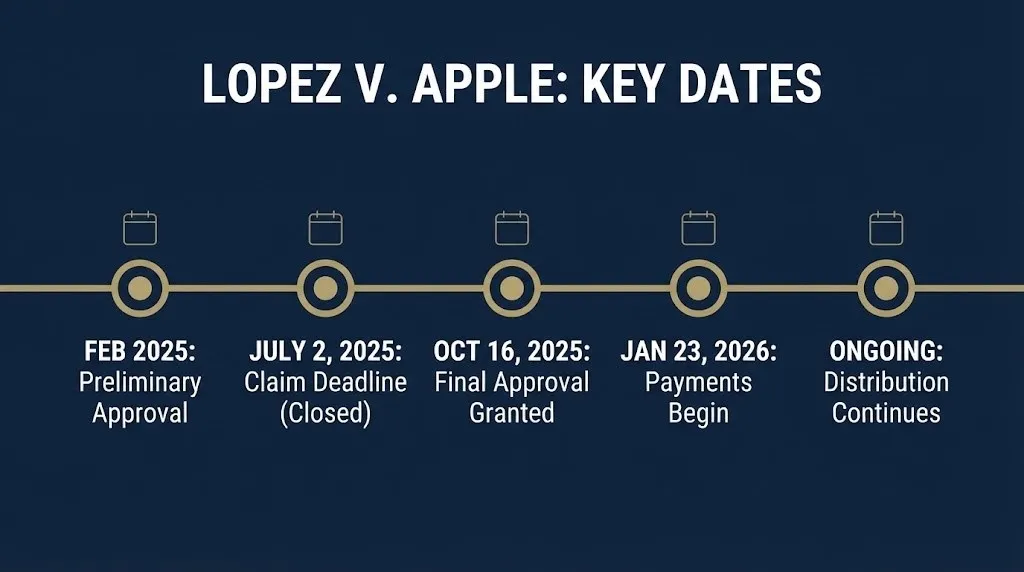
Most payments cleared within the first two weeks. Some stragglers, particularly paper checks and certain digital transfers, took longer to show up, with confirmed reports of payments still landing into early February 2026.
If your payment hasn’t arrived:
- Check spam and promotions folders for an email confirmation.
- Search your bank statement for “Lopez Voice Assistant” or close variations.
- Confirm the payment method you originally selected on the claim form.
- Contact Angeion Group directly if more than a few weeks have passed since late January.
Physical checks generally take the longest to arrive of any payment method offered.
What Is a Class Action Settlement Administrator? (BACKGROUND)
A settlement administrator is the neutral third-party company a court appoints to manage notice, claims processing, and payment distribution for a class action, separate from both the plaintiffs’ lawyers and the defendant. In this case, that role belongs to Angeion Group, a Philadelphia-based firm that has administered numerous large consumer class actions.
Angeion Group is responsible for verifying claim forms, calculating per-claimant payouts based on the total number of valid claims, and issuing payments in the format each claimant chose. Apple itself has no direct role in processing individual claims or payments.
Court filings from Angeion also estimated the total potential class size, information the company reported directly to the court as part of the notice process required under Federal Rule of Civil Procedure 23.
Key Takeaway: Angeion Group, not Apple, handles every step of claims processing, which is why payment labels reference the case name instead of the company.
Why Did Apple Settle Instead of Going to Trial? (BACKGROUND)
Apple agreed to settle rather than take the case to trial, while continuing to deny any wrongdoing throughout the litigation. Settling let the company resolve a case that had already run for roughly five years without admitting liability for Siri’s alleged recording practices.
Court records also noted a sanction against Apple during litigation for evidence spoliation, tied to deleted data relevant to the case, though a jury was never asked to weigh in on Apple’s intent since the case settled first.
This pattern, a large company settling a privacy claim without admitting fault, is common across tech litigation. It lets both sides avoid the cost and uncertainty of a jury trial while still delivering compensation to affected consumers.
Think of it the way a company might handle a product recall: it doesn’t have to agree the product was defective to decide a refund program is the cheaper, faster path forward.
Was There an Objection to the Attorney Fees? (STATUS)
Yes, the Hamilton Lincoln Law Institute formally objected to the size of the attorney fee award in this settlement. Class counsel requested roughly 30 to 31% of the $95 million fund, or about $28.5 million to $29.4 million.
The objector argued on behalf of class member Reilly Stephens that a fee closer to 20%, or about $19 million, would be more in line with typical awards for settlements of similar size. Standard benchmarks in many federal circuits run around 25%.
Judge White ultimately proceeded with final approval and described the requested fee as legally appropriate, according to court reporting. This detail matters for transparency, since it shows how much of the $95 million went to litigation costs rather than the class.
Key Takeaway: Roughly 30% of the settlement fund went to attorney fees, a point objectors flagged as high but the court allowed to stand.
What Happens Next
October 16, 2025: Judge White granted final approval of the $95 million settlement.
January 23, 2026: Payments began distributing to claimants who filed valid claims.
Late January through early February 2026: Most direct deposits, PayPal, and Venmo payments cleared, with some checks arriving later.
Ongoing: Angeion Group continues resolving stragglers, undeliverable checks, and claim status inquiries from people who filed before the deadline.
Not expected: No confirmed second claims window exists for people who missed the July 2, 2025 deadline.
Frequently Asked Questions
Is the Lopez v. Apple settlement real?
Yes, it’s a real, court-approved $95 million settlement over Siri privacy claims.
The case number is 4:19-cv-04577-JSW in the Northern District of California, and multiple fact-checkers including Snopes verified it.
How much money will I get from the Lopez v. Apple settlement?
Payments run roughly $8 to $40 per eligible device, capped at $20 per device before final proration.
The exact amount depends on how many total valid claims were filed against the $95 million fund.
Can I still file a claim in the Lopez v. Apple settlement?
No, the claim deadline was July 2, 2025, and it has passed.
There is currently no confirmed second filing window for late claimants.
Is the “Lopez Voice Assistant” deposit on my bank statement a scam?
No, it’s a legitimate payment label used by the settlement’s payment processor.
CBS News and Snopes both confirmed these deposits are tied to the real Apple Siri settlement.
Who is the settlement administrator for Lopez v. Apple?
Angeion Group is the court-appointed settlement administrator.
You can reach them at 1-888-981-4106 or by mail at the address listed on the official settlement website.
Why did some people get more than others per device?
Payouts are pro rata, meaning the fund is divided based on the total number of valid claims filed.
Because a smaller share of the eligible class filed than expected, many payments landed closer to the $20 per-device cap.
Did Apple admit to wrongdoing in this case?
No, Apple denied all allegations throughout the litigation and in the final settlement agreement.
The company agreed to pay $95 million to resolve the claims without admitting liability.
What devices were eligible under the settlement?
Eligible devices included iPhone, iPad, Apple Watch, MacBook, iMac, Apple TV, HomePod, and iPod touch.
Ownership had to fall within the September 17, 2014 to December 31, 2024 window.
Bottom Line
If you filed a claim before the July 2, 2025 deadline, check your bank statement and spam folder for a “Lopez Voice Assistant” deposit before assuming anything went wrong. If you missed the deadline, no current path exists to file late, so treat any message claiming otherwise with caution.
The single fact worth remembering: payments began January 23, 2026, from a real $95 million settlement, administered by Angeion Group, not Apple directly.