Fortnite Lawsuit 2026: Settlement Refunds, FTC Claims, and How to Get Paid
Quick Answer
- The Fortnite settlement is real. Epic Games agreed to pay over $520 million to resolve FTC claims about deceptive billing and privacy violations.
- Refunds vary by claim type. Unwanted V-Buck purchase claims can pay back the full amount charged. Privacy claims have their own fund.
- The FTC claim deadline has passed for the initial round. A second distribution is possible. Check the official FTC Fortnite refund site.
If you or your child played Fortnite and made in-game purchases you did not intend, you may have money coming back. The Federal Trade Commission secured two landmark settlements with Epic Games totaling more than $520 million. The larger settlement, $245 million, covers players tricked into making unwanted V-Buck and in-game purchases. The second, $275 million, addresses privacy violations involving children. These are not class action settlements run by private lawyers. The FTC is the plaintiff, and the FTC is the settlement administrator. That makes this different from nearly every other gaming lawsuit.
This article covers who qualifies for a Fortnite refund, how much you can get, how to file a claim if any window remains open, how to check your payment status, and how to avoid the scams that have already started targeting Fortnite players. One hard fact: the FTC has warned that scammers are sending fake Fortnite refund emails. Every legitimate refund comes through the FTC’s official process. Nothing comes by text, phone call, or direct email with a link to click.
The Facts
| Case | FTC v. Epic Games, Inc. (federal court and administrative actions) |
| Status | Settlements approved and paying claims |
| Fund Size | $245 million (unwanted charges) plus $275 million (privacy violations). Total: $520 million. |
| Est. Per Person | Varies. Unwanted V-Buck purchases may be refunded in full. Privacy payments are a flat amount not yet confirmed. |
| Claim Deadline | Initial FTC deadline passed in January 2025. Check the official site for any new rounds. |
| Administrator | Federal Trade Commission (directly, not through a private administrator) |
| Proof Needed | Varies by claim type. Some claims require proof of unauthorized charges. Others require an attestation. |
Is the Fortnite Settlement Real?
Yes, the Fortnite settlement is real, government-enforced, and paying refunds. This is not a private class action with a claims administrator website that looks like it was built in 2005. The Federal Trade Commission sued Epic Games, won, and is now distributing the settlement money directly to consumers.
The FTC announced the settlements in December 2022. The agency accused Epic of using “dark patterns,” design tricks that manipulate users into making purchases they did not intend. The FTC said the game’s interface made it too easy for children to buy V-Bucks without parental consent. It said Epic locked accounts of players who disputed unauthorized charges with their credit card companies. It said Epic collected personal information from children without parental consent in violation of the Children’s Online Privacy Protection Act.
Epic agreed to pay and to change its practices. The company did not admit all allegations. But the settlement terms are binding and enforceable by a federal court. The money is real. Refunds are going out. The FTC, not a private law firm, runs the process. That means the process is legitimate but also bureaucratic. Payments come by check or PayPal from the U.S. Treasury, not from Epic directly and not from a settlement fund with a generic name.
Key Takeaway: The Fortnite FTC settlement is real and government-run. The FTC is paying refunds directly. No private law firm or claims administrator is involved. The official site is the FTC’s Fortnite refund page.
What Is the Fortnite FTC Settlement About?
The FTC sued Epic Games over two categories of wrongdoing. The first was billing practices. The second was children’s privacy. Two separate settlements resulted.
The billing case focused on how Fortnite’s interface led players, especially children, to make unwanted purchases. The FTC alleged that the game’s button layout, loading screen design, and preview features were engineered to cause accidental clicks that triggered real-money charges. Players reported buying V-Bucks they did not want, skins they did not mean to purchase, and Battle Pass tiers they never intended to buy. Epic allegedly made it difficult to get refunds, locking accounts of players who disputed charges with their banks.
The privacy case focused on children. Fortnite collects voice and text chat data. For players under 13, the FTC alleged Epic did not obtain verifiable parental consent before collecting this information. COPPA, the Children’s Online Privacy Protection Act, requires that consent. The FTC also alleged Epic knew children were playing and did not adequately restrict their interactions with adult strangers in the game.
Epic paid $245 million to resolve the billing claims and $275 million for the privacy claims. The company also agreed to change its billing and privacy practices. The settlement included a detailed list of design changes, including requiring a second confirmation step before purchases and separating “purchase” and “preview” buttons more clearly.
How Much Will the Fortnite Settlement Pay?
The amount you receive depends on which claim you filed and how much you lost.
For unwanted in-game purchases, the FTC will refund the full amount of the unauthorized charge if you can document it. If you filed a claim for $50 in V-Bucks your child bought without permission, and you provided supporting documentation, you can receive $50 back. There is no pro rata reduction for unwanted charge claims. You get back what you lost, up to the settlement fund limit.
For claims without receipts, the FTC evaluates based on the information you provided. The agency has not published a flat dollar amount for undocumented claims. Payouts for undocumented claims are likely smaller and subject to available funds after documented claims are paid.
For privacy violation claims, the FTC created a separate fund. Per-person payments have not been publicly confirmed as of July 2026. Based on similar FTC privacy settlements, these payments could range from a few dollars to a moderate flat amount. The fund is large, but the class of affected players is also large. Division among millions of eligible players will reduce individual payments.
Fortnite Settlement Refund Estimates
| Claim Type | Estimated Payout | Based On |
| Unwanted V-Buck purchases (documented) | Full refund of documented charges | FTC settlement order |
| Unwanted purchases (undocumented) | Not yet confirmed, likely lower | FTC practice in similar cases |
| Privacy violation claims | Not yet confirmed, flat amount per person | FTC distribution formula |
| Credit card dispute lockouts | Refund of specific documented losses | FTC settlement order |
These are estimates. Your actual payment depends on the documentation you provided and the total number of valid claims.
Reality Check: The FTC does not text you about your refund. It does not call. It does not ask for your bank password or charge you a processing fee. If you receive a message about a Fortnite refund, navigate to the FTC’s official Fortnite page yourself. Do not click links in emails or texts. The FTC has explicitly warned about refund scams targeting Fortnite players.
Who Qualifies for the Fortnite Refund?
Eligibility is split into three categories. You may qualify under one or more.
First, you qualify if you were charged for V-Bucks or in-game items you did not intend to buy between January 2017 and September 2022. This covers the period when Epic’s billing practices were under FTC scrutiny. You qualify whether you made the purchase or your child made it on your account. The key is that the charge was unwanted.
Second, you qualify if your child made unauthorized credit card charges for Fortnite purchases between January 2017 and November 2018. This is a specific window covering the period before Epic added certain parental controls and refund mechanisms.
Third, you qualify if you disputed Fortnite charges with your credit card company and Epic locked your account as a result. This affected a smaller group of players but was one of the practices the FTC specifically targeted in its complaint.
You must be a U.S. resident to file for an FTC refund. The FTC’s enforcement authority is limited to U.S. consumers. If you are outside the U.S., these settlements do not apply to you, though other countries’ regulators have taken their own actions against Epic.
How to File a Fortnite Settlement Claim
The main FTC claim deadline passed in January 2025. The following steps describe the process that existed. If the FTC opens a second round, the process should be similar.
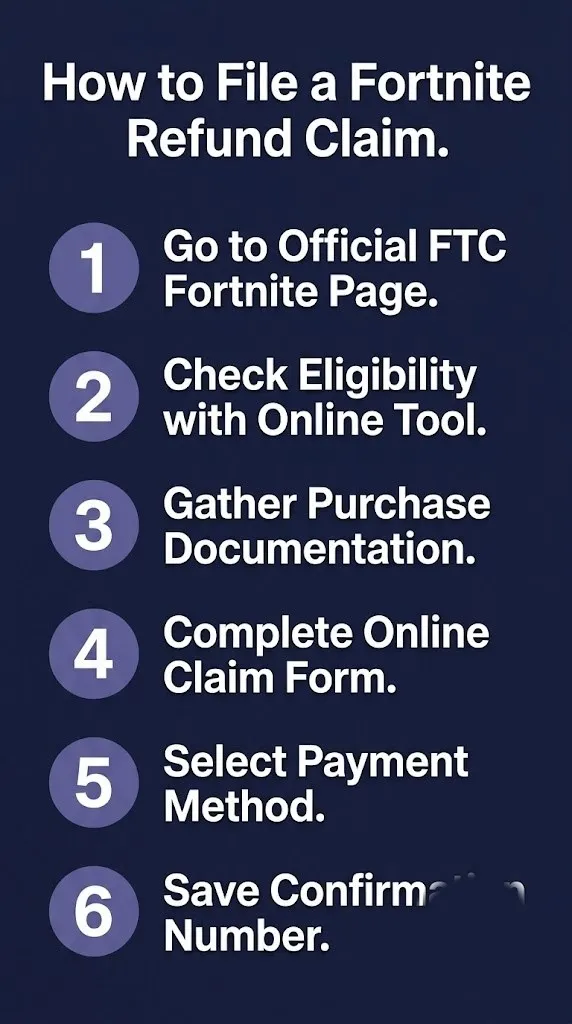
- Go to the official FTC Fortnite refund page. Type “FTC Fortnite refund” into a search engine or navigate directly to the FTC’s website. Do not use third-party links.
- Check if you are eligible. The FTC page has an eligibility tool. Answer the questions about your or your child’s Fortnite purchases.
- Gather your documentation. Epic account ID, purchase receipts, credit card statements showing Fortnite charges, and any correspondence with Epic about locked accounts or disputed charges.
- Complete the online claim form. Enter your personal information, the Fortnite account information, and details about the unwanted charges or privacy violations.
- Select a payment method. The FTC typically offers a check mailed to your address or a PayPal payment. PayPal is faster.
- Submit the claim. Save the confirmation number. Screen-capture the confirmation page.
- Watch for follow-up requests. The FTC may ask for additional documentation. Respond promptly.
If the deadline has passed, check the FTC page anyway. The FTC sometimes opens additional claim periods if funds remain after the initial distribution.
Key Takeaway: The initial FTC deadline passed. Check the official FTC Fortnite refund page for any new claim windows. File only through the FTC. Never pay to file.
How to Check Your Fortnite Refund Status
The FTC does not use a third-party claims administrator portal. The FTC’s own system handles status inquiries.
If you filed a claim, you should have received a confirmation email or letter. That correspondence includes your claim reference number and instructions for checking your status. The FTC processes claims in batches. Your payment may not arrive at the same time as someone else who filed around the same time.
If you have not received payment and want to check your status, start with the FTC’s Fortnite refund page. The page has a status inquiry function. You will need your claim reference number and the email address you used to file. If you cannot find your number, the page may allow you to look it up using your name and email.
If the FTC site cannot locate your claim, or if you believe your payment was lost or stolen, contact the FTC’s refund coordinator. Contact information is on the FTC’s Fortnite page. The FTC is slower to respond than a private administrator. Expect delays. The agency is handling hundreds of thousands of claims with government staffing levels.
When Will Fortnite Settlement Checks Be Mailed?
The FTC began distributing payments in late 2024. Additional waves continue through 2026. Some claimants have already been paid. Others are still waiting.
The FTC sends payments on its own schedule, not on a timeline published in advance. When your payment arrives depends on when your claim was processed, whether your documentation was complete, and which batch your claim fell into.
Payments come in one of two forms. A check mailed by the U.S. Treasury to the address on your claim form. Or a PayPal payment sent to the email address you provided. PayPal payments arrive faster. Checks take one to three weeks from the mail date. The FTC does not offer direct deposit or Venmo for these settlements.
If your address has changed since you filed, contact the FTC’s refund coordinator immediately. A check sent to an old address will not automatically be reissued. You must request a stop payment and reissue.
What Other Fortnite Lawsuits Exist?
The FTC settlement is the largest, but it is not the only Fortnite legal action. Other cases exist and may have their own claims processes.
A separate class action lawsuit was filed over Fortnite loot boxes, specifically the Loot Llama mechanic. Plaintiffs argued that loot boxes constitute illegal gambling under certain state laws. That case did not result in a consumer payout settlement as of July 2026. The status of loot box litigation remains uncertain after a series of mixed court rulings.
Epic has also been sued over dance emotes. Multiple choreographers and performers, including Alfonso Ribeiro, 2 Milly, and the Backpack Kid, sued Epic for allegedly copying their dance moves for Fortnite emotes without permission. Most of these cases were dismissed or settled on undisclosed terms. None produced a consumer class action.
Epic’s antitrust lawsuit against Apple and Google is not a consumer case. It resulted in some policy changes requiring Apple and Google to allow alternative payment systems on their app stores. Consumers do not get payments from that litigation.
If you see a website or ad offering a “Fortnite class action refund” that is not the FTC settlement, verify it carefully. Multiple settlements exist. Each has its own eligibility criteria and its own deadline. The FTC settlement is the only one confirmed to be paying consumers as of mid-2026.
Why Did the FTC Sue Epic Games?
The FTC sued Epic because the agency believed the company’s design choices crossed the line from aggressive monetization into deceptive and unfair trade practices. The complaint reads less like a legal document and more like an indictment of modern free-to-play game design.
The FTC alleged that Fortnite’s interface used confusing button layouts to trigger purchases. The “preview” function for cosmetic items would open a purchase screen with the buy button placed where the preview button had just been. A single unintended tap completed the purchase. The FTC called this a dark pattern.
The agency also alleged that Epic made it unreasonably hard to get refunds. Players who disputed charges with their credit card companies found their Epic accounts locked. For many children, losing access to their Fortnite account meant losing social connection with friends. The FTC argued this was a coercive tactic to discourage chargebacks.
On the privacy side, the FTC alleged Epic collected voice chat and text data from children under 13 without parental consent. The game’s default settings enabled voice chat and text communication with strangers. The FTC said this exposed children to harassment and inappropriate content without parental knowledge.
Epic settled because fighting the FTC is expensive and risky. The company did not admit all allegations. But it agreed to pay and to change its practices. The design changes the FTC required are now industry-standard: purchase confirmation screens, clearer button separation, and parental control defaults that actually protect children.
What Changes Did Epic Make After the Settlement?
The settlement required Epic to change how Fortnite handles purchases and privacy. These changes affect every player, not just those who filed claims.
Epic now requires a second confirmation step before completing any in-game purchase. You cannot buy V-Bucks, skins, or Battle Pass tiers with a single accidental tap. The purchase button and the preview button are visually distinct and placed farther apart.
For accounts identified as belonging to minors, Epic must obtain parental consent before collecting personal information. The game’s voice and text chat defaults were changed to off for players under 13. Parents have more control over who their children can communicate with in the game.
Epic also agreed to stop locking accounts solely for credit card chargebacks. The company can still investigate and dispute fraudulent chargebacks, but it cannot use an account lock as a blanket response.
These changes were not optional. The FTC settlement order is enforceable by a federal court. Violations can result in additional penalties. The changes apply globally, not just in the U.S., because it is easier for Epic to build one compliant system than to maintain separate interfaces for different regions.
Key Takeaway: Fortnite’s purchase and privacy systems changed because of these lawsuits. The changes benefit every player. The refunds compensate those who were harmed before the changes took effect.
What Happens Next in the Fortnite FTC Settlement?
The settlement is in its distribution phase. Here is the expected remaining timeline.
- Ongoing through 2026: The FTC continues distributing payments in waves. Claim reviews and deficiency resolutions continue.
- Late 2026: Most distributions are expected to complete. The FTC evaluates whether funds remain for a second claim window.
- 2027: If funds remain unclaimed, the FTC may open a supplemental claim period or donate residual funds to consumer education programs as directed by the settlement order.
- 2027 and beyond: The FTC monitors Epic’s compliance with the required business practice changes. Violations can result in contempt proceedings.
The settlement’s impact extends beyond the payments. The design changes Epic made have become a template for other game companies seeking to avoid similar FTC action. The Fortnite case is now cited in FTC workshops and industry conferences as an example of what not to do.
Frequently Asked Questions
Can I still file a Fortnite refund claim in 2026?
The initial FTC deadline passed in January 2025.
Check the official FTC Fortnite refund page. A second round may open if funds remain.
How much will I get from the Fortnite settlement?
Documented unwanted V-Buck purchases may be refunded in full.
Privacy claims and undocumented purchase claims pay less. Exact amounts depend on your claim.
How do I know if a Fortnite refund email is real?
The FTC does not send refunds by email link.
Navigate directly to the FTC website. Do not click links in messages about Fortnite refunds.
What if my kid made the purchases without my permission?
That is exactly what the settlement covers.
You may have qualified for a refund if the purchases occurred during the covered period.
Does the Fortnite settlement cover gift card purchases?
Yes, if the gift card was used for unwanted in-game purchases.
Documentation of the charge, including gift card transaction records, supports a claim.
Is the Fortnite settlement only for U.S. players?
The FTC settlement covers U.S. residents only.
Other countries have separate regulatory actions or class actions against Epic.
When will my check arrive?
Payments are being distributed in waves through 2026.
Check your status on the FTC’s Fortnite refund page using your claim reference number.
Can Epic lock my account for asking for a refund?
Not anymore. The settlement prohibits retaliatory account locks for chargebacks.
If your account is locked for this reason after the settlement date, contact the FTC.
The Fortnite FTC settlement is the largest gaming refund program in U.S. history. If you filed a claim, your payment is either on the way or still being processed. Check the official FTC Fortnite refund page for your status. If you missed the deadline, watch the same page for any second chance filing window.
Scammers are actively exploiting this settlement. Remember: the FTC does not text. It does not DM. It does not ask for payment or your password. The only Fortnite refund process that exists is on the FTC’s official website. Go there directly. Ignore everything else.