Kaiser Privacy Settlement 2026: Payout, Deadline, and Case Status
Quick Answer
- The Kaiser privacy settlement is a real, court-approved class action worth $46 million, with a possible increase to $47.5 million.
- Eligible members who filed a claim can expect an estimated $20.98 to $41.95, depending on total claims filed.
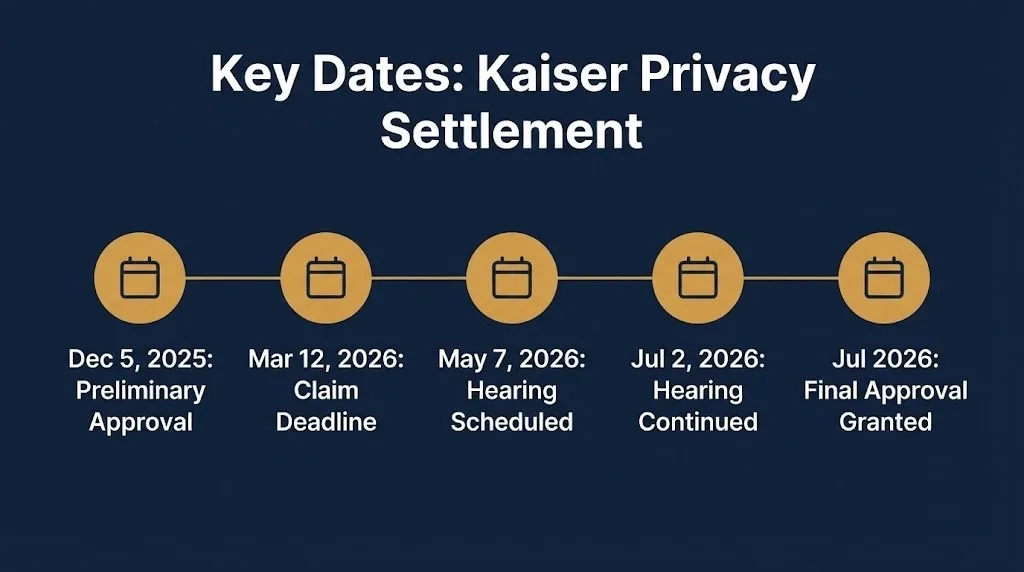
- The claim deadline was March 12, 2026, and has already passed. Final court approval was granted in July 2026.
If you got an email or postcard about a Kaiser privacy settlement, it’s real. Kaiser Foundation Health Plan agreed to pay $46 million, with a possible increase to $47.5 million, to resolve claims it let tracking code leak patient data to companies like Google and Meta.
This affects roughly 13.4 million current and former Kaiser members in nine states and Washington, D.C. The court granted final approval in early July 2026, which means payments are now moving toward the next stage: distribution.
This article covers who qualified, how much money was actually on the table, and what happens now that the case has cleared its biggest legal hurdle. One detail worth knowing: the fairness hearing didn’t wrap up in one sitting. It got continued from May 7 to July 2 before the judge signed off.
The Facts
| Case | Doe, et al. v. Kaiser Foundation Health Plan, Inc., et al., Case No. 3:23-cv-02865-EMC |
| Court | U.S. District Court for the Northern District of California |
| Status | Final approval granted, following a hearing continued from May 7 to July 2, 2026 |
| Fund Size | $46 million, with a possible increase to $47.5 million |
| Est. Per Person | $20.98 to $41.95, pro rata based on total valid claims |
| Claim Deadline | March 12, 2026 (closed) |
| Administrator | Strategic Claims Services Inc. |
| Proof Needed | None beyond a valid claim form and Settlement Class Member ID |
Is the Kaiser Privacy Settlement Legit?
Yes. The Kaiser privacy settlement is a legitimate, court-supervised class action, not a phishing scheme.
The case is formally titled Doe, et al. v. Kaiser Foundation Health Plan, Inc., et al., Case No. 3:23-cv-02865-EMC, filed in the U.S. District Court for the Northern District of California before Judge Edward M. Chen. Multiple lawsuits filed in 2024 were consolidated into this single class action.
Kaiser has denied any wrongdoing throughout the litigation. The company agreed to settle “to end the burden, expense, and uncertainty of further litigation,” according to language on the official settlement website.
You can verify every detail directly through the official site, kaiserprivacysettlement.com, or by checking the federal court’s public docket for this case number.
Is the Kaiser Settlement Email Real or a Scam?
A legitimate Kaiser settlement email is real if it includes a unique Settlement Class Member ID and directs you to kaiserprivacysettlement.com.
Kaiser began sending official notices in January 2026 to roughly 13 million current and former members across nine states and the District of Columbia. Those notices came by email or mail and included the ID needed to file a claim.
Scammers frequently copy real settlement notices to trick people into giving up personal information. A real notice never asks for a fee, your full Social Security number over email, or payment to “unlock” your settlement money.
Key Takeaway: This is a genuine, federally supervised class action settlement, and any message asking you to pay money to receive your payout is not legitimate.
How Much Money Can You Get From the Kaiser Privacy Settlement?
Eligible class members who filed a valid claim can expect an estimated $20.98 to $41.95, with the final number depending on how many people filed.
The settlement uses a pro rata structure. That means the leftover fund, after fees and costs, gets divided evenly among everyone who filed a valid claim.
| Estimated Claims Filed | Estimated Payout Per Person |
|---|---|
| Approximately 1.38 million claims | Around $20 |
| Approximately 690,000 claims | Around $40 |
Not yet determined: the exact final per-person figure, since it depends on the total number of valid claims the administrator confirms after final approval.
What Is the Kaiser Permanente Data Breach Settlement Fund Worth?
The settlement fund totals $46 million, with a contractual possibility of rising to $47.5 million under certain conditions outlined in a confidential supplemental agreement.
Before any money reaches class members, the fund covers settlement administration costs, attorneys’ fees, and service awards. Court filings show attorneys requested up to $15,675,000 in fees, plus litigation expenses capped at $900,000.
Named plaintiffs who represented the class can also request service awards up to $5,000 each. Whatever remains after those deductions becomes the net fund split among claimants.
How Are Kaiser Settlement Payouts Calculated?
Kaiser settlement payouts are calculated by dividing the net settlement fund evenly among everyone who submitted a valid, timely claim.
This works something like a shared restaurant bill split among however many people show up. The bigger the group that files, the smaller each individual slice becomes.
Members who were Kaiser patients for a longer stretch of the November 2017 to May 2024 window may receive a somewhat larger share, according to the settlement’s plan of allocation. The exact formula is detailed on the official settlement website.
Reality Check: No legitimate settlement administrator will call, text, or email you asking for a processing fee before releasing your payment. Filing a claim in this case was always free, and third parties charging money to “help” you file were never necessary.
Who Qualifies for the Kaiser Permanente Privacy Settlement?
You may qualify if you were a Kaiser Permanente member in one of nine states or Washington, D.C., who accessed authenticated Kaiser website or app pages between November 2017 and May 2024.
The covered states are California, Colorado, Georgia, Hawaii, Maryland, Oregon, Virginia, and Washington, plus the District of Columbia. Kaiser estimated roughly 13.4 million individuals fell within that class.
Who Was Covered:
- Kaiser Permanente members in the nine listed states or D.C.
- Anyone who logged into authenticated pages of Kaiser’s website or mobile app
- Members active during the November 2017 through May 2024 window
- Both current and former Kaiser members who meet those criteria
If you never received a notice and never logged into a Kaiser member portal during that window, you likely weren’t part of the settlement class.
How to File a Kaiser Settlement Claim
The claim window has closed, but here’s the process that was required, useful if you’re confirming whether you completed it correctly.
- Locate your settlement notice with your unique Settlement Class Member ID
- Go to kaiserprivacysettlement.com
- Enter your ID, or request one if you didn’t receive it
- Complete the claim form with your contact information
- Choose your preferred payment method
- Submit online, or mail your form to the settlement administrator
- Confirm submission before the March 12, 2026 deadline
If you filed before that date, your claim is on file and awaiting distribution now that final approval has been granted.
Can You Still File a Late Claim?
No, the claim filing deadline of March 12, 2026, has passed, and late claims aren’t being accepted under the terms of this settlement.
That’s similar to missing the window on a store’s return policy. Once the date passes, the option closes regardless of how strong your reason is for missing it.
If you missed the deadline, there’s no separate benefit like automatic credit monitoring available in this particular settlement, unlike some data breach cases. Monitor the official settlement website in case the court orders any changes.
How Will You Receive Your Kaiser Settlement Payment?
You’ll receive payment through whichever method you selected when filing your claim, either electronic transfer or a mailed paper check.
Electronic options included ACH direct deposit, Mastercard, Amazon, Target, Venmo, and PayPal. If you didn’t specify a preference or preferred a physical payment, Kaiser and the administrator planned to mail a check instead.
Key Takeaway: Payment method was locked in at the time of filing, so if you’re unsure what you selected, check your claim confirmation or contact the settlement administrator directly.
What Is the Status of the Kaiser Lawsuit as of July 2026?
As of July 19, 2026, the Kaiser privacy settlement has cleared final court approval, moving the case into the payment distribution phase.
The court originally scheduled a final approval, or “fairness,” hearing for May 7, 2026. That hearing was continued to July 2, 2026, when the judge indicated he would grant final approval pending resolution of the attorneys’ fee allocation.
Legal reporting confirmed the settlement received formal final approval in mid-July 2026, resolving claims brought by an estimated 13.1 to 13.4 million Kaiser patients.
Did the Court Grant Final Approval of the Kaiser Settlement?
Yes, Judge Edward M. Chen granted final approval of the $46 million settlement following the July 2, 2026 continued hearing.
Legal trade publications, including MLex and Courthouse News Service, confirmed the approval in mid-July 2026 coverage. The judge’s decision resolved outstanding questions around how attorneys’ fees would be allocated before signing off on the deal.
Key Takeaway: Final approval is confirmed, which clears the last major legal obstacle before eligible claimants receive payment.
When Will Kaiser Settlement Checks Be Mailed?
An exact mailing date is not yet confirmed, since payments typically follow final approval by a period that accounts for any potential appeals.
One settlement-tracking source estimated payouts could arrive by September 2026, though that figure is an estimate rather than a court-confirmed date. Federal class action settlements commonly include an appeal window of about 30 days after final judgment before funds are released.
If no appeals are filed, distribution can move relatively quickly. If someone appeals the approval order, payment could be delayed for months while that process plays out.
What Is the Kaiser Class Action Lawsuit About?
The Kaiser class action lawsuit alleges the healthcare provider let third-party tracking technology secretly collect and share sensitive patient information without consent.
Plaintiffs claimed Kaiser embedded tracking and analytics code on its website and mobile apps that transmitted data to outside companies including Google, Microsoft, Meta, and X (formerly Twitter). The lawsuit argued this violated federal and state privacy laws, including the Electronic Communications Privacy Act and California’s Confidentiality of Medical Information Act.
Kaiser disabled the tracking code in November 2023, shortly after the original complaint was filed, according to court records, though it maintained it had done nothing wrong.
What Data Was Involved in the Kaiser Permanente Data Breach?
The data involved reportedly included identifying information, patient status, medical histories, and communications with healthcare professionals.
Court documents describe the exposure as covering activity on authenticated, logged-in pages of Kaiser’s website and mobile apps, not just public browsing. That distinction mattered because logged-in sessions can reveal far more sensitive health details than anonymous site visits.
| Data Category | Description |
|---|---|
| Identifying information | Names, IP addresses, account details |
| Patient status | Whether someone was an active Kaiser patient |
| Medical histories | Health conditions and treatment records referenced in portal activity |
| Communications | Messages exchanged with healthcare providers through the portal |
Why Did Kaiser Permanente Settle Instead of Going to Trial?
Kaiser settled to avoid the cost, time, and uncertainty of continued litigation, according to language on the official settlement website, without admitting any wrongdoing.
The case had already run for roughly two years before the parties reached a settlement in principle in mid-2025. Kaiser had earlier attempted to compel arbitration and moved to dismiss the case, both of which extended the litigation timeline.
Settling gave class members a guaranteed payout without the risk of an uncertain trial outcome, while letting Kaiser resolve the claims without a formal finding of liability.
What Happens Next
March 12, 2026: Claim filing and opt-out deadline passed.
May 7, 2026: Original final approval hearing date, later continued.
July 2, 2026: Continued hearing held, judge indicated approval would follow.
Mid-July 2026: Final approval formally confirmed by the court.
Expected fall 2026: Payment distribution, pending resolution of any appeals, per available estimates.
Frequently Asked Questions
Is the Kaiser privacy settlement real?
Yes, it’s a court-approved federal class action settlement worth up to $47.5 million.
It resolves claims that Kaiser shared patient data through website tracking code without consent.
Final approval was confirmed by the court in July 2026.
How much money will I get from the Kaiser settlement?
Estimated payouts range from $20.98 to $41.95 per valid claim.
The exact amount depends on the total number of people who filed claims.
Payments are calculated on a pro rata basis from the net settlement fund.
Can I still file a Kaiser settlement claim?
No, the claim filing deadline was March 12, 2026, and has already passed.
Late claims are not being accepted under this settlement’s terms.
If you filed before the deadline, no further action is needed right now.
Who qualifies for the Kaiser Permanente settlement?
Kaiser members in nine states or Washington, D.C. who accessed authenticated site pages may qualify.
The covered window runs from November 2017 through May 2024.
Covered states include California, Colorado, Georgia, Hawaii, Maryland, Oregon, Virginia, and Washington.
When will Kaiser settlement checks be mailed?
No confirmed mailing date exists yet, since payment follows final approval and any appeal period.
One estimate places distribution around September 2026.
Watch the official settlement website for updates on exact timing.
Did Kaiser admit wrongdoing in the data breach case?
No, Kaiser has consistently denied any wrongdoing throughout the litigation.
The company agreed to settle to avoid the cost and uncertainty of continued legal proceedings.
The court’s approval resolves the case without a formal finding of liability.
What companies received Kaiser patient data?
Court documents name Google, Microsoft, Meta, and X (formerly Twitter) as recipients of tracking data.
The data allegedly came from tracking code embedded in Kaiser’s website and mobile apps.
Kaiser disabled the tracking code in November 2023, before the settlement was reached.
Is there a Kaiser settlement administrator I can contact?
Yes, Strategic Claims Services Inc. administers the settlement on the court’s behalf.
You can reach the administrator through the official settlement website or by phone.
Contact information for questions about your claim is listed on kaiserprivacysettlement.com.
Watch the official settlement website for updates on when payments will actually go out. The single most important fact right now: final approval is confirmed as of July 2026, and distribution is the next step.