Google Antitrust Lawsuit 2026: Payouts, Rulings and Deadlines
Quick Answer
- Confirmed real. Federal judges ruled Google an illegal monopolist in search and in ad tech.
- The $630 million Play Store consumer fund pays a guaranteed minimum of $2 per person.
- Most payments are automatic. No claim form is required.
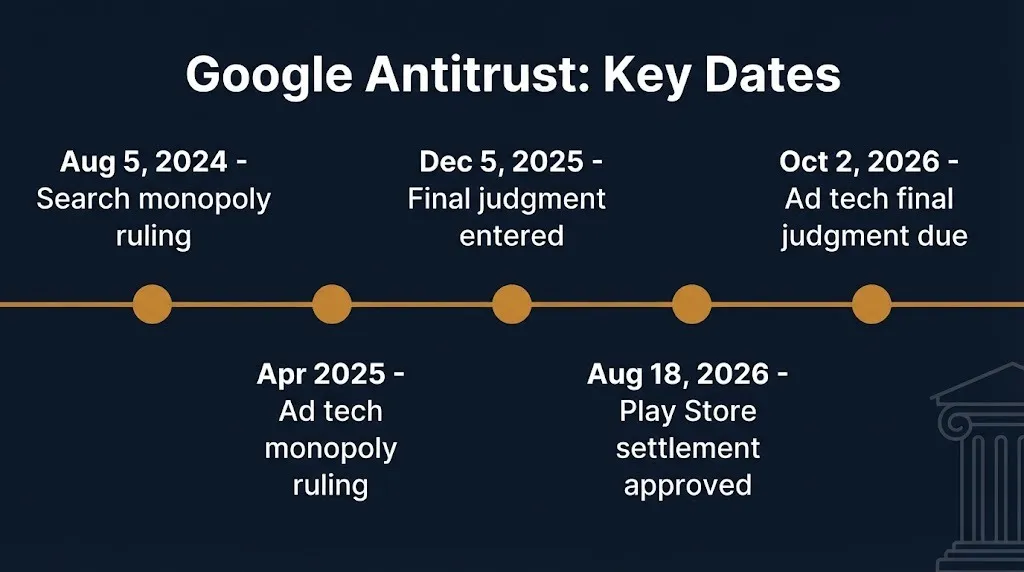
Google has lost two federal monopoly cases in two years. Judge Amit P. Mehta ruled on August 5, 2024, that Google unlawfully maintained monopolies in general search and search text advertising.
None of that puts money in your pocket. The only Google antitrust fund paying ordinary consumers right now is the $700 million Play Store settlement, covering purchases between August 16, 2016, and September 30, 2023.
This article separates the rulings that make headlines from the settlement that actually pays. One detail most coverage skips: the judge’s full ad tech remedies opinion is still sealed.
The Facts
| Case | United States et al. v. Google LLC (search and ad tech), plus the Google Play state AG and consumer settlement |
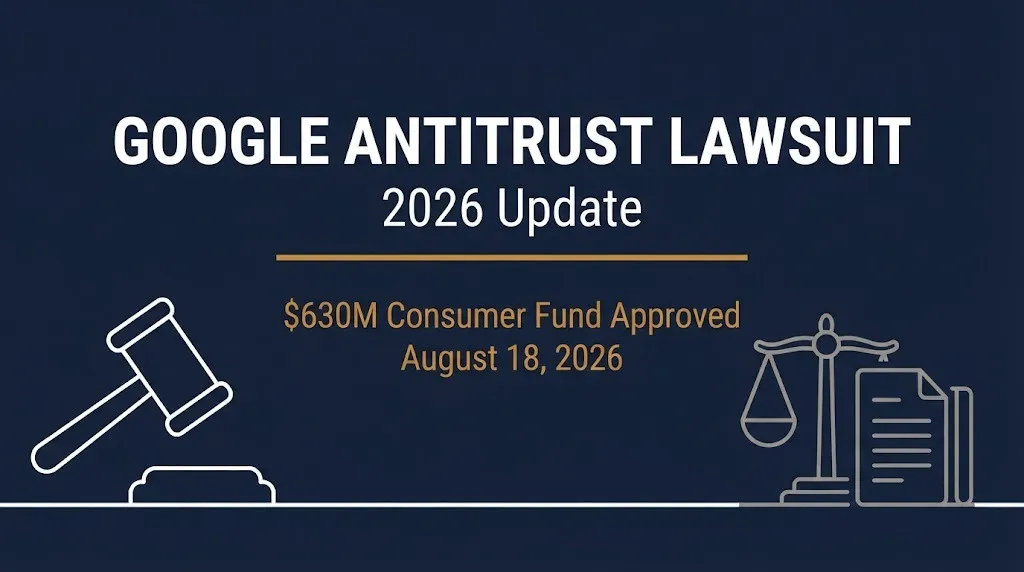
| Status | Search: liability affirmed at trial, final judgment entered, appeal pending. Play Store: final approval granted August 18, 2026 |
| Fund Size | $630 million for consumers, $70 million for states |
| Est. Per Person | At least $2, scaled to your Play Store spending |
| Claim Deadline | No claim form required for most consumers |
| Administrator | Court-appointed settlement administrator, N.D. California |
| Proof Needed | None for automatic payments |
Is the Google antitrust lawsuit real?
Yes. Two separate federal courts have found Google broke antitrust law, and both rulings are on the public docket.
Judge Amit P. Mehta of the U.S. District Court for the District of Columbia ruled on August 5, 2024, that Google illegally maintained monopolies in general search services and general search text advertising. The principal docket number is 20-cv-3010.
The second ruling came from Virginia. Judge Leonie Brinkema found in April 2025 that Google held illegal monopolies in publisher ad servers and in ad exchanges. The Department of Justice called it a landmark victory.
Google denies wrongdoing and is appealing. That does not change the trial record.
Three things to keep straight:
- The DOJ cases are government enforcement actions. They change Google’s conduct, not your bank balance.
- The Play Store settlement is a consumer case. It pays money.
- The private damages cases mostly involve publishers and advertisers, not individual users.
Is a Google settlement email or text legit?
Some are. Beginning December 2, 2025, consumers who made Google Play purchases began receiving notices about the distribution process.Once the court approved the settlement, consumers were told to expect an email from PayPal or a text from Venmo at the address or number linked to their Google Play account.
That is the legitimate path.
Here’s the problem. A real notice and a scam notice look nearly identical on a phone screen.
Red flags that mean it’s fake:
- Any request for your Social Security number
- Any request for bank login credentials
- Any fee to “release” or “expedite” your payment
- A shortened link that does not resolve to the official settlement domain
Think of it like a delayed tax refund. The IRS does not text you asking for a processing fee, and neither does a settlement administrator.
How many Google antitrust lawsuits are there in 2026?
There are at least four active tracks, and they resolve on separate timelines.
| Case | Court | Status |
|---|---|---|
| Search monopolization | D.D.C., Judge Mehta | Final judgment entered December 5, 2025; appeal pending |
| Ad tech monopolization | E.D. Va., Judge Brinkema | Remedy order issued September 2, 2026 |
| Play Store (states and consumers) | N.D. Cal., Judge Donato | Final approval August 18, 2026 |
| Epic Games v. Google | N.D. Cal., Judge Donato | Injunction in force; rival app stores opened July 22, 2026 |
Private damages litigation runs alongside these. In re Google Digital Advertising Antitrust Litigation won class certification in December 2025 on behalf of ad-supported online publishers.
Only one of these tracks has issued consumer checks.
Key Takeaway: Google has lost twice in federal court, but only the Play Store settlement converts those losses into consumer payments.
How much money can you get from the Google antitrust lawsuit?
Your payout depends entirely on which case you’re asking about. Most people get nothing from the DOJ cases.
Under the Play Store settlement, consumers receive a cash payment based on what they paid for apps and in-app content through Google Play Billing, with a floor of $2.
| Case | Consumer payout |
|---|---|
| DOJ search case | $0 to individuals |
| DOJ ad tech case | $0 to individuals |
| Play Store settlement | $2 minimum, scaled to spending |
| Publisher damages MDL | Businesses only, not consumers |
No official source has published a flat average per-person figure. Anyone quoting you a precise number is guessing.
The fund is large but the class is enormous. Officials estimated roughly 102 million consumers would receive automatic payments. Two plaintiffs’ firms requested $85 million in fees from the consumer fund.
How much is the Google Play Store settlement per person?
The exact amount varies by purchase history, and no verified average has been published.
Consumers who did not exclude themselves automatically receive benefits based on their qualifying Google Play spending. Someone who bought two apps in 2018 sits near the $2 floor. Someone with years of subscriptions and in-app purchases sits higher.
The settlement fund accrues interest and is subject to federal taxes. That interest slightly increases what is available.
What determines your number:
- Total spent through Google Play Billing during the class period
- The number of qualifying purchases on your account
- Deductions for attorneys’ fees and administration costs
- How many eligible consumers ultimately receive payment
Compare it to a store refund on a warranty claim. The store refunds what you actually paid, not a flat amount for everyone in line.
Does the DOJ search antitrust case pay consumers anything?
No. The search monopolization case awards no money to individual consumers.
It is a government enforcement action seeking to restore competition. The December 5, 2025 final judgment did not order Google to sell Chrome or break up Android. It limits certain exclusivity and tying arrangements and requires Google to build data-sharing and search-syndication programs for qualified competitors.The court barred Google from entering or maintaining exclusive distribution agreements for Google Search, Chrome, Google Assistant, and Gemini.
Default agreements must terminate no more than one year after signing.The contractual restrictions took effect February 3, 2026.
A five-member Technical Committee oversees compliance.
Those remedies may lower what you pay indirectly, over years. They do not generate a check.
Reality Check: Filing a settlement claim is always free. No legitimate administrator charges a fee, and no one will text you asking for bank details to “release” your Play Store payment. Third-party services offering to file for a percentage are unnecessary, because most Play Store payments require no claim form at all.
Key Takeaway: The headline monopoly rulings change Google’s contracts, not your balance, and the only consumer money flows from the Play Store fund.
Who qualifies for a Google antitrust payout in 2026?
Eligibility for the Play Store fund turns on purchase history and address, not on how often you use Google.
The settlement covers consumers who made a qualifying purchase through the Google Play Store between August 16, 2016, and September 30, 2023, while the legal address in their Google payments profile was in one of the 50 U.S. states, D.C., Puerto Rico, or the U.S. Virgin Islands.
You may qualify if all of these are true:
- You paid for an app, subscription, or in-app content through Google Play Billing
- The purchase fell inside the class period
- Your payments profile listed a covered U.S. address
- You did not exclude yourself by the February 19, 2026 deadline
Free app downloads do not count. Gmail use does not count. Owning an Android phone without making a Play purchase does not count.
California residents were covered separately by a prior state-specific case. Check your own notice rather than assuming.
How do you claim a Google antitrust settlement payment?
For most people, you don’t. Payment is automatic.
The settlement fund makes the majority of payments automatically, and no claim form is necessary in most cases.
Here’s what to do:
- Check the email and phone number tied to your old Google Play account.
- Look for a notice sent on or after December 2, 2025.
- Watch for an email from PayPal or a text from Venmo announcing an incoming payment.
- If that contact info matches a PayPal or Venmo account, the money lands there directly.
- If it doesn’t match, you can create an account or redirect the payment elsewhere.
- Verify the sender domain before clicking anything.
- Never pay a fee to receive settlement money.
Do not enter personal details on any site that is not the official settlement website.
What if you never got a Google settlement payment?
There is a backup route, and it is called the supplemental claims process.
A supplemental claims process follows the automatic payment phase for consumers who lack a PayPal or Venmo account, no longer have access to the email or phone tied to their Google Play account, or expected a payment and did not receive one.
The opening date for that supplemental process has not been publicly confirmed. Treat any specific deadline you see elsewhere as unverified until the administrator posts it.
Consumers can submit their name, email, and mobile number on the settlement website to be notified when the supplemental process starts.
Three situations that put you in this group:
- You closed the email account you used in 2017
- You changed carriers and lost the old number
- You spent heavily on Play but received no notice
Key Takeaway: Automatic payment covers most class members, and the supplemental claims process exists for everyone the automated system misses.
What is the Google antitrust update for September 2026?
The most recent movement came in the ad tech case, and it went Google’s way.
On September 2, 2026, Judge Brinkema denied the proposed sale of AdX and a contingent divestiture of DFP auction logic components, accepting most of the parties’ behavioral remedies subject to modification.The parties were directed to submit a jointly proposed Final Judgment within 30 days, and the accompanying Memorandum Opinion remains under seal for 14 days to allow redactions.
That puts two dates on the calendar right now:
| Date | Event |
|---|---|
| September 16, 2026 | Deadline to move for redactions to the sealed opinion |
| October 2, 2026 | Deadline for the jointly proposed Final Judgment |
Until that judgment is entered, the specific obligations on Google are not public.
What did the judge decide in the Google ad tech case?
Google keeps its ad tech business and accepts new rules governing how it runs.
Google retains AdX and DFP, but the final judgment will restrict how those businesses operate and interact with publishers and competing ad tech companies. The behavioral remedies require interoperability with competitors and curbs on practices that depress publisher ad rates.
The judge’s reasoning is worth noticing. She suggested behavioral fixes would be quicker than a breakup followed by years of appeals.
Compare the practical result against Google’s framing. Google’s regulatory affairs vice president said the company was pleased the court rejected the DOJ’s proposal, while a DOJ spokesperson said the antitrust division was pleased the court ordered substantial relief. Both statements are true, and neither tells you what the rules actually say.
For now, Google Ad Manager stays a single integrated product and the take rate is unchanged.
When will the Google appeal be decided?
No decision date is confirmed, and no oral argument has been scheduled.
Google filed its notice of appeal on January 16, 2026, challenging the December 2025 final judgment, then filed a 100-page opening brief on May 22, 2026, docketed as Case No. 26-5023.The Justice Department responded on July 28, 2026, with a 144-page brief urging the D.C. Circuit to affirm the monopoly finding and the data-sharing remedies, while asking it to vacate the denial of a ban on payments to distributors like Apple.That filing carries the notation that oral argument has not yet been scheduled.
Commentators have suggested arguments could land in late 2026 or early 2027.
Treat any firm ruling date you see as speculation.
Key Takeaway: The ad tech judgment is due in court by October 2, 2026, while the search appeal has no argument date at all.
What happened in the Google search monopoly ruling?
The government won liability and lost most of what it asked for at the remedy stage.
Judge Mehta found Google unlawfully maintained monopoly power in general search services and search text advertising, principally through exclusionary agreements with distributors.The remedy stopped short of forcing a Chrome sale, an Android divestiture, or a complete ban on search payments.
The court declined mandatory choice screens and limited the scope of data-sharing obligations to qualified competitors rather than any third party.
What Google must now do:
- End exclusive distribution deals for Search, Chrome, Assistant, and Gemini
- Cap default agreements at one year
- Share portions of its search index and user-interaction data with qualified competitors
- Offer search and search ad syndication at standard rates
As of the most recent detailed public reporting, data-sharing and syndication access had not yet reached qualified competitors.
Why is Google being sued for antitrust?
The core allegation across all these cases is the same: Google used control of a chokepoint to charge more than competition would allow.
In search, the mechanism was payment for defaults. The government argued Google used contracts and payments to secure distribution while discouraging or restricting rivals.
In ad tech, the mechanism was ownership of both sides of the auction. The DOJ alleged Google subverted competition for over 15 years through acquisitions and auction manipulation.
In the Play Store, the mechanism was billing. The states alleged Google forced developers onto its own billing system and took a cut of up to 30%, raising the prices consumers paid.Google has not admitted wrongdoing in the Play Store settlement.
What changes for Android and Google users?
The most visible change already happened, and it came from the Epic case rather than the DOJ cases.
A California jury ruled unanimously for Epic in December 2023, and Judge Donato issued a permanent injunction against Google in October 2024. The Supreme Court rejected Google’s request to delay the app store changes in October 2025.Starting July 22, 2026, third-party app stores began appearing inside Google Play in the United States, and Google opened its catalog to rival stores through the Play Catalog Access Program.Google and Epic withdrew their joint motion to modify that injunction in July 2026.
Practical effect for you:
- Rival app stores are installable without full sideloading
- Developers can point users to outside payment options
- Price competition on subscriptions becomes possible
Can businesses that bought Google Ads sue?
Businesses have live claims, and some are already certified as a class.
In re Google Digital Advertising Antitrust Litigation won class certification in December 2025, representing ad-supported online publishers who allege Google charged supracompetitive prices for its tools.The MDL court approved a notice plan in late January 2026 for a certified class of roughly 5,000 publishers who claim they were overcharged through AdX, with an opt-out window running 45 days from first notice.Publishers including Vox, The Atlantic, Business Insider, McClatchy, Slate, and Advance Publications have filed their own suits in the Southern District of New York.
Individual small advertisers are not automatically part of any certified damages class. Google moved in January 2026 to cut a wide swath of claims from that litigation. Nothing there is paying out yet.
Key Takeaway: Publisher and advertiser damages claims are moving, but no verified business payout schedule exists in 2026.
What happens next
September 16, 2026: Deadline for parties to move for redactions to Brinkema’s sealed ad tech opinion.
October 2, 2026: Google and the DOJ must file a jointly proposed Final Judgment in the ad tech case.
Expected Q4 2026: Play Store automatic payments continue, followed by the supplemental claims process. No opening date confirmed.
Expected late 2026 to 2027: Possible D.C. Circuit oral argument in the search appeal. Not yet scheduled.
Expected 2027 or later: Appellate ruling on search liability and remedies. Timing unconfirmed.
Frequently Asked Questions
Is the Google antitrust lawsuit a scam?
No, the underlying cases are real federal lawsuits.
The Justice Department publicly announced its ad tech victory.
Scam texts imitating settlement notices are a separate problem.
Do I need to file a claim for the Google Play settlement?
No claim form is required for most eligible consumers.Payments are made automatically through PayPal or Venmo.
A supplemental process exists for people the automated system misses.
How much will I actually get?
At least $2, with more depending on your Play Store spending.
No verified average per-person figure has been published.
Anyone quoting an exact amount is estimating.
When will Google Play settlement payments arrive?
Final approval was granted August 18, 2026.That order cleared the path toward distribution.
No official completion date has been confirmed.
Did Google have to sell Chrome?
No.
The December 5, 2025 final judgment did not require Google to sell Chrome or divest Android.
The DOJ is challenging parts of that outcome on cross-appeal.
Is Google being broken up?
No, not in either DOJ case.
Judge Brinkema rejected the proposed AdX divestiture on September 2, 2026.
Behavioral rules apply instead.
Can I still opt out of the Play Store settlement?
No.
The exclusion and objection deadline was February 19, 2026.
That window has closed.
Does using Gmail or Search qualify me for money?
No.
Eligibility depends on qualifying Google Play purchases during the class period.
General Google account use does not qualify.
Check the email address and phone number attached to your old Google Play account today. That single detail determines whether an automatic payment reaches you.
If nothing arrives, register on the official settlement website for supplemental claim alerts. The ad tech Final Judgment is due in court by October 2, 2026.