What a Commercial Litigation Lawyer Actually Does in 2026
Quick Answer:
- A commercial litigation lawyer handles business disputes in court, from contract breaches to partnership breakups and fraud claims.
- Fees range from $350 to $1,200 per hour depending on experience, firm size, and market, contingency arrangements exist but are less common than in personal injury.
- Most business disputes settle before trial, roughly 95 to 97 percent resolve through negotiation, mediation, or arbitration.
If you typed “commercial litigation lawyer” into a search bar, you are probably staring at a lawsuit, a threatening letter, or a business deal that just blew up. You want to know what these attorneys actually do, whether you need one, and what this is going to cost. You do not need a law review article. You need straight answers.
A commercial litigation lawyer handles disputes between businesses, or between business owners, that have escalated past the point of a phone call fixing them. That covers everything from a supplier who stopped delivering, to a partner who emptied the company account, to a competitor who stole your trade secrets. These attorneys file lawsuits, defend against them, and more often negotiate resolutions that keep you out of a courtroom entirely.
This article explains what commercial litigation attorneys actually do, what you should expect to pay in 2026, how to pick the right firm, and what the process looks like start to finish. It also covers one fact most people miss: the lawyer you hire for a business divorce or contract fight is rarely the same type you would hire for a slip-and-fall, and picking the wrong one costs time and money you cannot get back.
The Facts
| Detail | What’s Confirmed |
|---|---|
| Role | Represents businesses in civil disputes over money, contracts, ownership, and business torts |
| Typical Fee Range (2026) | $350 to $1,200 per hour, flat fees for some discrete matters |
| Contingency Available | Yes, but only in specific types of cases, most commonly fraud or unpaid commission disputes |
| Average Case Duration | 12 to 24 months for a typical commercial case that does not settle early |
| Settlement Rate | 95 to 97 percent of business cases resolve before trial |
| Bar Membership Required | State bar in the jurisdiction where the case is filed |
Is a Commercial Litigation Lawyer Different From a Business Lawyer?
Yes. A business lawyer drafts contracts, forms LLCs, and handles compliance. A commercial litigation lawyer shows up when those contracts get broken and someone needs to sue or defend. Think of the business lawyer as the architect who draws the blueprint. The litigator is the one who shows up when the building collapses.
Many firms have both. But the attorney who reviewed your operating agreement three years ago is probably not the one you want arguing in front of a judge. Litigation is a specialty. It demands courtroom experience, deposition skills, and a working knowledge of the rules of evidence. Not every business attorney has that.
The distinction matters because hiring the wrong type costs money. A transactional lawyer who agrees to handle your lawsuit is learning on your dime. A seasoned litigator who takes your contract review work is billing you partner rates for something an associate could do. Match the lawyer to the problem.
Key Takeaway: A commercial litigation lawyer is a trial attorney who focuses on business disputes. A general business lawyer handles non-dispute work like contracts and formation. The skill sets are not interchangeable.
What Types of Cases Does a Commercial Litigation Attorney Handle?
A commercial litigation attorney handles disputes that involve money, property, contracts, or business relationships. The most common types break down into a few clear categories.
Contract disputes dominate the field. A vendor fails to deliver. A client refuses to pay. A non-compete gets violated. A purchase agreement falls apart before closing. If there is a signed document and one side says the other breached it, that is commercial litigation territory.
Business torts come next. Fraud claims. Misrepresentation. Tortious interference when a competitor poaches your clients using unlawful means. Trade secret theft under the Defend Trade Secrets Act or state equivalents. These are not contract cases because no agreement existed between the parties, the law imposes the duty.
Partnership and shareholder disputes make up a large share of filings, particularly in closely held companies. One owner locks another out of the books. Majority shareholders squeeze out minority holders. A partner diverts company funds. These cases are often called “business divorces” for good reason, they get personal fast.
Employment-related business litigation sits at the intersection of commercial and employment law. Executive compensation fights. Non-solicitation agreement enforcement. Misappropriation of corporate opportunities by departing officers. These are not wrongful termination cases, they are business disputes dressed in employment-law clothing.
Real estate litigation rounds out the list: purchase and sale disputes, commercial lease fights, construction defect claims between developers and contractors. Anything where a piece of commercial property and a contract intersect.
A litigation law firm that handles commercial work will typically have experience across most of these areas, though some boutique firms specialize in just one or two.
How Much Does a Commercial Litigation Lawyer Cost in 2026?
Expect to pay between $350 and $1,200 per hour depending on firm size, market, and the seniority of the attorney handling your file. That range reflects the 2026 market based on published rate surveys and law firm filings in fee-shifting cases. A mid-level associate at a regional firm in a mid-sized city might bill $350 to $450 per hour. A name partner at a major-market litigation firm can exceed $1,200.
Here is a typical rate breakdown by lawyer seniority:
| Professional Level | Typical Hourly Rate (2026) |
|---|---|
| Junior Associate (1 to 3 years) | $250 to $400 |
| Mid-Level Associate (4 to 7 years) | $400 to $600 |
| Senior Associate / Of Counsel | $550 to $850 |
| Junior Partner | $650 to $1,000 |
| Senior / Name Partner | $900 to $1,200+ |
| Paralegal | $150 to $300 |
A full commercial case that goes from complaint through trial can cost $100,000 to $500,000 or more. A simple contract dispute that settles after a demand letter and some negotiation might run $5,000 to $15,000. The spread is enormous because the variables are enormous: how much discovery is involved, how many parties, whether expert witnesses are needed, and how hard the other side fights.
Flat fees exist for discrete tasks. Some commercial litigation solicitors offer flat fees for drafting a demand letter, responding to a cease and desist, or handling a single deposition. But for full-case representation, the billable hour remains the standard.
Contingency arrangements are available in a subset of cases. If you are suing to recover money and the defendant has assets, some commercial litigation attorneys will take the case on a percentage, typically 30 to 40 percent of the recovery. This is common in unpaid commission disputes, business fraud claims, and some partnership breakups. It is rare in pure contract interpretation fights where damages are hard to quantify upfront.
Key Takeaway: Hourly billing is the norm. Expect $350 to $1,200 per hour. Flat fees exist for smaller tasks. Contingency is available if you are clearly owed money and someone has assets to collect from.
When Should You Call a Litigation Law Firm?
Call a litigation law firm the moment you receive a demand letter, a complaint, a subpoena, or a credible threat of legal action. Waiting is the most expensive thing you can do. Deadlines in litigation are rigid. If you miss a response deadline, the other side may get a default judgment against you before you have even told your side of the story.
You should also call before you send your own demand letter. A common mistake is business owners firing off an angry email or letter that later becomes Exhibit A in the case against them. What you write in anger gets read back to you in deposition. Let the attorney draft the first formal communication.
Signs you need to make the call now:
- You received a complaint filed with a court and a summons.
- A business partner stopped communicating and you suspect funds are missing.
- A key client owes you more than $50,000 and has stopped responding.
- A former employee took client lists, pricing data, or proprietary code.
- You got a cease and desist letter accusing you of contract breach or unfair competition.
- A regulatory agency sent a notice of investigation.
The initial consultation with most litigation law firms is free or low-cost. Use it. Bring every relevant document: the contract in dispute, the emails, the text messages, the demand letter. The more the attorney sees in that first meeting, the better the advice you will get about whether you have a case worth pursuing or one you should settle immediately.
How Do You Pick the Right Business Lawsuit Lawyer?
Pick based on three things: experience in your specific type of dispute, familiarity with the court where your case will be heard, and a communication style you can tolerate for the next year or more of your life.
Experience in your dispute type matters more than a firm’s overall reputation. A white-shoe firm that handles billion-dollar securities cases may have no interest in your $200,000 partnership breakup. A boutique litigation firm that does nothing but business divorce work may be exactly what you need. Ask the attorney directly: “How many cases like mine have you handled in the last three years?” The number should be more than one.
Courtroom and jurisdiction experience is undervalued by most clients. Every court has its own quirks, local rules, and unwritten customs. A commercial litigation attorney New York based who practices regularly in the Southern District of New York knows the judges, the pace, and the expectations in ways an out-of-town lawyer never will. The same goes for state courts. Local counsel who know the clerk’s office and the judges’ individual practice rules have an advantage.
Here is a quick checklist for vetting business lawsuit lawyers:
- Ask how many similar cases they have handled in the last three years.
- Ask whether they typically represent plaintiffs or defendants in your type of dispute.
- Confirm they are admitted to practice in the court where your case belongs.
- Ask who will actually be working on your file, partner or associate.
- Request a written fee agreement with a scope of representation clearly defined.
- Ask for a realistic timeline and cost estimate, even a broad range.
- Check their bar status online for any disciplinary history.
- Ask about their experience with the specific judge if one is already assigned.
Red flags: the attorney guarantees an outcome (no honest litigator does), promises to “destroy” the other side without understanding the facts, or cannot explain the fee structure in plain English. Walk away from anyone who sounds like a TV commercial.
What’s the Difference Between a Commercial Litigation Solicitor and an Attorney?
The terms “solicitor” and “attorney” reflect different legal systems. In the United States, the correct term is “attorney” or “lawyer.” Litigation solicitors are the term used in the United Kingdom, Ireland, Australia, and other common-law jurisdictions outside the U.S.
In the UK system, solicitors handle client contact, case preparation, and pre-trial work. Barristers handle courtroom advocacy. A commercial litigation solicitor in London manages the case, gathers evidence, negotiates settlements, and briefs the barrister who appears in court. That split does not exist in the U.S. system. Here, a commercial litigation attorney does it all: client meetings, document discovery, depositions, motion practice, and trial.
If you are a U.S.-based business searching for representation, you want a commercial litigation attorney. If you are a UK-based business, you want litigation solicitors and possibly a barrister if the case is headed to trial. The distinction matters because searching for the wrong term in the wrong country will surface lawyers who cannot represent you in your jurisdiction.
International disputes add another layer. A U.S. company sued in a UK court needs UK-qualified solicitors. A UK company sued in a U.S. federal court needs a U.S.-qualified attorney. Cross-border commercial litigation is a sub-specialty that combines knowledge of both legal systems and often involves treaty frameworks like the Hague Service Convention.
Reality Check: If someone claiming to be a commercial litigation lawyer contacts you first, unsolicited, it is almost certainly a scam or a claim-chaser service charging for something you can do yourself. Real litigators do not cold-call strangers to offer representation. They get hired by referral, firm reputation, or direct outreach from a client who found them. If you got a text, a WhatsApp message, or a pop-up ad offering “free lawsuit money,” delete it and search for an attorney directly through your state bar association.
How Does a Commercial Lawsuit Actually Work Step by Step?
A commercial lawsuit follows a predictable path. Most cases settle somewhere along that path, but understanding the full route helps you know what you are signing up for.
The process starts with a demand letter in most cases. The attorney sends a formal letter to the opposing party outlining the claim, the damages sought, and a deadline to respond. This is not required by law in most jurisdictions, but it is standard practice. Sometimes the demand letter alone resolves the case.
If the demand fails, the plaintiff files a complaint with the court. The complaint states the facts, the legal claims, and what the plaintiff wants. The defendant gets served and must respond, typically within 20 to 30 days depending on the court. That response is usually an answer, a motion to dismiss, or both.
Discovery comes next. This is the longest and most expensive phase. Both sides exchange documents, answer written interrogatories, and sit for depositions. In a moderately complex commercial case, discovery can take 6 to 18 months. Electronic discovery, searching emails and databases, is a major cost driver.
After discovery, summary judgment motions are common. One or both sides argue that the undisputed facts entitle them to judgment without a trial. If the judge denies these motions, the case proceeds.
Then comes trial preparation, settlement conferences, and in the roughly 3 to 5 percent of cases that do not settle, the trial itself. A trial lasts anywhere from a few days to several weeks depending on complexity. Post-trial motions and appeals can extend the process by another year or more.
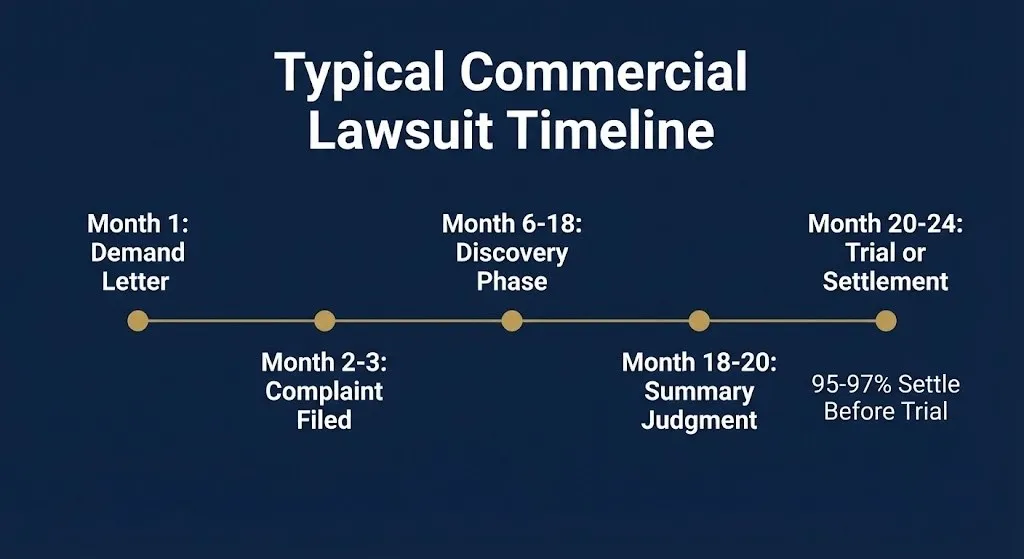
Here is a simplified timeline for a typical commercial case:
- Month 1: Demand letter and pre-suit negotiation
- Month 2 to 3: Complaint filed, served, response due
- Month 4 to 5: Initial disclosures and case management conference
- Month 6 to 18: Discovery, depositions, expert reports
- Month 18 to 20: Summary judgment briefing and ruling
- Month 20 to 24: Final settlement conference, mediation, or trial
- Month 24 and beyond: Appeal if applicable
This timeline assumes no unusual delays. A heavily contested case with multiple parties and electronic discovery issues can stretch to three years or more before trial.
Key Takeaway: A commercial lawsuit is a marathon, not a sprint. Expect 12 to 24 months for a case that settles before trial. Trial and appeals add another year minimum. The cost and duration depend heavily on discovery scope and how hard each side fights.
Can You Find a Commercial Litigation Attorney New York Based or Does Location Matter?
Location matters more than most people realize. If your dispute will be litigated in New York state or federal courts, you want a commercial litigation attorney New York based. A local attorney knows the judges, the Commercial Division rules, and the local procedural quirks that can determine outcomes before the merits are ever reached.
New York has one of the busiest commercial dockets in the country. The New York Supreme Court Commercial Division handles complex business disputes and has its own specialized rules. An attorney who practices there regularly knows that depositions are presumptively limited to seven hours, that interrogatories are limited to 25 including subparts, and that the court expects active judicial management of discovery. An out-of-state lawyer may not.
The same principle applies to any major business hub. Delaware Chancery Court for corporate governance disputes. Northern District of California for tech-sector trade secret cases. Southern District of New York for securities and financial services litigation. If your case is in one of these venues, hire local.
If you are a business based in one state but the contract specifies another state’s law and courts, you need an attorney admitted in that jurisdiction. A clause that says “governed by the laws of Delaware” means you need Delaware counsel or at minimum local co-counsel. Do not let your hometown attorney handle a case in a court where they have never practiced. The learning curve is on your bill.
For large national litigation firms, cross-jurisdictional coverage is less of an issue. They have offices in multiple states and can staff cases accordingly. But small and mid-sized firms are typically limited to their home state and neighboring jurisdictions where their attorneys hold licenses.
What Should You Look for in a Commercial Litigation Solicitor for an International Case?
If your dispute crosses borders, you need someone who understands the procedural differences between legal systems. A commercial litigation solicitor in London operates under the Civil Procedure Rules. A New York commercial litigator operates under the Federal Rules of Civil Procedure or the New York CPLR. These are different worlds.
International commercial litigation adds layers: service of process across borders, enforcement of foreign judgments, forum non conveniens arguments about which country’s courts should hear the case, and choice-of-law analysis. These are not standard contract-dispute skills. They are a sub-specialty.
Key things to confirm when hiring for an international case:
- The attorney or solicitor is licensed in the jurisdiction where the case will be heard.
- The firm has experience with cross-border service under the Hague Convention if applicable.
- They understand how to enforce a judgment from one country’s courts in another country where assets are located.
- They have relationships with local counsel in the relevant foreign jurisdiction, because no single lawyer handles it all alone.
Cost structures differ internationally too. UK solicitors bill differently than U.S. attorneys. Some use hourly rates, some use value-based billing, and conditional fee arrangements (a form of contingency) are more common in the UK than in U.S. commercial litigation. Clarify the fee structure in writing before you sign anything.
How Do You Handle a Business Dispute Without Going to Court?
Most business disputes resolve without a trial. The overwhelming majority, more than 90 percent, settle through negotiation, mediation, or arbitration. Litigation is the lever that makes settlement happen, not necessarily the destination.
Start with direct negotiation. Before you hire a litigator, have a real conversation with the other party. Sometimes disputes arise from misunderstandings that a clear, documented conversation can resolve. If that fails, a demand letter from an attorney signals seriousness without the full expense of filing a complaint.
Mediation is the next step and often the most cost-effective. A neutral third party, usually a retired judge or experienced litigator, sits with both sides and tries to broker a resolution. Mediation is private, faster than litigation, and costs a fraction of trial. Many commercial contracts now require mediation before either party can file a lawsuit. Even when not required, it is worth proposing. A mediation that costs $5,000 to $15,000 in mediator fees and attorney time is a bargain compared to even a modest lawsuit.
Arbitration is a binding alternative to court. It is faster and more private but has downsides. You lose the right to appeal on most grounds. Discovery is often more limited. And the arbitrator’s fees, which can be substantial, are paid by the parties rather than taxpayers. Whether arbitration is better than court depends entirely on your specific case and the arbitration clause language if one exists.
A good litigation law firm will advise you honestly on whether to litigate or pursue these alternatives. A firm that pushes immediately for a lawsuit without discussing settlement options may be more interested in billable hours than in your outcome.
Key Takeaway: Lawsuits are expensive and slow. Direct negotiation, mediation, and arbitration resolve most disputes faster and cheaper. A good commercial litigation lawyer helps you decide which path fits your case, rather than defaulting to litigation.
What Evidence Do You Need for a Commercial Litigation Case?
Evidence wins commercial cases. The side with better documents usually beats the side with the better story. Here is what you need to gather before your first meeting with a business lawsuit lawyer.
Contracts and agreements are the foundation. Every version, every amendment, every signed exhibit. If a contract was negotiated by email, save those emails. Courts look at pre-contract communications to interpret ambiguous terms. The “integration clause” that says the written contract is the whole agreement is strong, but courts still consider course of dealing and trade usage in many jurisdictions.
Financial records come next. Invoices, payment records, general ledgers, bank statements. If your dispute involves money, you need to prove the money. Spreadsheets you create for the lawyer are helpful but not evidence. Source documents are evidence. Bank statements from the bank. Invoices from your accounting system with timestamps. P&L statements that can be authenticated.
Communications records make or break cases. Emails, Slack messages, text messages, WhatsApp threads, voicemail recordings if legally preserved. Never delete anything once a dispute is foreseeable. Spoliation, the destruction of evidence, can result in severe sanctions including an adverse inference that the destroyed evidence would have hurt your case. If you are even thinking about suing or being sued, stop deleting anything.
Here is a pre-meeting document checklist for your attorney:
- All signed contracts, amendments, addenda, and related exhibits.
- Complete email threads with the opposing party, preserved with full headers if possible.
- Invoices and payment records tied to the dispute.
- Corporate formation documents, operating agreements, bylaws, board minutes.
- Any prior demand letters, cease and desist letters, or regulatory notices.
- Calendar or timeline of key events with dates, created while memory is fresh.
- List of all people with knowledge of the dispute and what they know.
Bringing these to your first consultation cuts hours off the evaluation time and saves you money.
How Long Do You Have to File a Commercial Lawsuit?
The statute of limitations sets the deadline, and it varies by claim type and jurisdiction. Miss it by a day and your case is dead forever. This is not a flexible deadline. Courts enforce statutes of limitations strictly.
For breach of a written contract, most states allow four to six years from the date of breach. New York gives six years for written contracts. California gives four. Delaware gives three. For oral contracts, the period is shorter, typically two to three years.
Fraud claims have their own limitations periods, often three to six years from discovery of the fraud rather than from the fraud itself. The “discovery rule” can extend the clock, but you still need to act once you know or should have known something was wrong. Sitting on fraud suspicions for years while you decide what to do is how cases die.
Business torts like tortious interference or trade secret misappropriation typically fall under two to four year statutes, with the clock starting at the time of the harmful act or reasonable discovery.
The safest approach: if you think you have a claim, talk to a commercial litigation attorney immediately. Do not wait until the deadline is close. Investigations take time. Drafting a complaint takes time. The attorney needs lead time to file properly. Walking in the door three weeks before the statute runs is a position you never want to be in.
Key Takeaway: Statutes of limitations are hard deadlines. Written contract claims typically have four to six years. Fraud claims run from discovery. Do not wait, the clock is running.
What Happens Next in a Typical Commercial Litigation Case?
Most cases follow a predictable path from filing to resolution. Here is what the near-term stages look like once you have hired an attorney.
- Within 30 days: Attorney reviews documents, evaluates claims, sends demand letter or prepares complaint.
- Month 1 to 3: Complaint filed and served. Defendant responds with answer or motion to dismiss.
- Month 4 to 6: Rule 26 conference in federal court or its state equivalent, initial disclosures exchanged, case management order entered.
- Month 6 to 18: Discovery phase. Document production, interrogatories, depositions. This is the most expensive stretch.
- Month 12 to 18: Expert witness designations if needed. Damages experts, industry experts, forensic accountants.
- Month 18 to 20: Summary judgment motions filed, argued, and decided.
- Month 20 to 24: Final pretrial conference, mediation if not already attempted, trial date set or settlement finalized.
Settlement can happen at any point on this timeline. Most cases that settle do so after significant discovery, when both sides have seen each other’s evidence and can realistically assess their risks. A case that looked strong on day one can weaken considerably once the emails come out in discovery.
Frequently Asked Questions
Do I need a commercial litigation lawyer for a small claims case?
No. Small claims courts handle disputes under a set dollar amount, typically $5,000 to $10,000 depending on the state.
Attorneys are often not even allowed in small claims court or their role is limited.
For claims above the small claims limit, hire a lawyer.
Can I sue a business partner without a written agreement?
Yes, but it is harder.
Partnerships can exist based on conduct even without a written operating agreement.
Courts look at profit sharing, decision-making roles, and how you held yourselves out to third parties.
Oral partnership claims are fact-intensive and expensive to prove.
How long does a commercial trial take?
Most commercial trials last 3 to 10 trial days depending on complexity.
A simple contract dispute with two witnesses might take 2 to 3 days.
A multi-party fraud case with expert testimony can run 3 to 4 weeks.
Your attorney should give you a realistic estimate before trial begins.
What is the difference between mediation and arbitration?
Mediation is non-binding negotiation with a neutral facilitator who helps the parties reach an agreement.
Arbitration is a binding decision by a private judge, similar to a court trial but less formal.
Mediation lets you walk away if you do not like the outcome.
Arbitration does not.
Do I have to testify in my commercial case?
Probably, if the case does not settle.
The opposing side has the right to depose you and call you as a witness at trial.
Your attorney prepares you for both.
Telling the truth is non-negotiable.
Perjury and misleading statements destroy your credibility and your case.
Can I recover my attorney fees if I win?
It depends on your contract and the applicable law.
Many commercial contracts include attorney fee provisions that allow the prevailing party to recover fees.
Some statutes, like trade secret laws, authorize fee shifting.
Without a contract clause or a statute, each side typically pays its own fees under the American Rule.
What should I do if I get a demand letter?
Do not ignore it.
Do not respond to it yourself without legal advice.
Call a commercial litigation attorney immediately.
What you write back will be used as evidence.
An attorney can respond on your behalf and protect your position.
How do I know if my case is worth pursuing?
Your attorney evaluates three things: liability, damages, and collectability.
You need a strong argument that the other side did something wrong.
You need provable damages, not just a sense of being wronged.
And you need someone on the other side with assets or insurance to pay a judgment.
If any of those three is missing, litigation may not be worth the cost.
The single most important thing you can do right now is gather every document related to the dispute and get a consultation with a qualified commercial litigation lawyer. The consultation is typically free. The information you get will help you decide whether to pursue the case, settle it, or walk away.
Deadlines are running whether you pay attention to them or not. The statute of limitations, the response date on that demand letter, the 30-day clock on that complaint sitting on your desk. Every day you wait is a day the other side is preparing. Make the call.