Discovery in a Lawsuit 2026: How the Process Works, What You Must Produce, and What Happens If You Don’t
Quick Answer
- What it is: Discovery is the formal process where both sides exchange evidence, documents, and witness testimony before trial.
- Key rule: Discovery must be relevant and proportional to the case. Courts reject fishing expeditions that cost more than the case is worth.
- Key deadline: Responses to interrogatories and document requests are typically due within 30 days of service.
If you are involved in a lawsuit, discovery is the phase where the other side gets to look inside your filing cabinets. It is the formal process of exchanging information about witnesses, evidence, and facts before trial. Both sides use it. Both sides must comply.
The rules are strict, and the consequences for ignoring them are severe. Courts can and do dismiss cases entirely when a party refuses to participate. One federal appeals court affirmed the dismissal of a pro se plaintiff’s case after he repeatedly refused to answer interrogatories and comply with court orders, noting he “abused the discovery process and flouted several court orders” .
This article explains what discovery is, the tools each side uses, what the 2025 rule changes mean for you, and what happens if you fail to respond.
The Facts
| What It Is | Pre-trial exchange of information between parties |
|---|---|
| Governing Rules | Federal Rules of Civil Procedure, state equivalents |
| Key Tools | Interrogatories, depositions, document requests, admissions |
| Response Deadline | Typically 30 days after service |
| 2025 Change | Privilege logging procedures must be negotiated early |
| Consequence of Non-Compliance | Sanctions including dismissal or default judgment |
What Is Discovery in a Lawsuit?
Discovery in a lawsuit is the formal process where both sides exchange information about the case before trial. It is designed to prevent “trial by ambush,” where one side surprises the other with evidence at the last minute .
During discovery, you collect facts, get witness statements, find out what the other side plans to say, and see how strong their case is. You also get to see how strong your own case is .
The information gathered during discovery is generally not filed with the court. It is shared between the parties. Courts only get involved when there is a dispute about what must be produced.
Discovery can be expensive. In most civil cases, the costs of discovery make up almost all the costs of litigation. Lawyers spend significant time writing questions, reviewing responses, and arguing about whether the other side responded fully .
What Are the Different Types of Discovery?
The different types of discovery are interrogatories, depositions, requests for production of documents, requests for admission, and subpoenas. Each tool serves a different purpose.
Interrogatories are written questions directed to the other party. The receiving party must answer in writing and under oath. Answers can be used at trial. Parties are generally limited to 25 interrogatories each in federal court .
Depositions are oral, in-person questions that the person being deposed must answer under oath. You can depose a party or a third-party witness like an expert. A court reporter takes down everything said and produces a written transcript. Videotaping is common .
Requests for production of documents ask the other side to produce specific documents or categories of documents relevant to the case. This includes electronically stored information (ESI) .
Requests for admissions ask a party to admit or deny specific facts. They are often used to authenticate documents and narrow the issues in dispute .
Subpoenas are written court orders requiring a third party to testify or produce evidence. They can compel document production from someone not directly involved in the case .
Key Takeaway: Discovery tools work together. Interrogatories identify witnesses, depositions lock in testimony, and document requests uncover the paper trail.
How Does the Scope of Discovery Work?
The scope of discovery is limited to non-privileged matter that is relevant to the case and proportional to its needs. This is the standard under Federal Rule of Civil Procedure 26(b)(1) and many state equivalents .
Relevance alone is not enough. Courts consider six factors when evaluating proportionality:
- The importance of the issues at stake
- The amount in controversy
- The parties’ relative access to relevant information
- The parties’ resources
- The importance of the discovery in resolving the issues
- Whether the burden or expense outweighs its likely benefit
Arkansas updated its civil discovery rules in June 2026 to track this federal standard, removing the old language that allowed discovery of anything “reasonably calculated to lead to the discovery of admissible evidence.” The new rule confines discovery to what is relevant and proportional .
What does this mean in practice? Courts are rejecting open-ended ESI protocols that would require searching every possible data source. One court declined to compel searches that generated over one million hits and more than a terabyte of data, calling the request disproportionate .
Reality Check: Discovery Is Not a Fishing Expedition
Reality Check: You cannot demand every document a company ever created just because you filed a lawsuit. Courts require you to show that what you are asking for is relevant and proportional. A request that costs $500,000 to comply with in a $50,000 case will likely be denied. If you are representing yourself, focus your discovery on the specific facts you need to prove your case.
What Are the 2025 Changes to Privilege Logging Rules?
The December 2025 amendments to Federal Rules 26(f) and 16(b) now require parties to negotiate privilege logging procedures early in the case. A privilege log is the document that lists what materials are being withheld and why .
Previously, privilege log disputes often erupted late in discovery after thousands of documents had been reviewed. The amendments shift this negotiation to the Rule 26(f) conference, which must happen at least 21 days before the scheduling conference .
The practical effect: parties must now discuss the timing and method for privilege claims before they start producing documents. Courts can incorporate these agreements into scheduling orders. This early negotiation aims to reduce last-minute disputes and lower costs .
For litigants in federal court, this means you need to be prepared to discuss privilege logging specifics at the very first discovery meeting. Waiting until later invites court intervention and potential sanctions.
How Do You Respond to Discovery Requests?
You respond to discovery requests in writing within the deadline, typically 30 days. Each request must be answered or objected to separately. You cannot simply ignore requests you do not like .
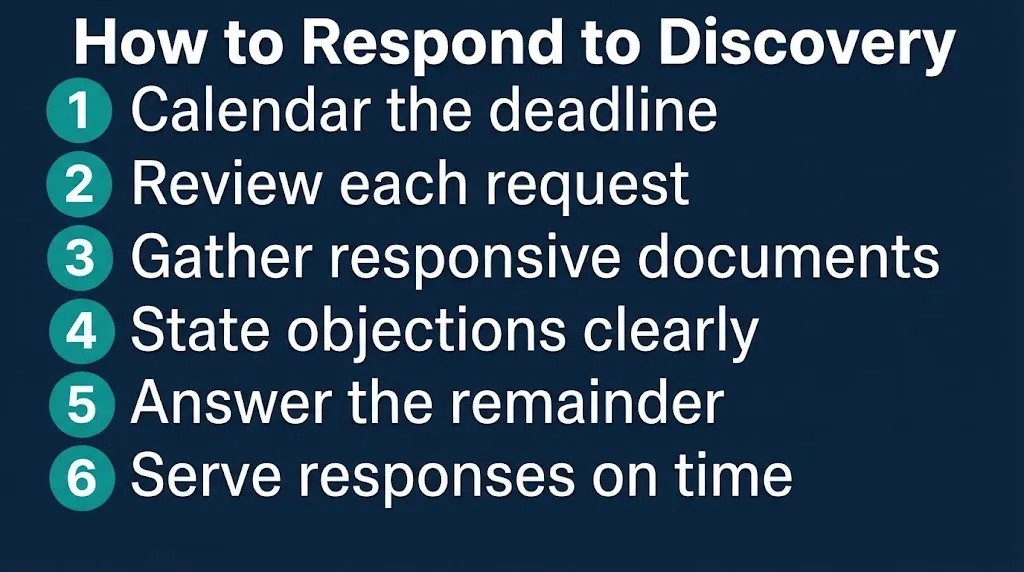
Here are the steps for responding:
- Calendar the deadline. Typically 30 days from service, but check your court’s rules.
- Review each request carefully. Understand what is being asked.
- Gather responsive documents. Search your files, emails, and records.
- State objections clearly. If you object, specify the grounds.
- Answer the rest. If you object to part of a request, answer the remainder.
- Sign the responses. Your signature certifies the responses are complete after reasonable inquiry .
- Serve the responses on the other side. Do not file them with the court unless required.
Missing a deadline can waive your objections. One court rule states that “failure to timely object to interrogatories or requests for the production of documents constitutes a waiver of any objection” .
What Happens If You Fail to Comply With Discovery?
Failing to comply with discovery can result in dismissal of your case, default judgment, or monetary sanctions. Courts take discovery obligations seriously.
Sanctions can include:
- Dismissal of the action for plaintiffs who refuse to produce
- Default judgment for defendants who fail to respond
- Striking pleadings or defenses
- Monetary sanctions including attorney’s fees
- Adverse inference instructions to the jury
One federal appeals court upheld dismissal where a pro se litigant “repeatedly refused to answer defendants’ interrogatories and requests for production, raising numerous objections to all of defendants’ discovery requests.” The court warned him that dismissal was a likely result of continued noncompliance, and he still did not comply .
The message is clear: you cannot stonewall discovery. If you have objections, you must raise them properly and on time. If the court orders you to produce something, you must comply or face escalating sanctions.
What Are the New Rules for AI in Document Review?
Courts are now approving generative AI tools for document review in discovery. In Schulte v. LinkedIn, a federal judge permitted LinkedIn to use Relativity aiR, a generative AI-powered review platform, to make final responsiveness determinations .
The court found that using search strings to pre-cull documents before AI review satisfied reasonableness and proportionality standards. The plaintiffs did not challenge the use of AI itself, and the court denied their motions for additional validation metrics .
This decision extends the line of authority approving technology-assisted review (TAR) that began with Da Silva Moore in 2012. The key takeaway: AI review is acceptable if implemented with quality control measures and human sampling .
For organizations managing large document collections, this opens the door to faster and cheaper review. But it also raises new questions about transparency and validation that courts will continue to address.
What Happens Next in the Discovery Process?
Rule 26(f) Conference: Parties meet and confer about discovery scope, privilege issues, and ESI protocols. This must happen at least 21 days before the scheduling conference .
Initial Disclosures: Parties exchange basic information about witnesses and documents they may use to support their claims or defenses.
Written Discovery: Interrogatories, document requests, and requests for admission are served and responded to.
Depositions: Witnesses are deposed, including parties, experts, and third-party witnesses.
Discovery Motions: If disputes arise, parties file motions to compel or for protective orders. Courts rule on these disputes.
Discovery Cutoff: The deadline for completing fact discovery and expert discovery, set by the scheduling order .
Frequently Asked Questions
What is discovery in a lawsuit?
Discovery is the pre-trial process where both sides exchange information about witnesses, evidence, and facts relevant to the case.
How long do you have to respond to discovery requests?
Typically 30 days from service, but this varies by court and type of request. Check your local rules.
What happens if you ignore discovery requests?
You can face sanctions including dismissal of your case, default judgment, or monetary penalties. Courts take compliance seriously.
Can you object to discovery requests?
Yes, but you must state your objections clearly and on time. Failure to object may waive your right to object later.
What is a privilege log?
A privilege log lists documents or communications that a party is withholding because they are protected by attorney-client privilege or work-product doctrine.
Is electronic discovery different from paper discovery?
Electronically stored information (ESI) is subject to the same discovery rules as paper documents. Courts apply proportionality and accessibility standards under Rule 26(b)(2)(B).
Can AI be used for document review in discovery?
Yes. Courts have approved generative AI review tools when used with quality control measures and human sampling.
What is the scope of discovery?
Discovery is limited to non-privileged matter that is relevant to the case and proportional to its needs, considering factors like cost and burden.
What You Should Do If You Receive Discovery Requests
Read every request carefully. Calendar the deadline immediately. Respond in writing, under oath where required, and on time. If you have objections, state them clearly and specifically. If you do not understand a request, ask for clarification rather than ignoring it.
The single most important fact: courts can dismiss your entire case if you refuse to participate in discovery. The rules apply to everyone, including people representing themselves.