What Is the Purpose of a Fixed Period Settlement Option in 2026?
Quick Answer
- The purpose is to stretch a lump sum into predictable income over a set period, such as 10, 15, or 20 years.
- If you die before the period ends, remaining payments go to your beneficiary, unlike a life income option.
- There is no claim deadline or form. You elect this option through your insurer when the policy matures or pays out.
A fixed period settlement option answers a simple question: do you want one big check, or a steady stream of smaller ones? You pick the number of years. The insurer calculates the payment amount. The money runs out when the period ends, not when you die. This article explains how the option works, how it compares to other choices, and what to watch for in 2026.
Is a Fixed Period Settlement Option the Same as a Lawsuit Settlement?
No. A fixed period settlement option is a life insurance or annuity payout feature, not a legal settlement. It has nothing to do with class actions, court judgments, or claims administrators.
The word “settlement” causes confusion here. In insurance, a settlement option is how the company settles its obligation to pay you. In law, a settlement is an agreement to resolve a dispute.

| Feature | Fixed Period Settlement Option | Lawsuit Settlement |
|---|---|---|
| What it is | Insurance payout method | Resolution of a legal claim |
| Who controls it | You or the policy beneficiary | The court or parties |
| Is there a deadline | No | Often yes |
| Is there a claim form | No | Often yes |
| Tax treatment | Generally tax-advantaged | Varies by case |
You elect a fixed period option through your insurance contract. You do not file anything with a court.
How Much Money Does a Fixed Period Settlement Option Pay?
The payment amount depends on the lump sum, the interest rate the insurer guarantees, and the number of years you choose. The insurer calculates what the proceeds will “buy” over your selected period .
A larger lump sum and a shorter period mean bigger payments. A longer period spreads the same money thinner.
Here is how the math works in practice:
| Lump Sum | Period | Approximate Monthly Payment |
|---|---|---|
| $100,000 | 10 years | $900 to $1,100 |
| $100,000 | 20 years | $550 to $700 |
| $500,000 | 10 years | $4,500 to $5,500 |
| $500,000 | 20 years | $2,750 to $3,500 |
Not yet determined: Exact payment amounts vary by insurer, interest rate guarantees, and whether the payments are fixed dollar or variable . Your contract’s settlement option table shows the guaranteed minimum.
The insurer holds the principal and credits interest on the unpaid balance. Most contracts guarantee a minimum interest rate, often 1% to 3% per year .
Who May Qualify for a Fixed Period Settlement Option?
You may qualify for a fixed period settlement option if you are a life insurance beneficiary or an annuity owner with a contract that offers it. Not every policy includes every option.
Common triggers for electing this option include:
- A life insurance death benefit payout to a beneficiary
- An annuity reaching its maturity date
- A structured settlement or lottery payout election
- A retirement account distribution
The person who elects the option depends on the contract. The policy owner can pre-select a settlement option before death. The beneficiary can also choose at the time of claim if the policy allows .
Key Takeaway: The fixed period option is a tool for beneficiaries who want income rather than a lump sum. It protects against outliving the money and guarantees payments even if you die early.
Reality Check
A fixed period settlement option is not a scam. It is a standard feature in life insurance and annuity contracts, regulated by state insurance departments. But you should know one thing before you elect it: the interest rates insurers use are often conservative. Some financial advisors say beneficiaries are usually better off taking the lump sum and investing it themselves . That is not legal advice, just a pattern worth noting.
How Does a Fixed Period Settlement Option Compare to Other Options?
A fixed period option guarantees payments for a set number of years. Other options work differently. Here is how it stacks up.
| Option | How It Works | Risk to You |
|---|---|---|
| Lump Sum | One payment, you manage it | You could outlive or mismanage it |
| Fixed Period | Payments for X years | Runs out when period ends |
| Fixed Amount | Set payment until money runs out | You don’t know when it ends |
| Life Income | Payments for your lifetime | Smaller payments, no lump sum to heirs |
| Interest Only | Insurer holds principal, pays interest | Principal stays locked up |
The fixed period option sits in the middle. It gives you predictable income for a known duration. If you die during the period, your beneficiary gets the rest .
That last feature is important. A life income option stops paying when you die. A fixed period option keeps paying to someone else.
How Do You Elect a Fixed Period Settlement Option?
You elect the option by submitting a written request to your insurance company. The process is straightforward, but timing matters.
Here are the steps:
- Review your policy or contract. Find the settlement option section and the available periods.
- Contact your insurer. Ask for the current settlement option rates and the election form.
- Choose your period. Common choices are 5, 10, 15, 20, or 30 years.
- Submit the election in writing. Some insurers require this before the maturity date or death claim.
- Confirm the payment schedule. Monthly, quarterly, semiannual, or annual.
- Receive your payments. The insurer sends them on schedule.
If you are a beneficiary, you usually have a window after the insured’s death to make the election. Some policies require pre-selection. Others let the beneficiary decide at claim time .
Are Fixed Period Settlement Option Payments Taxable?
Tax treatment depends on whether the money is from life insurance or an annuity. Life insurance death benefits paid under a settlement option are generally income tax free, but the interest portion may be taxable.
For annuities, the taxable portion is spread over the payment period. Each payment includes a return of principal and a portion of taxable gain .
Not yet confirmed: State tax rules and individual circumstances vary. The IRS treats settlement option interest differently depending on the contract type. Consult a tax professional.
What Happens If You Die During the Fixed Period?
If you die before the fixed period ends, your beneficiary receives the remaining payments. This is the main advantage over a life income option.
The remaining payments can usually be taken in one of three ways:
- Continue the same periodic payments to the beneficiary
- Take the present value of remaining payments as a lump sum
- Apply the remaining value to a new settlement option
Most contracts allow the beneficiary to choose. The lump sum option may be taxable as ordinary income in some cases .
This feature makes the fixed period option useful for policyholders who want to protect a beneficiary who might not manage a large lump sum well.
What Is the Difference Between Fixed Period and Fixed Amount?
Fixed period pays for a set number of years. Fixed amount pays a set dollar amount until the money runs out. The difference is which variable you control.
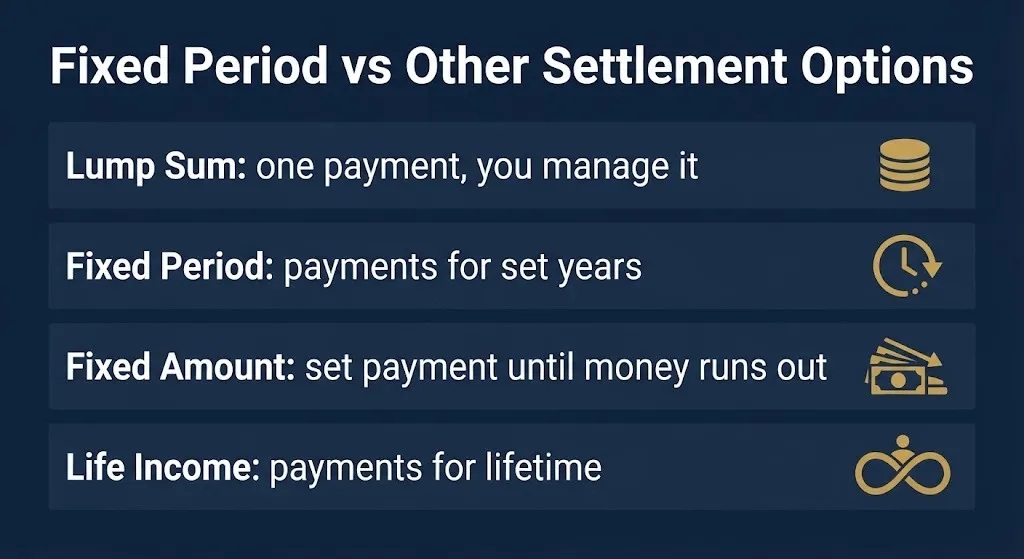
With fixed period, you know exactly when payments stop. With fixed amount, you know exactly how much each payment is, but not when the account hits zero.
| Feature | Fixed Period | Fixed Amount |
|---|---|---|
| You choose | Number of years | Dollar amount per payment |
| Payment amount | Calculated by insurer | You decide |
| Duration | Guaranteed | Depends on interest earned |
| Best for | Known income timeline | Budget certainty |
If you need a specific monthly income to cover bills, fixed amount might fit better. If you want to know the money will last exactly 15 years, fixed period is the answer.
What Happens Next If You Are Considering This Option?
The next step is to request your contract’s settlement option table from your insurer. Here is the timeline:
- Week 1: Locate your policy or annuity contract and find the settlement option section.
- Week 2: Call your insurer and request current rates and the election form.
- Week 2 to 3: Compare the fixed period payment to a lump sum and other options.
- Week 3 to 4: Submit your election in writing if you decide to proceed.
- 30 to 60 days: First payment arrives after processing.
There is no deadline to elect a settlement option in most cases, but some contracts require pre-selection before death. Check your specific policy.
Frequently Asked Questions
What is the purpose of a fixed period settlement option?
The purpose is to convert a lump sum into guaranteed periodic payments over a specific number of years, providing predictable income for a set duration.
How long can a fixed period settlement option last?
Common periods range from 5 to 30 years, but contracts vary. Some limit the period to 360 months or your life expectancy .
What happens to the money if I die during the fixed period?
The remaining payments go to your beneficiary. They can usually continue the payments or take a lump sum for the present value.
Is a fixed period settlement option taxable?
Life insurance death benefits are generally income tax free, but interest earned within the option may be taxable. Annuity payments spread the taxable gain over the period.
Can I change my mind after electing a fixed period option?
Some contracts allow you to withdraw the present value of remaining payments if the election was not irrevocable . Others lock you in. Read your contract.
How is the payment amount calculated?
The insurer uses the lump sum, a guaranteed interest rate, and your chosen period to calculate payments. The settlement option table in your contract shows the guaranteed minimum .
Is fixed period better than a lump sum?
It depends on your needs. Fixed period provides structure and protects against outliving the money. A lump sum gives you control and potentially higher returns if invested well.
Do all life insurance policies offer this option?
No. Settlement options vary by insurer and contract. Check your policy’s settlement option section or ask your insurer.
What You Should Do Now
If you are a beneficiary facing a payout decision, ask your insurer for the settlement option table before you choose anything. The difference between a lump sum and a fixed period payout can be tens of thousands of dollars over time. The key number to remember is the period you select. That is what determines how long the money lasts and how much each payment will be.