Settlement Patterns Definition 2026: How Legal Payout Structures Actually Work
Quick Answer
- Settlement patterns are the standard ways legal settlements are structured, calculated, and distributed to claimants.
- They include flat payments, pro rata distributions, tiered payouts, and points-based formulas depending on the case type.
- Understanding these patterns helps you estimate what you might receive and spot unrealistic promises.
Settlement patterns are the recurring structures that determine who gets paid, how much, and when in a legal settlement. They are not a single case or lawsuit. They are the templates that repeat across thousands of class actions, personal injury cases, and consumer claims every year.
You encounter these patterns whenever you file a claim. The formula that decides your check is a settlement pattern. The tier that puts you in one payment group or another is a settlement pattern.
This article explains the definition, the most common types, and how to read a settlement notice and know what your payment might look like.
The Facts
| Fact | Detail |
|---|---|
| Term | Settlement patterns |
| Definition | Recurring structures for calculating and distributing settlement funds |
| Common Types | Flat, pro rata, tiered, points-based, cy pres |
| Governing Law | Federal Rule of Civil Procedure 23 for class actions |
| Key Entity | Settlement administrator, claims administrator |
| Consumer Relevance | Determines individual payout amounts |
What Is the Simple Definition of Settlement Patterns?
Settlement patterns are the standardized methods used to divide settlement money among eligible claimants.
The definition is straightforward. A settlement pattern is a formula. It takes a pool of money, a group of eligible people, and a set of rules, then determines how much each person gets.
These patterns exist because courts and parties need predictable, defensible ways to distribute funds. A judge must approve the pattern as fair. A settlement administrator must apply it consistently.
Without settlement patterns, every claim would be decided individually, which would make large settlements impossible to administer.
What Are the Most Common Settlement Patterns in 2026?
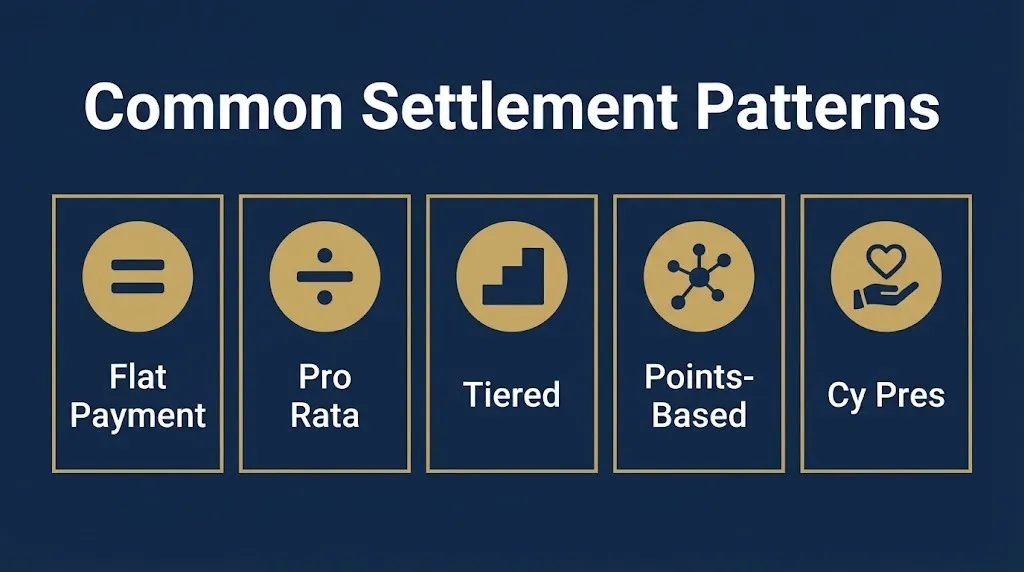
The most common settlement patterns fall into five categories. Each has a distinct formula and a typical use case.
A flat payment pattern gives every eligible claimant the same amount. This works best when harm is uniform and documentation is simple. Small data breach settlements often use flat payments.
A pro rata pattern divides the fund by the number of valid claims. If the fund is $10 million and 100,000 valid claims exist, each gets $100 before deductions. This pattern is common when the number of claimants is unknown at filing time.
A tiered pattern groups claimants by severity or proximity. Higher tiers receive more. Environmental settlements use this often.
A points-based pattern assigns points for specific factors like duration of harm or documented losses. The total points determine the payment. This is common in consumer fraud cases.
A cy pres pattern sends unclaimed or leftover money to a charitable or nonprofit organization instead of claimants. Courts approve cy pres when individual payments would be too small to distribute efficiently.
| Pattern | How It Works | Common Use |
|---|---|---|
| Flat payment | Same amount to everyone | Small data breaches |
| Pro rata | Fund divided by valid claims | Unknown claimant counts |
| Tiered | Groups by severity or proximity | Environmental cases |
| Points-based | Points assigned for factors | Consumer fraud |
| Cy pres | Leftover to charity | Unclaimed funds |
How Do Pro Rata Settlement Patterns Work?
A pro rata pattern divides the available fund among all approved claimants after deductions.
The word pro rata means proportional. If more people file than expected, each person gets less. If fewer people file, each gets more. The total fund stays fixed.
Here is the formula: subtract attorneys’ fees, administrative costs, and any court-approved expenses from the total fund. Divide what remains by the number of approved claims. That number is your pro rata share.
Pro rata is common in class actions where the defendant agrees to a fixed amount and the number of eligible claimants is unknown until the claim deadline passes. Your final check depends on how many other people filed.
How Do Tiered Settlement Patterns Work?
A tiered pattern assigns claimants to payment levels based on defined criteria.
The criteria vary by case. In an environmental settlement, tier one might be residents within one mile of the contamination. Tier two might be residents within five miles. Tier three might be people with documented health conditions linked to the exposure.
Each tier has a different payment range. Higher tiers receive larger amounts. The settlement agreement defines the tier boundaries and the payment range for each.
Tiered patterns are common when harm is uneven. A person who evacuated for weeks experienced more disruption than someone who lived at the edge of the affected area. The tiers reflect that difference.
Key Takeaway: Settlement patterns exist to distribute money fairly when harm is uneven, and the pattern in your case determines your payment more than any headline number.
How Do Points-Based Settlement Patterns Work?
A points-based pattern assigns a numerical value to specific claim characteristics, then converts total points into a dollar amount.
Your payment depends on your point total. More points means more money. The settlement agreement defines what earns points.
Common point categories include:
- Duration of exposure or service
- Geographic proximity to the harm
- Documented financial losses
- Medical diagnoses tied to the incident
- Length of displacement or disruption
A claims administrator reviews your documentation and assigns points according to the formula. The total fund is divided by the total points across all valid claims. That gives a per-point value. Your payment equals your points multiplied by that value.
What Is a Cy Pres Settlement Pattern?
Cy pres is a fallback pattern for leftover settlement money. The term comes from the French phrase “cy pres comme possible,” meaning “as near as possible.”
When individual payments would be too small to justify distribution costs, courts approve sending leftover funds to a charity or nonprofit whose mission aligns with the case. A privacy case might send leftover funds to a digital rights group. An environmental case might send them to a conservation organization.
Cy pres is controversial. Critics argue that leftover money should go to claimants or back to the defendant. Supporters say cy pres preserves the deterrent effect of the settlement when direct distribution is impractical.
You will see cy pres language in many class action settlement notices. It tells you what happens to unclaimed funds.
Why Do Settlement Patterns Matter to You?
The pattern in your case determines whether you get a meaningful check or a token amount.
A flat payment pattern might give you $25. A tiered pattern might give you $2,500 if you qualify for a higher tier. The same settlement fund can produce wildly different individual outcomes depending on the pattern.
Knowing the pattern helps you set expectations. It also helps you decide whether filing a claim is worth your time. A pro rata pattern with a huge potential claimant pool might produce a very small check. A points-based pattern that rewards documentation you already have might produce a larger one.
The pattern is not the only variable. Attorneys’ fees and administrative costs reduce the fund. The number of valid claims affects pro rata amounts. But the pattern is the skeleton everything else hangs on.
How Do You Identify the Settlement Pattern in a Notice?
The settlement notice usually states the pattern, but not always in plain language.
Look for these signals:
- “Each class member will receive” suggests a flat payment
- “Payments will be distributed on a pro rata basis” is explicit
- “Claimants will be assigned to tiers” or “categories” suggests tiered
- “Points will be awarded based on” is explicit for points-based
- “Unclaimed funds will be distributed to” followed by a nonprofit is cy pres
If the notice does not state the pattern, the full settlement agreement does. That document is on the official settlement website. The section titled “Plan of Allocation” or “Distribution Plan” contains the formula.
Reality Check: A settlement notice quoting a large total fund does not mean you will receive a large check. The pattern, the number of claimants, and the deductions determine your amount. Read the allocation section before you get excited.
How Do Attorneys’ Fees Affect Settlement Patterns?
Attorneys’ fees reduce the fund before claimants are paid.
In a typical class action, plaintiffs’ attorneys request a percentage of the settlement, often 25 to 33 percent. The court must approve the fee request. Administrative costs also come out of the fund.
What remains after those deductions is the net settlement fund available to claimants. The pattern applies to that net amount, not the headline total.
A $100 million settlement with 30 percent in fees and $5 million in administrative costs leaves $65 million for claimants. The pattern divides that $65 million.
You cannot opt out of attorneys’ fees. They are part of the settlement structure. You can object to the fee request at the final approval hearing, but objections rarely change the amount by much.
How Do Settlement Patterns Differ Between Case Types?
The pattern often reflects the nature of the harm.
Consumer fraud cases with small individual damages often use flat or pro rata patterns. The goal is to return money broadly, not to match individual losses precisely.
Personal injury and environmental cases often use tiered or points-based patterns. The harm varies widely, and the pattern must reflect that variance.
Data breach cases sometimes use a hybrid. A flat payment for everyone, plus additional compensation for documented identity theft losses. That hybrid pattern addresses both the common inconvenience and the severe outlier cases.
Employment cases often use a formula based on pay period or hours worked. The pattern ties compensation to the amount of time the violation affected you.
What Are Real Examples of Settlement Patterns in Recent Cases?
Recent high-profile settlements show these patterns in action.
The East Palestine train derailment settlement used a proximity-based tiered pattern. Residents closer to the derailment received more than those farther away. The pattern reflected the unequal impact of the evacuation and chemical exposure.
The Equifax data breach settlement used a hybrid. A flat component for basic relief, plus a documented-loss component for identity theft victims. The flat component also had a cap, which created a pro rata effect when claims exceeded expectations.
The Volkswagen emissions settlement used a complex formula tied to vehicle model, age, and mileage. That is a points-based pattern with resale value as a variable.
Each case chose a pattern that matched the harm and the available evidence. None used a one-size-fits-all approach.
Key Takeaway: Real settlements use patterns matched to the harm, and the same pattern can produce very different checks for different claimants.
How Do Settlement Patterns Handle Unclaimed Funds?
Unclaimed funds are a feature of every large settlement. Not everyone files a claim. Some checks go uncashed. The pattern must address the leftover.
The most common options are:
- Pro rata redistribution to claimants who did file
- Cy pres distribution to a nonprofit
- Reversion to the defendant
- Extended claim deadlines to capture more claimants
The settlement agreement specifies which option applies. Courts prefer redistribution or cy pres over reversion because they preserve the settlement’s deterrent and compensatory goals.
You benefit from unclaimed funds only if the settlement includes pro rata redistribution. In that case, a high rate of non-filing increases your payment. If the settlement uses cy pres, unclaimed money goes to charity, not to you.
What Is the Difference Between a Settlement Pattern and a Settlement Agreement?
The settlement agreement is the full contract. The pattern is one part of it.
The agreement covers the total fund, the release of claims, the class definition, the notice plan, the claim process, the attorneys’ fees, and the distribution formula. The pattern is the distribution formula.
When people ask “what does this settlement mean for me,” they are asking about the pattern. But the pattern cannot be understood without the rest of the agreement. The release of claims matters too. Filing a claim usually means giving up your right to sue separately.
Read the whole notice, not just the payout section. The pattern tells you what you might get. The release tells you what you give up.
How Are Settlement Patterns Approved by Courts?
A judge must approve the pattern as part of the settlement approval process.
For class actions, Federal Rule of Civil Procedure 23 requires the court to find that the settlement is fair, reasonable, and adequate. The distribution pattern is part of that analysis.
The judge reviews the plan of allocation. The judge considers whether similarly situated claimants are treated similarly. The judge weighs objections from class members who think the pattern is unfair.
Objections rarely derail a settlement. But they can force changes. A judge might require a higher minimum payment, a clearer tier structure, or a better explanation of how points are calculated.
The final approval hearing is the moment when the pattern becomes binding. After that, the claims administrator applies it mechanically.
What Happens Next in Settlement Pattern Trends?
Settlement patterns evolve as courts and parties respond to criticism and logistics.
Current trend: More hybrid patterns that combine flat payments with documented-loss options.
Current trend: More scrutiny of cy pres distributions, with some courts requiring stronger connections between the recipient and the case.
Expected 2027: More use of digital claim systems that can apply points-based patterns with less manual review.
Watch for: Continued criticism of low per-person payouts in pro rata cases with huge claimant pools.
Key Takeaway: Settlement patterns are not static. They evolve with case law, technology, and judicial attitudes toward fairness.
Frequently Asked Questions
What does settlement pattern mean?
A settlement pattern is the formula used to divide settlement money among eligible claimants.
It can be flat, pro rata, tiered, points-based, or a hybrid.
How do I know what settlement pattern applies to my case?
Read the settlement notice or the plan of allocation in the settlement agreement.
The official settlement website hosts both documents.
What is the most common settlement pattern?
Pro rata distribution is the most common pattern in consumer class actions.
It divides the net fund by the number of valid claims.
Can I get more money if fewer people file claims?
Yes, if the settlement uses a pro rata pattern.
Fewer valid claims means a larger share for each person who filed.
What happens to leftover settlement money?
Leftover money goes to charity through cy pres, back to claimants through redistribution, or back to the defendant.
The settlement agreement specifies the outcome.
Do attorneys’ fees come out of my settlement payment?
Yes, attorneys’ fees and administrative costs are deducted before the pattern is applied.
Your payment comes from the net fund after those deductions.
What is a points-based settlement pattern?
A points-based pattern assigns points for specific factors like duration or documented losses.
Your total points determine your payment amount.
Why do some settlement checks take years to arrive?
Claims review, verification, and the number of appeals affect the timeline.
Personal injury claims with medical review take longer than simple flat payments.
What You Should Remember
Settlement patterns determine your check more than any headline settlement amount. A $100 million fund divided among a million claimants pro rata means $100 each before deductions.
Read the plan of allocation before you decide whether filing is worth your time. Know which pattern applies, what it means for your likely payment, and what you give up by filing.
The pattern is the math underneath the legal language. Understanding it is the difference between realistic expectations and disappointment.