Litigation Associate Jobs in 2026: Salary Reality, Demand Shifts, and How to Actually Get Hired
Quick Answer
- Is the market real? Yes, but it is split: BigLaw pays record base salaries while entry-level litigation demand has contracted.
- How much can you make? Scale firms pay $235,000 to $455,000 base; the national average across all litigation associate postings is $53,900 .
- What deadline matters? There is no application deadline, but the July 2026 pay scale reset the market and lateral windows are tightening.
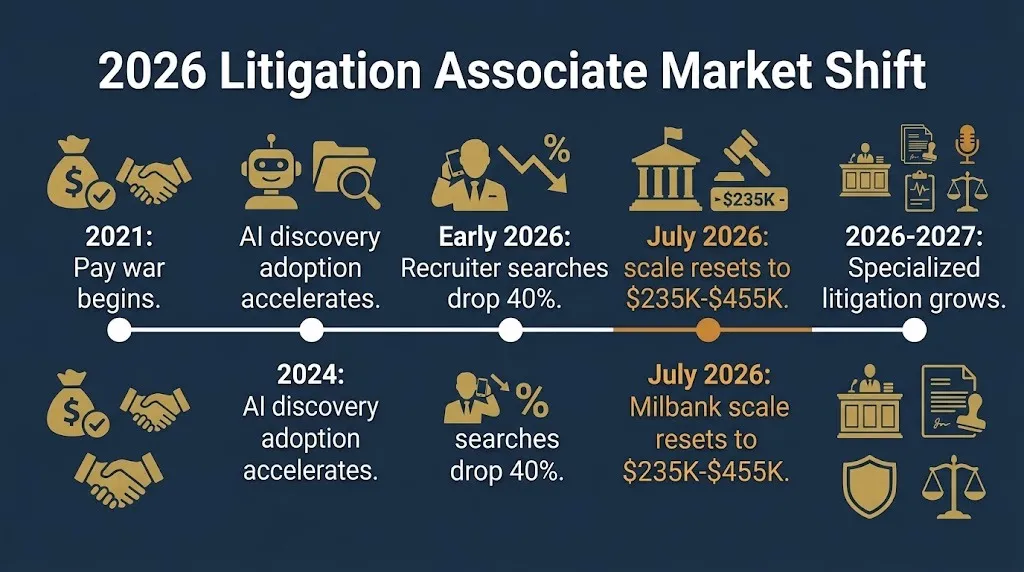
Litigation associate jobs are attorney positions focused on dispute resolution, courtroom advocacy, and case management, and the 2026 market looks nothing like 2021. The headline number is real: Milbank set a new scale on June 2, 2026, effective July 1, pushing first-year base pay to $235,000 and senior associates to $455,000 .
But that number applies to a shrinking slice of the market. Recruiter searches for litigation associates dropped almost 40% between early 2025 and early 2026, according to SignalHire data . AI discovery tools now handle document review that once consumed half of a junior associate’s billable hours.
You are probably here because you are a law student, a clerk, or a junior associate trying to figure out whether litigation is still a viable path in 2026. Or you saw a salary headline and want to know if it is real. This guide breaks down the verified numbers, the demand shift, and the concrete steps that actually lead to an offer.
The Facts
| Item | Status |
|---|---|
| Role Type | Attorney position, dispute resolution and litigation support |
| Top-of-Market Base Salary | $235,000 to $455,000 by class year (July 2026 scale) |
| National Average (All Postings) | $53,900 per year |
| Entry-Level Range (General Market) | $38,857 to $140,000 depending on market |
| Hiring Trend | Recruiter searches down ~40% year over year |
| Growth Subspecialties | Labor and employment, cybersecurity, AI/IP litigation |
| Key Credential | J.D., bar admission in relevant state, strong writing sample |
| Judicial Clerkship | Strong plus, often a direct pipeline |
Is the litigation associate job market real or is it shrinking?
The litigation associate job market is real but contracting at the entry level. Recruiter searches for litigation associates fell almost 40% year over year, according to SignalHire data covering January to April 2025 versus the same period in 2026 .
The decline has a specific cause. AI-powered discovery tools now cut contract review time by 30% to 50%, compressing the document review work that once defined a junior litigation associate’s first two years . Less billable time per matter means fewer associates needed to bill that time.
That does not mean litigation is dying. It means the work is shifting. Firms still need associates who can take depositions, argue motions, and manage client relationships. They need fewer associates to read documents.
The BLS projects steady growth for litigation roles through 2034, and a 2024 industry report showed a 3.3% increase in demand for litigators . More than 70% of firms surveyed planned to increase litigation hiring in the following year.
The gap between the aggregate projection and the recruiter search data tells you something important. Hiring is not collapsing. It is becoming more selective.
Key Takeaway: The litigation associate market is not disappearing. It is splitting into a smaller number of high-skill, high-pay roles and a larger number of generalist roles with stagnant pay.
How much do litigation associates actually make in 2026?
Litigation associate pay in 2026 ranges from $38,857 at the entry-level floor to $455,000 at the top of the BigLaw scale, depending entirely on firm type, location, and class year .
The national average across all litigation associate job postings is $53,900 per year, according to Talent.com data based on 10,000 salaries . That number includes small firms, legal aid, government, and insurance defense. It is the realistic center of gravity for most graduates.
The BigLaw scale is a different planet. Here is the verified 2026 structure:
| Class Year | Base Salary Range (Scale Firms) | Year-End Bonus Range |
|---|---|---|
| First Year | $235,000 | $20,000 |
| Mid-Level (3-6 years) | $260,000 to $365,000 | $30,000 to $80,000 |
| Senior (7-8 years) | $435,000 to $455,000 | $105,000 to $115,000 |
Data from the July 2026 Milbank scale and Cravath bonus memo . Special bonuses of $6,000 to $25,000 can add to these totals.
Regional variation matters. California litigation associate postings average $187,726, according to Indeed data updated July 2026 . New York averages $55,541 on the Talent.com dataset, which skews toward smaller firms .
Reality Check: The $235,000 first-year number applies to a few hundred graduates per year, not the thousands who pass the bar. If a recruiter promises you that scale at a firm you have never heard of, verify the firm’s actual salary scale before you believe it. The national average is $53,900 because most litigation associates do not work at scale firms.
What litigation associate jobs are actually growing in 2026?
Labor and employment litigation is the fastest-growing litigation subspecialty, with recruiter searches up over 700% year over year, according to SignalHire data .
The driver is AI employment regulation. New York City, California, Colorado, Illinois, and Texas have passed or considered laws governing AI in hiring and employment . Every new requirement creates demand for lawyers who understand both employment law and AI governance.
Other growth areas identified in 2026 career guidance:
- Cybersecurity and data privacy litigation: Growing over 40% annually, with average salaries above $185,000
- AI and intellectual property litigation: Demand surging as AI reshapes content creation, average earnings around $175,000
- Environmental and ESG litigation: Greenwashing and sustainability claims, typical salaries near $165,000
- Complex commercial litigation: Contracts, antitrust, cross-border disputes, salaries exceeding $170,000
- Employment and workplace litigation: Growth rates of 20% to 35%, compensation averaging $145,000 to $168,000
IP litigation is also becoming more technically selective. Firms want associates with engineering or science backgrounds for patent cases, not generalists who can learn on the job .
The pattern is clear: general litigation is flat or declining at the entry level. Specialized litigation is where the hiring is happening.
How do you get a litigation associate job in 2026?
Getting a litigation associate job in 2026 requires a J.D., bar admission, a writing sample that demonstrates analytical judgment, and a targeted application strategy. The generic approach of mass-mailing resumes to every firm in a market no longer works.
Here is the verified sequence that leads to offers:
- Get into a litigation-heavy summer program or clinic. Real case exposure beats classroom simulation.
- Build a writing sample that shows analysis, not just research. A de-identified bench memo or draft motion is stronger than a seminar paper .
- Target practice areas, not just firms. A clerk who spent a year on employment discrimination motions is a stronger candidate for an employment litigation group than a generalist .
- Apply during the right window. Lateral hiring moves fast, with a median offer-to-acceptance window of 10 days once cash terms are written .
- Use your clerkship as a bridge. Federal and state clerks should start applying during the last third of their term .
- Prepare for the hours gate. Mid-level associates who miss 2,000 to 2,200 billable hours lose a larger share of year-end compensation than any single base gap .
The hours gate is the number most candidates underestimate. A $365,000 mid-level base is not guaranteed cash. It is the printed number before the gate applies.
What is the litigation associate career path?
The litigation associate career path runs from junior associate through senior associate, counsel, and partner, with lateral moves increasingly common at the mid-level. The timeline varies by firm and market.
Years 0-2 (Junior Associate): Legal research, drafting, discovery management, and observing depositions. Base range $95,000 to $140,000 in the general market, or $235,000 at scale firms .
Years 3-5 (Mid-Level Associate): Taking depositions, managing discovery, early client contact, arguing smaller motions. Earnings up to $190,000 in the general market, or $260,000 to $365,000 at scale firms .
Years 6-8 (Senior Associate): Leading trial preparation, case strategy, mentoring juniors. Exceeding $250,000 in the general market, or $435,000 to $455,000 at scale firms .
Years 8+ (Partner or Counsel): Case management, client development, firm leadership. Frequently above $300,000 in the general market, with equity partners at scale firms earning multiples of that .
Lateral movement is common at the mid-level. Firms pay a premium for associates who bring specific expertise, and the offer-to-acceptance window is short. Counter-offers are common, with one San Diego dataset showing a 38% counter-offer incidence when scale associates resign .
What happens next if you are entering the 2026 litigation market?
The next stages depend on where you are right now. Use this timeline to plan.
Now through December 2026: Lateral hiring for mid-level litigation associates remains active in specialized practice areas. Employment and cybersecurity are the hottest lanes.
Expected Q1 2027: Law school Class of 2027 summer associate recruiting for litigation groups. Scale firms will recruit at the same tier of schools they always have.
Expected mid-2027: Bar exam results for 2027 graduates. Bar admission is the gate for any associate position that involves court appearances.
Expected late 2027: First-year associate start dates at scale firms and mid-size firms. The pay gap between the two will be visible from day one.
Frequently Asked Questions
How much do litigation associates make in 2026?
Litigation associates at scale firms make $235,000 to $455,000 base by class year. The national average across all postings is $53,900.
Is the litigation associate job market shrinking?
Entry-level litigation hiring has contracted, with recruiter searches down nearly 40% year over year. Specialized litigation roles are still growing.
What practice areas are growing for litigation associates?
Labor and employment, cybersecurity, AI and IP litigation, and environmental litigation are the fastest-growing areas in 2026.
Do you need a judicial clerkship to get a litigation associate job?
No, but a clerkship is a strong advantage. Many litigation groups actively recruit former clerks for their courtroom experience.
How long does it take to become a partner in litigation?
The partner track typically runs 8 to 10 years from associate start, depending on firm structure and individual performance.
What is the billable hour requirement for litigation associates?
Most firms require 2,000 to 2,200 billable hours per year. Missing the gate reduces year-end compensation significantly.
Can you get a litigation associate job without BigLaw experience?
Yes. Regional firms, insurance defense firms, and government litigation offices hire associates without scale-firm backgrounds, though pay is lower.
What is the biggest mistake candidates make in litigation hiring?
Applying broadly without a targeted practice-area story. Firms want associates who can articulate why they fit a specific litigation lane, not why they want to be a lawyer.
The one number that should shape your decision
The gap between $235,000 and $53,900 is the entire 2026 litigation associate story. The top of the market is real and it pays more than ever. The middle of the market is flat, selective, and increasingly automated.
If you are aiming for scale-firm litigation, start building a specialized story now. If you are aiming for the general market, know the average before you negotiate.