Real Estate Litigation Attorney 2026: When to Hire, Costs, and What to Expect
Quick Answer
- A real estate litigation attorney handles lawsuits over property contracts, disclosures, boundaries, and ownership.
- Attorney fees range from $250 to $650 per hour, with retainers of $2,500 to $10,000 typical.
- You may need one if you face a lawsuit, a failed deal, or a dispute that negotiation cannot resolve.
A real estate litigation attorney is a lawyer who handles property-related lawsuits in court. That includes contract disputes, seller non-disclosure claims, boundary fights, title problems, landlord-tenant conflicts, and construction defects. These attorneys differ from real estate transactional lawyers, who handle closings and paperwork.
The most important thing to know is timing. Many property disputes get worse because people wait. Once a lawsuit is filed, the procedural clock starts. Deadlines for answers, discovery, and motions are unforgiving.
This article covers when to hire, what it costs, how cases work, and what to expect in 2026. One surprising detail: many real estate lawsuits settle before trial, but only after both sides spend real money on evidence.
The Facts
| Item | Verified Details |
|---|---|
| Practice Area | Real estate litigation |
| Typical Hourly Rate | $250 to $650 per hour |
| Typical Retainer | $2,500 to $10,000 |
| Contingency Fees | Rare, mostly in fraud cases |
| Case Duration | 6 months to 3 years |
| Statute of Limitations | Varies by state and claim type |
| Settlement Rate | High, most settle before trial |
What does a real estate litigation attorney do?
A real estate litigation attorney represents clients in property-related court disputes. They file lawsuits, respond to lawsuits, conduct discovery, negotiate settlements, and try cases when needed.
The work is different from transactional real estate law. A transactional lawyer drafts contracts and closes deals. A litigator fights over what went wrong.

Common tasks include drafting complaints, filing motions, taking depositions, hiring expert witnesses, and appearing in court. The attorney also advises on settlement offers and trial strategy.
If you are sued over a property issue, this is the type of lawyer you need. If you need to sue someone else over a property issue, same answer.
What are the most common real estate lawsuits in 2026?
The most common real estate lawsuits in 2026 involve contract disputes, seller non-disclosure, and boundary or easement conflicts. Each has its own legal rules and typical timeline.
Contract disputes happen when a buyer or seller fails to close or breaches a term. These cases often turn on specific performance or damages. Specific performance asks the court to force the sale.
Non-disclosure cases involve sellers who hid defects. Buyers claim the seller knew about a problem and failed to disclose it. These cases need strong evidence of knowledge and concealment.
Boundary disputes involve fences, survey lines, and encroachments. They are often emotionally charged and can take years to resolve.
| Dispute Type | Typical Issue | Common Outcome |
|---|---|---|
| Contract breach | Failed closing, deposit fights | Damages or specific performance |
| Non-disclosure | Hidden defects, water damage | Damages or rescission |
| Boundary dispute | Survey line conflicts | Injunction or quiet title |
| Title dispute | Liens, ownership claims | Quiet title judgment |
| Landlord-tenant | Eviction, security deposit | Possession or damages |
When should I hire a real estate litigation attorney?
You should hire a real estate litigation attorney as soon as a property dispute turns serious. That means a lawsuit is filed, a demand letter arrives, or negotiation has clearly failed.
Early advice costs less than fixing mistakes. An attorney can review your contract, assess your exposure, and tell you whether a demand letter is worth answering.
If you receive a summons and complaint, the answer deadline is short. In most states, you have 20 to 30 days to respond. Missing that deadline can result in a default judgment against you.
The same urgency applies if you are the one who needs to sue. Statutes of limitations set firm deadlines for filing. Those deadlines vary by state and claim type, but they are not flexible.
Key Takeaway: The right time to hire is at the first sign of a court filing or a formal legal threat, not after the deadline has passed.
How much does a real estate litigation attorney cost?
Real estate litigators charge by the hour in most cases. Typical rates in 2026 range from $250 to $650 per hour, depending on location, experience, and firm size.
Most attorneys require a retainer upfront. That is a deposit against future hourly work. Retainers for real estate litigation typically start at $2,500 and can reach $10,000 or more for complex cases.
The total cost of a case depends on how far it goes. A simple motion to dismiss might cost $5,000. A full trial can cost $50,000 to $200,000 or more.
Contingency fees are rare in real estate litigation. They appear mainly in fraud or consumer protection cases where damages are clear and the defendant has money.
| Fee Structure | How It Works | Common Use |
|---|---|---|
| Hourly | Pay for time worked | Most litigation |
| Retainer plus hourly | Upfront deposit, then hourly | Standard engagement |
| Flat fee | Fixed price for a defined task | Simple motions, demand letters |
| Contingency | Percentage of recovery | Rare, fraud cases |
Can I afford a real estate litigation attorney?
You may be able to afford one if you plan carefully. The key is to match the lawyer to the size of the dispute.
A dispute over a $5,000 deposit does not justify a $50,000 legal fight. But a dispute over a $500,000 property likely does. Your attorney should tell you this honestly.
Some alternatives exist. Limited-scope representation lets you hire an attorney for specific tasks, like drafting a motion or appearing at one hearing, while you handle the rest yourself.
Mediation is cheaper than trial. Many real estate cases settle in mediation before they reach the courtroom. That can cut your total cost significantly.
Ask about payment plans and whether the attorney will cap fees for certain stages. A good lawyer will give you a realistic budget before you commit.
Reality Check: No legitimate attorney will promise a specific outcome. Watch out for anyone who guarantees a win, asks for a huge retainer with no written fee agreement, or refuses to explain their billing. Real estate litigation is uncertain. You are paying for skill, not a result.
How do I find a good real estate litigation attorney?
You find a good real estate litigation attorney through referrals, bar association directories, and court records. Each source has strengths.
Referrals from other lawyers are often the most reliable. A transactional real estate lawyer usually knows good litigators. Family members or business contacts who have been through a property lawsuit can also help.
State bar associations maintain lawyer referral services. These are not endorsements, but they do verify licensing and disciplinary history. Use them to check a lawyer before you call.
Court records are another tool. Look up recent real estate cases in your county and note which lawyers appeared. That tells you who is actually active in the courtroom.
Interview at least two or three attorneys before deciding. Ask about experience with your type of case, trial record, fee structure, and communication style.
What questions should I ask a real estate litigation attorney?
You should ask direct questions about experience, strategy, and cost before signing anything. The answers will tell you whether the lawyer is right for your case.
Here are the essential questions:
- How many real estate trials have you handled in the last five years?
- What percentage of your practice is real estate litigation?
- What is your hourly rate and retainer requirement?
- Who in your office will work on my case?
- What is your honest assessment of my chances?
- What is the likely timeline and total cost?
- Will you consider limited-scope representation or alternative fee arrangements?
A lawyer who avoids these questions or answers vaguely is not the right fit. You want candor, not charm.
What is the real estate litigation process?
The process follows a predictable path from filing to resolution. Understanding it helps you stay prepared.
First, one party files a complaint. The other party must answer within a set deadline, usually 20 to 30 days. Missing that deadline can mean a default judgment.
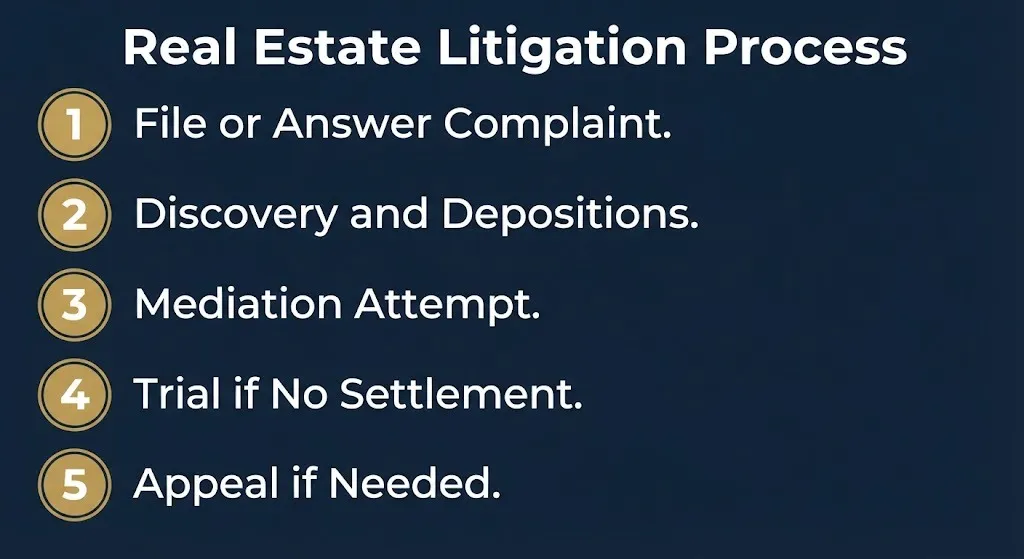
Next comes discovery. Both sides exchange documents, answer written questions, and sit for depositions. This is the most expensive phase.
After discovery, many cases go to mediation. A neutral third party helps both sides reach a settlement. Most real estate lawsuits settle here or through direct negotiation.
If no settlement happens, the case goes to trial. Trials are rare but expensive. A trial can last days or weeks.
| Stage | What Happens | Typical Duration |
|---|---|---|
| Pleading | Complaint and answer filed | 1 to 2 months |
| Discovery | Documents, depositions, experts | 6 to 18 months |
| Mediation | Settlement attempt | 1 to 3 months |
| Trial | Court or jury decides | 1 to 4 weeks |
| Appeal | Higher court review | 6 to 18 months |
Key Takeaway: Most real estate litigation settles before trial, but only after discovery gives both sides a realistic view of the evidence.
What are the odds of winning a real estate lawsuit?
The odds depend entirely on the facts, the contract, and the evidence. No attorney can honestly promise a win.
Contract cases are often easier to predict. If the written agreement is clear and one side breached it, the case is strong. If the contract is vague, both sides have room to argue.
Non-disclosure cases are harder. You must prove the seller knew about the defect and hid it. Knowledge is difficult to prove without documents or witness testimony.
Boundary disputes can go either way. They often depend on old surveys, property descriptions, and local law. Emotion runs high, which makes settlement harder.
The strongest position is a written contract with clear terms and a trail of evidence. The weakest is an oral agreement with no witnesses and no documents.
What is the statute of limitations for real estate lawsuits?
The statute of limitations sets the deadline for filing a lawsuit. It varies by state and by the type of claim.
Contract claims often have a limitations period of three to six years, depending on the state. Fraud and non-disclosure claims may have shorter or longer windows, depending on when the fraud was discovered.
Boundary and title disputes may have different rules. Some quiet title actions have no statute of limitations, while others are governed by adverse possession periods.
The safest approach is to consult an attorney as soon as you suspect a problem. Waiting to file can permanently bar your claim.
No single national deadline applies. The date that matters is the one in your state’s statute for your specific claim.
What is specific performance in real estate litigation?
Specific performance is a court order forcing a party to complete a real estate transaction. It is a unique remedy in property law because real estate is considered unique.
If a seller refuses to close, the buyer can ask the court for specific performance instead of money damages. The court orders the seller to sign the deed and transfer the property.
Specific performance is not automatic. The buyer must show the contract was valid, the buyer was ready and able to close, and money damages would not be enough.
This remedy is common in residential purchase disputes. It is less common in commercial cases where money can more easily make the buyer whole.
What is quiet title in real estate litigation?
Quiet title is a lawsuit to establish who owns a property or holds a valid claim to it. The goal is to clear disputes and remove clouds on the title.
A cloud on title can be an old lien, a disputed easement, a forged deed, or an unknown heir’s claim. Quiet title asks the court to declare the rights of all parties.
This action is common in boundary disputes, inherited property conflicts, and cases involving fraud or forgery. The court’s judgment clarifies who owns what.
Quiet title cases move slowly. They often require title searches, historical records, and sometimes testimony from surveyors or genealogists.
What is a lis pendens in real estate litigation?
A lis pendens is a notice recorded in the public record that a lawsuit affects a specific property. It warns potential buyers and lenders that the property is in dispute.
The name is Latin for “suit pending.” The notice does not resolve anything. It prevents the property from being sold or refinanced while the case is active.
A lis pendens can be powerful leverage. A seller who wants to close a sale may settle quickly to remove the notice. But a lis pendens filed without a valid claim can backfire and expose the filer to damages.
Attorneys use this tool carefully. Courts can remove a lis pendens if the underlying claim is weak.
Key Takeaway: Quiet title and specific performance are special real estate remedies that can force outcomes money alone cannot fix, but they take time and proof.
What happens if I ignore a real estate lawsuit?
If you ignore a real estate lawsuit, you risk a default judgment. That means the court rules against you because you did not respond.
A default judgment can lead to a money award, a lien on your property, or even a forced sale. The consequences depend on the type of case.
You cannot ignore a summons and expect the problem to disappear. Once the deadline passes, your options shrink. Setting aside a default judgment is possible but difficult.
The moment you are served, contact an attorney. Even if you cannot afford full representation, get advice on what to file and when.
How long does real estate litigation take?
Most real estate litigation takes six months to three years, depending on complexity and whether the case settles.
A straightforward contract dispute may settle in six to twelve months. A boundary dispute with multiple parties and old evidence can take two to three years or more.
Trials extend the timeline. Appeals add another six to eighteen months. The more contested the case, the longer it runs.
Your attorney should give you a realistic timeline after reviewing the complaint and the facts. Be wary of anyone who promises a fast result.
What should I do before meeting a real estate litigation attorney?
You should gather every document related to the dispute before your first meeting. The quality of the advice depends on what you bring.
Here is a checklist:
- The contract, deed, lease, or agreement at issue.
- All correspondence with the other party, including emails and texts.
- Any demand letter, complaint, or court notice you received.
- Photos, videos, inspection reports, or survey documents.
- Receipts, invoices, or proof of payments related to the property.
- A written timeline of events, with dates and names.
The more organized you are, the less time the attorney spends sorting through papers. That saves you money and gets you a faster assessment.
Frequently Asked Questions
Do I need a real estate litigation attorney for a boundary dispute?
You likely need one if the dispute involves a fence, a survey conflict, or an encroachment.
These cases can affect property value and are hard to resolve without legal action.
Can a real estate litigation attorney help me avoid trial?
Yes. Most real estate litigators aim to resolve cases through negotiation or mediation first.
Trial is expensive and uncertain. A good attorney will try to settle on favorable terms before trial.
What is the difference between a real estate litigator and a real estate lawyer?
A real estate lawyer may handle closings, contracts, and title work without going to court.
A litigator focuses on lawsuits and court proceedings over property disputes.
How much does it cost to sue over a real estate contract?
Costs vary widely. A simple case may cost $5,000 to $15,000.
A complex case with experts and depositions can cost $50,000 or more.
Can I handle a real estate lawsuit without an attorney?
You can, but it is risky. Courts have strict procedural rules.
A single missed deadline can result in a default judgment or dismissal.
What is the best way to find a local real estate litigation attorney?
Use referrals, bar association directories, and local court records.
Interview at least two attorneys before deciding.
Will my real estate case settle?
Most do. Studies and court data consistently show high settlement rates.
But settlement usually happens after discovery, not before.
What is a contingency fee in real estate litigation?
It is a fee based on a percentage of what you recover.
It is rare in real estate cases, except in some fraud claims.
Real estate litigation is expensive, slow, and uncertain. But ignoring a property lawsuit is worse. The legal system moves on a fixed schedule, and missed deadlines carry real consequences.
Your first step is simple. If you have been sued or are considering a lawsuit over property, consult a qualified real estate litigation attorney this week. Bring your documents, ask the hard questions, and get a straight answer before you spend a dollar.