What Is an ALTA Settlement Statement in 2026: A Complete Guide to Real Estate Closing Forms
Quick Answer
- An ALTA settlement statement is a standard form itemizing all costs in a real estate closing.
- It replaced the HUD-1 form for most mortgage transactions after 2015.
- No claim or payout exists; this is a closing document, not a settlement fund.
You searched for an ALTA settlement statement, and you may have expected a lawsuit payout. What you actually found is a real estate document, one that decides how much money changes hands when property is bought, sold, or refinanced.
The ALTA settlement statement is the balance sheet of a property closing. It shows every charge, every credit, every fee, and the exact amount the buyer must bring and the seller will receive.
This article explains what the form is, who uses it, what each page means, and the five mistakes that cost buyers and sellers real money in 2026.
| The Facts | |
|---|---|
| Form | ALTA Settlement Statement |
| Issuing Body | American Land Title Association |
| Current Version | 2021 ALTA forms |
| Replaces | HUD-1 Settlement Statement |
| Applies To | Most mortgage closings and cash deals |
| Legal Force | Contract disclosure; not a payout vehicle |
| Proof Needed | Loan Estimate, Closing Disclosure, receipts |
Is the ALTA Settlement Statement Real?
Yes, the ALTA settlement statement is real. It is the standard closing form used by title companies, escrow agents, and attorneys in residential and commercial real estate transactions.
The American Land Title Association, known as ALTA, develops and maintains the form. Lenders, title insurers, and settlement agents have used some version of it for decades.
It is not a government form. The Consumer Financial Protection Bureau created the Closing Disclosure, which is a separate document, but the ALTA form often appears alongside it in many closings.
The confusion is understandable. The word “settlement” here means a property closing, not a lawsuit settlement or class action payout.
What Is an ALTA Settlement Statement?
An ALTA settlement statement is a line-item record of every financial detail in a real estate transaction. It shows who owes what and who gets paid at closing.
The form breaks the transaction into debits and credits. A debit is money you owe. A credit is money you receive or that reduces what you owe.
For a buyer, the statement shows the purchase price, loan amount, earnest money deposit, lender fees, title charges, prepaid taxes, insurance, and the final cash required at closing.
For a seller, it shows the sale price, mortgage payoff, real estate commissions, transfer taxes, prorated property taxes, and the net proceeds.
How Does the ALTA Settlement Statement Differ From the HUD-1?
The ALTA form replaced the HUD-1 settlement statement as the industry standard, even though the HUD-1 never fully disappeared.
The HUD-1 was the federal form required for most mortgage loans under the Real Estate Settlement Procedures Act. In 2015, the CFPB replaced the HUD-1 and the Good Faith Estimate with the Loan Estimate and Closing Disclosure.
The ALTA form is not required by federal law. But title companies and settlement agents use it because it matches the Closing Disclosure while providing a clearer, more detailed breakdown for buyers and sellers.
| Feature | HUD-1 | ALTA Settlement Statement |
|---|---|---|
| Federal requirement | Yes, pre-2015 | No |
| Used in 2026 | Reverse mortgages only | Most closings |
| Detail level | High | Higher |
| Created by | HUD | American Land Title Association |
You may still see a HUD-1 in a reverse mortgage or certain assumptions. For almost everything else, the ALTA form is what sits in front of you at the closing table.
Key Takeaway: The ALTA settlement statement is an industry form, not a federal requirement, but it is now the dominant closing document in 2026.
What Is the Difference Between an ALTA Statement and a Closing Disclosure?
The Closing Disclosure is the federal form the CFPB requires for most mortgages. The ALTA statement is a voluntary industry form that often accompanies it.
The Closing Disclosure has five pages and is designed for consumers to compare against their Loan Estimate. It focuses on loan terms, projected payments, and closing costs.
The ALTA statement covers the entire transaction, including seller-side costs that the Closing Disclosure does not show. Buyers may receive both documents at closing.
Think of it like a store return without a receipt. The Closing Disclosure is the store’s official record. The ALTA form is the register tape showing every item that made up the total. You want both.
Who Prepares the ALTA Settlement Statement?
A settlement agent, escrow officer, title company, or closing attorney prepares the ALTA settlement statement.
The party depends on state law and local custom. In some states, an attorney must handle closing. In others, a title company or escrow agent does the work.
Whoever prepares the form bears responsibility for accuracy. Errors in payoffs, tax prorations, or fee allocations can cost either party hundreds or thousands of dollars.
You have the right to receive a copy before closing. Ask for it at least one business day in advance, the same window that applies to the Closing Disclosure under federal rules.
What Does Each Page of the ALTA Settlement Statement Show?
The ALTA settlement statement typically has four or five pages, depending on the transaction type.
Each page serves a distinct function, and skipping one can hide errors.
| Page | What It Shows |
|---|---|
| Page 1 | Transaction summary, property address, parties, settlement date |
| Page 2 | Buyer’s debits and credits |
| Page 3 | Seller’s debits and credits |
| Page 4 | Loan detail, disbursement breakdown, prorations |
| Page 5 | Receipts, additional disclosures, signatures |
The buyer page lists every dollar the buyer pays and every dollar credited back. The seller page does the same from the seller’s side.
Prorations appear on the later pages. These split property taxes, HOA dues, and sometimes rent between buyer and seller based on the closing date.
How Much Does an ALTA Settlement Statement Cost?
The cost of an ALTA settlement statement is included in your settlement or closing fee. It is not a separate line item on most final statements.
Settlement fees vary by state, property type, and transaction complexity. A typical residential closing fee ranges from $500 to $1,500, though this number varies widely and is not set by ALTA.
| Fee Type | Typical Range |
|---|---|
| Settlement or escrow fee | $500 to $1,500 |
| Title search | $100 to $400 |
| Title insurance | Varies by policy and value |
| Wire transfer fee | $20 to $75 |
Nothing in the ALTA form itself generates a separate consumer charge. The form documents charges that already exist in the transaction.
Key Takeaway: The ALTA statement does not add a new fee; it itemizes fees you already owe under your purchase contract and loan terms.
How Do You Read an ALTA Settlement Statement?
Reading an ALTA settlement statement means checking three things: the final cash number, the fee breakdown, and the prorations.
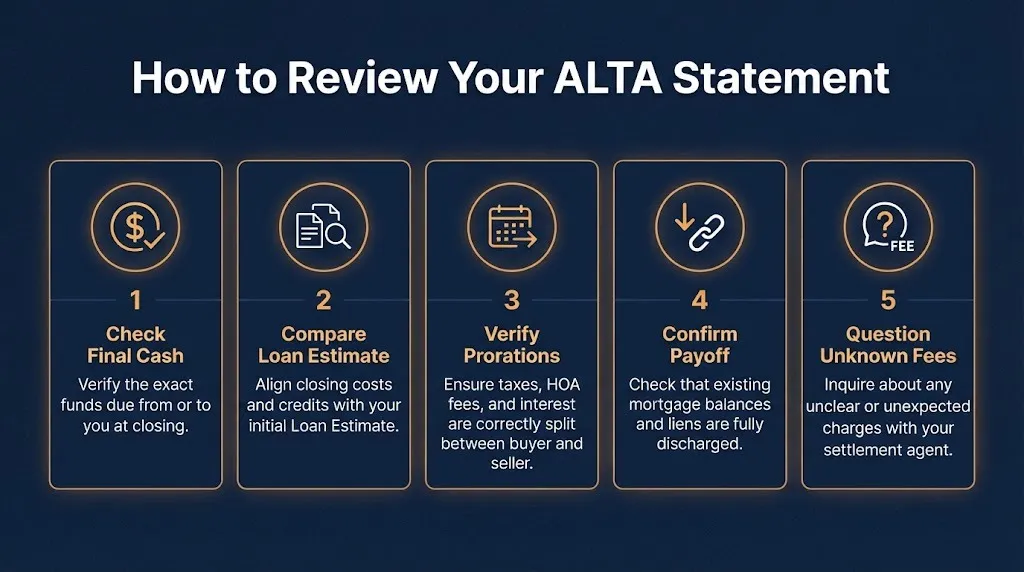
Start with the bottom line. The buyer’s final cash required and the seller’s net proceeds are the numbers that matter most.
Then scan the fees. Compare them to your Loan Estimate if you have a mortgage. Fees can increase, but some categories have legal tolerance limits under the CFPB rules.
Finally, verify prorations. Property taxes are the most common proration error source. If the seller prepaid taxes for the year, the buyer owes the seller a credit for the unused portion.
| Step | What to Check |
|---|---|
| 1 | Final cash due from buyer or net to seller |
| 2 | Fee amounts against Loan Estimate |
| 3 | Tax and HOA prorations |
| 4 | Loan payoff amount for seller |
| 5 | Earnest money credit for buyer |
Reality Check: No one should rush you through the ALTA statement at the closing table. If a fee is unexplained, stop and ask. You are not obligated to sign until you understand the numbers.
What Is the ALTA Settlement Statement for a Buyer?
The buyer’s ALTA settlement statement shows every dollar you pay to purchase the property and every dollar credited toward that obligation.
Your purchase price appears as a debit. Your loan amount, earnest money deposit, and any seller concessions appear as credits.
The difference is your final cash to close. That is the amount you wire or bring as a cashier’s check.
Buyer line items to verify include:
- Purchase price matches the contract
- Loan amount matches the Closing Disclosure
- Earnest money credit equals what you deposited
- Seller concessions appear as a credit
- Prepaid interest and escrow amounts match lender figures
What Is the ALTA Settlement Statement for a Seller?
The seller’s ALTA settlement statement shows the sale price as a credit and every cost of selling as a debit.
The largest debits are usually the mortgage payoff, real estate commission, and transfer taxes. The net proceeds line at the bottom is what you actually walk away with.
Sellers should verify:
- Sale price matches the contract
- Mortgage payoff matches the lender’s current payoff letter
- Commission rate matches the listing agreement
- Prorated taxes credit or debit is correct
- Any credits to the buyer are documented and intended
What Are the Most Common ALTA Settlement Statement Errors?
Common errors include incorrect prorations, missing earnest money credits, outdated payoff amounts, and fee duplication.
Proration errors happen most often with property taxes when the tax bill year does not line up cleanly with the closing date. A few hundred dollars can shift between parties.
Payoff amounts change daily because interest accrues. If the settlement agent used a payoff figure from a week ago, the seller could underpay the lender and face a surprise bill later.
| Error | Impact |
|---|---|
| Tax proration miscalculation | Buyer or seller loses hundreds |
| Missing earnest money credit | Buyer pays twice |
| Stale loan payoff | Seller owes lender more later |
| Duplicate title fee | Buyer overpays |
Ask for the ALTA draft at least one day before closing. Read every line. Question anything you do not recognize.
How Does the ALTA Settlement Statement Work in a Cash Purchase?
A cash purchase still uses an ALTA settlement statement, but the loan sections are simplified or removed.
The buyer’s page shows the full purchase price as a debit with no lender credit. The final cash required is simply the price plus closing costs minus the earnest money already paid.
Sellers see a cleaner statement too. No lender payoff if the seller owned free and clear, and no loan-related fees.
| Cash Purchase Line | What Changes |
|---|---|
| Loan amount | Zero or omitted |
| Lender fees | Removed |
| Prepaid interest | Removed |
| Buyer cash due | Higher, but simpler |
Cash buyers sometimes skip the full review because no lender is involved. That is a mistake. Title fees, tax prorations, and escrow charges still need checking.
Key Takeaway: The ALTA statement protects cash buyers and sellers too, because it forces every fee and proration into the open before money moves.
How Do Refinances Use the ALTA Settlement Statement?
Refinances use a shorter ALTA form focused on the borrower’s new loan and payoff of the old loan.
You still receive a Closing Disclosure for the loan. The ALTA statement supplements it with the payoff amount, escrow rollover or refund, and total cash due at closing.
For refinances, there is no seller page. The borrower’s side absorbs everything.
Verify the old loan payoff amount against your current lender’s payoff statement. Check that your existing escrow balance is credited properly. A refund of your old escrow account should appear as a credit.
What Does the ALTA Settlement Statement Include for Commercial Deals?
Commercial ALTA statements follow the same debit and credit structure but include more line items for pro rata items, CAM charges, and lender requirements.
Commercial closings may involve multiple lenders, tenant security deposits, and purchase price allocations. The ALTA form expands to handle these complications.
No standard commercial payout exists. Each deal is negotiated, and the statement reflects that deal exactly.
What Happens Next With ALTA Forms
The ALTA forms evolve slowly. The 2021 update remains current, and no new version is confirmed for 2026.
- Current through 2026: 2021 ALTA settlement statement forms
- Expected: No mandatory replacement announced
- Watch for: CFPB rulemaking on closing cost transparency
- Industry trend: More states pushing e-closing and remote online notarization
These are not dates with legal force. They describe an industry that changes by evolution, not by court order.
Frequently Asked Questions
Is an ALTA settlement statement the same as a lawsuit settlement?
No.
An ALTA settlement statement is a real estate closing form, not a legal settlement or payout.
Who gets an ALTA settlement statement?
Buyers, sellers, and refinancing borrowers get one at closing.
Your settlement agent prepares it and provides a copy to all parties.
Do I need to keep my ALTA settlement statement?
Keep it.
It proves your closing costs for tax purposes and future sale cost basis.
Is the ALTA form required by law?
No federal law requires it.
The Closing Disclosure is the required federal form for most mortgages.
Can I negotiate fees shown on the ALTA statement?
Some fees are negotiable.
Title and settlement fees vary by provider; lender fees may be less flexible.
What if I find an error on my ALTA statement?
Report it to the settlement agent immediately.
Errors corrected before recording are easier to fix than disputes later.
The Bottom Line
The ALTA settlement statement is the clearest picture you will get of where your money goes in a real estate closing. It is not a government form, not a lawsuit, and not a payout.
Ask for it early. Read every line. Question anything that does not match your contract, your Loan Estimate, or your payoff statement. The five minutes you spend checking now can save you hundreds or thousands in a misplaced proration.