Litigation Funding Companies in 2026: Who Backs Big Cases, What They Charge, and the New Transparency Push
Quick Answer
- Litigation funding companies advance cash to plaintiffs or law firms in exchange for a share of any recovery.
- Major funders like Burford Capital and Omni Bridgeway manage portfolios worth hundreds of millions to billions.
- The Litigation Funding Transparency Act of 2026 would require disclosure of funders in federal class actions and MDLs.
If you have a strong lawsuit but no money to fight it, litigation funding companies are the businesses that bridge that gap. They pay your legal bills or give you cash up front. If you win, they take a cut. If you lose, they often get nothing.
That model has turned into a multi-billion dollar global industry. UK-listed Burford Capital and Australia-listed Bentham IMF are expanding aggressively in North America, hiring Big Law veterans and opening new offices . A Swiss funder called Nivalion became the first litigation funder in continental Europe licensed as an asset manager by financial regulators .
But the industry is also facing its biggest regulatory test yet. Senator Chuck Grassley introduced the Litigation Funding Transparency Act of 2026 on February 11, 2026. It would require parties in class actions, MDLs, and other coordinated proceedings to disclose who is funding their case .
This article explains who the major litigation finance companies are, how their deals work, what they cost, and what the new transparency bill would change.
The Facts
| Item | Details |
|---|---|
| Industry Size | Over 300 known funders globally, at least 40 in Germany alone |
| Major U.S. Funders | Burford Capital, Omni Bridgeway, GLS Capital, Longford Capital, Parabellum Capital |
| Typical Investment Range | $1 million to $50 million per case for commercial funders |
| New U.S. Bill | Litigation Funding Transparency Act of 2026 (S. 3826), introduced Feb. 11, 2026 |
| Disclosure Trigger | Class actions, MDLs, and coordinated proceedings with 100+ cases |
| EU Regulatory Status | Commission found no demonstrated need for EU-wide TPLF legislation as of June 2026 |
What Are Litigation Funding Companies?
Litigation funding companies are businesses that provide capital to plaintiffs or law firms involved in legal disputes, in exchange for a portion of any settlement or judgment . They are also called litigation finance companies or third-party funders.
The model sounds simple, but the details matter. There are several types of funding:
- Single-case funding. The funder pays costs for one lawsuit and gets a share of the recovery if it wins.
- Portfolio funding. The funder backs a bundle of cases, spreading risk across multiple matters.
- Law firm financing. The funder lends money to a law firm, often secured by receivables.
- Defense funding. Less common, but some funders help defendants cover legal costs.
Commercial funders like GLS Capital invest between $1 million and $50 million per investment . Orchard Global, which manages over $8.1 billion in total assets, typically invests £1 million to £10 million for single cases and around £30 million for portfolios .
The key feature is nonrecourse. If the case loses, the funder typically recovers nothing. That is different from a loan, where you owe the money regardless of outcome.
Who Are the Biggest Litigation Finance Companies?
The biggest litigation finance companies include Burford Capital, Omni Bridgeway, Bench Walk Advisors, Nivalion, GLS Capital, Orchard Global, and Longford Capital, according to Chambers and Partners 2026 rankings and Lawdragon’s 2026 list of global leaders .
Here is a quick snapshot of some major players:
| Funder | Headquarters | Capital / Scale | Specialty |
|---|---|---|---|
| Burford Capital | UK / Global | Publicly listed (LSE) | Commercial litigation, arbitration, IP |
| Omni Bridgeway | Global | Global funder, Band 1 ranked | International arbitration, collective redress |
| Bench Walk Advisors | Global | Over $1 billion committed, 250+ investments | Commercial cases, portfolios |
| GLS Capital | Chicago, IL | $550 million+ under management | Complex commercial, patent, life sciences |
| Orchard Global | Global | $8.1 billion total AUM | Group actions, competition claims, insolvency |
| Nivalion AG | Switzerland | FINMA-licensed asset manager | Arbitration, class actions, portfolio financing |
Burford Capital has been expanding into intellectual property matters, hiring litigator Justin Daniels to lead the effort. The company also closed a $45 million deal to finance a portfolio of pending litigation for a UK-based company, reportedly BT Group .
Bentham IMF opened an office in Toronto, the first major commercial funder to do so, after a Canadian judge allowed a UK funder to finance litigation against Valeant Pharmaceuticals .
How Do Litigation Funding Companies Make Money?
Litigation funding companies make money by taking a share of the recovery when a funded case settles or wins at trial, and by charging fees that accrue over time if the case takes longer than expected.
The exact structure varies by deal, but common terms include:
- Multiplier on invested capital. The funder gets back its investment multiplied by a set factor, often 2x to 4x.
- Percentage of recovery. The funder takes a percentage of the settlement or judgment, sometimes 20% to 40% after attorney fees.
- Interest-style accrual. Some deals accrue a return that grows with time, similar to compounding interest.
The Litigation Funding Transparency Act of 2026 includes a definition of “commercial enterprise” that excludes entities whose return is limited to loan principal plus interest not exceeding the greater of 10% or three times the 30-year Treasury yield . That threshold matters because it distinguishes ordinary lending from litigation funding.
For plaintiffs, the practical question is simple: how much of your recovery goes to the funder? In a typical commercial case, the funder’s share can be substantial. But if the alternative is not pursuing the case at all, the funder’s capital may be the only way to get to a resolution.
Key Takeaway: Litigation funders make money only when you win, but their share can be significant, and the terms are often opaque until the case resolves.
What Is the Litigation Funding Transparency Act of 2026?
The Litigation Funding Transparency Act of 2026 is a U.S. Senate bill that would require parties in class actions, MDLs, and large coordinated proceedings to disclose the identity of third-party funders and the terms of their agreements .
Senator Grassley introduced the bill on February 11, 2026, with Senators Tillis, Kennedy, and Cornyn as cosponsors . It was referred to the Senate Judiciary Committee.
The bill defines a “covered civil action” as:
- Any civil action transferred to or filed in an MDL under 28 U.S.C. § 1407
- Any class action
- Any coordinated proceeding with 100 or more civil actions
If passed, the bill would require parties or their counsel to file a disclosure statement identifying any third-party funder that has a right to receive proceeds from the case. The definition of “third-party funder” includes commercial enterprises, foreign states, foreign persons, and sovereign wealth funds .
There is an exception for nonprofit legal organizations funded by donors that provide pro bono representation, as long as the donations do not come from foreign states or sovereign wealth funds .
The bill has not passed. It is pending in committee as of October 2026.
Does Litigation Funding Face New Regulations in 2026?
Litigation funding faces active regulatory scrutiny in the U.S., while the European Commission has declined to propose EU-wide rules for now. The regulatory picture is uneven across jurisdictions.
In the U.S., the Senate bill is the main federal push. At the state level, courts and bar associations have issued varying opinions on disclosure requirements . The debate often centers on whether funders should be treated like any other investor or whether they need special oversight.
In the EU, the Commission published a mapping study in 2025 that found no irregularities requiring legislative action on third-party litigation funding . A High-Level Forum on Justice for Growth broadly agreed there was “no demonstrated need for legislative action” at the EU level. The Commission said it would continue monitoring the field .
The European Parliament has pushed for more. A parliamentary question in May 2026 raised concerns about foreign capital in litigation funding and asked whether the Commission would consider disclosure requirements . The Commission’s answer in June 2026 maintained its position that no new legislation was needed at that time .
Certum Group, a litigation finance broker, published an article in August 2026 quoting William Marra arguing that “there’s just no evidence [of foreign influence] in the third-party funding space” and that any disclosure rule should apply to all forms of outside financing, not just litigation funding .
Reality Check: Litigation funding is not a loan, and you do not owe money if you lose. But the industry is not fully transparent either. The new Senate bill exists because disclosure is inconsistent, and you should read every funding agreement carefully before signing.
Who Uses Litigation Funding Companies?
Litigation funding companies are used by businesses, law firms, and individuals who have strong legal claims but lack the capital to pursue them, or who want to offload the financial risk of litigation.
The typical users include:
- Small and mid-size businesses pursuing breach of contract, trade secret, or competition claims against larger opponents.
- Patent holders who need capital to enforce intellectual property rights against infringers.
- Law firms that want to take on contingency cases without carrying all the cost risk on their own balance sheet.
- Insolvency practitioners pursuing clawback claims or asset recovery.
- Investors in international arbitration, including investor-state disputes.
Omni Bridgeway funded investment treaty arbitrations against Switzerland worth approximately $500 million on behalf of Asia-based Credit Suisse AT-1 bondholders . Bench Walk has committed over $1 billion across more than 250 investments in the UK, Australia, the U.S., and continental Europe .
You are less likely to see commercial litigation funding in a routine car accident case. It is most common in high-value business disputes where the legal costs run into the millions.
How Do You Choose a Litigation Funding Company?
Choosing a litigation funding company means comparing not just the cost, but the funder’s experience, speed of decision-making, and willingness to stay involved through trial if needed. Speed and certainty often matter as much as price.
Here are the factors to weigh:
- Track record in your type of case. A funder with patent experience may not be the best fit for an arbitration claim.
- Speed of decision. Some funders pride themselves on fast commitments. Bench Walk is known for “fast decisions and operating flexibly” .
- Capital size and staying power. A funder with $550 million under management like GLS Capital can stay in a case through appeals .
- Nonrecourse terms. Confirm in writing that you owe nothing if the case loses.
- Transparency. Ask how the funder’s return is calculated and what happens if the case settles early.
- Regulatory status. Some funders, like Nivalion, are regulated as asset managers. That can signal stronger governance .
- References. Ask your attorney if they have worked with the funder before and what the experience was like.
Lawdragon’s 2026 list of global leaders in litigation finance is a useful starting point. It names hundreds of professionals across funders like Burford, Omni Bridgeway, GLS, Longford, Parabellum, Harbour, and Woodsford .
What Happens Next for Litigation Funding in 2026 and Beyond?
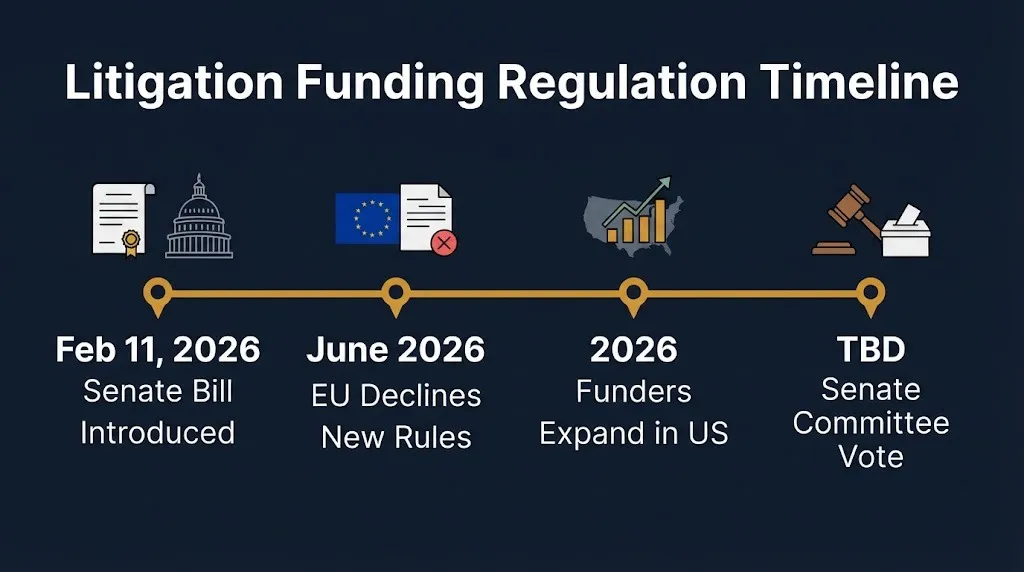
February 11, 2026: The Litigation Funding Transparency Act of 2026 was introduced in the Senate and referred to the Judiciary Committee .
Expected late 2026: The Senate Judiciary Committee may hold hearings or mark up the bill. No vote has been scheduled as of October 2026.
Ongoing 2026: Funders continue expanding in North America. Burford entered IP funding, and Bentham opened a Toronto office .
June 2026: The European Commission reaffirmed its position that no EU-wide TPLF legislation is needed at this time .
Watch for: Any movement on the Senate bill, and state-level disclosure rules that could create a patchwork of requirements across the U.S.
Frequently Asked Questions
What is a litigation funding company?
A litigation funding company provides capital to plaintiffs or law firms in exchange for a share of any recovery. If the case loses, the funder typically gets nothing.
Are litigation funding companies legal in the U.S.?
Yes, litigation funding is legal in the U.S., but disclosure requirements vary by jurisdiction. A Senate bill introduced in 2026 would create federal disclosure rules for class actions and MDLs.
How much do litigation funding companies charge?
Terms vary widely. Commercial funders typically seek a multiple of invested capital or a percentage of recovery. Some deals include interest-style accrual. There is no standard rate.
What is the Litigation Funding Transparency Act of 2026?
It is a Senate bill that would require parties in class actions, MDLs, and coordinated proceedings with 100+ cases to disclose their third-party funders .
Do I have to pay back litigation funding if I lose?
No, in most nonrecourse funding agreements. If the case loses, the funder recovers nothing. But you should confirm this in writing.
Who are the largest litigation funders?
Burford Capital, Omni Bridgeway, Bench Walk Advisors, Nivalion, GLS Capital, Orchard Global, and Longford Capital are among the largest and most active funders in 2026 .
Can foreign entities fund U.S. lawsuits?
Yes, foreign entities can fund U.S. litigation. The Senate bill would require disclosure of foreign funders in covered cases, but it has not passed .
How long does it take to get litigation funding?
It depends on the funder and the complexity of the case. Some funders pride themselves on fast decisions, but commercial funding deals can take weeks or months to negotiate.
If you are considering litigation funding, the most important step is to read the agreement carefully and understand exactly what the funder gets if you win. The Senate transparency bill, if passed, would make that information more public in class actions and MDLs. Until then, ask for the terms in writing and compare at least two funders before signing.