Slander Lawsuit: What You Need to Prove, What It Costs, and Whether It’s Worth Filing in 2026
Quick Answer
- A slander lawsuit covers spoken defamation; a libel lawsuit covers written or published defamation.
- Most defamation cases settle for modest amounts, and many are dismissed before trial.
- Statutes of limitations for defamation are short, often one year from the statement.
If someone said something false about you, and it cost you a job, a business deal, or your reputation, you have probably asked whether you can sue. The answer is yes, but the gap between being wronged and winning a slander lawsuit is wider than most people expect.
Slander is spoken defamation. Libel is written or published defamation. Both are civil claims that require you to prove specific elements, and both face legal hurdles that do not exist in a car accident or breach of contract case.
What surprises most people is not whether the statement was false. It is how hard the law makes it to collect money for a lie. This article walks through what a slander lawsuit actually requires in 2026, what it costs, and how to decide whether filing one makes sense.
The Facts
| Item | Verified Details |
|---|---|
| Case | Not a single lawsuit; applies to individual defamation claims |
| Status | Ongoing practice area, not a settlement or class action |
| Fund Size | Not applicable |
| Est. Per Person | Not applicable; damages vary by case and proof |
| Claim Deadline | Usually one year from the statement, sometimes two |
| Administrator | Not applicable |
| Proof Needed | False statement, publication, fault, and damages |
Is a Slander Lawsuit the Same as a Libel Lawsuit?
No, but they are close relatives. Slander is defamation by spoken words. Libel is defamation by written, published, or broadcast words. The legal elements are nearly identical, but the proof requirements differ slightly.
A slander claim usually requires proof of actual financial loss unless the statement falls into a category called slander per se. Those categories include false accusations of a crime, a loathsome disease, professional incompetence, or sexual misconduct. In those narrow cases, damages may be presumed.
Libel is often considered more serious because written statements last longer and reach more people. Courts sometimes treat libel as more damaging per se. But the practical differences matter less than the shared elements: a false statement, published to a third party, made with fault, causing harm.
If someone posted a lie about you online, that is libel. If someone said it at a meeting, that is slander. Both may support a lawsuit.
Key Takeaway: The medium matters: spoken words are slander, written words are libel, and both are defamation claims.
What Do I Have to Prove to Win a Slander Lawsuit?
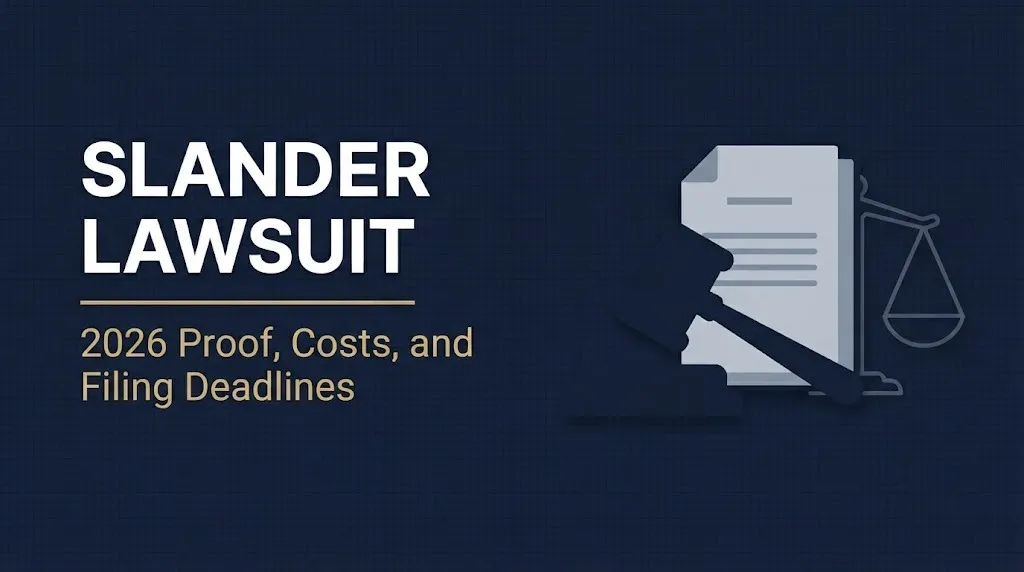
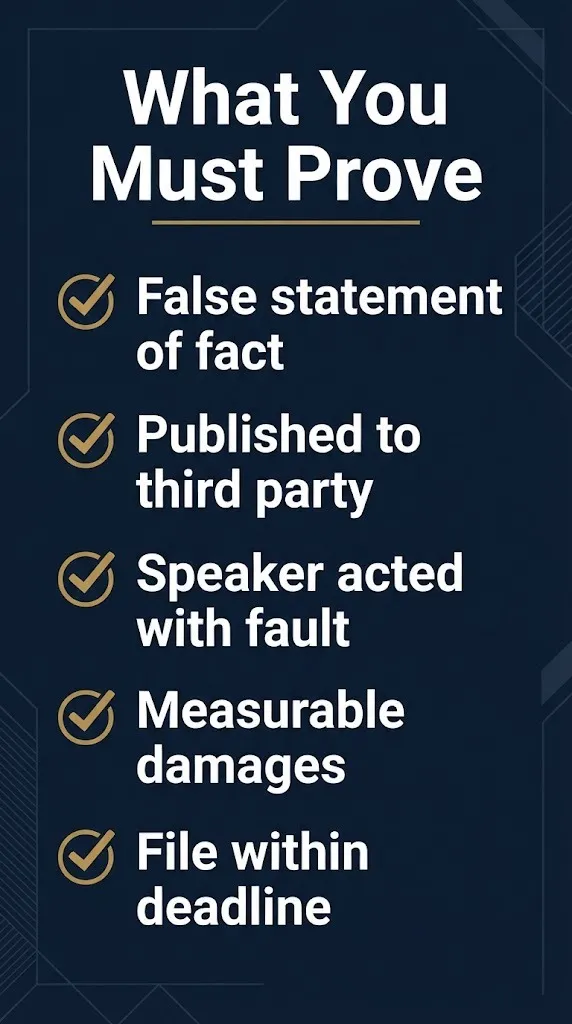
You must prove four elements in most states: a false statement of fact, publication to a third party, fault on the speaker’s part, and damages. Each element is harder than it sounds.
The statement must be factual, not opinion. Calling someone “a liar” may be protected opinion in some contexts. Saying “he stole $5,000 from the register” is a factual claim that can be proven true or false. Truth is an absolute defense.
Publication means the statement reached at least one person other than you. A private insult said only to you does not count. A single overheard remark at work may count.
Fault depends on who you are. Private figures usually prove negligence, meaning the speaker failed to act reasonably. Public figures must prove actual malice, meaning the speaker knew the statement was false or acted with reckless disregard for the truth.
Damages require proof of harm. Lost income, lost business, medical bills for emotional distress, and reputational harm all count. A hurt feeling without financial consequence rarely supports a lawsuit.
Who Counts as a Public Figure in a Defamation Case?
Public figures include elected officials, celebrities, and people who have voluntarily placed themselves in the public eye. Some people become limited-purpose public figures when they inject themselves into a public controversy.
The distinction matters because public figures face a much higher burden. They must prove actual malice, which is one of the hardest standards in civil law. Private figures only need to prove negligence in most cases.
Courts decide the status based on the person’s role and conduct, not just their fame. A local business owner with no public profile is usually a private figure. A social media influencer with hundreds of thousands of followers may be treated as a limited-purpose public figure for statements about their content.
If you are considering a defamation lawsuit, your status matters before you file. A lawyer can assess whether you face the negligence standard or the actual malice standard.
Key Takeaway: Your public status determines how hard it is to win. Public figures face a much steeper climb.
How Much Is a Slander Lawsuit Worth?
No fixed value exists for a slander lawsuit. Damages depend on what you can prove you lost. The most common categories are economic damages, reputational harm, and emotional distress.
Economic damages are the easiest to quantify. If you lost a $60,000 job because of a false accusation, that number anchors your claim. If you lost clients or a contract, those figures add to the total.
Reputational harm is harder to prove. Courts want evidence that your reputation actually suffered in measurable ways. Declining sales, lost opportunities, and witness testimony from people who heard the statement and changed their behavior all help.
Emotional distress damages require medical or therapeutic evidence in most cases. A therapist’s records, medication, and testimony about anxiety or depression strengthen the claim. Without treatment records, these damages are hard to collect.
| Damage Type | What It Covers | Proof Required |
|---|---|---|
| Economic | Lost wages, lost business | Pay stubs, tax returns, contracts |
| Reputational | Harm to standing | Witness testimony, business records |
| Emotional distress | Anxiety, depression, humiliation | Medical or therapy records |
| Punitive | Punishment for egregious conduct | Rare, requires malice or intent |
Reality Check: Most defamation cases settle for modest amounts, and many are dismissed before trial. Defamation is not a lottery ticket. The legal fees, the difficulty of proof, and the short filing deadlines make it one of the most challenging civil claims to pursue.
How Much Does a Slander Lawsuit Cost?
Defamation lawyers rarely work on contingency because these cases are hard to win and harder to collect. Most charge hourly rates, and the total cost of a contested slander lawsuit can run from $10,000 to $100,000 or more.
Hourly rates for experienced defamation lawyers in 2026 typically range from $300 to $800 per hour in most markets. Partners at large firms in major cities bill more. A case that survives a motion to dismiss and proceeds to discovery can consume hundreds of hours.
Some lawyers offer flat fees for a demand letter or a pre-litigation cease and desist. Those may cost $500 to $2,500. That is often the first step, and it sometimes resolves the matter without a lawsuit.
If you cannot afford hourly fees, your options are limited. Some lawyers take defamation cases on a reduced fee or hybrid arrangement when the damages are large and the defendant has assets. But pure contingency defamation work is uncommon.
What Is the Statute of Limitations for a Slander Lawsuit?
Most states require you to file a defamation claim within one year of the statement. Some allow two years. The clock starts when the statement is published, not when you discover it, in most jurisdictions.
The one-year rule surprises people because other civil claims allow much longer. A car accident claim often gives you two to three years. A defamation claim can expire before you have finished deciding whether to sue.
The rule has an exception. In some states, the discovery rule starts the clock when you learned or should have learned about the statement. That matters for online posts you discover months after publication. But not every state applies the discovery rule to defamation.
If you are considering a slander lawsuit, the deadline is the first thing to check. Missing it bars your claim permanently.
What Are Common Defenses to a Slander Lawsuit?
Defendants in defamation cases rely on a few standard defenses. The most common is truth. If the statement was substantially true, the case ends.
Opinion is another defense. Statements that cannot be proven true or false, like “he’s a jerk” or “that restaurant is terrible,” are not actionable. Some statements blur the line, and courts evaluate context.
Privilege protects statements made in certain settings. Statements in court, legislative proceedings, and some government filings are absolutely privileged. Statements made in employment references or internal investigations may be conditionally privileged.
Consent is a defense if you asked for or agreed to the publication. If you told someone to repeat a statement, you cannot later sue for it.
The burden falls on the defendant to prove these defenses, but they are powerful tools.
Key Takeaway: Truth, opinion, privilege, and consent are the four walls that block most defamation claims.
Can I Sue Someone for Slander on Social Media?
Social media defamation is usually libel, not slander, because posts are written and published. The same legal elements apply, but the practical issues differ.
Anonymity is the first problem. If someone defamed you from a fake account, you must identify them before you can sue. That requires a court order to the platform, which is not automatic. Some platforms resist or delete data before you can act.
Reach matters for damages. A post with five followers causes less harm than a post with five hundred thousand. But a small post can cause big harm if it reached the right people, like your employer or clients.
Screenshots are your evidence. Capture the post, the URL, the date, and any comments before it disappears. A deleted post is harder to prove but not impossible.
What Is Slander Per Se?
Slander per se is a category of spoken defamation so serious that damages are presumed. You do not need to prove financial loss to recover something, though the amount may still be modest.
The four traditional categories are accusations of a crime, accusations of a loathsome disease, statements harming your profession or trade, and accusations of sexual misconduct. Each category varies slightly by state.
The advantage is procedural. You skip the hardest proof problem in defamation: showing the statement actually cost you money. The disadvantage is that the categories are narrow. A general insult or a vague accusation does not qualify.
If someone said you embezzled money or that you have a contagious disease, you may have a slander per se claim. If someone said you are bad at your job, you may not.
Do I Need a Lawyer to File a Slander Lawsuit?
You can file a defamation case without a lawyer, but it is a bad idea in almost every circumstance. Defamation law is procedural and technical. Anti-SLAPP statutes in many states allow defendants to quickly dismiss weak claims and seek attorney fees from the person who sued.
Anti-SLAPP laws target lawsuits filed to silence speech. If your case looks like retaliation for someone’s protected expression, the defendant can file a motion that shifts fees to you. That risk alone justifies consulting a lawyer before filing.
A lawyer evaluates whether your facts meet the elements, whether you are a public or private figure, and whether the defendant has assets to pay a judgment. Those questions determine whether the case is worth pursuing.
Key Takeaway: Anti-SLAPP statutes make defamation one of the most dangerous cases to file without counsel.
What Is the Difference Between a Cease and Desist and a Slander Lawsuit?
A cease and desist letter asks the person to stop making the statement and sometimes to retract it. It is not a lawsuit. It is a warning that litigation may follow.
These letters are cheaper and faster than filing. A lawyer may send one for a flat fee. If the person stops, the matter may end without court involvement.
A retraction demand is sometimes required before you can sue for certain types of defamation, particularly in media cases. Some states reduce damages if the defendant publishes a timely retraction.
If the letter is ignored, the lawsuit is the next step. But the letter itself often resolves the dispute by making the speaker aware that you are serious.
What Happens After I Win a Slander Lawsuit?
Winning a defamation verdict is rare, and collecting the judgment is harder. Many defendants lack the assets to pay a significant award. A judgment against someone with no money and no insurance is a paper victory.
If the defendant has assets, you may garnish wages or levy bank accounts. If the defendant is a company, collection is easier. If the defendant is an individual with modest means, it may be impossible.
Your lawyer should evaluate collectability before you file. Suing someone who cannot pay produces a moral victory and a legal bill. Neither puts money in your pocket.
Key Takeaway: A defamation verdict is not a check. Collectability is part of the case evaluation from day one.
What Happens Next
If you are considering a slander lawsuit, the next steps follow a specific sequence.
- Week 1: Document the statement with dates, witnesses, and any written evidence.
- Week 1 to 2: Calculate your actual financial losses from the statement.
- Week 2 to 3: Consult a defamation lawyer for a case evaluation.
- Week 2 to 4: Send a cease and desist or demand letter if recommended.
- Month 1 to 3: Decide whether to file based on the response and the evidence.
The single most important date is not a hearing or a settlement deadline. It is the one-year anniversary of the statement. In most states, that date closes the door on your claim forever.
Frequently Asked Questions
What is the difference between slander and libel?
Slander is spoken defamation.
Libel is written or published defamation.
Both require a false statement, publication, fault, and damages.
How much does a slander lawsuit cost?
Most defamation lawyers charge hourly rates of $300 to $800 per hour.
A contested case can cost $10,000 to $100,000 or more.
Contingency arrangements are rare in defamation cases.
How long do I have to file a slander lawsuit?
Most states give you one year from the date of the statement.
Some states allow two years.
Check your state’s specific rule before doing anything else.
What is actual malice in a defamation case?
Actual malice means the speaker knew the statement was false or acted with reckless disregard for the truth.
It applies to public figures, not private figures.
It is one of the hardest standards in civil law.
Can I sue for a false accusation at work?
Yes, if the accusation meets the elements of defamation and caused measurable harm.
Statements made in internal investigations may be privileged.
Employment references may be conditionally privileged.
What is slander per se?
Slander per se is a category of spoken defamation where damages are presumed.
It includes false accusations of crime, loathsome disease, professional incompetence, or sexual misconduct.
You do not need to prove financial loss in these cases.
Do I need a lawyer for a slander lawsuit?
You can file without one, but it is risky.
Anti-SLAPP statutes can shift attorney fees to you if your case is dismissed.
A lawyer evaluation is the first step in any defamation matter.
What if the person who slandered me has no money?
A judgment against a defendant with no assets may be uncollectible.
Your lawyer should investigate collectability before you file.
Suing someone who cannot pay produces a moral victory, not money.
A slander lawsuit is not a quick fix for a damaged reputation. It is a slow, expensive, and difficult path that succeeds only with clear proof of a false statement, real fault, and measurable harm. Most cases settle, many are dismissed, and the deadline to file is often shorter than you think.
Your first move is not to sue. It is to document what was said, calculate what it cost you, and sit down with a defamation lawyer who will tell you the truth about your chances. That conversation may save you from a lawsuit you would lose, or it may start one you can win. Either way, you will know where you stand.