What Is a Lawsuit? A 2026 Guide to Civil Lawsuits, Claims, and How Courts Actually Work
Quick Answer
- A lawsuit is a civil court action where a plaintiff asks a judge or jury to award damages or order specific relief.
- Civil lawsuits can seek money, property, injunctions, or a declaration of legal rights.
- Most civil lawsuits settle before trial, often after discovery but before a verdict.
A lawsuit is the official way to resolve a dispute through the court system. If someone breached a contract, injured you, or violated your rights, you may file a civil lawsuit to ask the court for a remedy.
This guide covers how civil lawsuits actually work in 2026, what the key stages are, how long they take, and what you can realistically expect if you are thinking about suing or have been sued.
A surprising verified detail: roughly 95 percent of civil cases settle before trial. The courtroom drama you see on television is a tiny fraction of what actually happens.
The Facts
| Legal Term | Lawsuit (civil action) |
| Definition | A court process where a plaintiff sues a defendant for a legal remedy |
| Governing Rules | Federal Rules of Civil Procedure or state civil procedure rules |
| Who Files | Plaintiff (person, business, or government entity) |
| Who Responds | Defendant |
| Common Remedies | Money damages, injunctions, declaratory judgments, specific performance |
| Typical Duration | 12 to 36 months, longer for complex cases |
| Filing Deadline | Statute of limitations, varies by claim type and state |
Is a Lawsuit the Same as a Civil Lawsuit?
Yes, a civil lawsuit is what most people mean when they say “lawsuit.” It is a non-criminal court action.
Civil lawsuits cover disputes between private parties. That includes individuals, businesses, nonprofits, and government entities acting in a non-criminal capacity.
Criminal cases are different. The government prosecutes someone for breaking a criminal law. The penalties are fines, probation, or prison.
A civil lawsuit does not send anyone to jail. It seeks money, property, or a court order. If you are being sued, the worst outcome in a civil case is a money judgment against you or an order to do or stop doing something.
Key Takeaway: All civil lawsuits are lawsuits, but not all lawsuits are civil; criminal prosecutions are technically separate.
What Does a Civil Lawsuit Mean in Plain Terms?
A civil lawsuit means one person or company is asking the court to make another person or company pay for a wrong.
Think of it like a formal complaint with legal power behind it. You claim someone harmed you. You file paperwork. The court decides if you are right.
The harm can be physical, financial, or reputational. It can come from a broken promise, a careless act, or an intentional wrong.
Civil lawsuits are not about punishment in the criminal sense. They are about making the injured party whole. Usually that means money.
The burden of proof is lower than in criminal cases. In a civil case, you must prove your claim by a “preponderance of the evidence.” That means more likely true than not.
What Are the Most Common Types of Civil Lawsuits?
Civil lawsuits fall into several broad categories. Here are the ones you are most likely to encounter:
| Type | What It Involves |
| Contract disputes | One party claims the other broke a binding agreement |
| Personal injury | Harm caused by someone’s negligence or intentional act |
| Property disputes | Conflicts over ownership, boundaries, or damage |
| Employment claims | Wrongful termination, discrimination, wage violations |
| Consumer claims | Fraud, deceptive practices, defective products |
| Family law | Divorce, custody, support (handled in specialized courts) |
Each type has its own filing deadlines and specific legal elements you must prove.
Key Takeaway: The type of lawsuit determines the deadline, the elements you must prove, and the court where you file.
How Much Can You Get From a Civil Lawsuit?
The amount depends on your actual damages, the defendant’s conduct, and sometimes statutory limits.
Compensatory damages cover your actual losses. Medical bills, lost wages, property repair costs, and pain and suffering all fall into this category.
Punitive damages are extra money meant to punish especially bad conduct. They are not available in every case. Some states cap them.
Here is a simple breakdown of damage types:
- Economic damages: medical bills, lost income, repair costs, out-of-pocket expenses
- Non-economic damages: pain and suffering, emotional distress, loss of enjoyment of life
- Punitive damages: awarded only for egregious or intentional misconduct
Reality Check: A lawsuit does not guarantee a payout. Even if you win, collecting a judgment from a defendant with no assets can be harder than winning the case itself.
How to Start a Civil Lawsuit in 2026
Starting a lawsuit means following a specific sequence. Missing a step can get your case dismissed.
Here are the 7 basic steps:
- Determine if you have a valid legal claim.
- Check the statute of limitations for your claim type.
- Gather evidence and documents that support your case.
- Draft and file a complaint with the correct court.
- Serve the defendant with the complaint and summons.
- Wait for the defendant to file an answer or motion.
- Begin discovery and prepare for settlement or trial.
Filing fees vary by court. Federal court filing fees are typically a few hundred dollars. State court fees are usually lower.
Key Takeaway: The first 90 days of a lawsuit set the tone. Procedural errors early are hard to fix later.
Can You File a Lawsuit Without a Lawyer?
Yes, you can file a lawsuit without a lawyer. This is called appearing “pro se.”
Small claims courts are designed for self-represented litigants. The rules are simpler. The amounts are capped, often between $5,000 and $10,000 depending on your state.
For anything larger or more complex, self-representation is risky. Civil procedure rules are technical. Opposing counsel will use every mistake against you.
A middle option is limited-scope representation. You hire a lawyer for specific tasks, like drafting the complaint or appearing at one hearing, while handling the rest yourself.
How Long Does a Civil Lawsuit Take in 2026?
Most civil lawsuits take 12 to 36 months from filing to resolution.
Simple breach-of-contract cases can resolve in under a year. Complex class actions or multi-party cases can take five years or more.
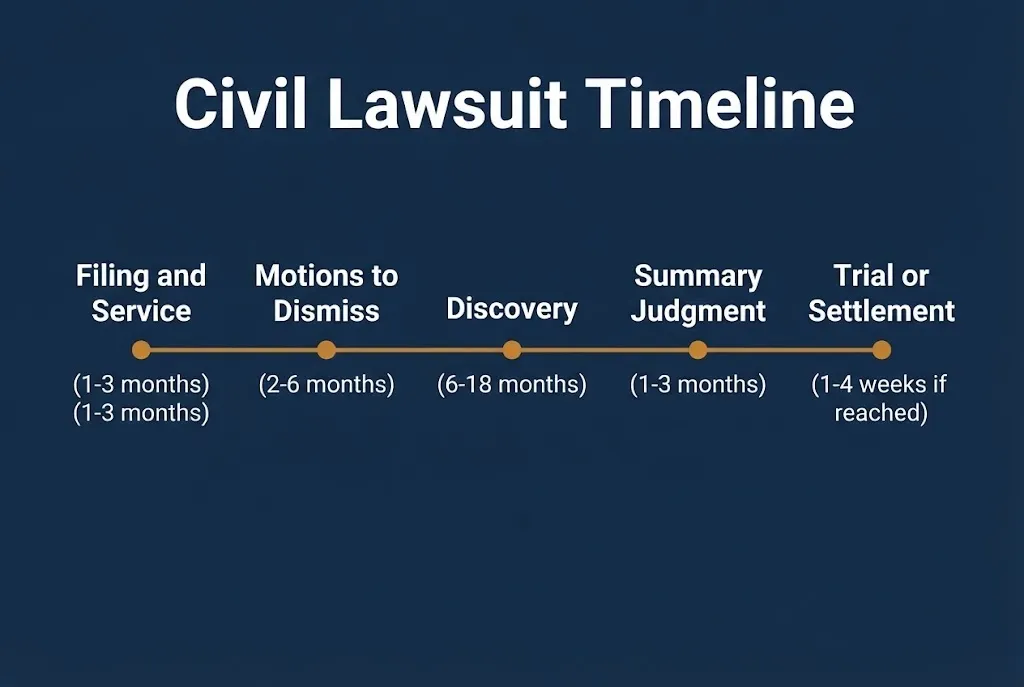
Here is a typical timeline:
| Stage | Typical Timeframe |
| Filing and service | 1 to 3 months |
| Motions to dismiss | 2 to 6 months |
| Discovery | 6 to 18 months |
| Summary judgment | 1 to 3 months after discovery |
| Trial | 1 to 4 weeks if reached |
| Appeal (if any) | 6 to 18 months |
Delays are common. Courts are still working through backlogs from pandemic-era closures. Your case may not be heard as quickly as the rules suggest.
Key Takeaway: A lawsuit is a marathon, not a sprint. Plan for at least a year, and often two or three.
What Is the Difference Between Filing a Lawsuit and Sending a Demand Letter?
A demand letter is not a lawsuit. It is a formal request for payment or action before you go to court.
A demand letter states your claim, the amount you want, and a deadline to respond. It often threatens legal action if the demand is not met.
A lawsuit starts only when you actually file a complaint in court and serve the defendant.
Many disputes settle at the demand letter stage. It is cheaper and faster than litigation. But a demand letter has no legal force by itself. The recipient can ignore it.
If the deadline in your demand letter passes, you then decide whether to file. The demand letter often becomes evidence later, showing you tried to resolve the matter first.
Why Do Most Civil Lawsuits Settle Before Trial?
Settlements happen because trials are expensive, slow, and unpredictable.
Here are the main reasons:
- Legal fees mount quickly once discovery starts.
- Businesses want to avoid bad publicity.
- Both sides face risk at trial.
- Insurance companies often push for settlement.
- Courts encourage settlement conferences and mediation.
A settlement is a private agreement. The defendant usually pays money. In exchange, the plaintiff drops the case and releases future claims.
Key Takeaway: Settlement is the likely outcome, not the exception. Prepare for trial, but expect a negotiated resolution.
What Happens After You Win a Civil Lawsuit?
Winning at trial gets you a judgment. Collecting on that judgment is a separate fight.
A judgment says the defendant owes you money. It does not automatically transfer money into your account.
If the defendant does not pay voluntarily, you may need to:
- File a writ of execution to seize assets.
- Garnish wages or bank accounts.
- Place a lien on real property.
- Hire a collection attorney or firm.
Some defendants are “judgment proof.” They have no income, no assets, and no insurance. Winning against them may be a hollow victory.
What Is a Class Action Lawsuit and How Is It Different?
A class action is one lawsuit filed by one or a few people on behalf of a much larger group.
The named plaintiffs represent all class members who share the same legal claim. A judge must certify the class before the case can proceed as a class action.
Class actions are common in consumer fraud, product defect, employment, and securities cases. They let small individual claims be combined into one large case.
Individual lawsuits involve one plaintiff and one defendant. Discovery, trial, and judgment apply only to those parties.
Key Takeaway: Class actions aggregate small claims. Individual lawsuits pursue one person’s specific damages. Which one applies depends on the size of your claim and how many people were harmed.
What Are Statutes of Limitations and Why Do They Matter?
A statute of limitations is a deadline for filing a lawsuit. If you miss it, your case is dead.
Each claim type has its own deadline. Personal injury claims are often two to three years. Breach of written contract claims can be four to six years.
The clock usually starts when the harm occurs or when you discover it. This is called the “discovery rule” and varies by state.
Here are common deadlines:
| Claim Type | Typical Deadline |
| Personal injury | 2 to 3 years |
| Breach of written contract | 4 to 6 years |
| Fraud | 2 to 4 years from discovery |
| Employment discrimination | 180 days to 300 days to file with EEOC |
Do not wait until the last month. Evidence disappears. Witnesses forget. Your attorney needs time to investigate.
What Are the Costs of Filing a Civil Lawsuit in 2026?
The costs go far beyond the filing fee.
Here is a realistic breakdown:
- Filing fee: $100 to $500 depending on court
- Service of process: $50 to $150
- Deposition transcripts: $500 to $2,000 per deposition
- Expert witnesses: $5,000 to $50,000 or more
- Attorney fees: $250 to $800 per hour, or a contingency fee in personal injury cases
Contingency fee arrangements mean your lawyer gets paid only if you win. That percentage is often 33 to 40 percent of your recovery.
Hourly billing applies to most other case types. You pay monthly regardless of outcome.
Key Takeaway: A lawsuit is an investment. Understand the full cost picture before you file.
What Should You Do If You Are Sued?
If you are served with a lawsuit, act immediately.
Here are the 5 steps:
- Read the complaint and summons carefully.
- Note the deadline to respond. It is usually 20 to 30 days.
- Notify your insurance company if the claim may be covered.
- Contact an attorney who handles your case type.
- Do not ignore the deadline. Missing it can lead to a default judgment against you.
A default judgment means you lose automatically because you did not respond. The plaintiff can then collect from you without a trial.
What Happens During Discovery in a Civil Lawsuit?
Discovery is the evidence-gathering phase. Both sides exchange information before trial.
The main discovery tools are:
- Interrogatories: written questions answered under oath
- Requests for production: demands for documents and records
- Depositions: in-person testimony under oath
- Requests for admission: asking the other side to admit or deny facts
- Subpoenas: demands for evidence from third parties
Discovery takes months. It is often the most expensive phase of the case.
It also forces settlement. Once both sides see the evidence, the risks become clearer.
Key Takeaway: Discovery is where cases are won, lost, or settled. What the evidence shows matters more than what either side says.
What Is Summary Judgment in a Civil Lawsuit?
Summary judgment is a ruling without a trial. The judge decides the case based on undisputed facts.
Either side can file a summary judgment motion after discovery. The moving party argues that no reasonable jury could rule for the other side.
If the judge grants summary judgment, the case ends. If denied, the case proceeds toward trial.
Summary judgment is common in contract disputes and cases where the facts are not genuinely disputed. It is less common in cases involving credibility or intent, which a jury should decide.
Frequently Asked Questions
What is a lawsuit in simple terms?
A lawsuit is a formal request to a court to resolve a dispute.
One party claims the other harmed them and asks the court for money or another remedy.
What is the difference between a civil lawsuit and a criminal case?
A civil lawsuit involves private parties seeking money or orders.
A criminal case involves the government prosecuting someone for breaking a criminal law.
How much does it cost to file a lawsuit?
Filing fees are usually $100 to $500.
Attorney fees, discovery, and expert costs add thousands more.
How long do I have to file a civil lawsuit?
The deadline depends on your claim type and state law.
Most personal injury deadlines are two to three years. Contract claims often allow four to six years.
Can I file a lawsuit without a lawyer?
Yes, you can appear pro se.
Small claims court is designed for self-representation. Complex cases are harder without counsel.
What happens if I miss the deadline to respond to a lawsuit?
The court may enter a default judgment against you.
That means you lose automatically and may owe the plaintiff money.
Do most civil lawsuits go to trial?
No, roughly 95 percent settle before trial.
Trials are expensive, risky, and time-consuming for both sides.
What is a class action lawsuit?
A class action is one lawsuit representing many people with the same claim.
A judge must certify the class before it can proceed.
If you are thinking about filing a lawsuit, start by checking your deadline. The statute of limitations is the single most important fact in your case.
If you have been sued, respond before the deadline. Ignoring a lawsuit never makes it go away. It makes it worse.