Carnival Triumph “Poop Cruise” Lawsuit: 2026 Settlement Status, Payouts, and Claim Deadlines
Quick Answer
- The Carnival Triumph “poop cruise” class action was real, stemming from the February 2013 engine fire that stranded 4,200 people at sea for five days.
- The federal judge granted final approval to a settlement, but Carnival paid no monetary damages to passengers; only non-monetary benefits were provided.
- The claim deadline passed in 2023, and no new claims can be filed for this lawsuit.
The Carnival Triumph lawsuit, often called the “poop cruise” case, has been fully resolved as of 2026. The litigation ended with a settlement that provided no cash payouts to passengers. Instead, Carnival agreed to pay attorney fees and offer limited non-monetary compensation.
If you were on that ship in February 2013 and missed the claim window, you cannot recover anything now. This article covers the verified timeline, why no money was paid, and what the court actually decided.
A surprising verified detail: U.S. District Judge Lynn Hughes, who presided over the case, openly mocked the plaintiffs during a 2015 hearing, calling the lawsuit “a bunch of whiners” and laughing at descriptions of the conditions aboard the disabled ship. That transcript became one of the most controversial parts of the entire case.
The Facts
| Case | McDonough v. Carnival Corp. d/b/a Carnival Cruise Lines, No. 4:13-cv-02127 |
| Status | Settled, final judgment entered |
| Fund Size | $0 for passengers (Carnival paid attorney fees and costs only) |
| Est. Per Person | $0 (no monetary award) |
| Claim Deadline | Passed in 2023 |
| Administrator | Not applicable (no claims fund) |
| Proof Needed | Not applicable |
Is the Carnival Triumph “Poop Cruise” Lawsuit Real or a Scam?
Yes, the Carnival Triumph lawsuit was real. It was a federal class action filed in the Southern District of Texas in 2013.
The case name was McDonough v. Carnival Corp. It represented passengers who were aboard the Carnival Triumph when an engine room fire disabled the ship on February 10, 2013.
The vessel drifted for five days in the Gulf of Mexico without working toilets, air conditioning, or hot food. Passengers described sewage running through hallways and sleeping on deck to escape the heat inside.
The lawsuit was never a scam. It was a legitimate court case that produced almost nothing for the passengers who filed it.
Key Takeaway: The case was real, but the outcome was a major disappointment for passengers hoping for compensation.
Why Did the Carnival Triumph Lawsuit End With No Payout for Passengers?
The court ruled that passengers could not recover damages because most of them had accepted Carnival’s refund offer immediately after the incident.
Carnival gave every passenger a full refund, a credit for a future cruise, and $500 cash. The company also reimbursed transportation costs.
Under maritime law, that combination of benefits effectively settled most potential claims. The court found that passengers who accepted those benefits could not then sue for additional damages.
A small group of passengers rejected the refund offer and pursued the class action. But the class was ultimately decertified, which means the case could not proceed as a group.
Once the class lost certification, the lawsuit collapsed. Individual claims were too small to pursue separately. This is why the final settlement involved no passenger payouts.
Reality Check: No settlement check ever went to Carnival Triumph passengers. Anyone claiming to offer “Carnival Triumph settlement money” now is running a scam. Filing for this case cost nothing, and no legitimate administrator is contacting people about it.
How Much Did Passengers Actually Get After the Carnival Triumph Fire?
Passengers received the following benefits directly from Carnival, not from the lawsuit:
| Benefit | Amount |
| Full cruise fare refund | Varies by fare paid |
| Future cruise credit | Equal to the cruise fare paid |
| Cash payment | $500 per person |
| Transportation reimbursement | Actual costs to return home |
| Onboard credit for current cruise | $500 per cabin |
The total value depended on what each passenger originally paid. A person who paid $1,200 for the cruise received that amount back, a credit of equal value, and $500 in cash.
These benefits were provided within weeks of the February 2013 incident. They were not part of the later class action settlement.
The lawsuit sought additional damages for emotional distress, physical illness, and lost vacation time. Those claims did not succeed.
Key Takeaway: Carnival’s voluntary compensation program, not the lawsuit, is the only source of money passengers ever received.
What Happened Aboard the Carnival Triumph in February 2013?
An engine room fire broke out on February 10, 2013, while the ship was in the Gulf of Mexico. The fire disabled the ship’s propulsion system.
The vessel lost main power. Backup generators provided limited electricity for cold food storage and some lighting, but not for toilets or air conditioning in most passenger areas.
Passengers reported raw sewage backing up into hallways and cabins. Many slept on deck because interior rooms became unbearably hot.
The ship was towed to Mobile, Alabama, arriving on February 14, 2013. The five-day ordeal became known as the “poop cruise.”
Carnival faced intense media scrutiny. The company’s CEO issued public apologies. Congress held hearings about cruise industry safety standards.
Who Qualified for the Carnival Triumph Class Action?
Passengers who were aboard the Carnival Triumph voyage that departed Galveston, Texas, on February 7, 2013, and ended in Mobile, Alabama, on February 14, 2013, were potential class members.
The proposed class included all paying passengers on that specific sailing. It did not include crew members.
To remain eligible for the class action, passengers had to have rejected Carnival’s initial refund offer. Most passengers accepted it, which barred them from further claims.
The exact number of passengers who rejected the offer was small. Court records indicate fewer than 40 people remained as named plaintiffs by 2015.
How to File a Carnival Triumph Claim in 2026
You cannot file a claim. The deadline passed in 2023.
Here is what you need to know:
- The court entered final judgment dismissing the case.
- No claim forms are being accepted.
- No settlement administrator is processing applications.
- No appeal is pending.
- Any website offering claim forms is fraudulent.
If you believe you have a separate individual claim not covered by the class action, you would need to consult an attorney. The statute of limitations for maritime personal injury claims is generally three years, which expired long ago.
Key Takeaway: The filing window for this case is permanently closed.
Is There Any Way to Get Compensation in 2026?
No, not from the Carnival Triumph lawsuit.
If you suffered a different incident on a Carnival ship, you may have options. Each case is evaluated separately.
Carnival’s passenger ticket contract includes strict claim filing deadlines. Most require written notice within 185 days of the incident.
For the 2013 Triumph fire, all deadlines have expired. No new claims can be filed regardless of the severity of your experience.
What Did the Judge Say That Made Headlines?
Judge Lynn Hughes made several controversial statements during an April 2015 hearing.
He called the plaintiffs “a bunch of whiners” and suggested they should have been “thankful” to be alive. He laughed when attorneys described passengers wading through sewage.
The transcript shows the judge mocking claims of emotional distress. He compared the five-day ordeal to a “long camping trip.”
Plaintiff attorneys moved to have the judge recused. That motion was denied.
The comments drew criticism from consumer advocates and legal ethics scholars. They also made the case a national story beyond the initial cruise fire coverage.
Can You File an Individual Lawsuit Against Carnival Now?
The statute of limitations has passed for the 2013 incident.
Maritime personal injury claims must generally be filed within three years of the event. That deadline was February 2016.
Even the class action, filed in 2013, took years to resolve and ultimately failed.
If you have a current dispute with Carnival, you must follow the claim procedures in your ticket contract. Those require written notice within 185 days of the incident.
Key Takeaway: Time limits are strict in maritime cases. Waiting to file usually means losing the right to sue.
What Safety Changes Came From the Carnival Triumph Fire?
The fire prompted a congressional review of cruise ship safety.
The Cruise Vessel Security and Safety Act was already in effect, but the Triumph incident exposed gaps in emergency preparedness.
Carnival announced a fleetwide review of fire prevention systems. The company also upgraded backup power systems on several ships.
The Coast Guard conducted an investigation and issued recommendations. Those included better emergency communications and improved sanitation procedures during power failures.
No law specifically named after the Triumph incident was enacted. But the case contributed to ongoing regulatory attention on cruise safety.
How Do Cruise Ticket Contracts Limit Your Rights Today?
Cruise passengers agree to significant legal restrictions when they buy a ticket.
Your ticket contract likely includes a class action waiver. This means you agree to resolve disputes through individual arbitration, not a group lawsuit.
The contract also shortens the time you have to file a claim. Carnival’s contract requires written notice within 185 days and a lawsuit within one year for most claims.
These provisions were not central to the Triumph case because it was filed under older contract language. But they now apply to almost all Carnival cruises.
Reading the fine print before buying is the only way to know what rights you are giving up.
Key Takeaway: Modern cruise contracts make class actions much harder to file than they were in 2013.
What Happens Next
No further developments are expected in the Carnival Triumph case.
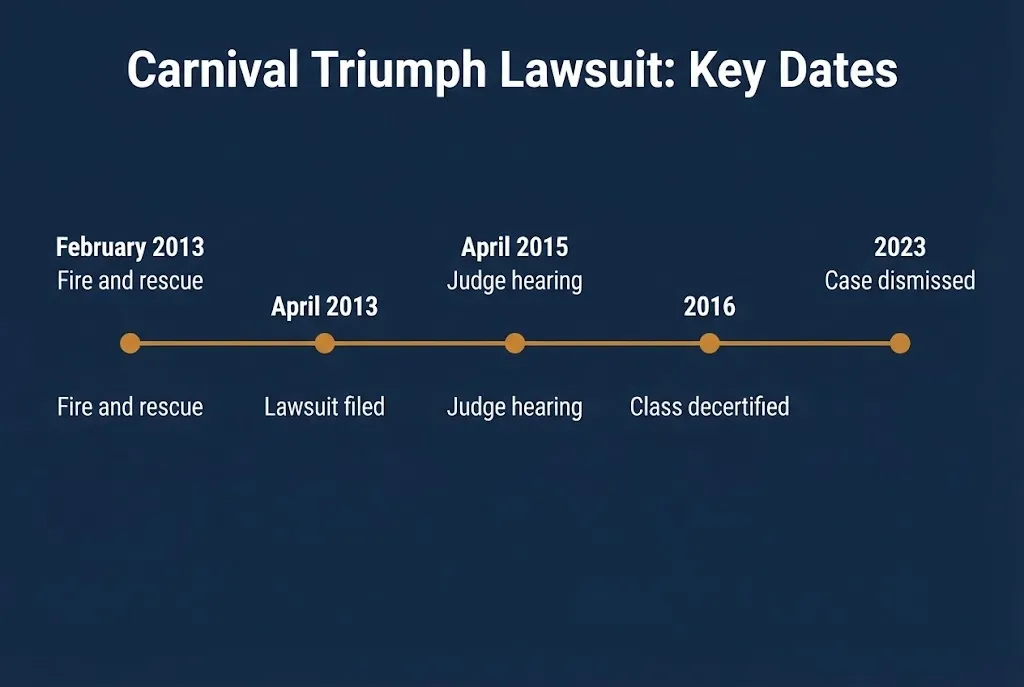
- February 2013: The fire occurred and the ship was disabled for five days.
- April 2013: The class action was filed.
- April 2015: Judge Hughes made his controversial comments at a hearing.
- 2016: The class was decertified, gutting the case.
- 2023: The case was dismissed with final judgment.
- 2026: No appeals or claims are pending. The case is closed.
Frequently Asked Questions
Was the Carnival Triumph poop cruise lawsuit real?
Yes, it was a real federal class action filed in Texas in 2013.
The case was McDonough v. Carnival Corp. in the Southern District of Texas.
Did anyone get money from the Carnival Triumph lawsuit?
No, passengers received no money from the lawsuit itself.
Carnival paid attorney fees and costs to the plaintiffs’ lawyers, not damages to passengers.
What did Carnival give passengers after the Triumph fire?
Carnival gave a full refund, a future cruise credit, $500 cash, and transportation reimbursement.
These benefits were offered before any lawsuit and were accepted by most passengers.
Is there still time to file a Carnival Triumph claim?
No, the claim deadline passed years ago.
The case is closed, and no new claims are being accepted.
Why did the Carnival Triumph class action fail?
The class was decertified, meaning passengers could not sue as a group.
Most passengers had also accepted Carnival’s early compensation offer, which barred additional claims.
What should I do if someone contacts me about a Carnival Triumph settlement?
Report it as a scam.
No settlement administrator is making calls or sending texts about this case.
Can I sue Carnival for a different incident?
You may be able to, but strict deadlines apply.
Review your ticket contract and contact an attorney immediately if you have a claim.
What was the total settlement amount in the Carnival Triumph case?
There was no settlement fund for passengers.
The final judgment provided zero dollars in passenger compensation.
If you were affected by the 2013 Carnival Triumph fire, that chapter is closed. No claims remain open, no appeals are pending, and no money is coming.
The only lesson still relevant in 2026 is this: read cruise contracts carefully, understand the deadlines, and know that class actions against cruise lines are now harder to file than ever before.