How Long Does a Personal Lawsuit Take to Settle in 2026? Full Timeline Explained
Quick Answer
- A personal injury lawsuit typically takes 6 months to 3 years, depending on injury severity and whether it goes to trial.
- There’s no fixed payout timeline because most cases settle privately, not through a class fund with a set schedule.
- The single biggest time factor is reaching maximum medical improvement (MMI) before your case can be accurately valued.
Most people searching “personal lawsuit” just got hurt, filed a claim, or hired a lawyer, and they want a straight answer: when does this end?
There isn’t one universal number. Federal data puts the average personal injury case at about two years from filing to verdict, but the range runs from a few months to several years.
This article breaks down every stage of a personal injury lawsuit, what speeds it up, what stalls it, and what you can actually control. One detail surprises a lot of people: cases that never go to trial often move faster than the case itself gets a court date.
The Facts
| Category | Detail |
|---|---|
| Topic | General personal injury lawsuit timeline (not a specific class action) |
| Typical range | 6 months to 3 years |
| Average to trial (DOJ data) | Around 25 to 26 months from filing to verdict |
| Fastest path | Pre-lawsuit insurance settlement, often 2 to 4 months after treatment ends |
| Slowest path | Full jury trial with contested liability, 1 to 3+ years |
| Fund/payout | Not applicable, this is not a class settlement |
| Deadline | Governed by your state’s statute of limitations, not a claims administrator |
Is a “personal lawsuit” the same as a personal injury claim?
Yes, in everyday use, a “personal lawsuit” almost always means a personal injury claim filed by one person against another party, usually after an accident.
It’s different from a class action, where one case represents thousands of people and a settlement administrator pays out from a shared fund. A personal injury lawsuit is usually just you, your lawyer, and the at-fault party’s insurer or defense attorney.
That distinction matters for timeline expectations. Class action payouts depend on court approval schedules that can add years. An individual lawsuit’s timeline depends mostly on your medical recovery and how willing the other side is to negotiate.
How long does it take to settle a lawsuit?
A lawsuit settles, on average, somewhere between 6 months and 3 years, based on multiple U.S. Department of Justice studies of state court tort cases.
Two DOJ datasets, one looking at large urban counties and another at national tort filings, found average times from filing to jury verdict of 25.6 months and 26.5 months. Median time was closer to 21.5 months.
Key Takeaway: The “years to settle” headline usually describes cases that went all the way to trial, not the majority that settle earlier.
Cases that settle before a lawsuit is even filed can wrap up in a few months. Cases that get filed but settle during discovery, before trial, often land in the 1 to 1.5 year range.
How long does it take to settle a lawsuit if it doesn’t go to trial?
If your case resolves through negotiation, without ever reaching trial, it can settle in as little as 2 to 6 months after you finish medical treatment.
Roughly 95 percent of personal injury cases settle out of court. The negotiation phase itself, once you’ve reached maximum medical improvement, typically takes:
- 1 to 2 months for straightforward claims with clear liability
- 3 to 6 months for disputed or higher-value claims
- 6+ months if the insurer disputes fault or lowballs repeatedly
What are the stages of a personal injury lawsuit timeline?
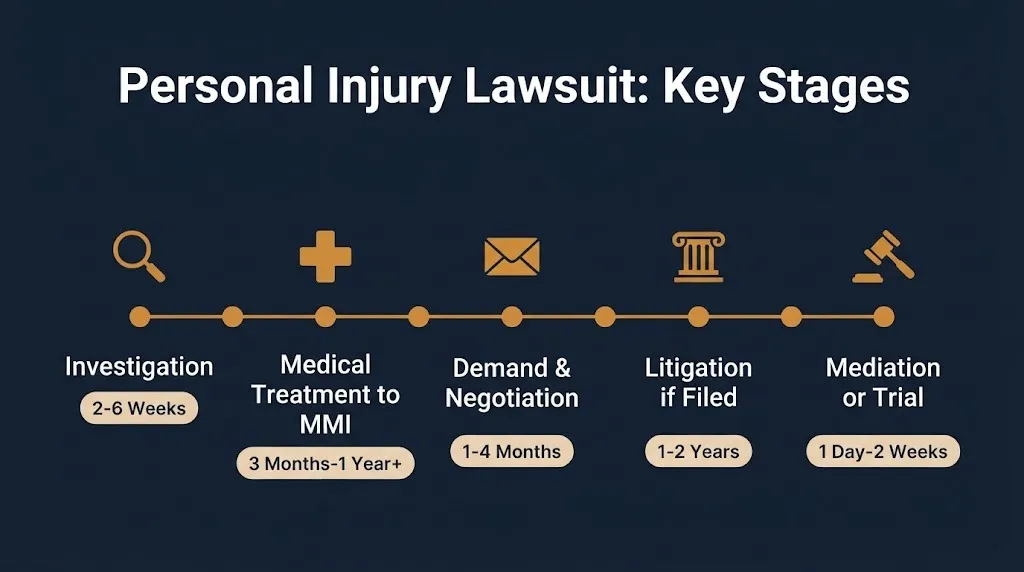
A personal injury lawsuit moves through five main stages, and each one has its own typical window.
| Stage | Typical Length |
|---|---|
| Initial investigation | 2 to 6 weeks |
| Medical treatment to MMI | 3 months to 1 year or more |
| Demand and negotiation | 1 to 4 months |
| Litigation and discovery (if filed) | 1 to 2 years |
| Mediation or trial | 1 day to 2 weeks |
Key Takeaway: The medical treatment stage, not the legal paperwork, is usually the longest part of the whole process.
You can’t accurately value a claim until doctors know the full extent of your injury. Settling too early, before you know if you need surgery or long-term care, often means settling for less than the case is worth.
Why does my lawyer say we have to wait for “MMI” before settling?
MMI, or maximum medical improvement, means your doctor believes your condition has stabilized and won’t significantly improve further.
Lawyers wait for MMI because it lets them calculate the full cost of your injury, medical bills, future treatment, lost wages, and pain and suffering, in one demand instead of guessing.
Think of it like getting a home repair estimate before all the damage is visible. Settling before MMI is like accepting a contractor’s quote before they’ve checked behind the drywall.
How long does the “demand letter” negotiation phase take?
The demand and negotiation phase typically takes 1 to 4 months, depending on how the insurance company responds.
Your attorney sends a demand letter outlining damages once you reach MMI. From there:
- Insurer reviews the demand (2 to 4 weeks)
- Insurer responds with an offer or denial
- Counteroffers go back and forth (weeks to months)
- Parties either agree or the case moves toward filing suit
- If agreed, settlement paperwork and payment follow (2 to 6 weeks)
Some states require insurers to respond within a set window. Colorado, for example, generally requires insurers to decide on a claim within 60 days of receiving it.
How much does a personal injury lawsuit typically pay out?
Not yet determined for any individual reading this, because payout amounts depend entirely on the facts of each case, not a shared settlement fund.
Unlike a class action with tiered payments, an individual lawsuit’s value depends on:
- Medical expenses, past and projected future costs
- Lost wages and lost earning capacity
- Severity and permanence of the injury
- Pain and suffering, which varies heavily by state and jury pool
- Comparative fault, if you’re found partly responsible, your payout typically shrinks
There’s no generic number a news article can honestly give you here. Anyone claiming a fixed average payout for “a personal lawsuit” without knowing your case specifics isn’t giving you real information.
Reality Check: No legitimate attorney or court will guarantee a payout amount before evidence is gathered and treatment is complete. Be skeptical of anyone, online or otherwise, who promises a specific dollar figure early on. Filing a legitimate claim never requires paying an upfront fee to a “claims helper.”
What happens if my case goes to trial instead of settling?
If your case goes to trial, expect the total timeline to stretch to 1 to 3 years or longer from filing to verdict.
Filing a lawsuit doesn’t mean you’re headed to trial immediately. Most jurisdictions are backed up, and getting an actual trial date can take a year or more after filing.
| Case Type | Average Time to Trial Verdict |
|---|---|
| General tort/personal injury | 21 to 26 months |
| Product liability | About 35 months |
| Medical malpractice | About 33 months |
| False imprisonment claims | About 40 months |
Key Takeaway: Filing a lawsuit is often a negotiating tactic, not a guarantee of trial. Many cases still settle after filing, sometimes on the courthouse steps.
Does the type of injury change how long the lawsuit takes?
Yes, injury type and complexity are two of the biggest factors in how long a case takes.
Simple, low-impact claims with clear liability (a straightforward rear-end car accident, for example) can resolve in months. Complex claims involving surgery, disputed fault, multiple defendants, or long-term disability routinely take over a year, sometimes several.
Cases needing expert witnesses (accident reconstructionists, medical specialists) also add time, since scheduling depositions and reports isn’t fast.
Does the state I live in affect my lawsuit timeline?
Yes, state court backlogs and procedural rules can add months or years to a case, separate from your specific injury.
Some states have faster resolution norms. One Pennsylvania-based estimate puts the state’s average personal injury timeline at about 14 to 21 months. Other states with heavier court dockets or stricter procedural requirements run longer.
Your state’s statute of limitations also matters. Miss that filing window, typically 1 to 6 years depending on the state and claim type, and you generally lose the right to sue at all.
How can I speed up my personal injury lawsuit?
You can’t force an insurance company to move faster, but you can avoid the delays that are within your control.
- Get consistent medical treatment without long gaps
- Follow your doctor’s recommendations fully
- Respond quickly to your attorney’s requests for documents
- Keep organized records of bills, wages lost, and correspondence
- Avoid posting about your injury or case on social media
- Ask your attorney for a realistic timeline update every few months
What Happens Next
- Now through MMI: Medical treatment continues, and case value can’t be finalized yet.
- After MMI: Demand letter goes out, negotiation begins.
- If no fair offer: Lawsuit gets filed, starting the discovery phase.
- During discovery: Depositions, expert reports, and continued settlement talks (often 6 months to 1.5 years).
- If unresolved: Mediation or trial, typically scheduled well over a year after filing in busy jurisdictions.
Frequently Asked Questions
How long does a lawsuit take on average?
Most personal injury lawsuits take 6 months to 3 years, depending on whether the case settles or goes to trial.
Government data on cases that reach trial shows an average of roughly 25 to 26 months from filing to verdict.
How long does it take to settle a lawsuit after a demand letter is sent?
Negotiation after a demand letter typically takes 1 to 4 months.
It can stretch longer if the insurer disputes liability or the injury’s severity.
Can a lawsuit settle in a few weeks?
Yes, if liability is clear and injuries are minor, some claims settle within weeks of finishing treatment.
This is more common with straightforward, low-dollar auto accident claims.
Why is my case taking so long if my lawyer said it would settle fast?
Delays usually come from ongoing medical treatment, insurer pushback, or court scheduling backlogs.
Ask your attorney which specific stage the case is currently in.
Does hiring a lawyer make a lawsuit take longer?
Not usually. Lawyers often speed up the useful parts of a claim by handling paperwork and negotiation professionally.
Cases without an attorney can stall due to inexperience with insurer tactics, not the presence of a lawyer.
What’s the difference between a claim and a lawsuit?
A claim is a request to an insurance company for compensation, filed before any court involvement.
A lawsuit is a formal legal case filed in court, usually after claim negotiations fail.
Is there a deadline to file a personal injury lawsuit?
Yes, every state has a statute of limitations, commonly between 1 and 6 years from the date of injury.
Missing this deadline generally bars you from filing at all, so check your state’s specific limit early.
Do all personal injury cases eventually go to trial?
No, an estimated 95 percent of personal injury cases settle before reaching trial.
Trial is typically a last resort when settlement negotiations break down entirely.
Every lawsuit timeline depends on your specific injury, state, and how the other side responds, so treat any “average” as a starting point, not a promise. The one date you can control is your own: track your statute of limitations deadline and don’t let it pass while you wait for a settlement offer.