Workplace Injury Compensation: 2026 Guide to Settlements, Claims, and What You Actually Get
Quick Answer
- Workplace injury compensation is real and legally required in most states for employees hurt on the job.
- Settlement amounts vary widely, often ranging from $2,000 to $40,000 or more depending on injury severity.
- You must report your injury to your employer within days, not weeks, to protect your claim.
Workplace injury compensation is the system that pays for medical care and lost wages when you get hurt on the job. In almost every state, employers are required to carry workers’ compensation insurance to cover these claims.
If you were injured at work, your next steps matter more than your diagnosis. Deadlines start immediately. Missing them can kill your claim no matter how serious your injury is.
This guide covers how compensation works in 2026, what you can realistically expect, and what to do right now if you are hurt.
A surprising verified detail: fewer than 5 percent of workers’ compensation claims go to trial. Nearly all are resolved through settlement or an administrative decision without ever seeing a courtroom.
The Facts
| System | State workers’ compensation programs |
| Who Is Covered | Most employees, not independent contractors |
| Benefits | Medical care, partial wage replacement, disability payments |
| Typical Settlement Range | $2,000 to $40,000, higher for severe injuries |
| Claim Deadline | 10 to 90 days to report, varies by state |
| Filing Cost | Free to employee |
| Legal Standard | No-fault, no need to prove employer negligence |
Is Workplace Injury Compensation Real or Do Employers Avoid It?
Yes, workplace injury compensation is real and legally mandated in all 50 states.
Workers’ compensation is a no-fault system. You do not need to prove your employer did something wrong. You only need to show the injury happened at work or was caused by your job.
Employers cannot legally refuse to carry workers’ compensation insurance in most states. Texas is the only state where private employers can opt out, but most still carry coverage voluntarily.
If your employer lacks coverage, state funds exist in many places to cover your claim. You may also have a separate legal claim against the employer for failing to carry required insurance.
The system exists to protect both sides. You get medical care and some wage replacement. Your employer gets protection from most lawsuits.
Key Takeaway: Workers’ compensation is not optional in most states. The legal framework is on your side if you are an employee hurt on the job.
Will You Get a Settlement If You Are Hurt at Work?
Not every workplace injury results in a settlement. Many claims resolve with medical care and a return to work.
A settlement typically happens when your injury reaches maximum medical improvement. That means your doctor says you will not get significantly better.
At that point, the insurance company may offer a lump sum to close the claim. This is called a compromise and release settlement in many states.
Whether you get a settlement depends on your injury severity, whether you can return to work, and your state’s laws. Minor injuries with full recovery often close without a settlement.
Permanent injuries, surgeries, and long-term disability claims are much more likely to end in settlement.
How Much Is the Average Workers’ Compensation Settlement in 2026?
Average settlement amounts vary widely. National data from workers’ compensation studies shows most settlements fall between $2,000 and $40,000.
Here is a rough breakdown by injury type based on industry data:
| Injury Type | Typical Settlement Range |
| Minor strains and sprains | $2,000 to $10,000 |
| Fractures and broken bones | $10,000 to $30,000 |
| Herniated discs and back injuries | $20,000 to $60,000 |
| Shoulder and knee surgeries | $25,000 to $75,000 |
| Permanent partial disability | $30,000 to $150,000 |
| Catastrophic injuries | $150,000 to $500,000 or more |
These are not guaranteed amounts. Your specific case depends on your state’s benefit formula, your wages, and the extent of permanent impairment.
Reality Check: No lawyer can promise you a specific settlement amount. Anyone who guarantees a dollar figure before reviewing your medical records is selling you something, not representing you.
How Does Workers’ Compensation Calculate Your Payout?
Workers’ compensation uses a formula based on your wages and your disability rating.
The most common calculation involves your average weekly wage before the injury. You typically receive a percentage of that wage, often two-thirds, while you cannot work.
For permanent injuries, your doctor assigns an impairment rating. That percentage is then applied to a state schedule of benefits.
For example, losing a finger might be worth a set number of weeks of benefits under your state’s schedule. A back injury with a 10 percent permanent impairment rating might pay a percentage of your weekly wage for a set number of weeks.
The exact math varies by state. The formula is public record in your state’s workers’ compensation rules.
Key Takeaway: Your settlement is based on a formula, not on how sympathetic your story is. The formula looks at wages, impairment, and state schedules.
What Should You Do Immediately After an Injury at Work?
Your first hours and days after a workplace injury determine everything.
Here are the 7 steps to take immediately:
- Report the injury to your supervisor in writing, not just verbally.
- Seek medical attention immediately, even if the injury seems minor.
- Tell the doctor your injury happened at work.
- Document everything: names, dates, what happened, and who saw it.
- Take photos of the injury and the scene if possible.
- File a formal workers’ compensation claim with your employer.
- Keep copies of all medical records, bills, and work restrictions.
Reporting deadlines are short. Some states require notice within 10 days. Others allow up to 90 days. Missing the deadline can bar your claim entirely.
How to File a Workers’ Compensation Claim in 2026
Filing a claim is free and you can do it yourself.
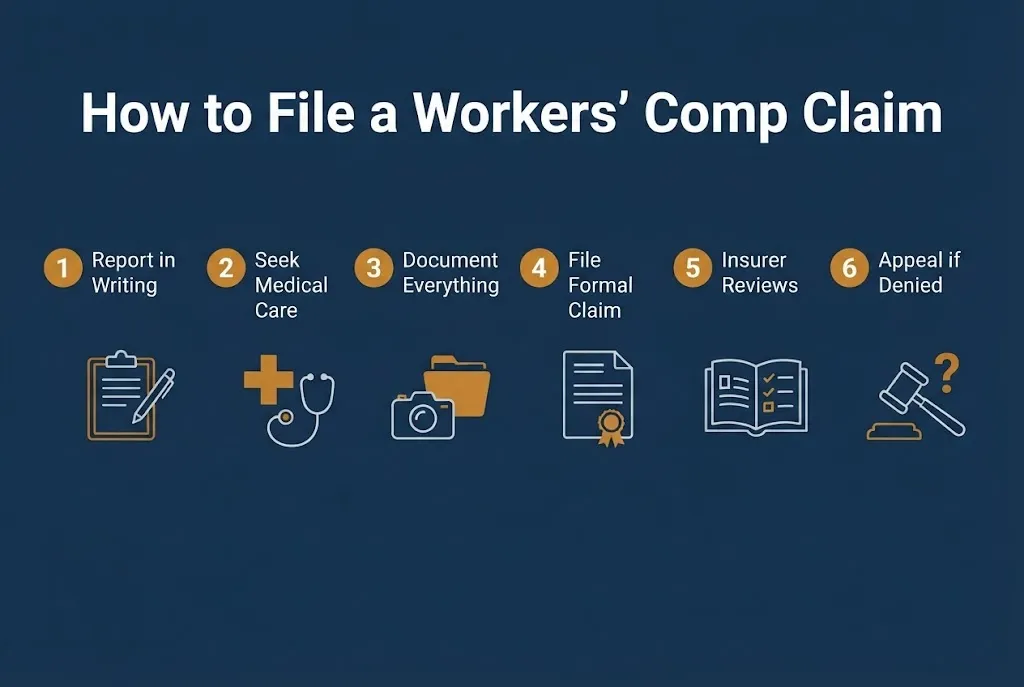
Here are the 6 steps to file:
- Notify your employer in writing of the injury and how it happened.
- Complete the state workers’ compensation claim form if required.
- Your employer files the claim with their insurance carrier.
- The insurer approves or denies the claim within 14 to 30 days in most states.
- If approved, you begin receiving medical care and wage benefits.
- If denied, you can appeal through your state’s workers’ compensation board.
You do not need a lawyer to file. But if your claim is denied or your injury is serious, legal help matters.
Can You Be Fired for Filing a Workers’ Compensation Claim?
No, firing you for filing a workers’ compensation claim is illegal retaliation.
Every state prohibits employers from retaliating against workers who file claims. That includes firing, demoting, cutting hours, or creating a hostile work environment.
If your employer retaliates, you may have a separate legal claim for wrongful termination or retaliation. That claim can include additional damages beyond workers’ compensation.
That said, the law does not protect you from being fired for legitimate reasons that exist independent of your claim. Document everything if you suspect retaliation.
Key Takeaway: Filing a claim is your legal right. Retaliation is illegal, but proving it requires documentation.
What Is the Difference Between Workers’ Compensation and a Personal Injury Lawsuit?
Workers’ compensation is a no-fault system. A personal injury lawsuit requires proving someone was negligent.
In workers’ compensation, you do not sue your employer. You file a claim. You give up the right to sue your employer for negligence in exchange for guaranteed benefits.
A personal injury lawsuit against a third party may be possible if someone other than your employer caused your injury. For example, if you were hurt by a defective machine, you might sue the manufacturer.
Third-party lawsuits can provide additional damages beyond workers’ compensation, including full lost wages and pain and suffering.
If you have a third-party claim, your workers’ compensation insurer may have a lien on any recovery. That means they get paid back from your lawsuit settlement.
What Types of Injuries Qualify for Workers’ Compensation?
Any injury that arises out of and in the course of your employment may qualify.
Here are common qualifying injury categories:
- Traumatic injuries from accidents, falls, or equipment
- Repetitive stress injuries like carpal tunnel or tendonitis
- Occupational illnesses from chemical exposure or other work conditions
- Mental health conditions in some states, though harder to prove
- Pre-existing conditions aggravated by work duties
The key test is whether the injury is work-related. If you were hurt while doing your job or because of your job, it likely qualifies.
What Is an Accident at Work Compensation Claim Worth?
The value of an accident at work claim depends on your medical costs, lost wages, and permanent impairment.
A minor accident with a full recovery might close for just medical bills and a few weeks of wage benefits. That could total $2,000 to $10,000.
A serious accident requiring surgery and causing permanent restrictions could be worth significantly more. Permanent impairment ratings drive settlement values up.
The table above in the settlement section gives general ranges. Your exact value depends on your state’s benefit schedule and your specific circumstances.
No state allows a fixed payout for pain and suffering in workers’ compensation. That is a personal injury lawsuit remedy, not a workers’ compensation benefit.
Key Takeaway: Workers’ compensation does not pay pain and suffering. That limitation keeps most settlements lower than personal injury jury verdicts.
What If Your Workers’ Compensation Claim Is Denied?
A denial is not the end. You can appeal.
Insurance companies deny claims for many reasons: the injury was not reported on time, the employer disputes the facts, or the insurer argues the injury is not work-related.
You have the right to challenge the denial through your state’s workers’ compensation board or commission. The process usually involves a hearing before an administrative law judge.
Here is the typical appeal path:
- File a formal appeal or petition with the state board.
- Attend a mediation or settlement conference.
- Present your evidence at a hearing.
- Receive a decision from the administrative judge.
- Appeal further to the state appeals board if necessary.
Having an attorney at this stage increases your chances. Appeals are technical and the insurance company will have lawyers.
How Long Does a Workers’ Compensation Settlement Take in 2026?
Most straightforward claims settle within 12 to 24 months.
The timeline depends on your recovery. You cannot negotiate a meaningful settlement until your medical condition stabilizes.
Here is a typical timeline:
| Stage | Timeframe |
| Injury and initial treatment | Day 1 to 30 |
| Claim approval or denial | 14 to 30 days |
| Medical treatment and recovery | 3 to 18 months |
| Maximum medical improvement | Varies by injury |
| Settlement negotiations | 1 to 3 months after MMI |
| Payout after settlement | 14 to 60 days |
Serious injuries with multiple surgeries take longer. Minor injuries resolve faster.
Key Takeaway: Settlements happen after your treatment ends, not before. Rushing the process leaves money on the table.
Should You Accept the First Workers’ Compensation Settlement Offer?
No, the first offer is often lower than what your claim is worth.
Insurance companies are businesses. Their adjusters are trained to settle claims for the least amount possible. The first offer is usually a starting point, not a final number.
Before accepting any settlement, you should:
- Confirm you have reached maximum medical improvement.
- Understand your permanent impairment rating.
- Calculate your future medical costs.
- Know the value of your wage loss and disability benefits.
- Consider whether a third-party claim exists.
Once you settle, you usually close your claim forever. Future medical care for the injury becomes your responsibility. That is why settling too early is dangerous.
What Is a Fall at Work Compensation Claim Worth?
A fall at work is one of the most common workplace injury claims. Its value depends on the injuries caused by the fall.
Falls can cause sprains, fractures, head injuries, and spinal damage. The more serious the injury, the higher the settlement.
A simple fall causing a wrist fracture might settle for $10,000 to $30,000. A fall causing a traumatic brain injury or spinal cord injury could be worth hundreds of thousands.
Falls from heights, like ladders or scaffolding, tend to produce more severe injuries and higher settlements. Same-level slips and trips are often less severe.
Documenting the fall scene, the cause, and any safety violations matters. That evidence can support a third-party claim if a property owner or equipment manufacturer was responsible.
Frequently Asked Questions
What should I do if I got hurt at work and my employer won’t report it?
File the claim yourself with your state’s workers’ compensation board.
Do not rely on your employer to protect your rights.
How long do I have to report a workplace injury?
Most states require reporting within 10 to 90 days.
Some states allow up to two years, but earlier is always better.
Can I see my own doctor for a workers’ compensation injury?
Some states allow you to choose your own doctor after an initial employer-selected visit.
Others require you to see an employer-approved physician for the life of the claim.
What if my injury was partly my fault?
Workers’ compensation is no-fault.
You are covered even if your own mistake caused the injury, with limited exceptions.
Do I have to pay taxes on a workers’ compensation settlement?
No, workers’ compensation benefits are generally not taxable.
This applies to both ongoing benefits and lump sum settlements.
Can I sue my employer for a workplace injury?
Generally no, workers’ compensation is your exclusive remedy against your employer.
You may have a third-party claim against someone other than your employer.
What is the highest workers’ compensation settlement ever paid?
Settlements in the millions are rare and usually involve catastrophic injuries.
Most settlements fall in the $10,000 to $100,000 range.
How much does a workers’ compensation lawyer cost?
Most charge a contingency fee, typically 15 to 25 percent of your settlement.
You pay nothing upfront and the fee comes out of your recovery.
If you are hurt at work, report the injury today. Do not wait for it to get worse or for your employer to act.
The system works, but it works on deadlines and documentation. The stronger your paper trail, the stronger your claim.