Mesothelioma Lawsuit Settlement 2026: Average Payouts, Eligibility, and How Claims Work
Quick Answer
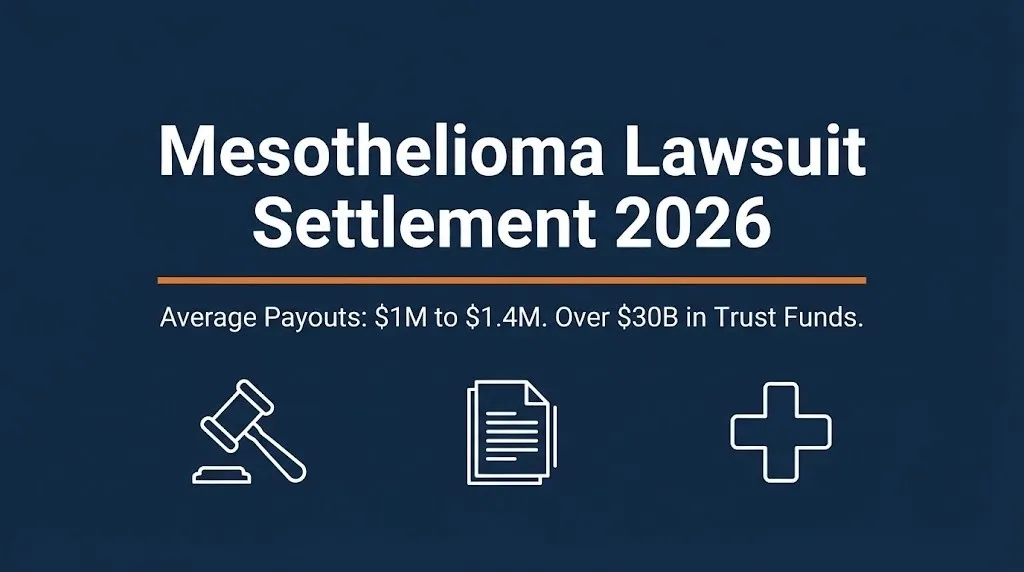
- Mesothelioma settlements are real. Over $30 billion is available across active asbestos trust funds.
- The average mesothelioma settlement ranges from $1 million to $1.4 million, based on verified industry data.
- There is no single claim deadline. Each trust fund and lawsuit has its own statute of limitations, usually 1 to 3 years from diagnosis.
If you or a family member received a mesothelioma diagnosis, you may have the right to seek compensation. This is not a class action with a claim form anyone can fill out. It is a legal process that requires specific evidence: medical records, work history, and proof of asbestos exposure.
This article explains how mesothelioma settlements actually work in 2026, what the average payout figures mean, which trust funds are still paying, how long the process takes, and what steps to take first. Every number comes from verified trust fund reports, court records, and industry data, not marketing materials from law firms.
The Facts
| Case | Mesothelioma personal injury and wrongful death claims |
| Status | Ongoing. Thousands of claims filed yearly. No single settlement. |
| Fund Size | Over $30 billion across active asbestos trust funds |
| Average Settlement | $1 million to $1.4 million per case (individual lawsuits) |
| Claim Deadline | Varies by trust fund and state statute of limitations |
| Administrator | Each trust fund has its own claims processor |
| Proof Needed | Medical diagnosis, work history, asbestos exposure evidence |
Is the Mesothelioma Settlement Process Real?
Yes. The mesothelioma compensation system is real. It is not a government program or a single class action settlement with a claim form. It is a network of asbestos bankruptcy trusts and active lawsuits against solvent companies.
Over 60 asbestos trust funds exist today. They were created when companies that manufactured or used asbestos filed for bankruptcy. Courts ordered those companies to set aside money for future victims. That money is real and accessible.
The trusts have paid out over $20 billion since the late 1980s. In 2024 alone, asbestos trusts paid an estimated $2.5 billion to claimants. These are not hypothetical funds. They write checks every month.
Separate from the trusts, thousands of mesothelioma lawsuits are filed each year against companies that are still in business. Many of those cases settle before trial. The average settlement in those cases falls between $1 million and $1.4 million, according to multiple industry reports and law firm disclosures.
The process is legitimate. The money exists. But it requires legal representation, documentation, and patience. No one sends you a check just because you search online.
Key Takeaway: The money is real. Over $30 billion sits in trust funds. Getting it requires a legal claim with evidence, not a simple online form.
What Is the Average Mesothelioma Settlement?
The average mesothelioma settlement in a lawsuit against a solvent company ranges from $1 million to $1.4 million. Trust fund claims typically pay less per trust but can be filed against multiple trusts.
These numbers come from aggregated data published by legal industry analysts, not from a single official source. No government agency tracks every settlement. The figures represent averages across thousands of resolved cases.
A settlement is not one check. Most claimants file against multiple trusts and multiple defendants. A single case might involve five to ten trust fund claims plus two or three lawsuits against active companies. Each pays separately.
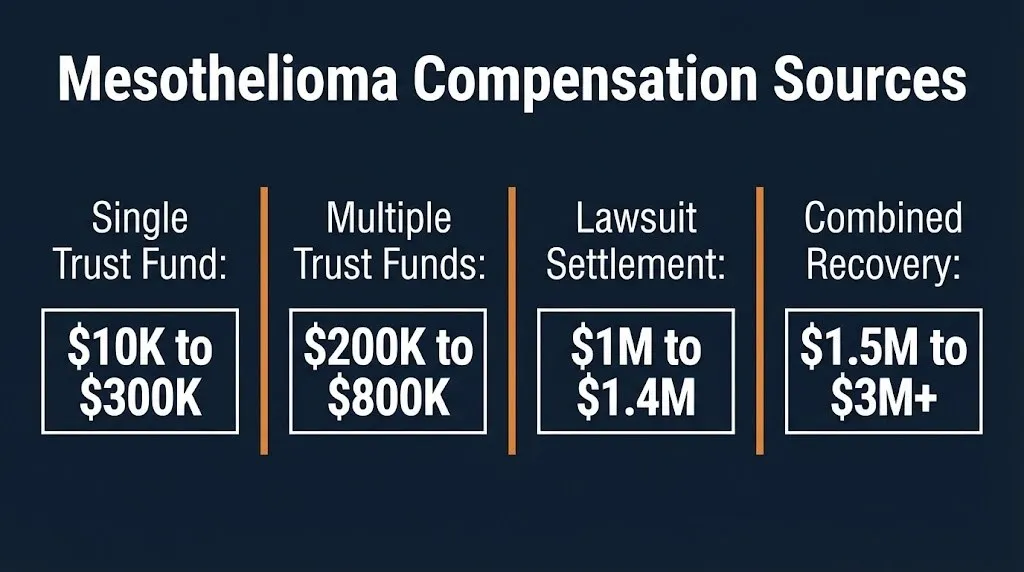
Here is how the compensation typically breaks down.
| Source | Typical Payout Range |
|---|---|
| Single asbestos trust fund claim | $10,000 to $300,000 |
| Multiple trust fund claims combined | $200,000 to $800,000 |
| Lawsuit settlement (pre-trial) | $1 million to $1.4 million |
| Trial verdict (if case goes to court) | $2 million to $10 million+ |
| Total combined recovery (trusts + settlement) | $1.5 million to $3 million+ |
These are averages. Your case depends on your diagnosis, your exposure history, the companies involved, your age, your state, and whether you file during your lifetime or your family files a wrongful death claim.
Key Takeaway: The average settlement cited in most articles refers to lawsuit settlements against solvent companies, not trust fund claims alone. Combined recoveries are often higher.
What Factors Determine a Mesothelioma Settlement Amount?
Every case is priced individually. There is no fixed formula. But specific factors consistently influence how much a case settles for.
Your diagnosis matters most. Mesothelioma cases generally settle for more than other asbestos-related diseases like asbestosis or pleural plaques. Epithelioid cell type cases tend to resolve faster and for higher amounts than sarcomatoid or biphasic types.
Your exposure history matters second. Cases with clear, well-documented exposure to a specific company’s product are stronger. Cases where the exposure is vague or the company has already gone bankrupt rely more on trust funds, which pay less.
Your age and health affect the value. Younger claimants with dependents often recover more because economic damages like lost wages and future medical costs are higher.
Your state’s laws affect everything. Some states have faster dockets and plaintiff-friendly procedures. Others have damage caps or stricter evidence rules. Where you file matters as much as what you file.
The defendant’s financial condition matters. A company on the verge of bankruptcy settles differently than a Fortune 500 manufacturer with deep insurance coverage.
Finally, your attorney’s experience matters. Law firms that regularly take mesothelioma cases to trial get higher settlements because defendants know they will not fold before a jury.
How Do Mesothelioma Trust Fund Claims Work?
Asbestos trust funds are not lawsuits. They are claims filed directly with a trust set up by a bankrupt company. The process is administrative, not judicial.
Each trust has a set of criteria called the Trust Distribution Procedures. These documents spell out what diseases are covered, what exposure evidence is required, and how much the trust pays for each type of claim.
Most trusts use a payment percentage system. The trust sets a scheduled value for each disease type, then applies a percentage to that value. If a trust’s scheduled value for mesothelioma is $300,000 and the payment percentage is 25%, the claimant receives $75,000.
Payment percentages change over time. Trusts adjust their percentages to ensure enough money remains for future claimants. A trust that once paid 40% might now pay 15% because its assets have been depleted.
Filing a trust claim requires specific documentation. Medical records confirming the diagnosis. A work history showing where and when exposure occurred. Product identification linking the exposure to the bankrupt company’s products. An attorney handles all of this.
Most claimants file against multiple trusts. An electrician might have been exposed to insulation made by Company A, gaskets by Company B, and brake linings by Company C. Each exposure supports a separate trust claim.
Which Asbestos Trust Funds Are Still Paying in 2026?
Over 60 trusts are active and accepting claims. The largest and most frequently accessed include the following.
| Trust Fund | Year Established | Current Payment Percentage (Approx.) |
|---|---|---|
| Johns Manville | 1988 | 5-10% |
| Owens Corning / Fibreboard | 2006 | 2-10% |
| United States Gypsum | 2006 | 15-25% |
| W.R. Grace | 2014 | 20-30% |
| Pittsburgh Corning | 2016 | 15-20% |
| Kaiser Gypsum | 2019 | 10-20% |
| DII Industries (Halliburton) | 2004 | 5-15% |
Payment percentages fluctuate. Trusts update their percentages periodically based on asset levels and projected future claims. The percentages listed are approximate ranges based on recent claimant reports and trust disclosures. Exact current percentages are confirmed during claim filing.
New trusts continue to form. Companies that used asbestos and later filed bankruptcy are still establishing trusts. The total number of active trusts grows by one or two per year.
Key Takeaway: The trust system is complex. An experienced mesothelioma attorney knows which trusts to file against, what evidence each requires, and what percentage each currently pays.
Mesothelioma Settlements vs. Trial Verdicts: Which Pays More?
Trial verdicts are larger on paper. They also take longer, cost more, and carry a risk of zero recovery. Most cases settle.
The median mesothelioma trial verdict is between $2 million and $3 million. Some verdicts exceed $10 million, especially when punitive damages are awarded. But a verdict is only worth the defendant’s ability to pay it.
Settlements are guaranteed. A settlement for $1.2 million paid within 60 days is often better than a verdict for $5 million that gets tied up in appeals for three years, then reduced on appeal, then collected in installments.
Defense attorneys know this math. They also know that mesothelioma cases are emotionally powerful before a jury. A 65-year-old Navy veteran with pleural mesothelioma is a compelling plaintiff. Companies settle to avoid that trial.
Roughly 95% of mesothelioma lawsuits settle before trial. The cases that go to verdict tend to involve defendants who refuse to negotiate or plaintiffs with unusually strong facts seeking maximum punitive damages.
The decision to settle or try a case belongs to the client. Your attorney advises. You decide.
How Long Does a Mesothelioma Settlement Take?
Most mesothelioma cases settle within 12 to 18 months from filing. Some resolve faster. Cases for living claimants with clear exposure histories and urgent medical needs often receive expedited treatment from courts and defendants.
Trust fund claims process separately. Some trusts pay within 60 to 90 days of a complete submission. Others take six months or more, especially if the claim requires additional review or the trust is processing a high volume.
Wrongful death cases filed by family members after the patient has died sometimes move more slowly. The medical evidence is already complete, but the procedural posture differs from a living plaintiff’s case.
Here is a typical timeline for a mesothelioma lawsuit that settles.
- Month 1 to 2: Attorney investigation, evidence gathering, complaint drafting.
- Month 3: Complaint filed. Defendant served.
- Month 4 to 6: Defendant answers. Discovery begins.
- Month 7 to 12: Depositions, document exchanges, settlement negotiations.
- Month 12 to 18: Settlement reached or trial date set.
- Post-settlement: Payment within 30 to 90 days.
Courts in certain jurisdictions move faster. Delaware, Illinois, and California have developed procedures to expedite terminally ill plaintiffs’ cases. Cases there can settle in six to nine months.
Who Is Eligible to File a Mesothelioma Claim?
Eligibility requires a confirmed mesothelioma diagnosis and a documented history of asbestos exposure. The diagnosis must come from a biopsy, not just imaging or symptoms.
Exposure can occur in many settings. Shipyards, construction sites, power plants, factories, automotive repair shops, and the military all involved heavy asbestos use for decades. Even secondary exposure, like a wife washing her husband’s asbestos-covered work clothes, may support a claim.
Veterans make up a disproportionate share of mesothelioma patients. Roughly 30% of all cases involve Navy or other military service. The Department of Veterans Affairs provides separate benefits for veterans with mesothelioma, independent of lawsuits and trust claims.
Smoking history does not disqualify you. Mesothelioma is caused by asbestos, not smoking. Lung cancer cases can be complicated by smoking history, but mesothelioma cases are not.
Family members may file wrongful death claims if the patient has passed away. The statute of limitations for wrongful death typically runs from the date of death, not the date of diagnosis.
Reality Check: A mesothelioma diagnosis alone does not guarantee compensation. You need evidence linking your disease to a specific product or worksite. Without that link, trust funds and defendants will deny the claim. This is why work history documentation is as important as medical records. If you cannot remember every job site from 40 years ago, that is normal. Attorneys use investigators and databases to reconstruct exposure histories. But the process requires honest, detailed information from you.
What Is the Statute of Limitations for Mesothelioma Claims?
The statute of limitations varies by state and claim type. For personal injury claims, the clock usually starts on the date of diagnosis. For wrongful death claims, it starts on the date of death.
Most states allow one to three years from diagnosis to file. Some states allow longer. A few allow less. Missing the deadline bars your claim permanently.
Trust fund claims follow the statute of limitations of the state where the claim is filed or where the exposure occurred. Some trusts also impose their own filing deadlines independent of state law.
Do not wait. The single biggest mistake mesothelioma patients make is delaying the call to a lawyer. Evidence gets harder to gather over time. Witnesses become unavailable. Companies destroy records. Your own health may decline to a point where giving a deposition becomes impossible.
The statute of limitations is not a suggestion. It is a hard legal deadline. Once it passes, no amount of sympathy or medical evidence revives the claim.
How Do I Start a Mesothelioma Lawsuit or Trust Claim?
The process begins with a single phone call to a law firm that handles mesothelioma cases. Everything after that is managed by the legal team.
- Contact a mesothelioma law firm. Most offer free consultations by phone or video.
- Provide your diagnosis details. Have your pathology report ready.
- Provide your work history. List every job, employer, and worksite you remember, with approximate dates.
- Provide your military service records if applicable. The DD-214 is particularly important for veterans.
- The firm investigates your exposure history. They identify which products you encountered and which companies made them.
- The firm identifies viable defendants and trust funds. Some companies are bankrupt, some are active, some have no remaining assets.
- Complaints are drafted and filed. You may need to provide a deposition about your work and medical history.
- Trust claims are submitted separately. Each trust receives its own evidence package.
- Settlement negotiations begin. Your attorney presents your case to each defendant or trust.
- You receive and approve or reject settlement offers. You make the final call on every offer.
The process sounds overwhelming. It is not your job to manage it. A dedicated firm handles every step. Your role is to provide honest, detailed information and to approve or reject settlement offers.
How Much Do Mesothelioma Lawyers Charge?
Mesothelioma law firms work on contingency. You pay nothing upfront. The firm covers all case costs, including filing fees, expert witnesses, depositions, and investigation.
If the firm recovers money for you, it takes a percentage. The standard contingency fee for mesothelioma cases ranges from 25% to 40% of the total recovery, depending on the stage at which the case resolves and the fee agreement you sign.
Case costs are reimbursed separately from the fee. If a firm spends $50,000 on experts and depositions, that amount is deducted from your recovery before the fee is calculated or after, depending on the contract.
If the firm recovers nothing, you owe nothing. This is the contingency model. It means the firm only gets paid if you get paid.
Some firms advertise “no fee unless you win.” That is industry standard for mesothelioma, not a special offer. Read the retainer agreement carefully before signing. Ask what the fee percentage is. Ask how case costs are handled. A reputable firm answers both questions directly.
What Is the Difference Between Mesothelioma Settlement and VA Benefits?
They are separate and independent. You can receive both.
The VA provides disability compensation, healthcare, and dependency benefits to veterans with service-connected mesothelioma. VA benefits are not a lawsuit settlement. They come from the government, not from asbestos companies.
VA disability ratings for mesothelioma are typically 100%, the maximum available. Monthly payments in 2026 for a veteran with a 100% disability rating range from roughly $3,700 to over $4,200 per month depending on dependents.
Filing a VA claim does not affect your right to file lawsuits or trust claims. These are separate pots of money from different sources. You do not have to choose.
Veterans with mesothelioma should pursue both paths: VA benefits through the Department of Veterans Affairs and compensation through the civil justice system. A mesothelioma law firm handles the civil claims. A VA-accredited claims agent or veterans service officer handles the VA claim.
Key Takeaway: VA benefits and civil settlements are independent. Receiving one does not reduce the other.
Are Mesothelioma Settlements Taxable?
Most mesothelioma settlement proceeds are not taxable. The IRS generally excludes personal injury settlements from gross income under Section 104(a)(2) of the tax code.
This exclusion applies to amounts received for physical injuries or physical sickness. Mesothelioma clearly qualifies.
Some portions of a settlement may be taxable. Punitive damages are generally taxable. Interest on a settlement paid over time may be taxable. Emotional distress damages not tied to physical injury may be taxable, though in mesothelioma cases these are almost always tied to the physical disease.
Wrongful death settlements follow similar rules. Compensation for the family’s loss is typically not taxable.
This is general information, not tax advice. You should consult a tax professional about your specific settlement. The attorney handling your case can also advise on structuring a settlement to minimize tax exposure.
What Happens Next After Filing a Mesothelioma Claim?
The timeline from filing to payment follows predictable stages. Each case is different, but the broad structure is consistent.
- First 90 days: Attorney investigation, complaint filing, trust claim preparation.
- Months 3 to 6: Defendant responses, initial discovery, trust claim submissions.
- Months 6 to 12: Depositions, medical expert reviews, initial settlement offers.
- Months 12 to 18: Negotiations continue, claims not settled move toward trial.
- Months 18 to 24: Most cases resolve. Complex cases or trial-bound cases extend longer.
- Post-resolution: Payment processing, typically 30 to 90 days after settlement execution.
Trust claims on a separate track may pay faster. Some trusts process claims in 60 to 90 days. Others take six months or more.
Expedited review is available in many jurisdictions for living claimants with terminal diagnoses. Courts recognize that time matters. Your attorney can request preferential scheduling.
Frequently Asked Questions
What is the average mesothelioma settlement in 2026?
The average mesothelioma lawsuit settlement ranges from $1 million to $1.4 million.
Trust fund claims pay less per trust, typically $10,000 to $300,000 each.
How long does it take to get a mesothelioma settlement?
Most cases settle in 12 to 18 months from filing.
Expedited cases for terminally ill plaintiffs can settle in six to nine months.
Do I need to go to court for a mesothelioma claim?
Most cases settle before trial. Roughly 95% never reach a courtroom.
You may need to give a deposition, which is sworn testimony outside of court.
Can family members file after a mesothelioma patient dies?
Yes. Spouses, children, and other heirs may file wrongful death claims.
The statute of limitations runs from the date of death, not diagnosis.
How many asbestos trust funds can I file against?
There is no limit. Most claimants file against five to fifteen trusts.
Each trust requires evidence linking your exposure to that company’s products.
Does smoking affect a mesothelioma claim?
No. Mesothelioma is caused by asbestos, not smoking.
Smoking history is relevant in lung cancer cases, not mesothelioma.
Are mesothelioma settlements taxable?
Generally no. Personal injury settlements for physical illness are excluded from income.
Consult a tax professional about your specific case.
What if I don’t remember every job where I was exposed?
That is normal. Mesothelioma law firms employ investigators who reconstruct exposure histories.
Provide whatever information you have, and the firm fills in the gaps.
The mesothelioma compensation system is not a single settlement with a claim form and a deadline. It is a network of trusts and active lawsuits that require specific evidence, experienced legal representation, and patience. The money is real. Over $30 billion sits in trust funds, and solvent companies continue to settle cases every month for an average of $1 million to $1.4 million.
If you or a family member received a mesothelioma diagnosis, the single most important step is the first one: a phone call to a qualified law firm. The statute of limitations is running. The evidence does not get easier to gather with time. The call is free. The consultation costs nothing. From that first conversation, everything else follows.