What Is a Negligent Security Lawsuit? 2026 Guide to Claims, Settlements and Payouts
Quick Answer
- A negligent security lawsuit is a real, individually filed injury case, not a class action with a shared payout pool.
- Verified 2024 to 2026 settlements and verdicts in these cases have ranged from roughly $500,000 to $21 million, depending on the injury and facts.
- There’s no single deadline: each state sets its own statute of limitations, and it runs from the date of the incident, not from any settlement announcement.
Negligent security means a property owner or manager failed to provide reasonable safety measures, like working locks, adequate lighting, or functioning security cameras, and that failure let a preventable crime happen. If you were hurt on someone else’s property because of that kind of gap, you may have grounds for a lawsuit. Whether you’d win, and how much you could recover, depends entirely on your state’s law and the specific facts of what happened.
This isn’t one lawsuit everyone can join. It’s a category of premises liability claim that gets filed thousands of times a year across the country, one victim and one property at a time. A 2026 jury in Duval County, Florida awarded more than $10 million to a man shot four times at a Jacksonville apartment complex, while a Philadelphia shooting victim settled confidentially for a seven figure sum the same year, after five other law firms had turned the case down. Those numbers show how differently these cases can resolve, even when the underlying facts look similar.
The Basics
| What it is | An individual premises liability lawsuit, not a class action |
| Who can be sued | Property owner, property manager, and sometimes the hired security company |
| Settlement fund | None. Payouts come from the defendant’s liability insurance or assets, case by case |
| Filing deadline | Set by each state’s statute of limitations, typically 1 to 4 years from the incident |
| Administrator | None. You or your attorney file directly in civil court |
| Proof needed | Evidence the property owner knew or should have known about a security risk and did nothing |
There’s no “Not yet confirmed” cell here because there’s nothing pending at a national level. Every one of these facts is a matter of how premises liability law generally works, not a status update on a specific fund.
Is a Negligent Security Lawsuit Legit?
Yes, negligent security is a recognized legal claim in every state, built on basic premises liability law. Property owners have a duty to keep their premises reasonably safe for people who are lawfully there, and that duty can include taking reasonable security steps when crime is foreseeable.
Courts don’t require a property to be crime-proof. They ask whether the owner knew, or should have known, about a pattern of danger and failed to respond reasonably. A landlord who ignores months of reported break-ins in a parking lot, then does nothing about broken gate locks, is in a very different legal position than one with no prior incidents at all.
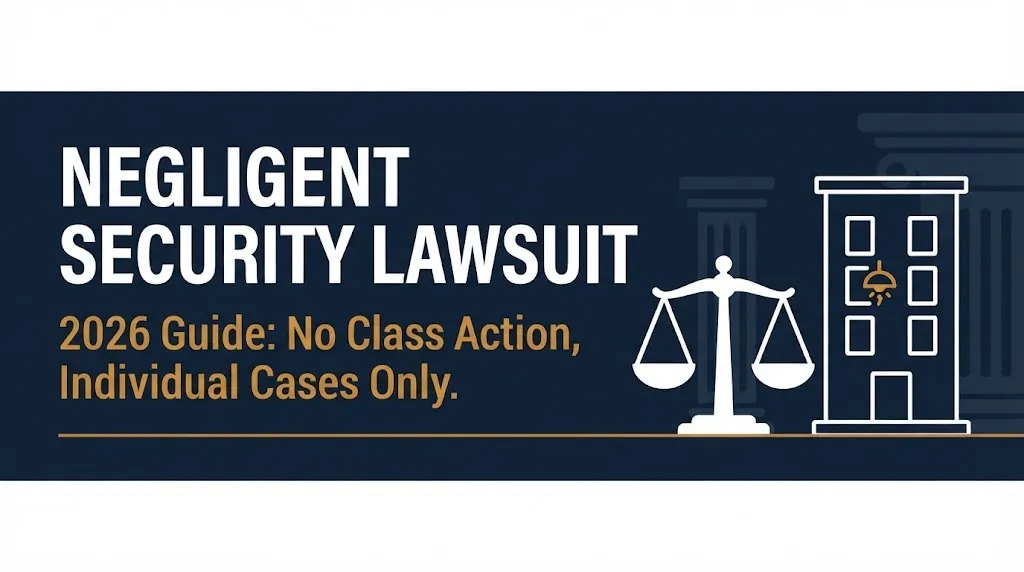
That’s why “foreseeability” is the term that shows up constantly in these cases. Attorneys and courts look at police call logs, prior incident reports, and even social media complaints to establish that the owner had notice.
Key Takeaway: Negligent security claims are real and long-established in premises liability law, but each one has to prove the property owner knew or should have known about the danger.
How Much Can You Get From a Negligent Security Lawsuit?
There’s no fixed payout because every case is negotiated or tried on its own facts. Verified recent outcomes show just how wide that range runs.
| Case (verified, plain text sources) | Outcome | Year |
|---|---|---|
| Broward County, FL wrongful death (Windward Vista) | $21 million settlement | Announced 2024 |
| Jacksonville, FL shooting, La Estancia Apartments | $10.01 million jury verdict | June 2026 |
| Philadelphia apartment shooting | Seven-figure confidential settlement | 2026 |
| New Jersey apartment complex shooting (Locks Law Firm case) | $2.8 million settlement | 2017 |
| California negligent security assault cases (general range) | Roughly $500,000 to $3 million+ | Ongoing |
Not yet determined for you specifically: none of these figures predict what any individual case is worth. Settlement value depends on medical costs, lost income, the strength of the foreseeability evidence, and the defendant’s available insurance coverage.
Attorneys who handle these cases generally look at three things when estimating value: the severity and permanence of the injury, how clearly the property owner ignored known risks, and how much liability insurance the defendant actually carries. A catastrophic injury against a well-insured commercial landlord tends to produce a very different number than a minor injury against an owner with a thin policy.
How Do You File a Negligent Security Lawsuit?
You file it yourself or through an attorney directly in civil court, there’s no separate claim form or administrator to submit anything to. The general process looks like this:
- Get medical treatment and keep every record tied to your injury.
- Request the police report from the incident.
- Document the security failure with photos: broken locks, missing lights, non-working cameras.
- Look for evidence of prior incidents at the same property (news reports, police call logs, prior lawsuits).
- Consult a personal injury attorney who handles premises liability cases.
- File the lawsuit before your state’s statute of limitations runs out.
- Go through discovery, where your attorney can subpoena the property’s security and incident history.
- Negotiate a settlement or proceed to trial if the property owner won’t offer fair value.
Key Takeaway: There’s no claim form or portal for negligent security cases. You (or your attorney) have to file directly in your state’s civil court system.
What Is the Deadline to File a Negligent Security Lawsuit?
The deadline is set by your state’s statute of limitations for personal injury or wrongful death claims, and it starts running on the date of the incident, not on any settlement news date. Most states set personal injury limits somewhere between one and four years, but the exact number varies significantly by state and by whether the claim is for injury or wrongful death.
Missing that window generally bars the claim entirely, regardless of how strong the evidence is. If you’re unsure of your state’s specific deadline, a licensed attorney in that state can confirm it, this article can’t give you a state-by-state legal answer without risking an inaccurate one.
Reality Check: no government agency or settlement website is going to text or email you about a “negligent security payout” you’re owed. These are individually filed lawsuits, so any message claiming you’re automatically eligible for money from a negligent security case is not how this process works. Filing a lawsuit costs nothing upfront in most personal injury arrangements, since attorneys in this field typically work on contingency, taking a fee only if you recover money.
Who Can Be Sued in a Negligent Security Case?
You can generally sue whoever controlled the property’s safety conditions, which is often more than one party. Common defendants include:
- The property owner
- The property management company
- The hired security company, if one was contracted and failed to perform
- In some cases, a master tenant or business operating on the property
The Broward County case illustrates why multiple defendants matter. Attorneys there secured $6 million from the security company’s policy limit and another $15 million from the property owner and manager, reaching $21 million total by pursuing every responsible party rather than just one.
Key Takeaway: Naming every responsible party, not just the property owner, is often what determines whether a settlement reflects the full value of the injury.
What Counts as Proof of Negligent Security?
Proof generally means showing the property knew about a danger and didn’t respond with reasonable safety measures. That typically requires documentation, not just an account of what happened.
Attorneys building these cases look for:
- Police call logs showing prior crimes at the same address
- Maintenance records showing broken locks, gates, or lights that went unrepaired
- Lease or property management records showing safety complaints from tenants
- Security company contracts showing what protection was promised versus delivered
- Expert testimony on what “reasonable” security should have looked like for that type of property
Without this kind of documentation, a case can struggle even when the injury itself is severe. That’s part of why five law firms reportedly declined the Philadelphia shooting case before one took it and eventually secured a seven-figure settlement: building the foreseeability evidence takes real investigative work.
What Types of Properties Get Sued for Negligent Security?
Negligent security claims arise most often at apartment complexes, but the same legal theory applies anywhere the public or tenants are invited onto a property. Common settings include:
- Apartment and condo complexes
- Hotels and motels
- Bars, nightclubs, and restaurants
- Shopping centers and parking garages
- Gas stations and convenience stores
- College dorms and off-campus housing
Parking lots and garages come up constantly in these cases because they’re often poorly lit, sit at the edge of a property’s camera coverage, and see a disproportionate share of violent incidents compared to the interior of a building.
How Long Does a Negligent Security Lawsuit Take?
Most negligent security cases take somewhere between one and three years from filing to resolution, though it varies with how contested the liability issue is. A case that settles early, once the defendant’s insurer sees strong foreseeability evidence, can move faster. A case that goes to trial, like the Jacksonville verdict that took roughly three years from the 2023 shooting to the June 2026 verdict, takes considerably longer.
Think of it the way you’d think about a delayed home insurance claim after storm damage: the stronger and more documented your evidence going in, the faster the insurer tends to move toward a real number instead of dragging out the investigation.
Do Negligent Security Cases Usually Settle or Go to Trial?
Most negligent security cases settle before trial, similar to personal injury litigation generally, but a meaningful share do proceed to a jury verdict when the property owner’s insurer disputes liability. The Jacksonville case above is a clear example of the trial path: the jury found the defendants fully responsible after hearing the evidence, rather than the case resolving through negotiation.
Settlement is usually faster and less risky for both sides. Trial becomes more likely when the defense believes it can defeat the foreseeability argument, or when the parties are far apart on what the injury is actually worth.
Do You Need a Lawyer for a Negligent Security Case?
You’re not legally required to have one, but these cases are heavily fact-dependent and hard to build without legal investigative resources. Establishing foreseeability usually requires subpoenaing records the property owner controls, something individual claimants generally can’t do on their own.
Most personal injury attorneys who handle these cases work on contingency, meaning you pay nothing upfront and the fee comes out of any recovery. That arrangement is worth confirming directly with any attorney before signing anything.
What Happens Next
- Ongoing: New negligent security lawsuits continue to be filed across the country as they arise from individual incidents; there is no single national case to track.
- Case-by-case: Verdicts and settlements will keep being reported individually, as with the 2026 Jacksonville jury verdict and the 2024 Broward County settlement.
- State-specific: Statute of limitations deadlines continue to run on a per-incident, per-state basis, unaffected by news coverage of other cases.
- Expected: As more properties adopt visible security measures like cameras and controlled entry, foreseeability arguments in future cases will increasingly hinge on documented gaps in that technology.
Frequently Asked Questions
Is there a negligent security class action lawsuit I can join?
No, negligent security claims are filed individually against the specific property where the injury happened.
There is no shared settlement fund or claims administrator for this category of case.
What is the average settlement for a negligent security lawsuit?
There is no single average, verified outcomes from 2024 to 2026 range from around $500,000 to $21 million depending on the injury and facts.
Severity of injury and the property owner’s insurance coverage are the two biggest factors in the final number.
How long do I have to file a negligent security lawsuit?
The deadline is set by your state’s statute of limitations for personal injury or wrongful death, generally one to four years from the incident.
An attorney licensed in your state can confirm the exact deadline that applies to your situation.
Can I sue an apartment complex for not having enough security?
You may be able to, if you can show the complex knew about a safety risk and failed to take reasonable steps to address it.
A pattern of prior crimes at the same property is typically central to that kind of claim.
Who pays a negligent security settlement?
Payment typically comes from the property owner’s or security company’s liability insurance policy, not directly out of pocket in most cases.
Cases with multiple defendants, like an owner and a hired security firm, can draw on more than one policy.
Do I have to pay upfront to file a negligent security lawsuit?
Most personal injury attorneys handling these cases work on contingency, meaning no upfront legal fees.
Confirm the fee arrangement directly with any attorney before signing a retainer.
What’s the difference between negligent security and premises liability?
Negligent security is one specific type of premises liability claim, focused on inadequate protection against foreseeable crime.
Premises liability more broadly also covers things like slip and falls, pool accidents, or structural failures.
Will I get a text or email if I qualify for a negligent security payout?
No, since there’s no shared fund or class list, there’s nothing to be automatically notified about.
Any unsolicited message claiming otherwise for this type of case should be treated with suspicion.
If you believe a property’s poor security contributed to an injury, the first practical step is documenting everything: the police report, your medical records, and any evidence of prior incidents at the same location. From there, a consultation with a personal injury attorney licensed in your state can tell you whether the facts support a claim, and what your specific state’s filing deadline looks like.