How Long Does a Personal Injury Lawsuit Take?
Quick Answer
- Claims settled without filing a lawsuit average 11.4 months from injury to payout.
- Cases that require a filed lawsuit average 21.4 months, and trials push that closer to 25.6 months.
- Every state sets its own filing deadline, ranging from 1 year to 6 years, so missing it can end your case.
You’re probably asking this question because your case is dragging on longer than you expected. That’s normal. National data shows the median personal injury claim without a lawsuit takes 11.4 months, and that number nearly doubles to 21.4 months once a lawsuit gets filed.
The timeline depends heavily on your injury’s severity and your state’s filing deadline. Miss your state’s statute of limitations, which runs as short as one year in a few states, and your claim is barred entirely, no matter how strong it is.
This article breaks down each stage of a personal injury case, why most of the wait happens before you ever see a courtroom, and what actually speeds things up. One detail that surprises people: about 95% of these cases settle before trial ever happens.
Fast Facts on Personal Injury Timelines
| Avg. time (no lawsuit filed) | 11.4 months |
| Avg. time (lawsuit filed) | 21.4 months |
| Avg. time (goes to trial) | Approximately 25.6 months from filing |
| Share that settle before trial | About 95% |
| Statute of limitations range | 1 year to 6 years, varies by state |
| Median settlement amount | Approximately $31,000 (varies widely by injury) |
| Biggest single delay factor | Waiting to reach Maximum Medical Improvement (MMI) |
These are national averages pulled from consumer legal surveys and court data, not guarantees. Your case could move faster or slower depending on your injury, your state, and whether the insurer disputes fault.
How Long Does a Personal Injury Lawsuit Take?
A personal injury lawsuit typically takes between 1 and 2 years from filing to resolution, though it can run longer if the case goes to trial.
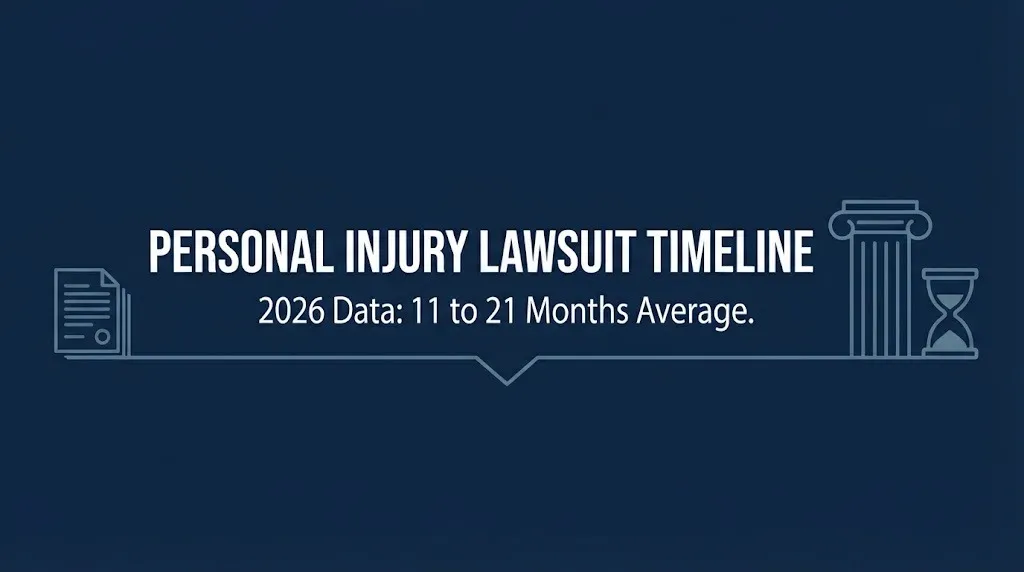
That’s the median, not a guarantee. Cases resolved through pre-suit negotiation, meaning no lawsuit was ever filed, average 11.4 months according to Martindale-Nolo’s consumer injury survey. Once a lawsuit is actually filed, the median jumps to 21.4 months.
Key factors that stretch a case longer:
- Disputed fault or liability
- Severe or ongoing injuries requiring years of treatment
- Multiple defendants or insurance carriers
- A crowded court docket in your jurisdiction
Think of it like a home renovation with a contested insurance claim. The simple jobs move fast. The ones where everyone’s pointing fingers over what’s covered take months longer, and this works the same way.
What Is the Personal Injury Settlement Timeline, Stage by Stage?
The personal injury settlement timeline runs through five general stages: treatment, demand, negotiation, litigation if needed, and resolution.
Stage 1: Investigation and medical treatment. Weeks to several months. Your attorney gathers evidence while you receive treatment.
Stage 2: Reaching Maximum Medical Improvement (MMI). This is usually the longest stretch. Attorneys typically wait until your doctor confirms you’ve healed as much as you’re going to, so the case reflects your full damages.
Stage 3: Demand letter and negotiation. Roughly 2 to 6 months. Your attorney sends a formal demand once MMI is documented.
Stage 4: Filing a lawsuit and discovery. If negotiation stalls, this phase runs 6 to 18 months and includes depositions and evidence exchange.
Stage 5: Mediation or trial. Usually the final 1 to 3 months, when most remaining cases resolve.
Key Takeaway: Most personal injury cases settle during Stage 3 or Stage 4, long before a courtroom is ever involved.
How Much Is the Average Personal Injury Settlement?
The average personal injury settlement is roughly $31,000 to $52,900, though the median is closer to $24,000 to $31,000 depending on which dataset you use.
Settlement value depends on injury severity far more than it depends on timeline. Serious injuries like spinal cord damage can average over $1.1 million, while minor soft-tissue claims often settle for a fraction of that.
| Data Source | Reported Average |
|---|---|
| FairSettlement.org (2023 Insurance Research Council data) | Median $31,000 (auto accident claims) |
| Rev 2026 industry report | $52,900 average |
| ConsumerShield September 2026 firm survey | $44,000 average (3 firms) |
| Brown & Crouppen sample of 4,500 cases | $37,248.62 average (car accidents) |
Not yet determined: your specific case value. These are national averages, not a prediction for any individual claim, and amounts depend entirely on your medical bills, lost wages, and evidence of fault.
Attorney representation matters here too. Represented claimants average $77,600 compared to $17,600 for people handling claims alone, according to Insurance Research Council data cited by FairSettlement.org.
How Long Does It Take Without Filing a Lawsuit?
Claims resolved without ever filing a lawsuit average 11.4 months from the date of injury to final settlement.
This path involves your attorney negotiating directly with the insurance company. No court, no judge, no discovery. It’s the fastest route when liability is clear and the insurer is cooperating.
Most of that 11.4 months is spent waiting for your medical treatment to conclude, not negotiating. Insurers typically won’t make a serious offer until they see your full medical picture.
How Long After Filing a Lawsuit Does a Case Take to Settle?
Once a lawsuit is filed, cases average 21.4 months from injury to resolution, according to Martindale-Nolo survey data.
Filing suit doesn’t mean you’re heading to trial. It usually means negotiations stalled and your attorney needs the formal discovery process, depositions, medical expert testimony, document requests, to build pressure toward a better settlement.
Numbered breakdown of what happens after filing:
- Defendant is served and has a set window to respond (usually 20 to 30 days by state rule).
- Written discovery begins, exchanging documents and interrogatories.
- Depositions of both parties and witnesses follow.
- Expert witnesses may be retained for medical or accident-reconstruction testimony.
- A mediation session is often scheduled before trial.
- Most cases settle at or before mediation.
- If not, the case proceeds toward a trial date.
How Long Does a Personal Injury Trial Take?
Trials add significant time, with cases that reach a verdict averaging around 25.6 months from filing, and some sources place filing-to-verdict timelines closer to 24 to 30 months.
Only about 1 in 20 personal injury cases, roughly 4% to 5%, actually reaches trial. The other 95% settle beforehand, because trial is expensive and unpredictable for both sides.
Reality Check: No legitimate attorney or insurer will pressure you to settle within days by claiming your case will “expire” tomorrow unless your state’s actual statute of limitations deadline is genuinely near. Contingency-fee lawyers don’t charge anything upfront, and anyone demanding a fee just to “review” your claim before you’ve hired them is not standard practice in this field.
What Is Maximum Medical Improvement and Why Does It Delay Settlement?
Maximum Medical Improvement, or MMI, is the point where your doctor determines your condition has stabilized and further treatment won’t significantly improve it.
Attorneys generally wait for MMI before settling, because settling early means giving up the right to seek more money later. If you settle before MMI and later need surgery, that cost typically comes out of your own pocket.
This is the single biggest reason personal injury cases take longer than people expect. A broken bone that heals in 8 weeks moves the case forward fast. A back injury requiring a year of physical therapy holds up the entire timeline.
Key Takeaway: The wait for Maximum Medical Improvement, not court delays, is usually the biggest reason your case is taking a while.
What Is the Statute of Limitations for a Personal Injury Claim?
The statute of limitations is the legal deadline to file a personal injury lawsuit, and it varies by state from 1 year to 6 years.
| Deadline Length | Example States |
|---|---|
| 1 year | Kentucky, Louisiana, Tennessee |
| 2 to 3 years | Most states |
| 6 years | Maine, North Dakota |
Missing this deadline generally ends your right to sue, regardless of how strong your case is. This deadline is the one hard date in this entire process, unlike everything else in a case, which moves on a rough estimate.
Checklist for tracking your deadline:
- Confirm your state’s specific statute of limitations for your injury type.
- Note the date the clock started, usually your injury date, though some states use discovery of the injury instead.
- Calendar the deadline the moment you decide to pursue a claim.
- Don’t assume ongoing negotiation with an insurer pauses the clock. It usually doesn’t.
How Can You Speed Up a Personal Injury Settlement?
You can speed up a personal injury settlement by finishing treatment promptly, keeping thorough records, and responding quickly to your attorney’s requests.
Steps that realistically shorten your timeline:
- Attend every scheduled medical appointment without gaps.
- Keep copies of all bills, receipts, and lost-wage documentation.
- Respond to your attorney’s document requests within days, not weeks.
- Avoid social media posts that could contradict your injury claims.
- Be available for scheduled depositions and mediation sessions.
None of these guarantee a faster payout. Insurance companies and court calendars control much of the timeline regardless of how organized you are, but disorganization on your end almost always adds delay.
Why Do Personal Injury Cases Take So Long?
Personal injury cases take a long time mainly because attorneys wait for full medical recovery before valuing the claim, and because courts require a lengthy discovery process once a lawsuit is filed.
It’s a bit like waiting for a delayed tax refund tied to an amended return. The paperwork alone doesn’t take long, but the review process behind it does, and rushing it usually costs you money in the end.
Insurance companies also have a financial incentive to delay. Every month a claim sits unresolved is a month they hold onto that money instead of paying it out.
Does Having a Lawyer Change the Timeline or the Payout?
Yes, hiring a lawyer generally increases your payout significantly, though it doesn’t necessarily shorten your timeline.
Represented claimants received an average of $77,600 compared to $17,600 for unrepresented claimants, a difference cited from Insurance Research Council data. That’s roughly 340% more.
Key Takeaway: Hiring an attorney tends to increase your settlement substantially, even though it usually doesn’t make your case move faster, because the extra time is often spent building a stronger claim.
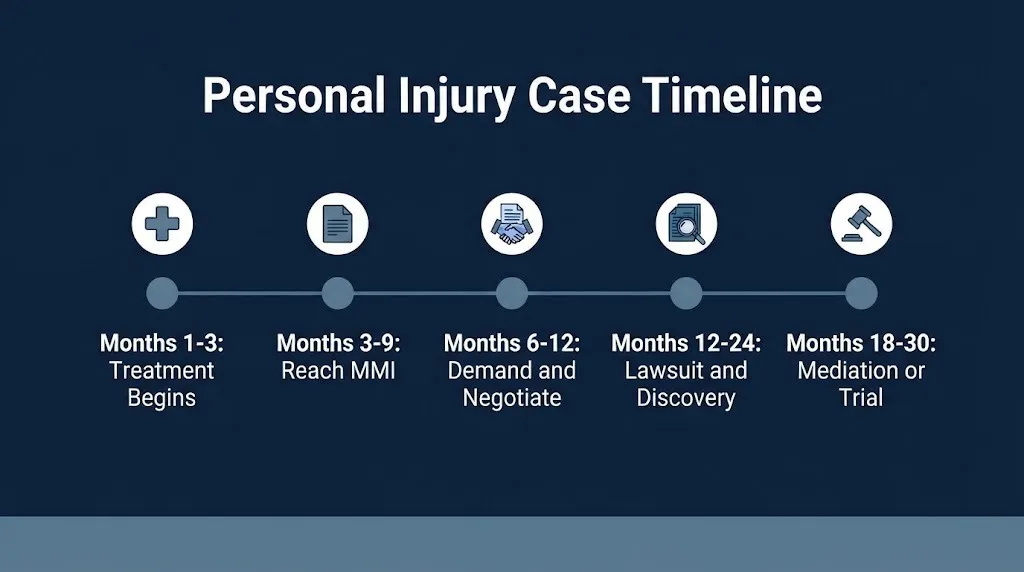
Where You Are Now: Typical Case Timeline at a Glance
Months 1 to 3: Initial treatment, evidence gathering, and injury documentation begin.
Months 3 to 9 (varies widely): Continued treatment until Maximum Medical Improvement is reached. This stage often determines your total timeline.
Months 6 to 12: Demand letter sent, negotiation with the insurance company begins.
Months 12 to 24 (if lawsuit filed): Discovery, depositions, and expert testimony proceed.
Months 18 to 30 (if unresolved): Mediation, and if still unresolved, trial.
Expected outcome: about 95% of cases resolve before ever reaching the final trial stage.
Frequently Asked Questions
How long does a personal injury lawsuit take on average?
Cases resolved without a lawsuit average 11.4 months.
Cases requiring a filed lawsuit average 21.4 months.
Trials add more time, pushing the average closer to 25 months from filing.
What is the fastest a personal injury case can settle?
Some straightforward cases with clear liability and minor injuries can settle in a few months.
This usually happens when the insurer accepts fault quickly and medical treatment concludes fast.
Severe injuries almost always take longer because of the wait for Maximum Medical Improvement.
Do most personal injury cases go to trial?
No, about 95% of personal injury cases settle before trial.
Only roughly 1 in 20 cases reaches an actual verdict.
Trial is generally a last resort when settlement negotiations fail.
What happens if I miss my state’s statute of limitations?
Your claim is almost always permanently barred if you miss the deadline.
Deadlines range from 1 year in some states to 6 years in others.
Courts rarely make exceptions, so this date matters more than any other in your case.
Why does my lawyer want to wait before settling?
Your lawyer likely wants to wait until you reach Maximum Medical Improvement.
Settling too early can mean losing the ability to recover costs for future treatment.
This wait is usually the single biggest reason a case takes longer than expected.
Does filing a lawsuit mean my case is going to trial?
No, filing a lawsuit does not mean your case is headed to trial.
Most filed lawsuits still settle during discovery or mediation, before any trial date.
Filing is often a negotiating tool to move a stalled claim forward.
How much will my personal injury case be worth?
That depends entirely on your specific injury, medical costs, and evidence of fault.
National averages range from roughly $24,000 to over $50,000, with severe injuries averaging far more.
No article or calculator can predict your case’s value without reviewing your actual medical and financial documentation.
Tracking your state’s statute of limitations is the one deadline in this process you can’t afford to miss. Beyond that, expect your timeline to hinge mostly on your medical recovery, not the court system.
If you’re actively pursuing a claim, calendar your filing deadline today and keep every medical and financial record organized as you go.