Injury Settlement 2026: Is Your Claim Real, How Much You Could Get, and When Payments Arrive
Quick Answer:
- Most injury settlement notices you receive by mail or email in 2026 are real court-ordered notices, not scams.
- Per-person payouts range from under $100 for data-breach-adjacent claims to six figures for serious physical injury cases.
- The single most important date is your claim deadline, which varies by case and is listed on the official settlement website.
If you received a notice about an injury settlement, you probably have two questions: is this real, and how much will I get. The answer to the first question is usually yes, these are court-supervised class actions or multidistrict litigation settlements, not random solicitations. The answer to the second question depends entirely on your specific injury, the total settlement fund, and how many people file valid claims.
This article covers injury settlements active in 2026, including Camp Lejeune payouts, Roundup claims, talcum powder cases, hernia mesh settlements, and the 3M earplug litigation. One surprising verified detail: the Camp Lejeune Justice Act claims have already paid over $4 billion to qualifying veterans and family members, but thousands of claims still await processing.
The Facts
| Detail | Information |
|---|---|
| Case Types | Camp Lejeune water contamination, Roundup (glyphosate), talcum powder (Johnson & Johnson), hernia mesh (multiple manufacturers), 3M Combat Arms earplugs, Exactech knee/hip implants |
| Status | Multiple settlements approved and paying; some still in appeals |
| Fund Size | Combined funds exceed $20 billion across all active injury settlements |
| Est. Per Person | Varies by case: $50,000 to $450,000 for Camp Lejeune; $5,000 to $250,000 for Roundup; $25,000 to $500,000 for talc; $10,000 to $1 million+ for mesh; $5,000 to $300,000 for earplugs |
| Claim Deadlines | Varies by settlement; Camp Lejeune filing window closes August 10, 2026; Roundup claims ongoing with no hard cutoff yet; 3M earplug registration deadline passed but late claims may be accepted |
| Administrators | Multiple: BrownGreer (Camp Lejeune), Archer Systems (Roundup), Epiq (talc), various for mesh |
| Proof Needed | Medical records, diagnosis documentation, proof of product use, military service records (Camp Lejeune, earplugs), implant records (mesh, Exactech) |
Is the Injury Settlement Notice I Received Legitimate?
Yes, most injury settlement notices you receive are legitimate court-ordered communications. These notices are required by federal and state judges to inform potential class members of their legal rights. A legitimate notice will always direct you to an official settlement website ending in .com or .org and will never ask you to pay a fee to file a claim.
Legitimate settlement administrators include companies like BrownGreer, Epiq, Kroll, JND Legal Administration, and Archer Systems. If your notice comes from one of these administrators, it is real. The notice will include a case name, a court where the case was filed, and a claim deadline. It will not ask for your Social Security number upfront, though some settlements require it later for tax reporting on larger payouts.
Scam notices do exist. A fake notice will often pressure you with a 48-hour deadline, ask for payment to “release funds,” or come from a Gmail address rather than the settlement administrator. No real settlement ever requires you to pay money to receive your payout. If you are unsure, do not click any link in the email. Instead, search the case name independently and compare the official website URL.
Key Takeaway: Legitimate settlement notices never charge a fee, always list a real court and case name, and come from known claims administrators rather than random email addresses.
How Much Money Can I Get From an Injury Settlement in 2026?
Injury settlement payouts in 2026 range from modest five-figure amounts to mid-six-figure awards depending on injury severity and the specific case. The Camp Lejeune Justice Act claims are currently paying between $50,000 and $450,000 for qualifying illnesses including kidney cancer, liver cancer, leukemia, and Parkinson’s disease. Roundup settlements continue to pay between $5,000 and $250,000 depending on diagnosis, duration of use, and whether the case resolved pre-trial or as part of the broader Master Settlement Agreement.
The dollar amount you receive depends on three factors. First, the settlement tier assigned to your injury, which is based on medical records and diagnosis codes. Second, the total number of valid claims filed, since most settlements divide a fixed fund among all qualified claimants. Third, your attorney’s contingency fee, typically 25 to 40 percent depending on the stage at which your case resolved and the specific fee agreement you signed.
Here is what verified payout ranges look like across the major active injury settlements in 2026:
| Settlement | Low-End Payout | High-End Payout | Based On |
|---|---|---|---|
| Camp Lejeune | $50,000 | $450,000+ | Illness tier, latency period |
| Roundup (NHL) | $5,000 | $250,000 | Diagnosis, usage duration |
| Talcum Powder | $25,000 | $500,000 | Ovarian cancer diagnosis, years of use |
| Hernia Mesh | $10,000 | $1,000,000+ | Complication severity, revision surgeries |
| 3M Earplugs | $5,000 | $300,000 | Hearing loss severity, service records |
| Exactech Implants | $50,000 | $350,000 | Revision surgery costs, recovery |
The high-end amounts typically go to claimants with the most serious documented injuries, often involving cancers, permanent disability, or multiple revision surgeries. Most claimants fall somewhere in the middle of these ranges.
Reality Check: No settlement formula guarantees a specific dollar amount. The “average payout” numbers you see in attorney advertising are marketing, not court-confirmed figures. Your actual payment will reflect your specific medical records and the claims administrator’s point system, not a headline number.
What Is the Camp Lejeune Settlement Paying in 2026?
The Camp Lejeune Justice Act settlement program has paid over $4 billion to veterans, family members, and civilian workers exposed to contaminated water at Camp Lejeune between 1953 and 1987. Payouts are structured by illness tier, with specific dollar ranges for each qualifying condition as of 2026.
The Elective Option, which lets eligible claimants bypass extended litigation, uses fixed payment amounts. Kidney cancer claims receive $150,000 to $350,000. Liver cancer claims receive $150,000 to $300,000. Non-Hodgkin’s lymphoma falls between $150,000 and $300,000. Leukemia pays $200,000 to $450,000. Parkinson’s disease claims receive $150,000 to $400,000. Bladder cancer, multiple myeloma, and other qualifying conditions fall into similar ranges with variations based on latency period and exposure duration.
Claimants who opt out of the Elective Option and pursue individual litigation may receive more, or less, than these fixed amounts. The Department of Justice has resolved thousands of claims, but the filing deadline of August 10, 2026, is now weeks away and will not be extended. You must have documentation showing you lived or worked at Camp Lejeune for at least 30 days during the contamination period, plus medical records confirming a qualifying diagnosis.
How Do I File an Injury Settlement Claim in 2026?
Filing an injury settlement claim follows a specific process that starts the moment you receive notice or become aware you may qualify. Each settlement has its own administrator and claim form, but the steps below apply to almost every personal injury class action or mass tort in 2026.
- Locate the official settlement website using the case name and administrator listed on your notice.
- Download the claim form and read every instruction before filling anything out.
- Gather your medical records showing the exact diagnosis code that matches the settlement’s qualifying conditions.
- Collect proof of product use or exposure: receipts, pharmacy records, military service records, employment records, or witness statements.
- Complete the claim form, matching every answer to your documentation exactly.
- Make copies of everything you submit, including the completed form and all supporting documents.
- Submit before the deadline using the method specified on the official website, typically online upload or certified mail.
- Save your confirmation number or certified mail receipt as proof of timely filing.
Missing documentation is the most common reason claims get delayed or denied. If the settlement requires proof of purchase and you do not have receipts, some administrators accept a sworn declaration or pharmacy printout. Check the FAQ on the official settlement website for alternatives if your documentation is incomplete.
Key Takeaway: Filing is free, the form is on the official settlement website, and the single biggest mistake is submitting incomplete medical records that do not match the qualifying diagnosis exactly.
When Will My Injury Settlement Check Arrive?
Settlement payment timelines in 2026 range from a few months after final approval to over a year depending on appeals and claims processing volume. The 3M earplug settlement began issuing payments in late 2025 and continues into 2026, with new claimant groups receiving funds on a rolling basis as they meet documentation thresholds. Camp Lejeune Elective Option claims typically pay within 60 to 90 days of claim approval.
The timeline from filing to payment follows a predictable path for most settlements. After you submit your claim, the administrator reviews it for completeness, which takes 30 to 90 days. If approved, your claim enters the payment queue. If the settlement has already received final approval and all appeals have resolved, you may receive payment within 60 to 120 days of approval. If appeals are still pending, you will wait until the appeals court rules, which can add 6 to 18 months.
Paper checks remain the most common payment method, but some 2026 settlements now offer digital payment options including Zelle, Venmo, or ACH direct deposit. The settlement notice or administrator’s website will tell you which payment methods are available. Always update your address with the administrator if you move while your claim is pending.
What Proof Do I Need for an Injury Settlement Claim?
Every injury settlement requires specific documentation that proves three things: you are the person entitled to file, you used or were exposed to the product, and you suffered a qualifying injury. The exact documents vary by case, but the pattern is consistent across all personal injury settlements in 2026.
For Camp Lejeune claims, you need DD-214 military service records or civilian employment records proving you were at the base for at least 30 days between 1953 and 1987. You also need medical records confirming a qualifying illness diagnosis. For Roundup claims, you need medical records showing a non-Hodgkin’s lymphoma diagnosis, plus any evidence of Roundup use such as receipts, store loyalty program records, or sworn testimony.
For talcum powder claims, you need medical records showing ovarian cancer diagnosis and documentation of talc product use. For hernia mesh claims, you need surgical records identifying the specific mesh product implanted, plus records of revision surgery or complications. For 3M earplugs, you need military service records and audiology reports documenting hearing loss or tinnitus. For Exactech implant claims, you need surgical records identifying the recalled implant and records of revision surgery if applicable.
| Settlement Type | Required Documentation |
|---|---|
| Camp Lejeune | DD-214 or civilian work records, medical records with qualifying diagnosis |
| Roundup | Medical records (NHL diagnosis), proof of Roundup use |
| Talcum Powder | Medical records (ovarian cancer), proof of talc product use |
| Hernia Mesh | Surgical implant records (specific product ID), revision surgery records |
| 3M Earplugs | Military service records, audiology reports |
| Exactech Implants | Implant records (recalled product), revision surgery documentation |
Key Takeaway: The claims administrator does not take your word for anything. Every assertion on your claim form needs a matching document, and missing documents are the top reason valid claims go unpaid.
How Are Injury Settlement Payouts Calculated?
Injury settlement payouts are calculated using a point system or tiered grid, not a fixed per-person amount. The settlement fund is divided among all valid claimants based on the severity of their injury, length of exposure or use, and the strength of their documentation. Understanding how this math works helps you set realistic expectations about your payout.
Most personal injury settlements use a formula that assigns points for each qualifying factor. A cancer diagnosis might earn 100 base points. Longer exposure duration might add 20 points. Younger age at diagnosis might add 15 points. Death might add 50 points for a wrongful death claim. The administrator totals each claimant’s points, then divides the available fund proportionally. If you have 120 points and the total points across all valid claims is 120,000, you receive 0.1 percent of the net fund.
Attorney fees reduce the gross payout. In most mass tort settlements, the contingency fee is taken from your award before you receive it. If your calculated share is $100,000 and your attorney fee is 33 percent, you receive $67,000 before any lien resolutions. Medical liens from health insurers or government programs like Medicare or TRICARE may further reduce your net payment, and lien resolution can add months to the payment timeline even after your claim is approved.
Can I Still File a Camp Lejeune Claim in 2026?
Yes, you can still file a Camp Lejeune claim in 2026, but the deadline is August 10, 2026. This is a hard statutory deadline set by the Camp Lejeune Justice Act. After this date, no new claims will be accepted. The Department of the Navy has confirmed there will be no extension, so if you or a family member lived or worked at Camp Lejeune between 1953 and 1987 for at least 30 days and received a qualifying illness diagnosis, you must act now.
Qualifying illnesses include kidney cancer, liver cancer, leukemia, non-Hodgkin’s lymphoma, bladder cancer, multiple myeloma, Parkinson’s disease, aplastic anemia, and several other conditions linked to the toxic water contamination at the base. The water at Camp Lejeune contained trichloroethylene (TCE), tetrachloroethylene (PCE), vinyl chloride, and benzene at levels far exceeding current safety standards. The government has acknowledged this contamination and established the settlement framework to compensate victims.
Filing requires the same documentation as described above: service or employment records proving presence on base, and medical records proving a qualifying diagnosis. You can file through the Department of the Navy’s Camp Lejeune Claims Unit or through a private attorney. If you file without an attorney, you keep 100 percent of your award but must navigate the process yourself.
What Happens If I Miss the Claim Deadline?
Missing a claim deadline in a personal injury settlement usually means you lose your right to compensation permanently. Courts enforce deadlines strictly because settlement funds are finite and administrators need finality to calculate and distribute payments. There are limited exceptions, but they are rare and not something you should count on.
For settlements that offer an exclusion or opt-out deadline, missing that deadline means you stay in the class and cannot file your own separate lawsuit. For settlements with a claim filing deadline, missing it means you get nothing, even if you clearly qualify. The Camp Lejeune filing deadline of August 10, 2026, is a legislative deadline, not a court-set deadline, making it even less flexible. Once the window closes, it closes for good.
Some settlements accept late claims if you can show you never received proper notice. This is uncommon and requires proving the administrator failed to notify you despite having your correct contact information on file. If you think you may qualify for a settlement, check the official website now, not later. Set a calendar reminder for the deadline and file early, since last-day technical problems with submission portals can cause problems that administrators are not required to accommodate.
Reality Check: Late claims are almost never paid. The one exception is when a settlement fund has money remaining after all timely claims are paid, which almost never happens in large injury settlements where funds are fully allocated. File on time or expect nothing.
What Is the Status of Roundup Lawsuits in 2026?
Bayer’s Roundup litigation continues in 2026 with thousands of claims still pending despite multiple settlement rounds totaling over $11 billion. The company has resolved most claims from the original wave of lawsuits, but new non-Hodgkin’s lymphoma diagnoses linked to glyphosate exposure continue to generate new filings. Bayer maintains that Roundup does not cause cancer, a position contradicted by the International Agency for Research on Cancer’s classification of glyphosate as a probable human carcinogen.
Current Roundup claims fall into two tracks. Pre-existing claims filed before the Master Settlement Agreement cutoff dates are being processed through the settlement program administered by Archer Systems. New claims filed after those cutoff dates enter a separate resolution process that may involve individual litigation rather than the class settlement framework. Payouts for settled claims continue to flow, with amounts varying based on diagnosis severity, exposure duration, and whether the claim resolved through the settlement program or through individual negotiation.
Bayer has also moved to reformulate its residential Roundup products, removing glyphosate from the consumer version sold in U.S. retail stores starting in 2023. The agricultural and professional versions still contain glyphosate, and claims related to those products continue to be filed by farmworkers, landscapers, and others with occupational exposure.
Key Takeaway: Roundup settlements are still paying in 2026, but new claims face a different and potentially more difficult path than claims filed during the original settlement window.
Are Talcum Powder Settlements Paying Out in 2026?
Yes, Johnson & Johnson’s talcum powder settlements are paying out in 2026, though the process has been complicated by the company’s use of bankruptcy tactics. J&J has attempted multiple times to resolve talc claims through a subsidiary bankruptcy, a strategy courts have rejected. In 2025 and 2026, the company shifted to negotiating individual and group settlements outside the bankruptcy framework, and thousands of ovarian cancer and mesothelioma claims have now been resolved.
Claimants with ovarian cancer linked to talc use receive settlements generally ranging from $25,000 to $500,000 depending on diagnosis specifics, duration of product use, and whether the claimant is still living. Mesothelioma claims, which are rarer but more directly linked to asbestos contamination in talc, typically settle for higher amounts, sometimes exceeding $1 million. The exact payout for any individual claim depends on the negotiated resolution and the claimant’s specific medical history.
New talc claims continue to be filed as women receive ovarian cancer diagnoses and trace potential causes. J&J stopped selling talc-based baby powder in North America in 2020 and globally in 2023, but exposure periods for most claimants date back years or decades earlier. If you used J&J talcum powder products for an extended period and received an ovarian cancer or mesothelioma diagnosis, you may still be able to file a claim through an attorney handling these cases.
What Are Hernia Mesh Settlement Payouts in 2026?
Hernia mesh settlements continue to pay out in 2026 across multiple manufacturers, with Bard, Ethicon, and Atrium products representing the largest pools of resolved claims. Payouts vary dramatically based on the severity of complications, number of revision surgeries, and whether the mesh was recalled. Claimants with multiple revision surgeries, chronic pain, and permanent injury receive the highest awards.
Bard hernia mesh settlements have resolved thousands of claims, with per-person payouts ranging from approximately $10,000 for minor complications to over $1 million for cases involving severe, permanent injury or death. Ethicon Physiomesh settlements fall into a similar range, though the average payout trends somewhat lower than Bard cases. Atrium C-Qur mesh settlements are more recent, and while individual case resolutions exist, a global settlement covering all claims has not yet been confirmed as of mid-2026.
The mesh product implanted in your surgery determines which settlement track you follow. You need your surgical records identifying the exact manufacturer and product name. Without this documentation, your claim cannot proceed, since each manufacturer settles claims separately and product identification is the first threshold requirement. If your surgeon no longer practices or the hospital has closed, you can often obtain records through the hospital system’s medical records office or your state’s health department.
What Is Happening With 3M Earplug Settlements in 2026?
The 3M Combat Arms earplug settlement is actively paying claimants in 2026, with over $4 billion allocated across more than 250,000 claims from veterans and active-duty service members. The settlement resolved allegations that 3M knowingly sold defective earplugs to the U.S. military, resulting in hearing loss and tinnitus for service members who used them during training and deployment between 2003 and 2015.
Payouts under the settlement range from approximately $5,000 for documented tinnitus without significant hearing loss to $300,000 or more for severe hearing loss requiring hearing aids. The average payout across all paid claims is around $20,000 to $25,000, though individual amounts vary based on audiology test results, length of service, and the specific hearing loss pattern documented in military medical records. Payment is being distributed in waves as claims are verified and approved.
The claim registration deadline has passed for the main settlement group, but some late claims may still be accepted depending on when you received notice and your specific circumstances. Veterans who served during the covered period and have documented hearing loss or tinnitus should check the official settlement website to determine if they can still file. The settlement administrator continues to process existing claims and issue payments on a rolling schedule throughout 2026.
What Happens Next
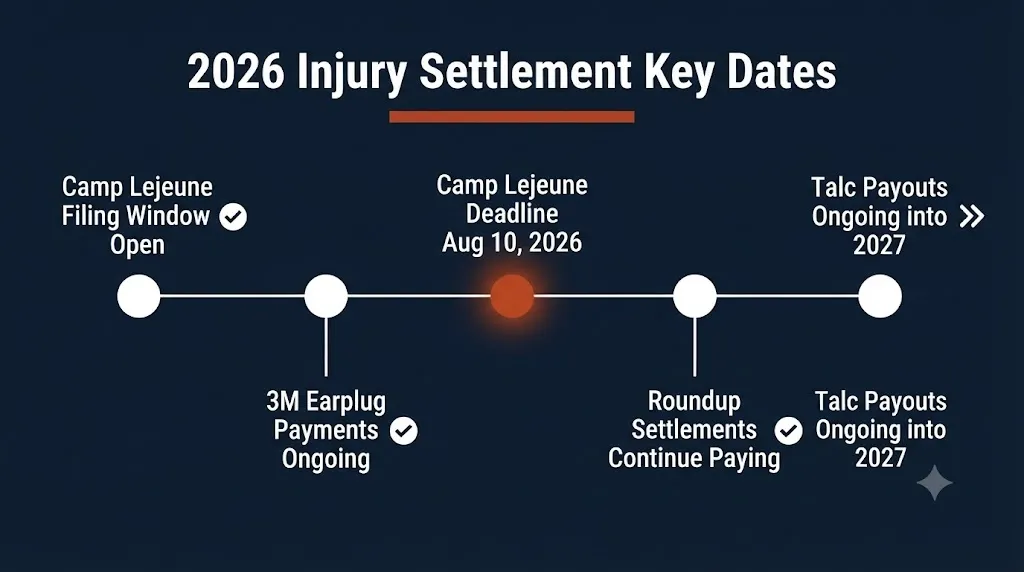
The remaining months of 2026 will bring significant developments in several injury settlements. Here is the expected timeline for the most active cases:
August 10, 2026: Camp Lejeune Justice Act filing deadline. No claims accepted after this date.
Late 2026: Continued 3M earplug payment distributions to verified claimants in processing waves.
Ongoing throughout 2026: Roundup settlements continue paying pre-Master Settlement Agreement claims while new claim processes evolve.
Expected Q4 2026: Possible global settlement framework announcements for remaining hernia mesh cases from smaller manufacturers.
2026 to early 2027: Talcum powder settlement payments continue as J&J resolves claims outside bankruptcy court.
Frequently Asked Questions
How Do I Know If My Settlement Notice Is Real?
Check that the notice lists a real court and case number and directs you to a .com or .org settlement website, not a .net or random domain.
Search the case name independently to verify the official site matches.
Never pay a fee to file a claim, legitimate settlements never require payment from claimants.
Do I Need a Lawyer to File an Injury Settlement Claim?
You do not need a lawyer to file if the settlement has a simple claim form and fixed payout tiers.
For complex mass torts like Roundup or talc, an attorney can maximize your award by advocating for a higher tier placement.
Attorneys take a percentage, so weigh the fee against the complexity of proving your claim.
How Long Does It Take to Get Paid After Filing?
For settlements already approved with no pending appeals, payment typically arrives within 60 to 120 days after your claim is approved.
If appeals are pending, payment may be delayed 6 to 18 months until the appeals court rules.
Camp Lejeune Elective Option claims pay fastest, usually within 60 to 90 days of approval.
Will My Settlement Payment Be Taxed?
Personal injury settlements compensating for physical injury or illness are generally not taxable under current IRS rules.
Punitive damages and interest earned on settlement funds are taxable.
Consult a tax professional, large settlements often trigger IRS reporting even if the underlying award is not taxable.
Can I File Multiple Injury Settlement Claims?
Yes, if you qualify for multiple settlements independently, such as a Camp Lejeune claim and a separate defective product claim.
Each settlement has its own eligibility criteria and filing process.
Filing one does not affect your eligibility for another unless the same injury is being compensated twice, which settlement agreements typically prohibit.
What If My Medical Records Are Incomplete?
Incomplete medical records are the most common reason for claim delay or denial.
Request a complete copy from your treating physician or hospital medical records office before filing.
If records no longer exist, some settlements accept a sworn affidavit from your treating doctor or other alternative documentation.
How Much Are Attorney Fees in Injury Settlements?
Contingency fees in mass tort and class action injury settlements typically range from 25 to 40 percent of your total recovery.
The specific percentage depends on whether your case settled early or went further into litigation.
Common benefit fund assessments may also apply, covering shared litigation costs across all claimants.
Is There a Camp Lejeune Tier 2 Payout Table?
Yes, Camp Lejeune Elective Option Tier 2 payouts cover intermediate latency periods and less severe presentations of qualifying illnesses.
Exact dollar figures depend on the specific illness and medical record details.
The official Navy CLJA website publishes current payout ranges, which have been updated as of July 2026.
Your next step is straightforward. If you have a notice, go directly to the official settlement website listed on it. If you think you qualify but received no notice, search the case name independently to find the correct site. Calendar the deadline now. Gather your medical records this week, not next month. The difference between being paid and being excluded often comes down to filing complete documentation before the deadline passes, not the strength of your underlying claim.
August 10, 2026, is the date that matters most right now. That is the Camp Lejeune filing cutoff, and it will not move.