YouTube Class Action Lawsuit 2026: Privacy Settlement Payouts, Claim Deadlines, and Who Qualifies
Quick Answer:
- YouTube privacy settlements are real court-approved class actions, not scams, with verified settlement administrators managing claims.
- Payouts vary: the COPPA children’s privacy settlement has paid up to $500 per child, while other tracking settlements paid smaller amounts.
- The most active claim deadline in 2026 applies to newer privacy cases, with some still accepting filings on a rolling basis.
You probably searched this because you saw a headline or a social media post about YouTube paying out settlement money. You want to know if there is cash waiting for you, whether the whole thing is legitimate, and what you need to do to get your share. The short version: yes, YouTube has been hit with multiple class action lawsuits over privacy violations, and some of those settlements are paying real money to real people in 2026.
This matters if you, or your child, watched YouTube in the last decade. One settlement already paid parents for their kids’ data being collected without consent. Another targeted adults tracked through YouTube’s ad systems. A third, newer case could affect an even broader group of users.
This article covers every active YouTube class action lawsuit in 2026, including who qualifies, how much you might get, how to file, and what deadlines you cannot miss. One surprising fact: a federal judge found YouTube’s parent company Google violated federal child privacy law on a massive scale, and the settlement that followed set a record for COPPA enforcement.
The Facts
| Detail | Information |
|---|---|
| Case | Multiple: In re YouTube Children’s Privacy (COPPA); Google Tracking class action; proposed YouTube ad-discrimination suits |
| Status | COPPA settlement: paying. Tracking settlement: paying. New privacy suits: in litigation |
| Fund Size | $170 million (COPPA/FTC settlement); $23 million (tracking referral settlement); additional cases pending |
| Est. Per Person | COPPA: $100 to $500 per child. Tracking: $30 to $100 per valid claim. New cases: not yet determined |
| Claim Deadlines | COPPA: claim period closed. Tracking: claim period closed. New suits: check official settlement site |
| Administrator | Rust Consulting (COPPA); various for newer cases |
| Proof Needed | COPPA required child’s channel information. Tracking required account proof. New cases: TBD |
Is the YouTube Class Action Lawsuit Legitimate?
Yes, the YouTube class action lawsuits are legitimate. They were filed in federal courts, overseen by U.S. District Court judges, and settled with court approval after years of litigation. The FTC and the New York Attorney General’s office were involved in the children’s privacy case, which is not something that happens with a scam. A scam does not get the federal government to sign off on a consent decree.
The most prominent case, the YouTube children’s privacy COPPA settlement, resulted from a joint action by the Federal Trade Commission and the New York Attorney General. Google agreed to pay $170 million. $136 million went to the FTC. $34 million went to New York state. A separate class action on behalf of parents was consolidated and handled through Rust Consulting, a major claims administrator that has run hundreds of federal settlements.
Smaller YouTube-related settlements include a $23 million Google referral tracking case that affected YouTube and other Google properties. That case alleged Google tracked users who clicked links in emails and search results without proper consent. The settlement administrator sent payments to verified claimants. If you received a check from that settlement, it was real, and cashing it does not waive rights to other claims you may have.
Key Takeaway: YouTube privacy settlements are verified, government-involved legal actions with real court oversight, and Rust Consulting is a legitimate administrator handling valid claims.
How Much Money Can I Get From a YouTube Settlement?
YouTube settlement payouts in 2026 vary from roughly $30 to $500 depending on which case you qualify for and how many people filed valid claims. The children’s privacy COPPA settlement paid parents up to $500 per child whose data YouTube collected without consent. The Google referral tracking settlement paid smaller amounts, typically between $30 and $100, because the $23 million fund was divided among a larger pool of claimants.
Actual payouts for the COPPA settlement exceeded initial expectations. When the settlement was announced, estimates suggested $100 to $300 per child. The final payments landed closer to $500 in many cases because fewer families filed than administrators anticipated. This is unusual. Most settlements see the opposite: more claims than expected, reducing per-person payouts to fractions of the original estimate.
For newer YouTube privacy lawsuits filed or pending in 2026, no payout amounts have been confirmed. These cases are still in litigation or early settlement negotiations. Estimates from legal analysts range from $50 to several hundred dollars per class member, but those numbers are speculative. The court has not approved a settlement fund, a claims administrator has not been appointed, and no payout formula exists yet. Anyone telling you a specific dollar amount for an unsettled YouTube case is guessing.
| Settlement | Fund Total | Typical Payout | Status |
|---|---|---|---|
| YouTube COPPA (Children’s Privacy) | $170 million ($136M FTC, $34M NY) | $100 to $500 per child | Paying |
| Google Referral Tracking | $23 million | $30 to $100 | Paying |
| New 2026 Privacy Filings | Not yet confirmed | Not yet determined | In litigation |
Reality Check: No one from a legitimate YouTube settlement will call, text, or email you promising a specific dollar amount. Scammers do that. The real administrator sends a check or an electronic payment with zero upfront contact beyond a mailed notice or an email directing you to an official .com settlement website. If someone asks for your bank password or a processing fee, it is a scam, period.
What Is the YouTube Children’s Privacy COPPA Settlement?
The YouTube COPPA settlement resolved allegations that Google collected personal data from children under 13 who watched YouTube, without first getting parental consent as required by the Children’s Online Privacy Protection Act. The FTC and New York AG argued that YouTube knowingly profited from kids’ data by serving targeted ads on child-directed channels and content.
The settlement required Google to pay $170 million, the largest COPPA penalty in history. It also forced YouTube to change how it handles children’s content. Channels must now designate whether their content is made for kids. If a video is marked as child-directed, YouTube cannot serve personalized ads on it. Comments, notifications, and other engagement features are limited. These changes affect creators, but they exist because of this lawsuit.
For parents, the private class action portion of the settlement compensated those whose children watched child-directed YouTube content while under 13 and had their data collected without consent. The claim deadline for that settlement has passed. If you filed a valid claim, you should have already received payment. If you did not file, you cannot file now. The settlement is closed to new claims.
What Is the YouTube Tracking Class Action Settlement?
The YouTube tracking settlement is part of a broader Google referral tracking case that alleged the company tracked users who clicked links in emails, search results, and other Google properties, including YouTube, without proper disclosure or consent. The $23 million settlement fund covered Google users whose data was collected through this mechanism during the class period.
This case did not focus exclusively on YouTube. It covered Google’s entire ecosystem. But YouTube was a significant part of the alleged tracking, since YouTube links shared via email and embedded on external sites triggered the same tracking systems. The settlement administrator verified claims and distributed payments. If you received a check for this case in 2025 or 2026, it is legitimate and yours to keep.
The claim deadline for this settlement has also passed. No new claims are being accepted. This is an important point: much of the online chatter about “YouTube settlement money” in 2026 refers to old settlements with closed deadlines. Knowing which case is actually active saves you from wasting time on a claim window that shut years ago.
Key Takeaway: Two major YouTube privacy settlements have already paid out with deadlines now closed, but new cases are active in 2026 with potentially broader eligibility.
Are There New YouTube Class Action Lawsuits in 2026?
Yes, new YouTube class action lawsuits have been filed in 2026. These cases target different aspects of YouTube’s data collection and advertising practices, and their claim deadlines remain open because the cases are still in early litigation stages. The most notable new filings allege that YouTube’s ad targeting discriminates against protected classes, including claims related to housing and employment ad delivery.
These lawsuits argue that YouTube’s ad platform allows advertisers to exclude certain demographics, violating fair housing and employment laws. The legal theory is similar to cases previously brought against Facebook, which resulted in settlements and changes to Meta’s ad systems. YouTube’s parent company Google faces parallel allegations. The cases are pending in U.S. District Courts, and no class has been certified yet.
Another group of 2026 cases challenges YouTube’s use of analytics and tracking pixels on third-party sites, alleging that YouTube collects viewer data even when the user is logged out or has not interacted with a YouTube embed. These cases are newer and less advanced than the ad discrimination suits. None have reached a settlement or been certified as class actions. Any articles claiming these cases will pay out specific amounts in 2026 are fabricating details the court records do not support.
Who Qualifies for a YouTube Privacy Settlement?
Qualifying for a YouTube privacy settlement depends on the specific case, and eligibility rules differ for each one. For the COPPA children’s privacy settlement, you qualified if you were the parent or legal guardian of a child under 13 who watched child-directed YouTube content and had their data collected without consent during the class period. The child did not need a YouTube account. Watching alone was enough.
For the Google referral tracking settlement, you qualified if you used Google services, including YouTube, during the class period and clicked links in emails or other Google-tracked contexts where your referral data was allegedly collected without proper consent. Eligibility was broader than the COPPA settlement, which is why individual payouts were smaller. More claimants meant a thinner slice of the $23 million fund.
For the newer 2026 cases, eligibility criteria have not been finalized because no classes have been certified and no settlements have been approved. If the ad discrimination cases proceed, eligibility may include users who were shown, or excluded from, housing or employment ads based on protected characteristics. If the tracking pixel cases advance, eligibility could include a wide swath of internet users who visited sites with embedded YouTube content. Until a judge certifies a class or approves a settlement, these descriptions are based on the complaints filed, not on court orders.
Key Takeaway: Eligibility depends on which case you are targeting, and only the older settlements have finalized rules; newer 2026 cases are still defining who is in the class.
How Do I File a YouTube Settlement Claim in 2026?
Filing a YouTube settlement claim in 2026 requires checking which cases are still accepting claims and following the process on the official settlement website for that specific case. Most older YouTube settlements have closed their claim windows. You cannot file for them now. For active 2026 cases, no claim forms exist yet because no settlements have been approved. Filing a claim now means waiting and watching, not filling out a form today.
When a new YouTube settlement does open for claims, the process will follow the standard pattern for federal class actions. The steps below explain what to expect, based on how the COPPA and tracking settlements worked.
- Wait for official notice by mail or email from the settlement administrator.
- Visit the official settlement website by typing the URL from the notice directly into your browser.
- Review the class definition and class period to confirm you are covered.
- Gather documentation if required, such as YouTube account details or proof of child’s age and viewing.
- Complete the claim form online or by mail before the posted deadline.
- Submit and save your confirmation number as proof of filing.
You cannot file a claim for a case that has not settled. You cannot file a claim for a case whose deadline has passed. These two facts eliminate most of the confusion and scam risk around YouTube settlements. Anyone offering to file a claim for you right now, for a fee, is taking advantage of uncertainty. The real process costs nothing and starts with a court-approved notice.
When Will YouTube Settlement Checks Be Mailed?
YouTube settlement checks from the COPPA and tracking cases have already been mailed. If you filed a valid claim in either of those settlements and have not received payment, you should check the official settlement website for your claim status. The administrators, Rust Consulting for the COPPA case and the tracking settlement administrator, maintain claim lookup tools that show whether your payment was issued, returned, or is still processing.
For the COPPA settlement, payments were distributed primarily through digital methods including PayPal and Venmo, with paper checks as a secondary option. For the tracking settlement, payments went out as checks and electronic transfers in multiple waves throughout 2025 and early 2026. A small number of claims remain under review due to documentation issues. If your claim is still pending, the settlement website is the only place to get a real status update.
For new 2026 lawsuits, no payments have been scheduled because no settlements have been reached. This is the single most important fact to remember when you see social media posts claiming “YouTube is sending checks now.” Those posts are recycling old news or fabricating new details. Settlement checks arrive only after final approval, appeals resolution, and claim processing, a process that takes at least 12 to 18 months from the settlement date.
Key Takeaway: Old YouTube settlement checks are already out. New YouTube settlement checks do not exist yet. Check the official administrator’s site for claim status, not social media.
Why Was YouTube Sued in a Class Action?
YouTube faced class action lawsuits primarily because of privacy violations. The strongest and most successful cases alleged that YouTube collected personal data from users, especially children, without the legally required consent. Federal law, specifically COPPA, requires platforms to get verifiable parental consent before gathering data from children under 13. YouTube did not do that, and the evidence in court showed the company knew its platform was popular with kids.
Internal Google documents revealed during the FTC investigation showed that YouTube executives understood the platform was the number one online destination for children. Marketing materials pitched YouTube to toy companies as a replacement for Saturday morning cartoons. At the same time, YouTube told the public and regulators that its platform was not for children. That contradiction is why the FTC and state AGs pursued the case so aggressively.
The tracking lawsuits argued a different theory: that Google embedded tracking code in YouTube links shared across the web, collecting user data even when the user had no direct interaction with YouTube. The new 2026 cases add another layer, alleging that YouTube’s ad targeting systems violate civil rights laws by allowing advertisers to exclude protected groups from housing, employment, and credit offers. Each case targets a different aspect of YouTube’s data and advertising machinery, but they all share a common thread: the allegation that YouTube collected or used data in ways the law forbids.
What Did YouTube Do Wrong in the Privacy Lawsuits?
YouTube’s main violation in the privacy lawsuits was collecting data from children without parental consent. The FTC found that YouTube knowingly gathered persistent identifiers, viewing histories, and device information from kids watching child-directed channels. YouTube then used that data to serve targeted ads, generating revenue from children’s attention without meeting the legal requirements that protect children’s privacy online.
The harm was not theoretical. Targeted advertising to children is restricted because kids cannot distinguish ads from content and cannot meaningfully consent to data collection. When YouTube profiled young viewers and sold their attention to advertisers, it created permanent data trails attached to those children. Those profiles follow them as they grow up, feeding into Google’s broader advertising ecosystem. The COPPA settlement attempted to stop this cycle for YouTube, though critics argue enforcement remains uneven.
In the tracking cases, the alleged wrong was different. YouTube and Google tracked users across the internet through referral links, building behavioral profiles even when users took steps to limit tracking. The legal theory argued this violated wiretap laws and state privacy statutes. The $23 million settlement resolved those claims without a trial or admission of wrongdoing. Google denied the allegations while agreeing to pay.
How Do YouTube Privacy Settlements Compare to Other Tech Settlements?
YouTube privacy settlements sit in the middle of the tech settlement landscape. The $170 million COPPA penalty was record-setting for child privacy enforcement. The $23 million tracking settlement was modest compared to the $5 billion FTC fine Google paid for broader privacy violations or the $725 million Facebook privacy settlement. YouTube cases tend to settle for less than headline-grabbing Facebook or TikTok settlements because the alleged violations, while serious, affected narrower groups or specific practices rather than platform-wide data harvesting.
Facebook’s $725 million Cambridge Analytica settlement paid eligible users roughly $30 to $50 each. TikTok’s $92 million privacy settlement paid similar per-person amounts. The YouTube COPPA settlement paid more per claimant, up to $500, because the class was smaller and the harm was more clearly defined: data collection from children is a bright-line violation that regulators and courts treat with particular seriousness.
| Tech Settlement | Total Fund | Per-Person Payout |
|---|---|---|
| Facebook Cambridge Analytica | $725 million | $30 to $50 |
| TikTok Privacy | $92 million | $25 to $100 |
| YouTube COPPA | $170 million | $100 to $500 |
| Google Tracking | $23 million | $30 to $100 |
| New YouTube 2026 Cases | Not yet confirmed | Not yet determined |
Reality Check: Tech settlements almost never pay thousands of dollars per person. The funds are large, but the classes are larger. A $170 million fund divided among 300,000 claimants works out to roughly $566 per person before fees. That math, not viral headlines, is what controls your actual payout.
What Are the YouTube Ad Discrimination Lawsuits About?
The YouTube ad discrimination lawsuits, filed in 2025 and early 2026, allege that YouTube’s advertising platform allows advertisers to exclude users from seeing housing, employment, and credit ads based on protected characteristics like race, gender, age, and family status. Federal fair housing and equal employment laws prohibit this kind of targeting. The lawsuits argue YouTube’s platform makes it possible and that Google profits from the discrimination.
These cases follow the legal blueprint established by similar lawsuits against Facebook. Meta settled with the ACLU and other civil rights groups in 2019, agreeing to change how its ad platform handles housing, employment, and credit ads. The YouTube cases seek similar remedies: platform changes, a settlement fund, and oversight of Google’s ad targeting systems. The cases are in early stages. No class certification. No settlement. No payout estimates.
If these cases succeed or settle, the eligible class could be large. Any U.S. user who was shown, or not shown, a housing, employment, or credit ad based on a protected characteristic during the class period could qualify. But until a judge approves a class definition, that description is based on the complaints, not a court order.
How Can I Check My YouTube Settlement Claim Status?
You can check your YouTube settlement claim status by visiting the official settlement website for the specific case you filed under and using the claim lookup tool. For the COPPA settlement, the administrator Rust Consulting maintains a claim status portal. You need the claim ID or confirmation number from when you filed. Without that, the lookup process is slower and may require contacting the administrator by phone.
For the Google tracking settlement, the settlement website also offers a claim status lookup. Enter your claim details and the system shows whether your claim was approved, paid, denied, or is still under review. If your check was mailed but returned as undeliverable, the status tool will show that too, and you can update your address. This is the single most common issue with undelivered settlement checks: the claimant moved and never told the administrator.
Do not search for your claim status on third-party sites. Only the official settlement administrator can tell you whether your claim was received, approved, and paid. Scam sites that ask for your Social Security number or bank login to “check your settlement status” are phishing operations. The real status check requires only your claim ID and maybe your name and zip code.
Key Takeaway: Official settlement sites are the only place to check claim status. Third-party sites asking for sensitive information are scams.
What Happens Next
The YouTube class action landscape in late 2026 will likely include developments in the ad discrimination and tracking pixel cases. Here is what to watch in the coming months:
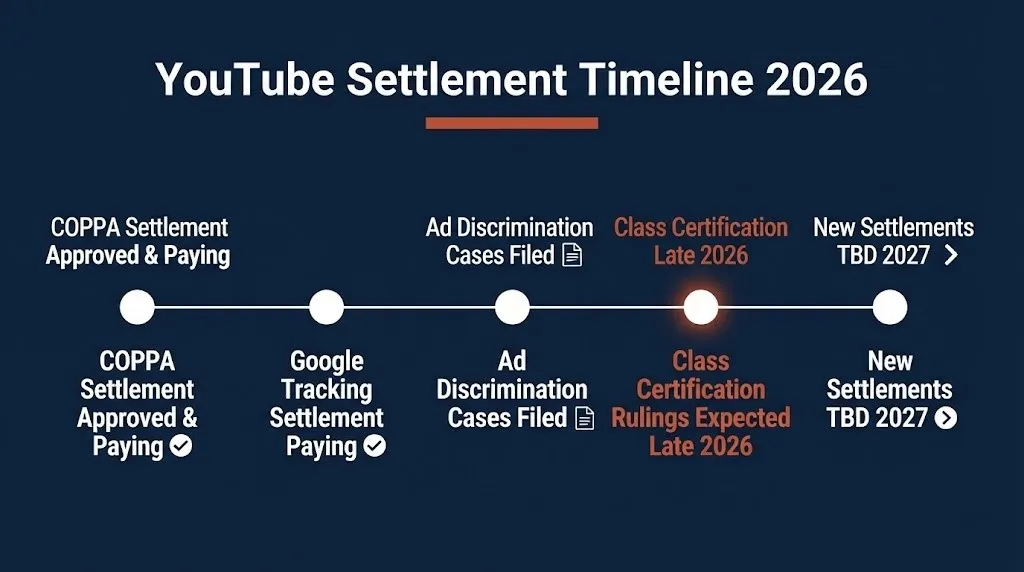
Late 2026: Expected rulings on class certification in the YouTube ad discrimination cases. If certified, a class definition and class period will be published.
Early 2027: Possible preliminary settlement announcements if the ad discrimination cases follow the Facebook pattern and settle before trial.
Ongoing: Tracking pixel lawsuits against YouTube and Google continue through discovery. No trial dates set as of July 2026.
Watch for: Official settlement notices from court-appointed administrators like Rust Consulting, Epiq, or JND Legal Administration. These are the only legitimate sources of claim information.
Frequently Asked Questions
Is There a YouTube Class Action Settlement in 2026?
Yes, there are active YouTube class action lawsuits in 2026, but older settlements with closed deadlines are not accepting new claims.
New cases target ad discrimination and tracking practices and have not yet reached settlements.
Check the official settlement website for any case you receive notice about.
How Do I Know If I Am Part of the YouTube Settlement?
You are part of a settlement if you fit the class definition and class period listed on the official settlement website for that specific case.
For closed settlements, eligibility was determined at filing and cannot be established now.
For active cases, class definitions have not yet been finalized by the court.
Will I Get a Check From the YouTube Lawsuit?
If you filed a valid claim in the COPPA or tracking settlements, you should have already received payment.
If you did not file a claim, you will not receive a check from those closed cases.
New 2026 cases have no checks to send yet because no settlements have been approved.
How Much Will the YouTube Settlement Pay?
Closed settlements paid $100 to $500 per child for COPPA and $30 to $100 for the tracking case.
New cases have no confirmed payout amounts because no settlement funds exist yet.
Any specific dollar figure for unsettled cases is speculation, not verified fact.
Can I Still File a Claim for the YouTube Privacy Lawsuit?
For the COPPA and tracking settlements, no, the claim deadlines have passed and no new claims are accepted.
For new 2026 lawsuits, claim forms do not exist yet because no settlements have been approved.
Watch the official settlement administrator’s website for announcements when a settlement is reached.
What Is the YouTube Class Action Lawsuit Settlement Date?
The COPPA settlement received final approval years ago and payments have been distributed.
The tracking settlement is also in the payment phase, not the claims acceptance phase.
New 2026 cases have no settlement date yet because they are still in litigation.
How Long Does It Take to Get a YouTube Settlement Check?
For closed settlements, approved claims were paid within 90 to 180 days of final approval and claims processing.
For new cases that have not settled, no timeline exists because no settlement has been reached.
Once a settlement is approved, expect at least 12 to 18 months before payments begin.
Is the YouTube Children’s Privacy Settlement Real?
Yes, the YouTube children’s privacy COPPA settlement is real, court-approved, and has paid out verified claims through Rust Consulting.
The FTC and New York Attorney General brought the case, which gives it government enforcement credibility beyond a private lawsuit.
The claim deadline has passed and no new claims are being accepted for this settlement.
Your next step depends on which YouTube settlement you are interested in. If you filed a claim in a closed case, check your status on the official administrator’s website. If you are waiting for a new 2026 case to settle, there is nothing to file yet and anyone asking you for money to file now is not legitimate. Bookmark the court-approved settlement websites for active cases, not third-party blogs or social media accounts.
The only reliable source for claim deadlines, payout amounts, and filing instructions is the official settlement administrator. Everything else is noise.