Temu Lawsuit 2026: Data Privacy Claims, Class Actions, and What Shoppers Need to Know
Quick Answer
- Is it real? Yes, verified class action lawsuits allege Temu collected user data without proper consent and engaged in deceptive business practices.
- How much? No settlement fund is confirmed; per-person payout amounts are not yet determined in any court-approved agreement.
- Deadline: No public claim deadline exists yet; monitor official court dockets for any settlement announcement before filing anything.
The Temu lawsuit refers to several active class action complaints filed against Temu and its parent company, PDD Holdings, in U.S. federal courts. Verified complaints allege the app collected sensitive consumer data without adequate disclosure, including location data, contact lists, and device information, and transmitted that data to servers in China. These are not rumors. They are documented in federal court filings.
If you downloaded the Temu app, made purchases on the platform, or created an account, you may fall within the class definitions described in active complaints. No settlement administrator has been appointed and no claim form is open as of October 2026. Cases remain in early litigation stages.
This article covers every verified legal action against Temu in 2026, what the complaints actually allege, and what you should do if you believe your data was affected. One detail most coverage misses is that Temu’s app was flagged by cybersecurity researchers at Grizzly Research in 2023, and those findings directly informed the class action complaints now working through federal court.
The Facts
| Feature | Details |
|---|---|
| Case | Multiple class actions vs. Temu / PDD Holdings Inc. |
| Status | Active litigation, early pre-trial stages |
| Fund Size | Not yet confirmed |
| Est. Per Person | Not yet determined |
| Claim Deadline | TBD, watch official court notices |
| Administrator | Not yet appointed |
| Proof Needed | Temu account registration, app download, purchase history |
Is the Temu lawsuit real or just a social media rumor?
The Temu lawsuit is real. Multiple verified class action complaints have been filed in U.S. federal courts against Temu’s operating entity and its parent company, PDD Holdings Inc. These are publicly accessible court filings, not social media speculation.
The complaints were filed by consumer protection law firms on behalf of U.S. users who allege the Temu app harvested personal data far beyond what any shopping application needs to function. Allegations include unauthorized access to microphone data, contact lists, location information, and browsing history. Plaintiffs argue this constitutes violations of federal wiretapping statutes, state consumer protection laws, and data privacy regulations.
PDD Holdings, the Chinese technology conglomerate behind Temu, also owns Pinduoduo, a Chinese e-commerce platform. Pinduoduo’s app was suspended from the Google Play Store in March 2023 after Google identified malware in the application. Plaintiffs in the Temu suits cite this as context for their data security claims, arguing the same corporate parent had a prior history of app-based data exploitation.
Is there a Temu settlement claim you can file right now?
There is no Temu settlement claim process open to the public as of October 2026. This is the most important fact to state clearly, because several misleading third-party websites suggest otherwise. No court has approved a Temu settlement. No administrator has launched a claims portal. No deadline has been set.
What exists right now are active lawsuits in pre-trial stages. Settlement negotiations, if they are occurring, are happening privately between attorneys. Courts do not require companies to disclose settlement talks. You will know a real settlement is approved when a federal judge issues a preliminary approval order and an administrator publishes an official notice.
If you see a website today claiming you can file a Temu settlement claim for $50, $100, or any specific amount, that site is not legitimate. No such fund exists on any verified court record as of this date. Bookmark this page and return when a real announcement is made.
How much could you get from a Temu lawsuit settlement?
The per-person payout from any future Temu settlement is not yet determined because no settlement fund has been confirmed in court records. Stating a specific dollar figure right now would be fabrication, and you deserve better than that.
Not yet determined. The reason is straightforward: cases are in early litigation. No settlement agreement exists. When courts approve data privacy class action settlements, individual payouts typically depend on the total fund size, the number of valid claims submitted, and whether the settlement includes tiered categories based on verified harm.
Historical context from comparable data privacy cases provides a reference point only, not a prediction. The Facebook Biometric Privacy settlement paid approximately $397 per claimant in Illinois. The Google Location Tracking settlement of $391.5 million resulted in small per-person amounts distributed across states. Temu cases are at a far earlier stage than either of those resolved matters.
| Settlement Reference (Other Cases) | Outcome | Note |
|---|---|---|
| Facebook Biometric (BIPA) Settlement | ~$397 per Illinois claimant | Different defendant, different law |
| Google Location Tracking Settlement | $391.5 million total, small per-person | Different defendant, state-level |
| Temu Data Privacy Cases | Not yet confirmed | Active litigation, no fund approved |
Reality Check: No legitimate Temu settlement texts you first. If you receive a message saying you are owed Temu settlement money and need to click a link or pay a processing fee, it is a scam. Real class action settlements require you to file your own claim through an official administrator portal, always for free, and only after a judge has approved the settlement agreement.
Who qualifies for a Temu class action claim?
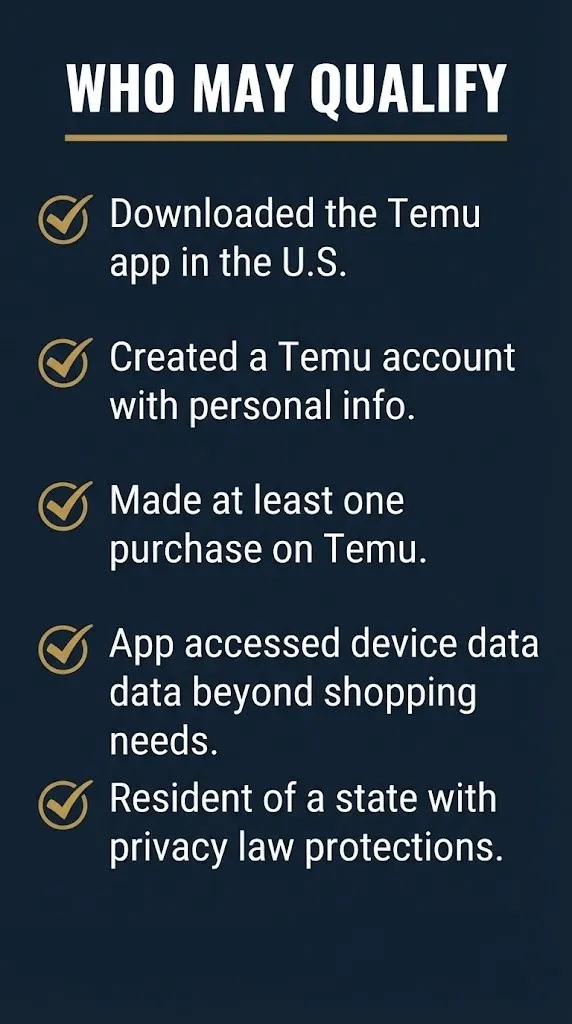
The class definitions in active Temu complaints generally cover U.S. residents who downloaded the Temu app, created an account, or made purchases during specified time periods. No class has been formally certified by a federal judge as of October 2026, so these descriptions are based on the proposed definitions in filed complaints, not a final legal ruling.
Based on verified complaint language, you may fall within a proposed class if:
- You downloaded the Temu app on an iOS or Android device in the United States.
- You created a Temu account and provided personal information including your name, email, or phone number.
- You made at least one purchase on the Temu platform during the relevant period.
- Your device data, location information, or contact list may have been accessed by the app.
- You reside in a U.S. state with an applicable data privacy or consumer protection statute.
Some complaints define narrower state-specific subclasses based on laws like the Illinois Biometric Information Privacy Act (BIPA), the California Consumer Privacy Act (CCPA), or the Washington Privacy Act. Your state of residence at the time of your Temu use may determine which subclass applies to you.
Key Takeaway: No Temu class has been court-certified yet, meaning no one officially “qualifies” until a judge formally approves the class definition, which has not happened as of October 2026.
What does the Temu lawsuit actually allege?
The Temu lawsuit allegations center on unauthorized data collection, deceptive privacy disclosures, and the transmission of U.S. consumer data to servers in China without meaningful user consent. These allegations appear across multiple independently filed complaints and are corroborated by third-party cybersecurity research.
Grizzly Research, a cybersecurity-focused short-seller, published a detailed report in September 2023 characterizing the Temu app as “dangerous malware and spyware.” The report alleged the app could access device functions far beyond what shopping requires. Temu publicly denied those characterizations. Courts will determine which version of events is supported by evidence.
The legal theories in the complaints include violations of the Electronic Communications Privacy Act, which governs unauthorized interception of electronic data, as well as state-level unfair and deceptive trade practices statutes. Some complaints cite the California Consumer Privacy Act for failures to properly disclose data collection and provide opt-out rights. These are distinct legal claims that require separate proofs and may resolve on different timelines.
What is the current status of the Temu class action in 2026?
The current status of the Temu class action litigation in 2026 is active pre-trial proceedings across multiple federal court cases. No case has reached the class certification stage. Discovery has not been completed. No trial dates are confirmed on any publicly accessible docket.
This stage of litigation is similar to the investigation phase of an insurance claim. Both sides are gathering information, filing preliminary motions, and establishing the factual record. The plaintiff’s attorneys are seeking internal Temu documents about app design, data storage, and privacy policy decisions. Temu’s legal team is contesting the factual basis of the claims and working to limit the scope of discovery.
Temu has contested the lawsuits’ characterizations in public statements. The company has maintained that its data practices comply with applicable laws and that its app does not engage in the data harvesting alleged. Public statements from defendants do not resolve litigation. Only court rulings and evidentiary findings do that.
What data does Temu allegedly collect from its app users?
The data Temu allegedly collects from app users goes significantly beyond what most consumers would expect from a shopping platform. Verified complaint filings and the Grizzly Research report identify specific categories of data that plaintiffs claim were accessed or transmitted without adequate user consent.
Alleged data categories named in complaints and research include:
- Precise GPS location data: Collected even when the app is not in active use.
- Contact list access: Alleged access to the full device address book.
- Device identifiers: IMEI numbers, advertising identifiers, and device fingerprinting data.
- Browsing and app usage history: Information about other apps installed and used on the device.
- Clipboard data: Alleged access to text copied to the device clipboard.
- Camera and microphone access: Permissions that plaintiffs argue exceeded shopping functionality.
- Network information: Wi-Fi network names and connection data.
Temu has disputed that it uses these permissions improperly. Its privacy policy, which was updated following public scrutiny in 2023, describes data collection practices in general terms. Plaintiffs argue those disclosures remain inadequate under CCPA, BIPA, and federal law.
What is PDD Holdings and why does it matter for the Temu lawsuit?
PDD Holdings is the Chinese technology company that owns and operates Temu. Understanding PDD Holdings is central to understanding why U.S. lawmakers and plaintiffs’ attorneys have treated these cases as higher priority than typical consumer data suits.
PDD Holdings also owns Pinduoduo, one of China’s largest e-commerce platforms. In March 2023, Google suspended Pinduoduo from the Google Play Store after identifying versions of the app that contained malware capable of escalating device privileges and evading detection. This was not an allegation. Google confirmed the suspension in a public statement. Shortly after, Pinduoduo’s app was delisted from the Apple App Store as well.
Plaintiffs argue that the same corporate parent responsible for the Pinduoduo malware incident controls Temu. This corporate history is cited in complaints as evidence of a pattern of behavior rather than isolated technical errors. Courts will weigh whether the Pinduoduo incident is legally relevant to Temu’s separate operations. For consumers deciding whether to keep the app on their devices, it is a fact worth knowing.
Key Takeaway: PDD Holdings’ ownership of both Temu and Pinduoduo, combined with Google’s 2023 Pinduoduo suspension for malware, forms a critical factual backdrop that plaintiffs cite throughout the active Temu complaints.
Has the FTC or any government agency taken action against Temu?
Government regulatory action against Temu is an area where confirmed facts are limited as of October 2026. The Federal Trade Commission monitors data privacy practices and has broad authority over unfair and deceptive trade practices under Section 5 of the FTC Act. No confirmed FTC enforcement action specifically against Temu has been announced as of this date.
Congressional attention has been documented. A bipartisan group of U.S. senators sent a letter to Temu in 2023 requesting information about its data practices and its relationship with the Chinese government. Temu provided responses, but no enforcement action resulted from that inquiry as of October 2026.
The Committee on Foreign Investment in the United States (CFIUS) has authority over national security risks posed by foreign-owned companies operating in the U.S. Whether CFIUS has reviewed Temu’s operations is not confirmed in any public statement or filing. Regulatory investigations of this type are often conducted confidentially until an enforcement action is taken.
What are U.S. lawmakers saying about Temu in 2026?
U.S. lawmakers have expressed concerns about Temu and its Chinese parent company across multiple congressional hearings and committee letters in 2024 and 2025. These concerns fall into two broad categories: consumer data security and potential connections to Chinese government data access.
The Select Committee on the Chinese Communist Party, which operated in the prior Congress, issued multiple statements about Chinese-owned apps operating in the U.S. market. Temu was named in that context. These statements are political expressions, not legal findings. Courts do not treat congressional committee letters as evidence of wrongdoing.
What makes the legislative attention relevant to consumers is that it signals increased regulatory scrutiny going forward. If federal privacy legislation advances in 2026, it could affect how data privacy class actions like those against Temu are litigated or settled. Federal privacy law would also give individual consumers new rights and remedies beyond what state laws currently provide.
What should you do if you used the Temu app and are concerned about your data?
If you used the Temu app and are concerned about your data, there are concrete steps you can take right now that do not require waiting for any lawsuit to resolve. Taking these steps protects you regardless of whether any settlement ever occurs.
Think of this like checking your credit report after hearing about a data breach. You do not wait for a lawsuit to settle before you review your accounts. You act now to limit potential damage.
- Review the Temu app’s current permissions on your device and revoke any that seem excessive for a shopping app.
- Go to your device settings and check which data categories Temu has permission to access.
- Disable location access for Temu if you did not knowingly grant it.
- Revoke microphone and camera access unless you actively use those features.
- Consider deleting the Temu app if you no longer use it.
- Submit a data deletion request through Temu’s privacy portal, which is required under CCPA if you are a California resident.
- Monitor your credit report and financial accounts for any unusual activity.
- Save records of your Temu account history including your email, order history, and account creation date in case they are needed for a future claim.
Keeping your account records now protects you if a settlement opens later. Courts often require some form of documented Temu use to participate in a claim.
What are the differences between the various Temu lawsuits filed in 2026?
Multiple distinct Temu lawsuits have been filed across different federal districts, and they are not all the same case. Understanding the differences helps you identify which complaint, if any, covers your specific situation as a consumer.
Some complaints focus narrowly on Illinois residents and invoke BIPA, which imposes strict requirements on biometric data collection and provides for statutory damages of $1,000 to $5,000 per violation. BIPA cases have historically resulted in some of the largest per-person payouts in consumer class action history. If you are an Illinois resident who used Temu, this is the most financially significant subclass to watch.
Other complaints are national in scope and rely on federal wiretapping statutes and unfair trade practices laws. These national class actions cover a broader group of plaintiffs but typically yield smaller per-person recoveries because the class size is much larger. A judge will eventually determine whether these cases should be consolidated into a single MDL or proceed separately.
| Complaint Type | Geographic Scope | Primary Law Cited | Per-Person Potential |
|---|---|---|---|
| BIPA-based complaints | Illinois residents | Illinois Biometric Information Privacy Act | Higher (statutory damages) |
| CCPA-based complaints | California residents | California Consumer Privacy Act | Moderate |
| Federal wiretapping complaints | National class | Electronic Communications Privacy Act | Lower (larger class) |
| Unfair trade practices | Multi-state | State consumer protection statutes | Varies by state |
Key Takeaway: Illinois residents who used Temu may have access to the highest potential per-person recovery through BIPA-based subclass claims, a detail that most general Temu lawsuit coverage fails to explain.
What Happens Next
- Ongoing through late 2026: Discovery proceedings continue in federal courts as plaintiffs’ attorneys seek internal Temu documents on app design, data routing, and privacy policy decisions.
- Expected Q1 2027: Class certification motions are likely to be filed in lead cases, triggering the key legal test of whether these suits can proceed as formal class actions.
- Expected Q2 2027: If class certification is granted, settlement mediation between Temu and plaintiffs’ counsel may begin under court supervision.
- TBD: Any preliminary settlement approval hearing would be the first public signal that a claims process is coming; watch federal court dockets for this notice.
- TBD: An official settlement administrator website and claims deadline would be published following preliminary approval, marking the start of any public filing period.
Frequently Asked Questions
Is there a Temu settlement I can file a claim for right now?
No confirmed Temu settlement is open for public claims as of October 2026.
Any website currently claiming to accept Temu settlement claims is not operating from a court-approved process.
Check official federal court dockets or this page for updates when a real settlement is announced.
What is the Temu lawsuit about?
The Temu lawsuit alleges the app collected sensitive user data including location, contacts, and device information without proper disclosure or consent.
Plaintiffs also allege Temu transmitted that data to servers in China, raising both privacy and national security concerns.
Multiple complaints cite violations of BIPA, CCPA, and federal wiretapping statutes.
Is Temu safe to use in 2026?
Whether Temu is safe to use is a personal decision based on your comfort with its data practices.
Courts have not issued any ruling finding Temu guilty of the alleged conduct; those findings require a full litigation process.
You can reduce your data exposure by reviewing and restricting the app’s permissions in your device settings.
How do I delete my Temu data?
You can submit a data deletion request through Temu’s privacy settings, which is a legal requirement under CCPA for California residents.
Temu must respond to verified deletion requests within 45 days under California law.
Deleting the app without submitting a formal deletion request does not automatically erase stored data from Temu’s servers.
Does the Temu lawsuit affect sellers on the platform?
Active lawsuits focus on consumer data privacy and deceptive practices affecting buyers, not sellers.
Third-party sellers using Temu’s marketplace may have separate legal concerns about their own data shared with the platform.
No verified class action specifically targeting Temu sellers has been confirmed in court records as of October 2026.
Why did Google suspend Pinduoduo, and is it related to Temu?
Google suspended Pinduoduo from the Play Store in March 2023 after identifying malware in certain app versions capable of gaining elevated device access.
Pinduoduo and Temu are both owned by PDD Holdings, the same Chinese parent company.
Plaintiffs in Temu lawsuits cite the Pinduoduo suspension as evidence of corporate history, but courts have not ruled on whether it is legally relevant to Temu’s separate conduct.
What states have the strongest legal claims against Temu?
Illinois and California residents have the strongest potential individual claims based on BIPA and CCPA protections respectively.
BIPA allows statutory damages of $1,000 to $5,000 per violation without requiring proof of actual harm, making Illinois cases potentially the most valuable.
Washington state residents may have rights under the Washington Privacy Act, which also provides individual claims.
Will there be a Temu ban in the United States?
No confirmed federal ban on Temu has been enacted as of October 2026.
Congressional debate over Chinese-owned apps continues, and legislative proposals have been introduced but not passed into law.
Any future ban would be a regulatory action separate from the civil class action lawsuits currently pending.
Your most useful action today is to save your Temu account records. Log in and take a screenshot of your account creation date, your order history, and your registered email address. Store these somewhere safe. If a settlement opens in 2026 or 2027, these records will be your starting point for any claim.
Watch federal court dockets in the Northern District of Illinois and Northern District of California for class certification rulings. Those are the two most legally significant milestones before any settlement becomes possible. A certified class is the clearest signal that a claims process is coming.