Wrongful Death Settlement 2026: How Much Families Actually Recover and Who Gets Paid
Quick Answer
- A wrongful death settlement compensates survivors for financial and emotional losses after a negligent death.
- Average payouts range from $500,000 to $1.2 million, with simple cases near $75,000 and severe cases above $10 million.
- The statute of limitations varies by state, often two years from the date of death.
Is a Wrongful Death Settlement Real?
A wrongful death settlement is a real legal outcome, and it is the most common way these cases end.
Most wrongful death claims never reach a jury. The defendant’s insurance company pays the survivors to avoid trial, and the family signs a release giving up further claims against that party.
That does not mean every case settles. Disputed liability, low insurance limits, or multiple defendants can push a case to trial. But the majority resolve through negotiation or mediation .
You should treat any advertised “average” with caution. No government agency tracks a national wrongful death settlement average . The numbers you see online come from law firm marketing, not verified data.
Key Takeaway: Settlements are the norm, but the amount depends on proof of fault and the specific losses your family suffered.
How Much Is a Wrongful Death Settlement Worth in 2026?
A wrongful death settlement in 2026 typically ranges from $500,000 to $1.2 million, but that range hides enormous variation.
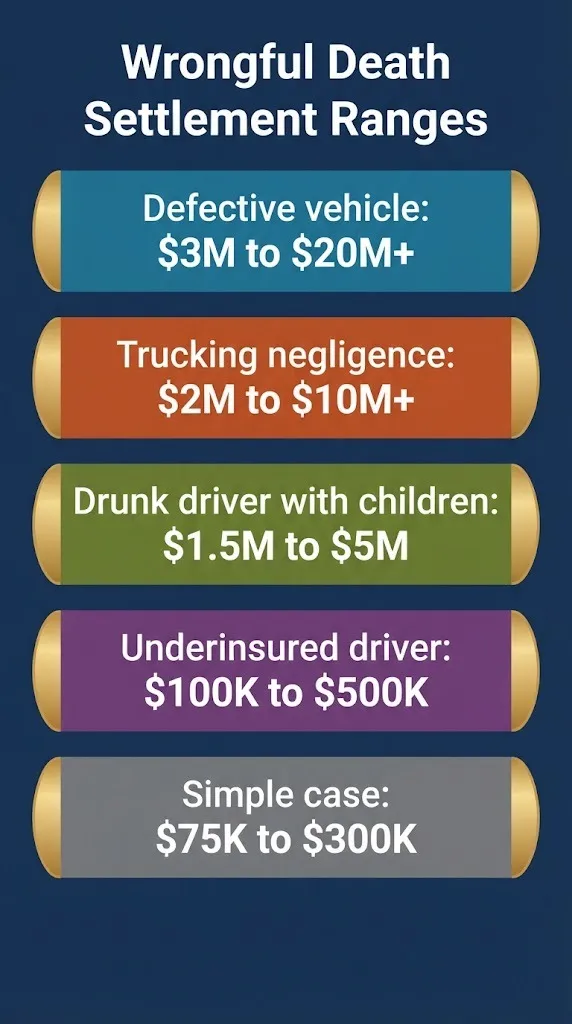
Simple cases with clear liability and modest income loss can settle for $75,000 to $300,000. Catastrophic cases involving corporations, defective products, or egregious negligence can exceed $10 million .
Here is how settlement values break down by case type:
| Case Type | Typical Settlement Range |
|---|---|
| Rear-end crash, underinsured driver | $100,000 to $500,000 |
| Drunk driver, victim age 40 with children | $1.5 million to $5 million |
| Trucking company negligence | $2 million to $10 million+ |
| Defective vehicle (manufacturer liable) | $3 million to $20 million+ |
| Workplace accident | $750,000 to $4 million |
These figures come from 2026 case data and reflect reported outcomes, not guarantees .
The single biggest driver is the victim’s income and age. A 35-year-old surgeon with three young children leaves a larger financial gap than a 70-year-old retiree. An economist calculates the lost future earnings, and that projection anchors the demand.
What Damages Can You Recover in a Wrongful Death Settlement?
You can recover two main categories of damages in a wrongful death settlement: economic losses and non-economic losses.
Economic damages cover measurable financial harm. These include lost future income and benefits, medical bills incurred before death, funeral and burial expenses, and the value of household services the deceased provided .
Non-economic damages cover human loss. These include loss of companionship, loss of parental guidance, and in some states, the survivors’ grief and mental anguish.
Some states also allow punitive damages to punish especially reckless conduct. Many states cap or bar punitive damages in wrongful death cases, so availability depends entirely on where you file .
Reality Check: No legitimate settlement administrator will text you first about a wrongful death payout. These are private negotiations through an attorney and an insurance company. If someone contacts you claiming you are owed money from a specific wrongful death case, verify the case number and court directly before sharing any information.
Who Can File a Wrongful Death Lawsuit?
The right to file a wrongful death lawsuit belongs to specific family members, defined by state law where the death occurred.
In most states, the eligible parties are the surviving spouse, children (including adopted children), and parents. Some states allow common-law spouses to file. A few bar legally separated spouses .
If no immediate family members exist, extended relatives like siblings or grandparents may qualify. The personal representative of the estate often files on behalf of all beneficiaries .
State law controls everything here. California allows parents to claim emotional damages without proving financial dependence. Other states require proof that survivors relied on the deceased for support .
If the deceased died without a will, the court appoints an administrator to manage the estate and bring the claim .
How Is a Wrongful Death Settlement Divided Among Family Members?
The settlement is divided according to state law and, in many cases, court approval.
A surviving spouse usually receives the largest share. Children and dependent parents receive portions based on their relationship and financial reliance on the deceased .
The key factors courts weigh are financial dependency and relationship closeness. A minor child who lived with the deceased receives more than an adult child who had little contact. A spouse who relied on the deceased’s income receives more than one who did not .
If beneficiaries cannot agree on division, the court decides. Mediation often resolves disputes before a judge gets involved. When minors are among the survivors, a guardian ad litem represents their interests, and court approval of any settlement is almost always required .
The Walker v. Walker case from West Virginia illustrates how far courts can go. In that 1986 case, a court awarded the entire $65,000 net settlement to the decedent’s minor child, cutting out ten adult children who had little relationship with their father .
How Long Does a Wrongful Death Settlement Take?
Most wrongful death settlements take anywhere from several months to a few years. There is no fixed schedule.
Clear liability, cooperative insurers, and modest damages can settle in under a year. Contested fault, multiple defendants, or a trial can stretch past two or three years .
The timeline runs through predictable stages:
- Investigation: Your attorney gathers medical records, accident reports, and witness statements. This takes weeks to months.
- Opening the estate: A personal representative must be appointed before filing. Probate court schedules add time.
- Filing the claim: The complaint goes to court and the defendant’s insurer.
- Discovery: Both sides exchange documents and take depositions. This is often the longest stage, running many months.
- Negotiation and mediation: Most cases settle here.
- Settlement approval or trial: Many states require court approval of wrongful death settlements, especially when minors are beneficiaries .
Payment comes after the settlement is final, liens are resolved, and the estate is administered. That can add weeks or months after the ink dries.
Are Wrongful Death Settlements Taxable?
Most of a wrongful death settlement is tax-free under federal law. Compensatory damages for physical injury or death are excluded from gross income under IRC Section 104(a)(2).
That covers lost future income, medical expenses, funeral costs, and loss of companionship .
Three parts can trigger taxes. Punitive damages are almost always taxable. Pre-judgment and post-judgment interest is taxable as ordinary income. And if you deducted medical expenses in a prior tax year and the settlement reimburses those same bills, that portion becomes taxable under the tax benefit rule .
How the settlement agreement allocates the money matters enormously. A vague agreement that lumps everything into one number invites the IRS to decide what is taxable. A well-structured agreement that separates compensatory damages from punitive damages can save your family tens of thousands of dollars .
You need both a wrongful death attorney and a tax professional. The attorney structures the agreement. The CPA handles the reporting.
What Happens Next in a Wrongful Death Case?
The next step is gathering evidence and identifying all responsible parties. The statute of limitations clock is already running.
Most states give you two years from the date of death to file a wrongful death lawsuit. A few allow three years. Missing the deadline typically bars the claim entirely .
Here is the sequence to expect:
- Immediate: Preserve evidence, get the death certificate, and consult an attorney.
- Weeks to months: Attorney investigates and gathers records. Estate is opened if not already done.
- Before the statute of limitations: The claim must be filed. This is the hard deadline.
- Months to a year: Discovery and expert analysis.
- Ongoing: Negotiation or mediation. Most cases settle.
- If needed: Trial and, potentially, appeal.
- After settlement: Court approval (if required), lien resolution, and distribution to beneficiaries.
Frequently Asked Questions
How much is the average wrongful death settlement in 2026?
There is no verified national average, but typical settlements range from $500,000 to $1.2 million.
Simple cases can settle for under $300,000. Severe negligence cases can exceed $10 million .
How long do I have to file a wrongful death lawsuit?
Most states set a two-year deadline from the date of death.
Some states allow three years. A few are shorter. Missing the deadline usually kills the claim .
Who gets the money from a wrongful death settlement?
State law determines who receives the money.
A surviving spouse, children, and dependent parents typically have priority. Courts divide shares based on financial dependency and relationship closeness .
Are wrongful death settlements taxable?
Most compensatory damages are tax-free under IRC Section 104(a)(2).
Punitive damages and interest are taxable. Settlement agreement wording matters enormously for tax treatment .
Can adult children recover in a wrongful death case?
Yes, but the amount depends on their relationship and financial dependence on the deceased.
Adult children with no financial reliance often receive less than minor children or a surviving spouse .
What if the deceased had no spouse or children?
Parents are usually next in line to file.
If no parents survive, siblings or other dependents may qualify under state law .
Do I need an attorney to file a wrongful death claim?
You can file without one, but wrongful death cases involve probate, statutory deadlines, and complex damage calculations.
An attorney handles the estate appointment, evidence gathering, and negotiation. Most work on contingency, meaning no upfront cost .
Can a wrongful death case go to trial instead of settling?
Yes. If the insurance company disputes liability or offers too little, your attorney can take the case to trial.
Most cases settle, but the threat of trial often pushes the defense toward a fair number .
The statute of limitations is the single most important date in your case. Most states give you two years from the date of death to file. If you are considering a wrongful death claim, consult an attorney now, before that deadline passes. Gather the death certificate, any accident reports, and records of the deceased’s income and expenses. Do not wait.