Paramount Lawsuit 2026: $110B Warner Bros. Deal, State AG Antitrust Trial, and What Happens Next
Quick Answer
- A dozen Democratic state attorneys general sued to block Paramount’s $110 billion merger with Warner Bros. Discovery.
- Settlement talks are set for late October 2026, but Paramount has only offered behavioral concessions, not structural remedies.
- An antitrust trial is scheduled for March 2, 2027, with a $7 million per day ticking fee starting October 1, 2026.
Is the Paramount Lawsuit a Consumer Class Action?
The Paramount lawsuit is not a consumer class action. It is an antitrust enforcement action brought by state governments against a corporate merger.
You cannot file a claim for money from this case. There is no settlement fund, no claim form, and no payout administrator.
This is a government lawsuit against Paramount Skydance Corporation, led by California Attorney General Rob Bonta and joined by 11 other Democratic states . The plaintiffs argue the $110 billion acquisition of Warner Bros. Discovery would violate antitrust law and harm competition in film distribution and cable television.
The Writers Guild of America filed a parallel lawsuit seeking to block the deal . Both cases are now before U.S. District Judge Araceli Martínez-Olguín.
Key Takeaway: This case is about whether two media giants can merge. It is not a consumer claim and no payouts to individuals are involved.
How Much Would a Paramount Settlement Be Worth?
No settlement amount has been proposed or verified. There is no dollar figure on the table.
The settlement discussions are about structural remedies, not cash payments. California Attorney General Rob Bonta has said any resolution must include “robust structural remedies” that would change the shape of the merged company .
Structural remedies mean divestitures, spin-offs, or keeping parts of the business separate. Paramount wants to merge its studio and television operations with Warner Bros. Discovery, the parent of CNN, HBO, and the Warner Bros. film studio.
Bonta reportedly wants Paramount “to divest some cable channels and commit to keeping its movie studio separate from Warner Bros.” . Paramount has only offered behavioral concessions so far, including a pledge to release at least 30 movies with 45-day theatrical windows .
Not yet determined: No settlement value exists because the talks are about business structure, not money.
Reality Check
No one will text you about money from the Paramount lawsuit. This is a corporate antitrust case, not a consumer settlement. If you see ads promising payouts tied to Paramount or Warner Bros., they are false. The only people affected are Paramount and WBD shareholders, employees, and the companies themselves.
When Will Paramount and the States Meet to Settle?
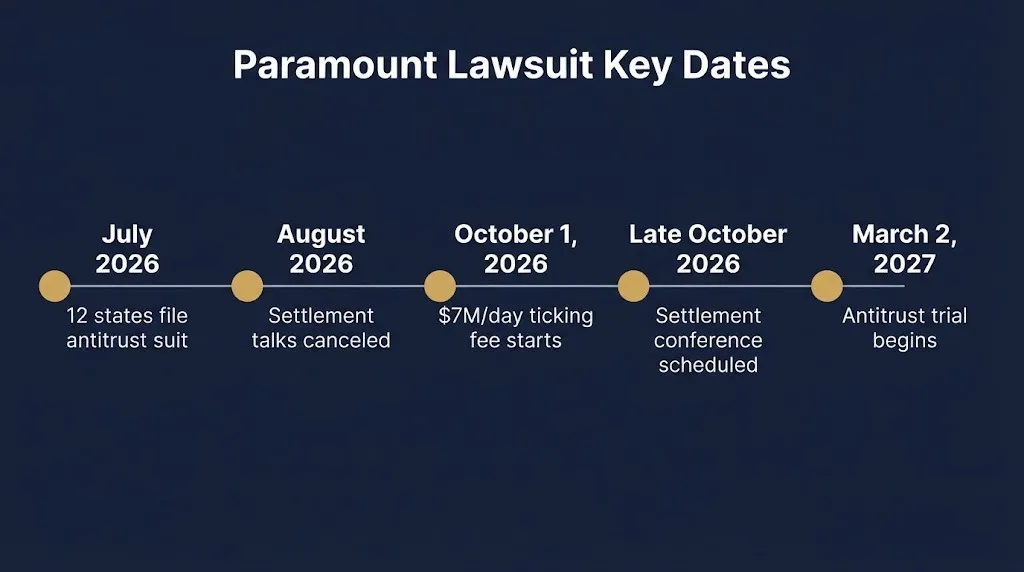
Paramount and California will sit down for two straight days at the end of October 2026 to explore a deal settling the state’s antitrust lawsuit .
U.S. Magistrate Judge Thomas Hixson ordered both sides to schedule an in-person settlement conference starting at 10:00 AM on two consecutive days in late October . The Writers Guild of America will also participate.
The meeting will be introductory, meaning there is no guarantee it will be substantive . Bonta canceled a previous meeting in August after accusing Paramount of leaking and misrepresenting settlement discussions .
Paramount denied the accusations and said it remains ready to negotiate in good faith .
The settlement conference will happen after the $7 million per day ticking fee starts accruing on October 1, 2026 . That fee is what makes the timeline urgent for Paramount.
What Is the Ticking Fee and Why Does It Matter?
The ticking fee is a $7 million daily penalty Paramount must pay Warner Bros. Discovery shareholders for every day the merger has not closed after September 30, 2026 .
At that rate, the fee exceeds $1 billion by the time the March 2, 2027 trial begins . The merger agreement also includes a June 4 deadline and a $7 billion termination fee if the deal falls apart .
The fee is why Paramount CEO David Ellison is eager to settle before trial. LightShed Partners analyst Rich Greenfield said the clock is working against Paramount .
“The only way to settle before a trial to ensure they can close before the WBD agreement expires in June is to offer structural remedies for both film production and linear TV,” Greenfield told CNN .
Key Takeaway: The ticking fee is the single biggest pressure point in the case. Every day of delay costs Paramount $7 million.
What Do the 12 States Allege in the Paramount Lawsuit?
The 12 states allege the Paramount-Warner Bros. Discovery merger would reduce competition and harm consumers in film distribution and cable television .
The complaint claims the combined company would control nearly 27% of the film distribution market and more than 30% of the market for major box office releases . It would also concentrate power in the basic cable television business.
The plaintiffs argue the deal would lead to higher prices, fewer choices, and reduced content production .
Paramount insists the WBD deal is pro-competitive. The company says the merger would increase output and benefit talent and entertainment workers .
The U.S. Department of Justice has already cleared the deal, saying it sees no competition problems . The European Union approved it with distribution conditions .
What Is the Current Status of the Paramount Merger?
The merger is paused. A federal judge issued a temporary restraining order blocking the deal for at least two weeks in July 2026, pending further arguments .
Paramount agreed to delay the closing until June 2027 or until the court rules, whichever comes first . The company also agreed not to challenge a preliminary injunction while the case proceeds.
The antitrust trial is set for March 2 through March 19, 2027 . Proposed findings of fact and conclusions of law are due by April 5, 2027 .
What Remedies Does California Want in the Paramount Case?
California wants structural remedies that would fundamentally change the merged company’s footprint.
Bonta has said “robust structural remedies” are required, not behavioral promises . The Wall Street Journal reported that Bonta wants Paramount to divest some cable channels and keep its movie studio separate from Warner Bros. .
Paramount has offered only behavioral concessions so far. Those include releasing at least 30 movies with 45-day theatrical windows .
Analyst Rich Greenfield said threading the needle would be difficult. Selling cable networks like CNN would be hard because there is not a strong market for them . And keeping the studios separate is a “nonstarter” for Ellison, according to the Journal .
Not yet determined: No structural remedy package has been agreed to or proposed in detail.
What Happens Next in the Paramount Lawsuit?
The settlement conference in late October is the next major milestone. If it fails, the case proceeds toward trial in March 2027.
Here is the likely sequence:
- October 1, 2026: Ticking fee starts. Paramount pays $7 million per day to WBD shareholders until the deal closes .
- Late October 2026: Two-day settlement conference before Magistrate Judge Thomas Hixson. Introductory session only .
- January 8, 2027: Fact discovery closes .
- February 24, 2027: Final pretrial conference .
- March 2 to March 19, 2027: Antitrust trial before Judge Araceli Martínez-Olguín .
- April 5, 2027: Proposed findings of fact and conclusions of law due .
- June 4, 2027: Merger agreement expiration deadline .
Frequently Asked Questions
Is the Paramount lawsuit a class action?
No. The Paramount lawsuit is an antitrust enforcement action brought by 12 state attorneys general, not a consumer class action.
There is no settlement fund and no way for individuals to file claims.
Can I get money from the Paramount lawsuit?
No. This case is about blocking a corporate merger, not compensating consumers.
There are no payouts, claim forms, or settlement administrators involved.
What is the Paramount lawsuit about?
The lawsuit seeks to block Paramount’s $110 billion acquisition of Warner Bros. Discovery.
The 12 states argue the merger would reduce competition in film distribution and cable television .
When is the Paramount antitrust trial?
The trial is scheduled for March 2 through March 19, 2027.
The judge has set an April 5, 2027 deadline for proposed findings of fact and conclusions of law .
What is the ticking fee in the Paramount merger?
The ticking fee is $7 million per day Paramount must pay Warner Bros. Discovery shareholders if the deal has not closed by September 30, 2026.
The fee starts on October 1, 2026, and could exceed $1 billion by the trial date .
Who is suing Paramount?
California Attorney General Rob Bonta leads the lawsuit, joined by 11 other Democratic states.
The Writers Guild of America filed a parallel lawsuit to block the merger .
What does California want from Paramount?
California wants structural remedies, meaning divestitures or keeping parts of the business separate.
Paramount has offered only behavioral concessions, which Bonta has rejected as insufficient .
Has the Paramount merger been approved?
The U.S. Department of Justice cleared the deal, and the European Union approved it with conditions.
But a federal judge has paused the merger pending the antitrust lawsuit .
The settlement conference in late October is the next date to watch. If no deal is reached, the case goes to trial on March 2, 2027. Paramount will pay $7 million per day in ticking fees starting October 1, 2026. Check court records for updates, and be wary of any website claiming you can file a claim for money from this case.