EU Flight Delay Compensation 2026: EC261 Rules, Payout Amounts, and How to Claim
Quick Answer:
- EC261 is a real EU law requiring airlines to pay compensation for qualifying delays, cancellations, and denied boarding.
- Compensation is 250, 400, or 600 euros per passenger depending on flight distance, not ticket price.
- You generally have up to 2 to 6 years to file a claim, depending on the country where the airline is based.
Your flight was delayed. You missed a connection. You arrived hours late, and someone at the gate mentioned something about EU compensation rules. Now you are searching to find out if you are owed money, how much, and whether filing a claim is worth the effort.
This guide covers every verified fact about EU flight delay compensation in 2026. That includes the exact payout amounts, which flights are covered, what counts as an extraordinary circumstance, and the step-by-step process for filing a claim. One fact most articles skip: EC261 applies to all flights departing from any EU airport, regardless of the airline’s nationality, and to flights arriving in the EU on an EU carrier. That means a delayed Delta flight from Paris to New York is covered. A delayed Delta flight from New York to Paris is not.
The Facts
| Detail | Value |
|---|---|
| Regulation | EC Regulation No. 261/2004 |
| Applies To | All flights departing EU airports, and flights arriving in EU on EU carriers |
| Qualifying Delay Threshold | 3 hours or more arrival delay |
| Compensation Amounts | 250, 400, or 600 euros depending on distance |
| Extraordinary Circumstances | Weather, strikes, political unrest, hidden manufacturing defects |
| Airline Obligations | Care and assistance during delay (meals, accommodation, communication) |
| Claim Deadline | Varies by country, typically 2 to 6 years |
| Enforcement Body | National Enforcement Bodies in each EU member state |
Is EU Flight Delay Compensation Legitimate?
EU flight delay compensation is a legal right, not a loophole or a scam. It is established by Regulation EC No. 261/2004, a binding EU law that took effect in February 2005. The regulation requires airlines to pay fixed compensation to passengers who experience qualifying delays, cancellations, or denied boarding. It is enforced by national aviation authorities in each EU member state and by the Court of Justice of the European Union, which has issued binding interpretations of the regulation’s key provisions.
The rights are real and enforceable. Airlines have paid hundreds of millions of euros in EC261 compensation since the regulation took effect. The Court of Justice has repeatedly affirmed that passengers are entitled to compensation unless the delay was caused by extraordinary circumstances that the airline could not have avoided. Airline arguments attempting to narrow the scope of the regulation have been consistently rejected.
The scam risk around EC261 is not the regulation itself. It is the third-party claim companies that charge high commissions for filing claims you could file yourself for free. Some of these companies are legitimate and transparent about their fees. Some are not. Some take 25 to 50 percent of your compensation as a fee for work that takes minutes. The regulation gives you the right to file directly with the airline at no cost. You do not need a middleman.
How to Spot a Legitimate Claim Company
A legitimate EC261 claim company clearly discloses its fee percentage before you sign anything. It does not guarantee results. It does not charge upfront fees. It takes its fee only if you receive compensation. If a company asks for payment before you receive your money, find a different company or file the claim yourself.
Key Takeaway: The right to compensation is real and enforceable. The scam is not the law. It is the companies that charge excessive fees for a service you can perform yourself.
How Much Is EU Flight Delay Compensation in 2026?
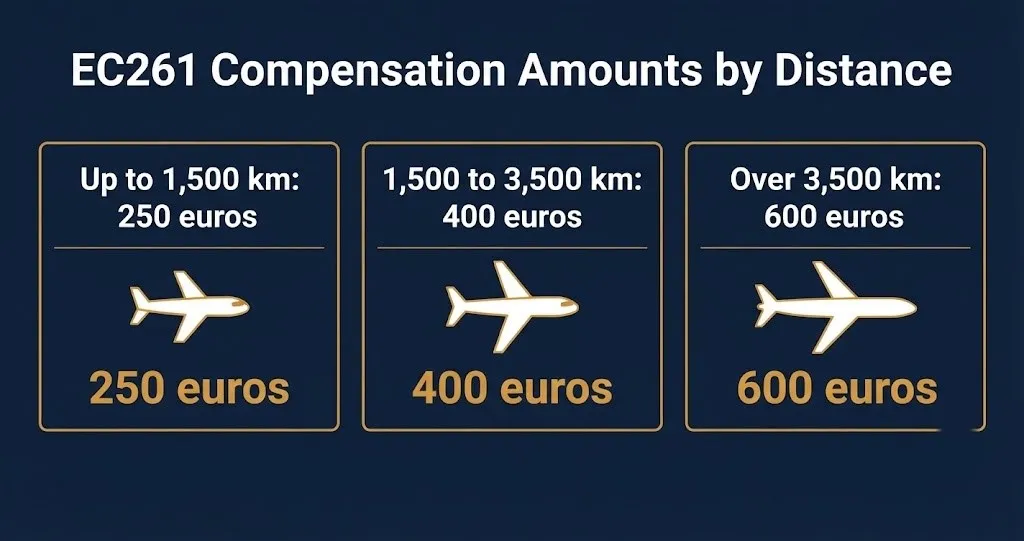
EC261 compensation is fixed by flight distance, not by ticket price. The amounts are set in euros and have not changed since the regulation was enacted. The three tiers are 250 euros, 400 euros, and 600 euros per passenger.
For flights of 1,500 kilometers or less, the compensation is 250 euros. This covers most intra-European flights, such as London to Paris, Berlin to Rome, or Amsterdam to Barcelona. For flights between 1,500 and 3,500 kilometers, the compensation is 400 euros. This covers longer European routes and some North African and Middle Eastern destinations, such as London to Cairo or Paris to Tel Aviv. For flights over 3,500 kilometers, the compensation is 600 euros. This covers long-haul flights such as London to New York, Frankfurt to Singapore, or Paris to Los Angeles.
The distance is measured by the great circle route between the departure and arrival airports, not the actual route flown. If a flight over 3,500 kilometers is delayed by more than 3 hours but less than 4 hours, the airline may reduce the compensation by 50 percent, paying 300 euros instead of 600 euros. This reduction applies only to long-haul flights where the delay falls within that specific window.
EC261 Compensation Table
| Flight Distance | Examples | Delay Over 3 Hours | Delay Over 4 Hours | Cancellation |
|---|---|---|---|---|
| Up to 1,500 km | Paris to Rome, Berlin to London | 250 euros | 250 euros | 250 euros |
| 1,500 to 3,500 km | London to Athens, Madrid to Cairo | 400 euros | 400 euros | 400 euros |
| Over 3,500 km | London to New York, Paris to Tokyo | 300 euros (reduced) | 600 euros | 600 euros |
These amounts are per passenger. A family of four on a delayed long-haul flight could be entitled to 2,400 euros. Compensation is payable regardless of the ticket price. A 50-euro budget airline ticket and a 3,000-euro business class ticket qualify for the same EC261 compensation amount.
Key Takeaway: Compensation is per passenger, not per booking. The amounts are fixed by law. A cheap ticket does not reduce your payout.
What Flights Are Covered by EC261?
EC261 applies to three categories of flights. First, all flights departing from an airport located in an EU member state, regardless of the airline’s nationality. This includes flights on U.S. carriers departing Paris, flights on Asian carriers departing Frankfurt, and flights on budget carriers like Ryanair and EasyJet. If the plane leaves the ground in an EU country, EC261 applies.
Second, flights arriving at an airport in an EU member state on an airline licensed in an EU country. A British Airways flight from New York to London is covered. A Delta flight from Atlanta to Amsterdam is not covered because Delta is not an EU carrier, even though Amsterdam is in the EU. The distinction matters. U.S. passengers flying U.S. airlines to Europe are not protected by EC261 on the outbound leg. They are protected on the return leg departing from Europe.
Third, the regulation extends to Iceland, Norway, and Switzerland through separate agreements, even though they are not EU members. It also extends to the UK post-Brexit under UK domestic legislation that mirrors EC261. The UK version, known as UK261, provides identical compensation amounts but may have different enforcement mechanisms.
Which Countries Are Covered
The EU member states plus Iceland, Norway, Switzerland, and the UK. This includes all major European airports: London Heathrow, Paris Charles de Gaulle, Frankfurt, Amsterdam Schiphol, Madrid Barajas, Rome Fiumicino, and every other airport in those countries. Departures from any of these airports are covered.
What Are Extraordinary Circumstances and When Can Airlines Deny Compensation?
Extraordinary circumstances are events beyond the airline’s control that could not have been avoided even if all reasonable measures had been taken. This is the most contested phrase in EC261. Airlines invoke it frequently. Passengers dispute it frequently. The Court of Justice has spent years defining its boundaries.
Weather conditions that make the flight unsafe qualify as extraordinary circumstances. A severe thunderstorm closing a runway, a volcanic ash cloud grounding aircraft, or hurricane-force winds preventing takeoff are all valid reasons for the airline to deny compensation. The key question is whether the weather event was genuinely exceptional and whether the airline could have taken reasonable steps to avoid the disruption.
Air traffic control decisions, political instability, security risks, and hidden manufacturing defects also qualify as extraordinary circumstances. A bird strike damaging an engine is generally considered extraordinary, as is a sudden strike by air traffic controllers that the airline could not have anticipated.
Technical problems caused by the airline’s own maintenance failures do not qualify. The Court of Justice has consistently ruled that ordinary technical faults, including those discovered during routine maintenance, are part of the airline’s normal operations and do not excuse compensation. This is the single most useful precedent for passengers. Airlines often cite technical issues as reasons to deny compensation. The law generally disagrees.
Extraordinary vs. Not Extraordinary
| Scenario | Extraordinary Circumstance? |
|---|---|
| Severe weather closing the airport | Yes, if genuinely exceptional |
| Air traffic control strike | Yes, if external and unavoidable |
| Bird strike causing engine damage | Yes, per CJEU rulings |
| Hidden manufacturing defect | Yes, if first occurrence |
| Technical fault found during routine maintenance | No, considered part of normal operations |
| Crew scheduling problems | No, within airline’s control |
| Operational issues and staff shortages | No, within airline’s control |
| Knock-on effect from earlier weather | Depends, must show all reasonable measures taken |
Key Takeaway: Airlines deny claims by default in many cases, citing extraordinary circumstances. Do not accept the first denial. Challenge it. The law is often on your side.
How to File an EC261 Claim in 2026
Filing a claim is straightforward. You do not need a lawyer. You do not need a claim company. You need your booking reference, flight details, and a description of what happened. Here is the process.
- Gather your documentation. You need your booking confirmation, flight number, departure and arrival airports, scheduled times, and actual times. Save your boarding pass or electronic ticket. If you received any communication from the airline about the delay, save it.
- Determine the exact length of your delay. EC261 compensation kicks in when you arrive at your final destination 3 hours or more later than scheduled. Use FlightRadar24, FlightAware, or similar flight tracking services to verify the actual arrival time. Screenshots help.
- Identify the correct airline. Your claim goes to the operating carrier, the airline that actually flew the plane, not the airline you booked through if they are different.
- Find the airline’s EC261 claim form. Most airlines have a dedicated page on their website for EC261 claims. Use it. Filing through the correct channel avoids delays.
- Submit your claim with all details. Include your full name, booking reference, flight number, date, and the specific provision of EC261 you are claiming under. State the amount you are claiming: 250, 400, or 600 euros per passenger.
- Wait for a response. Airlines are required to acknowledge claims, but response times vary. Some respond within weeks. Some take months. Keep a record of all correspondence.
- If the claim is denied or ignored, escalate. You can file a complaint with the national enforcement body in the country where the disruption occurred or where the airline is based. You can also use alternative dispute resolution services where available or file a claim in small claims court.
What If the Airline Ignores You?
If the airline does not respond within a reasonable time, typically 6 to 8 weeks, escalate to the relevant national enforcement body. Each EU member state has a designated body responsible for enforcing EC261. These bodies can investigate complaints and pressure airlines to pay, though their enforcement powers vary by country. In the UK, the Civil Aviation Authority handles EC261 complaints. In Germany, it is the Luftfahrt-Bundesamt. File your complaint with the body in the country of departure or the country where the airline is headquartered.
Reality Check: Filing directly with the airline costs nothing and takes less than 30 minutes. Third-party claim companies take 25 to 50 percent of your compensation. Use them if you want convenience. Do not use them if you want the full amount. Either way, know what you are paying before you agree.
What Is the EU261 Compensation Table and How Do I Use It?
The EU261 compensation table, which is the same regulation as EC261 with a slightly different abbreviation, is a fixed schedule. There is no discretion and no negotiation. The airline owes the amount set by law for the distance of your flight if the delay meets the threshold and no extraordinary circumstances apply.
To use the table, determine the great circle distance between your departure and arrival airports. You can use a great circle mapper tool online. Then identify your delay length. If your delay at final arrival was 3 hours or more, locate the distance tier and the corresponding compensation amount. If your flight was over 3,500 kilometers and your delay was between 3 and 4 hours, the amount is reduced by half. For all other flights, the full amount applies.
The compensation is separate from and in addition to the airline’s duty of care. The airline must provide meals, refreshments, accommodation if an overnight stay is required, and communication regardless of whether the delay was caused by extraordinary circumstances. You are entitled to care and assistance even if you are not entitled to cash compensation.
What Is the Difference Between EU261 and EC261?
There is no difference. EC261 and EU261 are the same regulation. The formal designation is EC Regulation No. 261/2004. Some countries and airlines refer to it as EU261. Both names refer to the same set of rules, the same compensation amounts, and the same enforcement mechanisms. The interchangeable naming is a source of confusion but not a legal distinction.
The UK post-Brexit version is known as UK261. It mirrors EC261 in almost all respects, with the same compensation amounts, the same distance tiers, and the same extraordinary circumstances exceptions. The enforcement body is different. The UK Civil Aviation Authority handles UK261 claims rather than the EU national enforcement bodies.
How Long Do You Have to File an EC261 Claim?
The deadline for filing an EC261 claim depends on the country where the airline is based or where the disruption occurred. Each EU member state applies its own statute of limitations. These range from 2 to 6 years.
For example, the UK applies a 6-year limitation period. Germany applies 3 years. France applies 5 years. If you are unsure which country’s limitation period applies, consult the national enforcement body or file your claim as soon as possible. Delay rarely benefits the passenger. Evidence fades. Memories blur. Airlines change their reservation systems.
The clock usually starts running from the date of the delayed flight. Some countries start the clock from the end of the calendar year in which the flight occurred. The safest approach is to file within 2 years of the flight date. That ensures you are within the limitation period regardless of which country’s law applies.
Limitation Periods by Country
| Country | Limitation Period |
|---|---|
| United Kingdom | 6 years |
| France | 5 years |
| Germany | 3 years |
| Spain | 5 years |
| Netherlands | 2 years |
| Italy | 2 years |
This table is illustrative. Consult the specific rules for the country where your claim arises.
Key Takeaway: File your claim as soon as possible after the delay. A claim filed within 2 years is safe in every EU member state.
What Happens Next: The EC261 Claim Timeline
- Day of Delay: The disruption occurs. Collect evidence. Save all communications from the airline. Note the actual arrival time.
- Week 1: File your claim with the airline’s EC261 claim portal. Keep a copy of your submission.
- Weeks 2 to 8: The airline acknowledges and processes your claim. Some airlines pay within weeks. Others delay.
- Months 2 to 3: If no response or a denial, escalate to the national enforcement body. This is free and can pressure the airline.
- Months 3 to 6: If enforcement body intervention fails, consider small claims court or a claim company. This is the point where professional help may be worth the fee.
This timeline assumes an uncomplicated claim without extraordinary circumstances disputes. Contested claims take longer. Straightforward claims on major airlines like British Airways, Lufthansa, and Air France are often resolved in weeks.
Frequently Asked Questions
How long does a flight delay have to be for compensation?
Three hours or more at your final destination.
The clock starts at scheduled arrival and stops at actual arrival.
Connection delays count if the entire journey was booked as one ticket.
Do I get compensation if my flight was cancelled?
Yes, if the cancellation was within the airline’s control.
You also get a refund or re-routing at no extra cost.
Compensation is not payable if the airline gave 14 days or more advance notice.
What if the airline offers me a voucher instead of cash?
You can refuse the voucher and demand cash.
EC261 gives you the right to cash compensation or bank transfer.
Do not accept vouchers unless you genuinely prefer them.
Can I claim for a flight from 3 years ago?
It depends on the country. Many jurisdictions allow claims within 3 to 6 years.
Check the limitation period for the relevant country.
If in doubt, file the claim and let the airline respond.
Does EC261 apply to U.S. citizens?
Yes. EC261 applies to all passengers regardless of nationality.
A U.S. citizen on a covered flight has the same rights as an EU citizen.
The flight route, not your passport, determines coverage.
What if my delay was caused by a connecting flight?
You are covered if the entire journey was booked under one reservation.
The delay is calculated at the final destination.
If separate tickets, the airline operating the delayed leg is responsible.
Can I claim for a delay that happened during COVID-19?
Yes, if the delay met EC261 criteria and no extraordinary circumstance applied.
The pandemic itself does not automatically excuse all delays.
Each case is evaluated on its specific facts.
How do I calculate the distance of my flight?
Use a great circle mapper tool available online for free.
Enter your departure and arrival airport codes.
The tool returns the distance used for EC261 compensation tiers.
EU flight delay compensation is a legal right, not a favor. The amounts are fixed. The rules are clear. The process is straightforward. You do not need a middleman, though one may be helpful if the airline stonewalls. File your claim directly, cite the regulation, state the amount, and demand the payment. The law is on your side.
The single most important thing to remember: save everything. Your booking confirmation, your boarding pass, the delay announcement, the text messages from the airline, and the screenshot of the flight tracker showing your actual arrival time. That evidence turns a denied claim into a paid one.