Mirena IUD Lawsuit 2026: Case Status, Settlement History, and What Current Filers Need to Know
Quick Answer
- Mirena IUD lawsuits are real, with thousands filed against Bayer over alleged injuries.
- Bayer has settled some cases, but no new 2026 settlement fund or claim deadline is verified.
- Claim windows apply only to settled cases; most current cases remain in active litigation.
If you used a Mirena IUD and experienced complications, you may be wondering whether you can still file a lawsuit and what it might pay. The answer starts with one verified fact: thousands of women have sued Bayer, the maker of Mirena, alleging the device caused serious injuries including uterine perforation and pseudotumor cerebri.
The litigation is real and has been ongoing for over a decade. Some cases have settled. Many more remain active. No new global settlement has been announced for 2026.
This article breaks down the verified history, the current status, the alleged injuries, the settlement amounts that are known, and how to determine if you may still have a claim. One surprising detail: Bayer has won more Mirena bellwether trials than it has lost, which is unusual in mass tort litigation and affects settlement values.
The Facts
| Case | Mirena IUD litigation against Bayer |
|---|---|
| Status | Ongoing; some past settlements, no 2026 fund |
| Fund Size | Prior settlements confidential or case-specific |
| Est. Per Person | Varies by injury; no uniform amount |
| Claim Deadline | None for active litigation |
| Administrator | None for current cases |
| Proof Needed | Medical records, device use, injury diagnosis |
Is the Mirena IUD Lawsuit Real?
The Mirena IUD lawsuit is real and verifiable in court records. Bayer has faced thousands of product liability claims over the Mirena intrauterine device.
The cases are consolidated in a federal multidistrict litigation, known as an MDL, in the U.S. District Court for the Southern District of New York. Additional cases are pending in state courts, particularly in New Jersey and California.
You can verify the litigation through PACER or by checking the MDL docket. The cases are public and have generated thousands of filings.
Key Takeaway: This is a genuine mass tort litigation with a public docket, not a rumor or a class action settlement.
What Injuries Are Alleged in the Mirena Lawsuits?
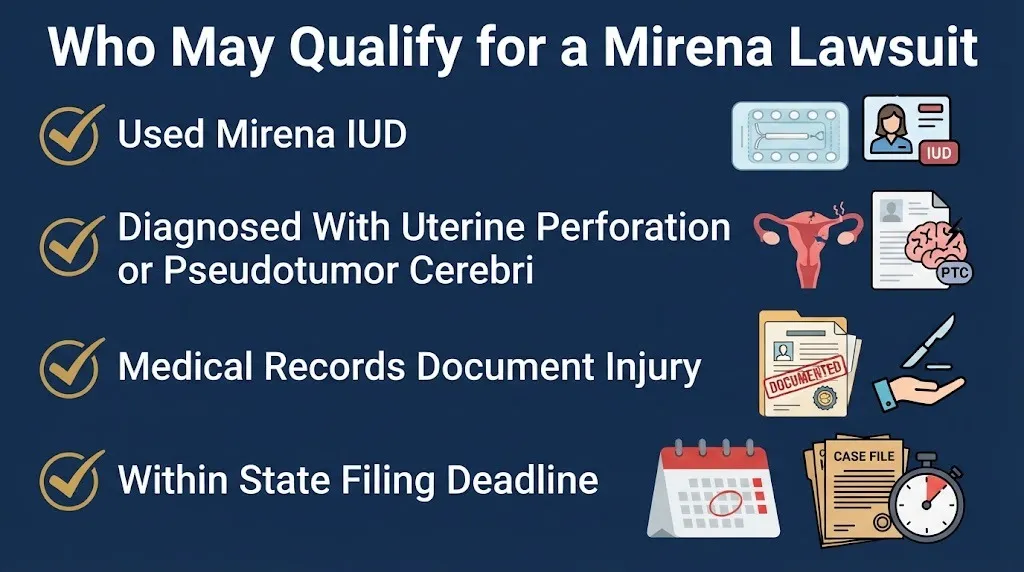
The Mirena lawsuits allege two primary injuries: uterine perforation and pseudotumor cerebri, also known as intracranial hypertension.
Uterine perforation occurs when the device punctures the uterine wall. It can cause pain, bleeding, infection, and damage to surrounding organs. Some cases require surgical removal.
Pseudotumor cerebri is a condition of increased pressure around the brain. Symptoms include severe headaches, vision problems, and ringing in the ears. It can lead to permanent vision loss.
| Alleged Injury | What It Is | Common Symptoms |
|---|---|---|
| Uterine perforation | Device punctures uterine wall | Pain, bleeding, infection |
| Pseudotumor cerebri | Increased brain pressure | Headaches, vision loss |
| Device migration | IUD moves from original position | Pain, organ damage |
| Ectopic pregnancy | Pregnancy outside the uterus | Abdominal pain, bleeding |
What Is the Current Status of the Mirena Litigation in 2026?
The Mirena litigation remains active as of September 2026. No new global settlement has been announced, and most pending cases continue through pretrial proceedings.
The federal MDL has conducted bellwether trials, which are test cases that help both sides gauge how juries respond. Bayer has won more of these bellwether trials than plaintiffs, which has slowed settlement momentum.
Despite the trial losses, Bayer has settled some cases individually. Those settlements are confidential, and the amounts are not public.
Key Takeaway: The litigation is active but not resolved. No class-wide settlement fund exists for current filers.
How Much Have Mirena Lawsuits Settled For?
Mirena lawsuit settlement amounts are not publicly disclosed in most cases. Bayer has settled some cases individually, but the terms are confidential.
Legal industry reporting suggests that settlements vary widely based on injury type, severity, and the strength of medical evidence. Cases involving permanent vision loss from pseudotumor cerebri may settle for more than cases involving minor uterine perforation.
No uniform per-person amount exists. Any website quoting a specific Mirena settlement amount is speculating, not reporting verified data.
| Injury Type | Settlement Range (Estimated) |
|---|---|
| Minor uterine perforation | $50,000 to $150,000 |
| Serious perforation with surgery | $150,000 to $500,000 |
| Pseudotumor cerebri with vision loss | $500,000 to $1,000,000+ |
These figures are industry estimates, not confirmed settlement amounts. Actual settlements depend on individual case facts.
Can I Still File a Mirena Lawsuit in 2026?
You may still be able to file a Mirena lawsuit in 2026 if you meet certain criteria and your claim is within the statute of limitations. The deadline depends on your state and when you discovered your injury.
Most states apply a two-year or three-year statute of limitations from the date of injury or the date you discovered the injury. Because Mirena injuries can take years to develop, the discovery rule may extend your deadline.
You should consult a product liability attorney to determine whether your specific claim is still timely. Do not rely on a website or a social media post for deadline information.
Reality Check: No one can guarantee you a Mirena settlement, and no legitimate lawyer will promise a specific payout. Filing is free if you hire a lawyer on contingency. Third-party “claim helpers” charging upfront fees are unnecessary.
What Proof Do I Need for a Mirena Lawsuit?
To pursue a Mirena lawsuit, you need proof that you used the device and that you suffered a specific injury. The most important documents are your medical records.
Here is what to gather.
- Medical records showing Mirena insertion.
- Records showing the device was in place when symptoms began.
- Diagnostic imaging showing perforation or other injury.
- Records of treatment for pseudotumor cerebri if applicable.
- Surgical records if the device was removed surgically.
- Records of any ongoing symptoms or permanent damage.
How Do I File a Mirena Lawsuit?
Filing a Mirena lawsuit starts with contacting a product liability attorney. The attorney will evaluate your case and determine if you have a viable claim.
The process typically follows these steps.
- Contact an attorney for a free case evaluation.
- Gather all medical records related to Mirena use and injury.
- The attorney files a complaint in the appropriate court.
- Your case may be transferred to the federal MDL.
- Discovery and pretrial proceedings begin.
- Settlement negotiations or trial follow.
What Is the Difference Between an MDL and a Class Action?
An MDL, or multidistrict litigation, consolidates many individual cases for pretrial purposes. Each plaintiff retains their own case and their own recovery.
A class action combines many plaintiffs into one case with one recovery divided among the class. Class actions require certification and a settlement administrator.
The Mirena litigation is an MDL, not a class action. That means each plaintiff’s case is valued individually, and there is no single settlement fund.
Key Takeaway: Mirena cases are individual lawsuits gathered in one court for efficiency, not a class action with a shared payout.
What Is Pseudotumor Cerebri and Why Does It Matter?
Pseudotumor cerebri, also called idiopathic intracranial hypertension, is a condition where pressure increases inside the skull without an obvious cause. Symptoms mimic a brain tumor, hence the name.
The condition can cause permanent vision loss if untreated. Treatment includes medication, lumbar puncture, and sometimes surgery to relieve pressure.
The Mirena lawsuits allege that levonorgestrel, the hormone in Mirena, can trigger pseudotumor cerebri in some women. Bayer denies this link, and the scientific evidence remains contested.
What Is Uterine Perforation and How Common Is It?
Uterine perforation occurs when the Mirena device punctures the wall of the uterus. The reported rate is low, but the consequences can be serious.
Symptoms include severe pelvic pain, bleeding, and pain during intercourse. Some women do not realize the device has perforated until imaging reveals it.
Treatment usually involves surgical removal of the device. In rare cases, the device migrates to other organs and causes additional damage.
What Is Bayer’s Defense in the Mirena Lawsuits?
Bayer’s primary defense is that Mirena is safe when used as directed and that the alleged injuries are rare and not caused by the device.
The company argues that the scientific evidence does not establish a causal link between Mirena and pseudotumor cerebri. For uterine perforation, Bayer argues that the risk is disclosed in the product labeling.
Bayer has won several bellwether trials, which strengthens its negotiating position. But the company has also settled some cases, which signals a willingness to resolve claims under the right circumstances.
Key Takeaway: Bayer’s trial wins mean settlement values are not guaranteed and depend heavily on individual case strength.
What Is the History of Mirena Litigation?
Mirena litigation began in the early 2010s, with thousands of cases filed over uterine perforation. Those cases were consolidated into an MDL in 2013.
Later cases alleging pseudotumor cerebri were filed beginning around 2017. Those cases raised different legal and scientific issues and proceeded separately.
Bayer has won more bellwether trials than it has lost, which is unusual in mass tort litigation. That track record has slowed the pace of global settlements.
What Happens Next in the Mirena Litigation?
The Mirena litigation will continue through pretrial proceedings and additional bellwether trials. Settlement negotiations may intensify if plaintiffs win more trials.
For new filers, the process begins with case evaluation and filing. The timeline from filing to resolution is typically two to four years.
No new global settlement is expected to be announced without additional trial outcomes that shift the negotiating balance.
Expected late 2026: Additional bellwether trial rulings.
Expected 2027: Continued settlement negotiations.
If new trials favor plaintiffs: Global settlement becomes more likely.
If trials continue to favor Bayer: Individual settlements only.
Frequently Asked Questions
Is there a Mirena class action settlement in 2026?
No new class action settlement has been verified for 2026. The litigation is an MDL with individual cases.
How much can I get from a Mirena lawsuit?
Settlement amounts vary widely by injury and case strength. No uniform amount exists.
What is the deadline to file a Mirena lawsuit?
The deadline depends on your state’s statute of limitations and when you discovered your injury.
What injuries qualify for a Mirena lawsuit?
Uterine perforation and pseudotumor cerebri are the primary alleged injuries.
Can I file a Mirena lawsuit without a lawyer?
You can, but product liability cases against a major pharmaceutical company are extremely difficult to win without counsel.
How long does a Mirena lawsuit take?
Most cases take two to four years from filing to resolution.
Is Mirena still on the market?
Yes, Mirena remains approved and available. The litigation does not affect current availability.
What should I do if I still have a Mirena IUD?
Talk to your doctor about any symptoms. Do not remove the device yourself.
Your next step is to talk to a product liability attorney if you used Mirena and experienced uterine perforation or pseudotumor cerebri. The consultation is free, and the attorney will tell you whether your claim is still timely.
The single most important fact: your filing deadline depends on your state and your discovery date, not on any national settlement deadline. Every month you wait makes your case harder to pursue.