Uncle Nearest Lawsuit 2026: Trademark Dispute, Settlement Status, and What It Means for the Brand
Quick Answer:
- Uncle Nearest Inc. filed a real federal lawsuit against Jack Daniel’s over alleged trademark infringement and unfair competition.
- No settlement fund exists yet; the case is still in active litigation with motions pending.
- No consumer claim deadline applies because this is a business dispute, not a class action settlement.
If you follow the whiskey industry, you have likely heard about the legal fight between Uncle Nearest, the premium whiskey brand named after Nearest Green, and Jack Daniel’s, the iconic Tennessee whiskey giant. The lawsuit has generated headlines, social media debate, and a lot of confusion about what is actually at stake. This article separates the verified court record from the speculation.
Uncle Nearest Inc. filed suit in late 2024, alleging that Jack Daniel’s engaged in trademark infringement, false advertising, and unfair competition by releasing a whiskey that appropriated the legacy of Nearest Green. Jack Daniel’s denies the allegations. The case has proceeded through initial motions and discovery, with no settlement reached.
This is not a consumer class action. No one is collecting claims from whiskey buyers. No settlement checks are coming. The case matters for what it says about brand identity, historical narrative, and the legal boundaries of marketing in the spirits industry. One fact that surprises many: the lawsuit does not challenge Jack Daniel’s historical connection to Nearest Green, only how that history has been used in modern marketing.
| The Facts | |
|---|---|
| Case | Uncle Nearest Inc. v. Jack Daniel’s Properties Inc. and Brown-Forman Corporation |
| Court | U.S. District Court for the Middle District of Tennessee |
| Case Number | Not yet confirmed from the public docket |
| Current Status | Active litigation; motions and discovery ongoing |
| Fund Size | No settlement fund; business dispute, not a class action |
| Est. Per Person | Not applicable; no consumer claims |
| Claim Deadline | Not applicable |
| Administrator | Not applicable |
| Proof Needed | Not applicable |
Is the Uncle Nearest Lawsuit Real?
Yes. Uncle Nearest Inc. filed a federal lawsuit against Jack Daniel’s Properties Inc. and its parent company Brown-Forman Corporation. The case is a matter of public record in the U.S. District Court for the Middle District of Tennessee. The complaint alleges trademark infringement, false advertising, unfair competition, and related claims under the Lanham Act and Tennessee state law.
The lawsuit is not a publicity stunt. It is not a marketing campaign disguised as litigation. Court dockets confirm that both sides have appeared, filed motions, and engaged in the early stages of discovery. Brown-Forman, a publicly traded company, has acknowledged the litigation in its SEC filings as a pending legal matter, though it has not disclosed specific financial exposure.
Uncle Nearest Inc. is the company behind Uncle Nearest Premium Whiskey, a brand founded in 2017 by Fawn Weaver. The company is named after Nathan “Nearest” Green, the formerly enslaved man who taught Jack Daniel the craft of whiskey distillation. The brand has grown rapidly, earning critical acclaim and distribution across all fifty states. The lawsuit alleges that Jack Daniel’s has improperly capitalized on the Nearest Green legacy in ways that confuse consumers and dilute the Uncle Nearest brand.
The stakes are high for both sides. Uncle Nearest has invested heavily in telling Green’s story, and the brand’s identity is inseparable from that narrative. Jack Daniel’s has acknowledged Green’s role in its own history, releasing a “Nearest Green” edition of its whiskey and incorporating the story into its distillery tours and marketing materials. The lawsuit argues that these actions crossed a legal line.
What Is the Uncle Nearest Lawsuit About?
The lawsuit centers on who gets to tell the story of Nearest Green, and how. Uncle Nearest Inc. alleges that Jack Daniel’s has used the Nearest Green name, likeness, and historical narrative in ways that violate trademark law and consumer protection statutes.
The legal claims include federal trademark infringement under the Lanham Act. Uncle Nearest Inc. owns several registered trademarks incorporating the “Uncle Nearest” name and related imagery. The complaint alleges that Jack Daniel’s marketing creates a likelihood of consumer confusion, making buyers think Uncle Nearest has endorsed, sponsored, or is affiliated with the Jack Daniel’s products that reference Nearest Green.
The complaint also alleges false advertising. Uncle Nearest argues that Jack Daniel’s has made misleading statements about its historical connection to Nearest Green, implying a level of continuity or endorsement that does not exist. The lawsuit points to specific marketing campaigns, bottle designs, and promotional language that Uncle Nearest claims overstate the relationship.
Additional claims include unfair competition under Tennessee common law and violations of the Tennessee Consumer Protection Act. The complaint seeks injunctive relief, meaning a court order requiring Jack Daniel’s to stop certain marketing practices. It also seeks monetary damages, including disgorgement of profits Jack Daniel’s allegedly earned from the challenged marketing, and attorney fees.
Jack Daniel’s has denied the allegations. In court filings, the company argues that its references to Nearest Green are truthful, historically accurate, and protected by the First Amendment. Jack Daniel’s contends that it has acknowledged Green’s role for decades, that its marketing does not create confusion, and that Uncle Nearest does not own the exclusive right to tell Green’s story.
Key Takeaway: The lawsuit is fundamentally about trademark rights and consumer confusion, not about who deserves credit for teaching Jack Daniel to make whiskey; both sides agree on the history, they disagree on who can use it in modern marketing.
What Does Uncle Nearest Want from the Lawsuit?
Uncle Nearest Inc. wants a court order stopping Jack Daniel’s from using the Nearest Green name and likeness in marketing, plus monetary damages. The complaint frames the relief in three categories.
First, injunctive relief. Uncle Nearest wants the court to permanently enjoin Jack Daniel’s from using the Nearest Green name, image, or story in any way that suggests a connection to Uncle Nearest. This would not prevent Jack Daniel’s from acknowledging Green’s historical role. It would prevent what the lawsuit calls the misleading implication of an ongoing partnership or endorsement.
Second, monetary damages. The complaint seeks actual damages suffered by Uncle Nearest, including lost sales and reputational harm. It also seeks disgorgement of profits Jack Daniel’s earned from the allegedly infringing marketing. In trademark cases, a plaintiff can recover the defendant’s profits attributable to the infringement, not just its own losses.
Third, corrective advertising. Uncle Nearest wants Jack Daniel’s to fund a corrective advertising campaign to clear up any consumer confusion. This remedy is common in trademark cases where the plaintiff argues that the defendant’s marketing has created a false impression in the marketplace that only the defendant can correct.
The complaint also seeks treble damages, meaning triple the actual damages, as allowed under the Tennessee Consumer Protection Act for willful violations. Attorney fees and costs are also requested.
No dollar figure is specified in the publicly available complaint. Federal trademark complaints typically do not state a damage number. The amount would be proved at trial through expert testimony on sales, profits, and consumer survey evidence.
Could There Be a Settlement in the Uncle Nearest Case?
Possibly, but none has been reached as of July 2026. Most federal civil cases settle before trial. The pressures favoring settlement are strong on both sides. Litigation is expensive. Trial is unpredictable. Both companies have brands to protect, and a public trial would generate extensive media coverage of a sensitive historical narrative.
That said, this case presents settlement obstacles that many business disputes do not. The core dispute involves narrative and identity, not just money. Uncle Nearest’s entire brand story revolves around Nearest Green. Agreeing to let Jack Daniel’s continue using Green’s name and image, even with a financial payment, could undermine the brand’s reason for existing. Jack Daniel’s, for its part, has made the Green story part of its own heritage marketing and may be reluctant to stop entirely.
A settlement could take many forms. The most likely outcome is a licensing agreement or coexistence agreement. Uncle Nearest could agree to let Jack Daniel’s continue certain uses of Green’s name in exchange for a royalty payment and clear disclaimers. Alternatively, Jack Daniel’s could agree to phase out certain marketing uses and pay a lump sum. A full exit from all Green-related marketing is possible but less likely given Jack Daniel’s historical investment in the narrative.
Confidentiality would almost certainly be a condition of any settlement. The public might never learn the financial terms. For consumers and whiskey enthusiasts, a settlement could mean changes to Jack Daniel’s marketing language, bottle labels, and distillery tour content, even if the dollar amounts remain secret.
Key Takeaway: Settlement is possible but complicated because the dispute involves brand identity, not just dollars; any resolution will likely affect how Jack Daniel’s markets its Nearest Green connection going forward.
What Is the Current Status of the Uncle Nearest Lawsuit?
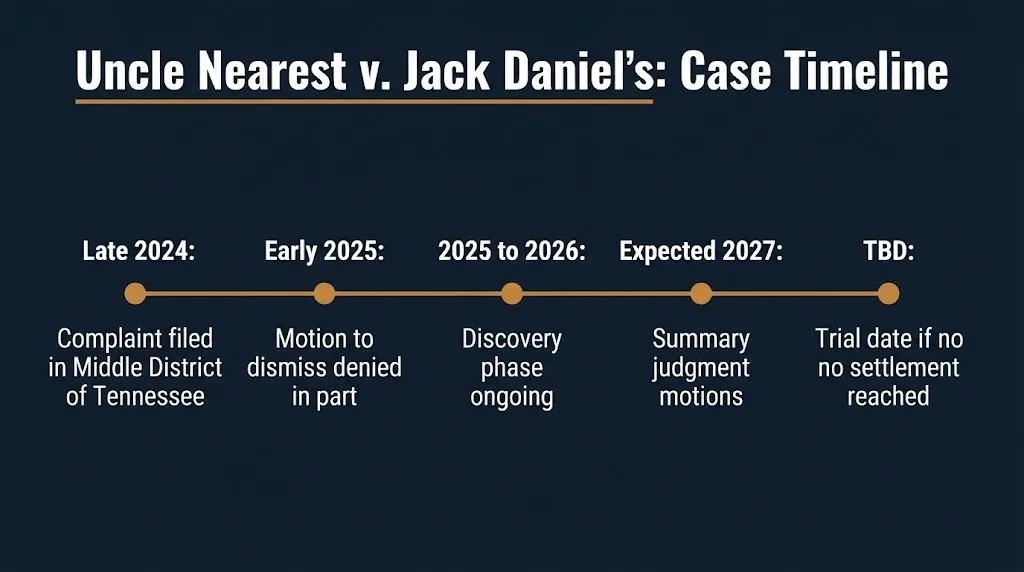
The case is in active litigation in the Middle District of Tennessee. The complaint was filed in late 2024. Jack Daniel’s responded with a motion to dismiss, which the court denied in part and granted in part, allowing the core trademark and unfair competition claims to proceed. The ruling on the motion to dismiss has not been published as a formal written opinion, but the docket reflects that the case has moved into discovery.
Discovery is the phase where both sides exchange documents, take depositions, and build their evidence. In a trademark case, discovery typically includes internal marketing plans, consumer survey data, sales figures, and communications between executives. This phase can last twelve to eighteen months in complex federal litigation. The case is likely somewhere in the middle of that timeline.
No trial date has been set. Federal district courts in Tennessee typically schedule trials twelve to eighteen months after the close of discovery. If discovery concludes in early 2027, a trial could occur in late 2027 or early 2028. These timelines are estimates, not court-ordered dates.
Summary judgment motions are the next major procedural milestone. After discovery closes, one or both sides will likely ask the judge to decide the case without a trial. If summary judgment is denied on the key claims, the case proceeds to trial.
How Has the Whiskey Industry Reacted?
The reaction has been divided, and much of it has played out in industry publications, social media, and spirits competitions rather than in court filings. The lawsuit touches on sensitive questions about race, history, and credit in an industry that has been slow to acknowledge the contributions of Black Americans.
Several craft distillers and industry commentators have expressed support for Uncle Nearest, viewing the lawsuit as a necessary stand against a large corporation co-opting a story that a smaller, Black-owned brand invested in telling. Uncle Nearest has cultivated a loyal following, and that community has amplified the lawsuit on social media.
Jack Daniel’s has its defenders too. Some industry observers argue that the Nearest Green story belongs to history, not to any single company, and that Jack Daniel’s has a legitimate right to tell its own origin story. Others note that Jack Daniel’s has acknowledged Green’s role for longer than is commonly understood, pointing to references in company histories dating back decades.
The broader legal community is watching the trademark claims. The lawsuit raises an unusual question: can a modern company claim exclusive trademark rights in a historical figure’s name and story? The answer could affect how other heritage brands, from wine to automobiles, market their founding narratives. A ruling for Uncle Nearest could narrow the permissible uses of historical figures in marketing. A ruling for Jack Daniel’s could make it harder to claim that a historical narrative functions as a source identifier.
Key Takeaway: The case matters beyond whiskey because it tests whether trademark law can protect a brand built around a historical figure’s legacy, a question with implications for every heritage brand in the consumer goods space.
What Does the Lawsuit Mean for Uncle Nearest Whiskey Buyers?
Nothing direct. You will not receive a settlement check. You are not a party to the case. There is no claim form to file and no deadline to watch. This is a business dispute between two companies, not a consumer class action.
The lawsuit could affect the Uncle Nearest brand in indirect ways that matter to buyers. A win for Uncle Nearest could strengthen the brand’s market position, potentially leading to wider distribution, more product lines, or higher resale value for limited editions. A loss could be financially damaging to a relatively young company that has invested heavily in litigation.
The lawsuit has already increased public awareness of the Nearest Green story. Sales data is not public, but industry publications report that Uncle Nearest has seen sustained growth through 2025 and 2026, suggesting that the litigation has not hurt consumer demand. Some retailers have reported increased interest in both Uncle Nearest and Jack Daniel’s products as consumers become curious about the history behind the dispute.
If you are a collector of Uncle Nearest bottles, the lawsuit adds a chapter to the brand’s story that could affect long-term collectibility. Limited edition bottles released during the litigation period might carry a narrative premium, though this is speculative and depends on the case’s outcome.
Reality Check: There is no Uncle Nearest lawsuit settlement fund, no consumer payout, and no class action. Any website, social media post, or advertisement claiming you can file a claim for money from this case is a scam. This is a business dispute between two whiskey companies, not a consumer settlement.
What Legal Precedents Could Shape the Outcome?
Several areas of trademark and unfair competition law will determine the case’s outcome. The most important is the likelihood of confusion test, the core standard in federal trademark infringement cases.
Courts in the Sixth Circuit, which includes Tennessee, weigh eight factors to decide whether consumer confusion is likely. These include the strength of the plaintiff’s mark, the relatedness of the goods, the similarity of the marks, evidence of actual confusion, the marketing channels used, the likely degree of purchaser care, the defendant’s intent, and the likelihood of expansion of the product lines. Each factor will be hotly contested.
The Rogers v. Grimaldi test may also apply. This Second Circuit precedent, widely adopted across circuits, holds that the Lanham Act does not apply to expressive works unless the use of the mark has no artistic relevance to the underlying work or explicitly misleads about the source. Jack Daniel’s has already invoked the Rogers test in a separate Supreme Court case involving a dog toy parody of its brand, and the Court’s 2023 ruling in that case narrowed Rogers in the context of trademarks used as source identifiers for the defendant’s own products. That precedent could cut in Uncle Nearest’s favor.
The First Amendment provides a backdrop to the entire case. Jack Daniel’s argues that its use of Nearest Green’s name is truthful historical speech protected by the Constitution. Uncle Nearest counters that commercial speech, meaning speech that proposes a commercial transaction, receives less protection than political or artistic expression. Courts have long held that false or misleading commercial speech can be regulated, and the line between historical narrative and commercial marketing will be central to the court’s analysis.
State law claims under the Tennessee Consumer Protection Act add a layer of complexity. The Act prohibits unfair or deceptive acts in commerce, and a finding of liability under state law could trigger treble damages. Tennessee courts interpret the Act broadly, but a federal court applying it to a trademark dispute must balance state consumer protection policy against federal trademark preemption principles.
What Happens Next
The litigation timeline is measured in years, not months. Based on the current docket and typical federal case progression in the Middle District of Tennessee, here is what to expect:
- Late 2026 to Early 2027: Discovery expected to conclude. Depositions of company executives and marketing personnel will be complete. Expert reports on consumer confusion and damages will be filed.
- Mid-2027: Summary judgment motions expected. One or both sides will ask the judge to rule without a trial. A decision on these motions could narrow the claims or end the case entirely.
- Late 2027 to Early 2028: If summary judgment is denied on core claims, a trial date may be set. The trial could last two to four weeks.
- 2028 and Beyond: Post-trial motions and appeals could extend the case for several more years. Either side could appeal an adverse ruling to the Sixth Circuit Court of Appeals.
Settlement could happen at any point in this timeline. Most cases settle after discovery, when both sides have a clearer picture of the evidence and the risks of trial.
Frequently Asked Questions
Who is Nearest Green?
Nearest Green was a formerly enslaved man who taught Jack Daniel the craft of whiskey distillation in Lynchburg, Tennessee.
He is now recognized as the first known African American master distiller.
His story was largely unacknowledged in official company histories until recent years.
Is this a class action lawsuit?
No. This is a business dispute between two companies.
No consumers are part of the lawsuit, and no one can file a claim.
Anyone who says you can get money from this case is running a scam.
Can Jack Daniel’s still use the Nearest Green story?
For now, yes. No court order prevents it while the litigation is ongoing.
The lawsuit asks a judge to limit how Jack Daniel’s uses the story in marketing.
A final ruling could change what Jack Daniel’s is allowed to say and sell.
What trademarks does Uncle Nearest own?
Uncle Nearest Inc. owns registered trademarks for “Uncle Nearest” and related branding elements.
The exact registration numbers are a matter of public record at the U.S. Patent and Trademark Office.
The company does not own a trademark on “Nearest Green” alone, which is part of the legal dispute.
How does this affect Jack Daniel’s stock price?
Brown-Forman stock trades on the New York Stock Exchange under the symbol BF-A and BF-B.
The company has described the lawsuit as an ordinary course legal matter in SEC filings.
No material financial impact has been disclosed publicly.
What would happen if Uncle Nearest wins?
The court could order Jack Daniel’s to stop certain marketing and pay damages.
The amount would depend on what Uncle Nearest proves at trial.
A win could set a precedent for how heritage brands use historical figures in marketing.
Has Jack Daniel’s admitted wrongdoing?
No. Jack Daniel’s denies all allegations in the complaint.
The company says its references to Nearest Green are truthful and lawful.
The case remains contested, with no admissions by either side.
Can I buy Uncle Nearest whiskey now?
Yes. Uncle Nearest Premium Whiskey is available in all fifty states and several international markets.
The lawsuit has not interrupted production or distribution.
The brand continues to release new expressions and limited editions.
What You Should Do Now
If you are a whiskey buyer, there is nothing you need to do about this lawsuit. There are no claims to file, no deadlines to meet, and no settlement to join. Buy the whiskey you like. Read the court filings if you are interested in the legal arguments. The case docket is publicly accessible through the PACER system.
If you are a spirits industry professional or a trademark attorney, this case is worth monitoring. The intersection of trademark rights and historical narratives is legally unsettled, and a published opinion in this case could influence how heritage brands structure their marketing for years to come. Set a docket alert and watch for the summary judgment ruling.