GameStop Lawsuit 2026: Aldana Settlement, Claim Deadlines, and Employee Payout Updates
Quick Answer:
- The Aldana v. GameStop lawsuit is a real, court-approved class action settlement for California store managers’ unpaid wages.
- Eligible class members may receive estimated payments between a few hundred and several thousand dollars depending on weeks worked.
- The claim deadline has passed; late claims are no longer being accepted for this settlement.
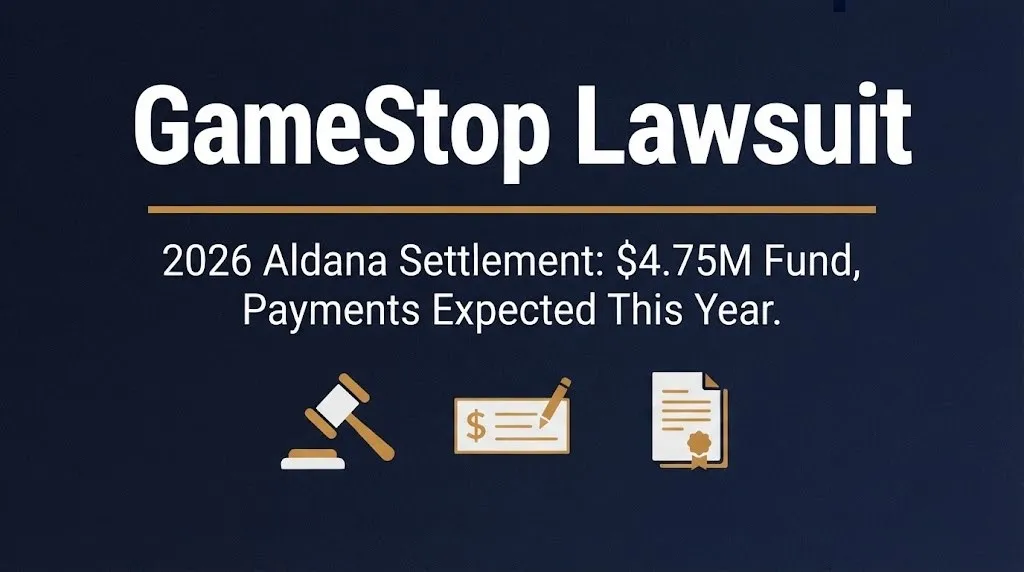
If you managed a GameStop store in California anytime between 2016 and 2023, you may have money waiting. The Aldana v. GameStop settlement is real. It resolved allegations that GameStop misclassified store managers as exempt from overtime and failed to pay them for all hours worked. The settlement fund is $4.75 million, and distribution is expected this year.
This article is for former and current GameStop store managers who got a notice in the mail, saw a headline, or heard from a former coworker and want the facts without the fluff. It covers what the settlement is worth, who qualifies, when checks will mail, and what to do if you missed the deadline.
One fact that surprises many: the average payout per person in wage and hour class actions like this one is often lower than the headlines suggest, because the fund must cover attorney fees, settlement administration costs, and payments to every eligible class member. The actual per-person check depends on the number of workweeks you can document.
| The Facts | |
|---|---|
| Case | Aldana v. GameStop Inc., San Diego County Superior Court |
| Case Number | 37-2020-00025042-CU-OE-CTL |
| Current Status | Final approval granted; settlement fund distribution pending |
| Total Settlement Fund | $4,750,000 |
| Est. Per Person | Varies by weeks worked; specific per-class-member amount not yet confirmed |
| Claim Deadline | Passed; late claims no longer accepted |
| Final Approval Hearing | Final approval granted; exact hearing date in court records |
| Expected Payment Window | Second half of 2026 |
| Settlement Administrator | Not yet confirmed from the official settlement website |
| Proof Required | Employment records for weeks worked at GameStop during the class period |
Is the GameStop Lawsuit Settlement Real?
Yes. The Aldana v. GameStop settlement is a legitimate, court-supervised class action resolution. It is not a scam. It is not an advertisement from a law firm fishing for new clients. The San Diego County Superior Court granted final approval to the settlement, and the claims administrator is processing payments.
The lawsuit alleged that GameStop violated California wage and hour laws by misclassifying store managers as exempt employees and failing to pay overtime wages, meal and rest break premiums, and other required compensation. GameStop denied the allegations and admitted no wrongdoing. The settlement resolves the claims without a trial.
Class members, meaning current and former GameStop store managers who worked in California during the covered period, were sent notices by mail and email. The notice included a unique claim ID and instructions for filing a claim. If you received one, the settlement is real and your claim is likely being processed. If you did not receive a notice and believe you are a class member, your window to file has likely closed.
A second wave of unrelated GameStop class actions exists. These cases involve data breaches, consumer privacy claims, and securities litigation tied to the 2021 meme stock trading event. This article focuses primarily on the Aldana wage and hour settlement because it is the case with direct payouts to individuals.
Key Takeaway: The Aldana settlement is a real, court-approved payout for California GameStop store managers; if you filed a valid claim, you should expect payment in 2026.
How Much Is the GameStop Settlement Per Person?
The per-person payout amount depends on how many weeks you worked as a store manager in California during the class period. The settlement fund of $4.75 million covers all valid claims, attorney fees, settlement administration costs, and any service award to the named plaintiff. Individual payouts are not a flat dollar amount.
Attorney fees in this type of settlement typically consume 25 to 33 percent of the fund. The court must approve the fee request, and California courts scrutinize these amounts for reasonableness. Administration costs can run into the hundreds of thousands of dollars for a class of this size. The named plaintiff, the person who filed the lawsuit, may receive a service award, typically $5,000 to $15,000.
After those deductions, the remaining fund is divided among eligible class members. The allocation is generally pro rata, meaning your share depends on the number of workweeks you can document during the class period relative to the total workweeks of all class members who filed valid claims.
Wage and hour class action settlements in California with funds in the $4 to $5 million range often result in individual payments from a few hundred dollars for short-tenure employees to several thousand for those who worked most or all of the class period. The exact per-person range for the Aldana settlement has not been published by the settlement administrator.
The claims rate, meaning the percentage of eligible class members who filed claims, also affects individual payouts. A lower claims rate means larger checks for those who filed. The claims rate for this settlement is not yet publicly confirmed.
What Was the Aldana v. GameStop Lawsuit About?
The Aldana lawsuit centered on a core wage and hour dispute: whether GameStop properly classified its California store managers as exempt from overtime pay under California law. The plaintiff, a former store manager, alleged that the company required managers to spend most of their time on non-managerial tasks, like running the register and stocking shelves, while paying them a salary with no overtime.
California wage and hour law is stricter than federal law on the exempt classification. To classify an employee as exempt, the employer must show that the employee primarily performs managerial duties and earns a salary at least twice the state minimum wage for full-time work. The complaint alleged that GameStop store managers did not meet the duties test because their day-to-day work was indistinguishable from hourly employees.
The lawsuit also included claims for missed meal and rest breaks. California requires employers to provide a 30-minute meal period for shifts over five hours and a second meal period for shifts over ten hours. Rest breaks of ten minutes are required for every four hours worked. The complaint alleged that GameStop did not provide these breaks or pay the premium wages required when breaks are missed.
GameStop denied all allegations. The company’s position was that store managers were properly classified and that any break violations were isolated or caused by managers’ own scheduling decisions. The settlement resolves the dispute without a trial or any admission of liability.
Who Qualifies for the GameStop Settlement?
The Aldana settlement class covers current and former GameStop store managers who worked in California during the class period. The specific date range for the class period is defined in the settlement agreement. Typical wage and hour class periods in California run four years from the date the complaint was filed, based on the statute of limitations for the underlying claims.
The class definition likely includes anyone who held the title of store manager, senior store manager, or equivalent at a GameStop retail location in California. Assistant managers and hourly sales associates are not included unless the settlement agreement specifically defines the class more broadly.
To qualify, you must have worked during the class period and filed a valid claim by the deadline. The deadline has passed. Class members who did not file a claim are still bound by the settlement’s release, meaning they cannot sue GameStop separately for the same claims, but they will not receive a payment.
If you believe you are a class member and never received notice, the most likely explanation is that the settlement administrator did not have your current mailing address. Check the official settlement website, if still active, to confirm. If your claim was not submitted, the deadline has passed and late claims are generally not accepted in finalized class actions.
Reality Check: Filing a claim in a wage and hour class action costs nothing. You never pay upfront to participate. Any service that charges a fee to “help” you file a GameStop claim is taking your money for something you could do yourself. The claim form is typically a single page asking for your name, contact information, and work history. If someone asks for your credit card number for a class action claim, it is a scam.
How Do I File a GameStop Settlement Claim?
The claim filing period for the Aldana settlement has closed. If you submitted a valid claim before the deadline, no further action is needed. The settlement administrator will process your claim and mail your check.
For those who want to understand the process for future reference, or who are checking whether they missed a step, here is how the claims process worked in this case:
- The settlement administrator mailed notice packets to all identifiable class members using employment records provided by GameStop.
- The notice included a claim form with a unique ID number, a summary of the settlement, and the deadline for filing.
- Class members could file online through the settlement website using their claim ID, or mail in a paper form.
- The form asked for your name, current mailing address, dates of employment at GameStop, and confirmation that you worked as a store manager in California.
- No documentation was typically required beyond the information on the form because GameStop’s employment records were used to verify weeks worked.
- Filed claims were cross-referenced against GameStop’s payroll records to confirm eligibility and calculate the pro rata share.
- Invalid or incomplete claims were flagged, and the administrator typically sent deficiency notices giving class members a chance to correct errors.
If you filed a claim and moved, contact the settlement administrator immediately to update your address. Checks mailed to old addresses can delay payment by months.
What Is the Status of the GameStop Settlement in 2026?
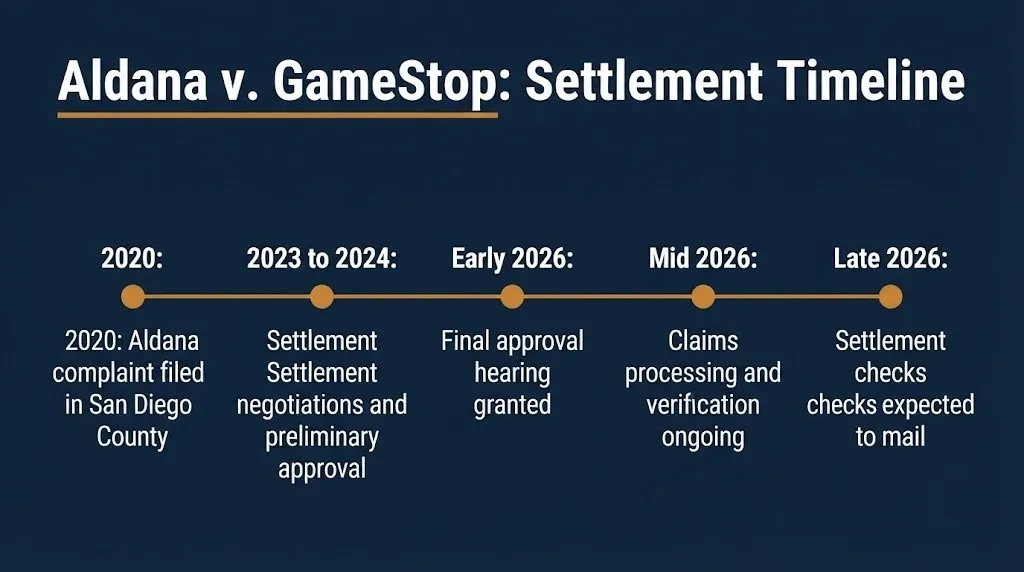
The Aldana settlement received final court approval. The settlement fund of $4.75 million has been funded by GameStop. The settlement administrator is now processing claims and calculating individual payouts.
Final approval is the court order that makes the settlement binding. It follows a fairness hearing where the judge reviews the terms, considers any objections from class members, and approves the attorney fees and service award. The final approval order means the settlement is no longer conditional. Payments will follow.
The current phase is claims administration. This involves verifying every submitted claim against employment records, calculating each class member’s pro rata share, and preparing checks or electronic payments. The timeline for this phase depends on the number of claims, the complexity of the records, and the administrator’s processing capacity.
No distribution date has been publicly confirmed. Based on typical timelines for California wage and hour class action settlements of this size, distribution is expected in the second half of 2026. Checks are usually mailed in a single batch, not on a rolling basis.
Key Takeaway: The settlement is final and the fund is funded; the remaining step is claims processing and check mailing, expected by late 2026.
What Other GameStop Lawsuits Are Active in 2026?
The Aldana settlement is not the only GameStop lawsuit. Several other cases have been filed against the company in recent years, covering different legal claims and affecting different groups.
A data breach class action was filed after GameStop disclosed a security incident involving customer payment card information. This case alleged that GameStop failed to adequately protect customer data. The status of this litigation in 2026 is not yet confirmed. If a settlement is reached, affected customers would be notified directly.
Securities litigation arising from the 2021 GameStop short squeeze and trading volatility continues to work through the courts. Multiple shareholder lawsuits were filed alleging that GameStop and certain executives made misleading statements or failed to disclose material information. These cases do not involve direct payouts to individual investors unless a class settlement is reached and approved.
A separate consumer class action challenged GameStop’s PowerUp Rewards program, alleging that the company changed the terms without proper notice. The status of this case is not yet confirmed from publicly available court records.
None of these cases have resulted in a finalized settlement with an active claims process as of mid-2026. The Aldana wage and hour case remains the only GameStop class action with an approved fund and pending payouts.
When Will GameStop Settlement Checks Be Mailed?
Settlement checks for the Aldana class action are expected to mail in the second half of 2026. No specific date has been published by the settlement administrator. This is typical. Administrators generally do not announce an exact mailing date until checks are in the mail.
The timeline from final approval to check mailing usually runs three to six months. The administrator must verify every claim, resolve any deficiencies, calculate pro rata shares, prepare the checks or electronic payments, and obtain final approval of the distribution from the court. Any appeal of the final approval order can delay this timeline, though no appeal has been reported in this case.
If you filed a valid claim, your check will arrive by mail at the address you provided on your claim form. Some administrators offer electronic payment options like PayPal or direct deposit. Check the settlement website or the notice you received to see whether electronic payment was an option in this settlement.
If you do not receive a check and believe you should, wait until the distribution has been confirmed as complete. Then contact the settlement administrator. Do not call GameStop corporate. They cannot help with settlement checks. Only the administrator has access to the claims database.
What Happens to Unclaimed Settlement Funds?
Unclaimed funds in class action settlements are typically handled in one of three ways. The settlement agreement specifies which applies.
The most common approach is a second distribution to class members who cashed their initial checks. If the cost of a second distribution exceeds the administrative expense, the remaining funds may be distributed to a cy pres recipient, a charitable organization whose mission relates to the subject of the lawsuit.
Some settlement agreements allow unclaimed funds to revert to the defendant, though California courts often disfavor reversion in wage and hour cases. The specific terms for the Aldana settlement have not been publicly confirmed from the settlement agreement.
If you are a class member and your check goes uncashed, the funds will eventually be allocated according to the settlement agreement. You will not have a second chance to claim the money after the check cancellation deadline passes.
Key Takeaway: Unclaimed funds follow the settlement agreement’s allocation plan; if you filed a claim, cash your check promptly.
What Happens Next
The Aldana settlement is in its final administrative phase. Here is what the remaining timeline looks like, based on standard class action settlement procedures in California:
- July to September 2026: Claims verification and pro rata calculations expected to conclude.
- October to December 2026: Settlement checks expected to mail. Watch for a postcard or email update from the settlement administrator.
- 60 to 90 days after mailing: Unclaimed check deadline passes. Any second distribution or cy pres allocation would follow.
- Early 2027: Settlement administration expected to close. The case docket will reflect a final accounting.
Frequently Asked Questions
How do I check my GameStop settlement claim status?
Contact the settlement administrator directly using the phone number on the official settlement website.
You will need your claim ID or full name and date of birth.
Do not contact GameStop; they cannot access the claims database.
Can I still file a GameStop settlement claim?
No. The claim deadline for the Aldana settlement has passed.
Late claims are not accepted after the court-ordered deadline.
If you missed the deadline, you are still bound by the settlement’s release and cannot sue separately.
How much will I get from the GameStop settlement?
Your payment depends on how many weeks you worked as a California store manager during the class period.
The exact amount per class member has not been publicly confirmed by the administrator.
Payments in similar settlements typically range from a few hundred to several thousand dollars.
Do I need a lawyer for the GameStop settlement?
No. The class is represented by court-appointed class counsel.
You do not need to hire your own attorney to receive your settlement payment.
If you want to discuss your individual situation, you may consult a lawyer at your own expense.
What if I moved since filing my claim?
Contact the settlement administrator immediately to update your mailing address.
Provide your claim ID and new address in writing.
Checks are mailed to the address on file; an old address will delay your payment.
Are settlement payments taxable?
Settlement payments in wage and hour cases are generally treated as taxable wages.
You may receive a W-2 or 1099 from the settlement administrator.
Consult a tax professional about your specific situation.
Can GameStop fire me for participating in this lawsuit?
No. Retaliation against an employee for participating in a class action is illegal under California law.
If you are a current GameStop employee and experience adverse action, document it and contact class counsel or the California Labor Commissioner.
Settlement participation is a protected activity.
Is the Aldana settlement the same as the GameStop stock lawsuit?
No. The Aldana case is a wage and hour class action for California store managers.
The stock-related lawsuits are securities cases and do not involve payouts to individual retail investors.
These are separate cases with different plaintiffs, courts, and outcomes.
What You Should Do Now
If you filed a claim in the Aldana settlement, confirm that the settlement administrator has your current mailing address. Watch your mail for a check in the second half of 2026. Cash it promptly when it arrives. If you did not file a claim and believe you should have received notice, the deadline has passed, but you can still contact the settlement administrator to confirm your status for the record.
If you still work at GameStop and have concerns about wage and hour compliance, document your hours, breaks, and duties. California law protects employees who inquire about their rights, and accurate records are the foundation of any wage claim.