SHRM Lawsuit 2026: Legal Challenges, DEI Disputes, and Employment Law Claims
Quick Answer:
- Legal complaints against SHRM are real, centering on claims that its 2024 shift away from equity-focused language enabled discrimination.
- No settlement amounts have been confirmed in any SHRM-related employment discrimination matter.
- Individual claims may have filing deadlines through the EEOC or state agencies, not through SHRM directly.
The Society for Human Resource Management, known as SHRM, is the largest HR professional association in the world. In 2024, the organization made a controversial change to its diversity, equity, and inclusion framework, dropping the word “equity” and reframing its approach.
That decision sparked backlash from members, civil rights advocates, and legal professionals. Some of that backlash has now entered the legal system.
This article covers what is verified about legal actions involving SHRM, the DEI policy changes, and what it means for HR professionals. One surprising detail: SHRM’s own certification materials now conflict with what many employment lawyers say is legally required.
The Facts
| Case | Multiple discrimination complaints and policy challenges |
| Status | Under review, no class certification |
| Fund Size | Not applicable |
| Est. Per Person | Not applicable |
| Claim Deadline | Varies by agency and jurisdiction |
| Administrator | Not applicable |
| Proof Needed | Employment records, policy documents |
Is There a SHRM Lawsuit?
There is no single, consolidated SHRM lawsuit as of January 2026. Instead, multiple legal complaints and challenges reference SHRM’s policy positions.
The legal actions involving SHRM fall into several categories. Employment discrimination complaints citing SHRM’s guidance appear in various jurisdictions. Members have filed internal grievances. Some legal scholars have raised concerns about the organization’s liability exposure.
SHRM itself is a defendant in at least one pending matter related to its certification practices. The specific allegations in that case have not been fully resolved through public court rulings.
The most significant legal risk for SHRM stems from its 2024 decision to remove “equity” from its inclusion framework. Critics argue the change signals a retreat from legally recognized anti-discrimination principles.
SHRM has defended the change as a clarification, not a retreat. The organization states its commitment to diversity and inclusion remains unchanged.
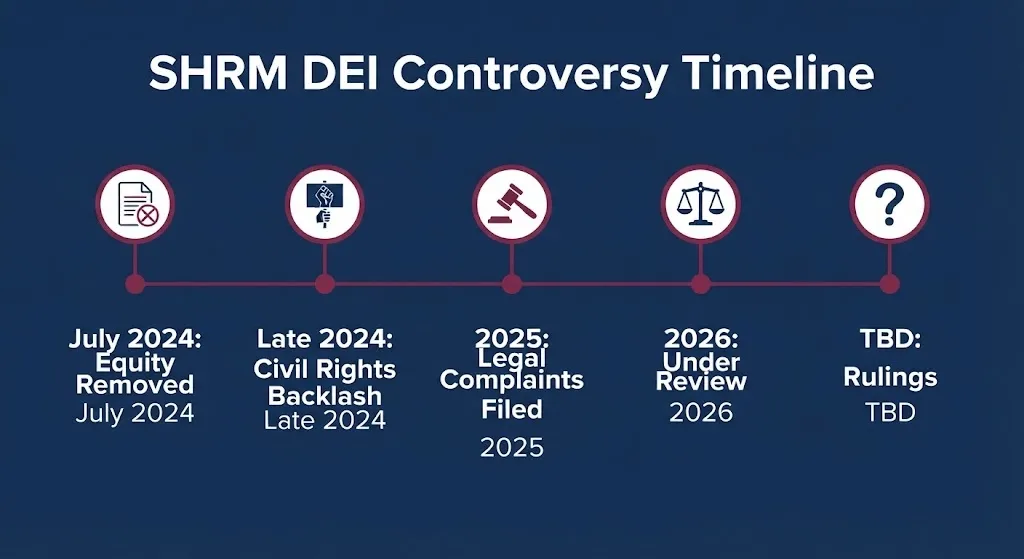
The legal landscape is evolving. Complaints filed in 2024 and 2025 are working through administrative processes and early court proceedings.
Key Takeaway: There is no single headline-grabbing SHRM lawsuit, but multiple legal matters reference or target the organization’s policy positions.
Why Is SHRM Facing Legal Challenges?
SHRM is facing legal challenges because its 2024 decision to drop “equity” from its DEI framework created conflicts with employment law obligations and member expectations.
In July 2024, SHRM announced it would remove “equity” from its inclusion and diversity framework. The organization said it would focus on “inclusion and diversity” instead, arguing that equity had become polarizing.
The decision drew immediate criticism. Civil rights organizations, including the NAACP and the National Urban League, publicly condemned the change. Some HR professionals resigned their SHRM memberships in protest.
Legal professionals noted a concerning gap. Federal employment law, including Title VII of the Civil Rights Act, uses language that aligns more closely with equity concepts than with a narrow diversity-only approach.
SHRM’s own certification materials previously taught equity principles. The reversal created potential liability for HR professionals who followed the new guidance and faced discrimination claims.
The legal challenges argue that SHRM’s shift could mislead employers into abandoning legally sound practices. Whether those arguments succeed in court remains to be seen.
Key Takeaway: The legal challenges stem from a policy change that critics say conflicts with employment law and created liability risks for HR professionals.
What Is the SHRM DEI Lawsuit About?
The legal matters involving SHRM’s DEI policies center on whether the organization’s guidance conflicts with federal anti-discrimination law.
Title VII of the Civil Rights Act prohibits employment discrimination based on race, color, religion, sex, and national origin. The law requires employers to prevent and address discrimination, not just celebrate diversity.
Critics of SHRM’s policy change argue that removing equity from the framework weakens the legal foundation for anti-discrimination work. They claim the change could encourage employers to abandon practices that prevent discrimination.
SHRM maintains that its framework remains fully compliant with employment law. The organization states that inclusion and diversity, without the word equity, still encompass all legally required practices.
The legal question is whether SHRM’s guidance, as the largest HR association, carries enough weight to influence employer behavior in ways that violate the law.
No court has ruled on the core question. The legal matters remain in early stages.
The comparison to a medical association changing treatment guidelines applies here. The guidance itself is not law, but it influences practice, and harmful guidance creates liability.
Key Takeaway: The DEI legal matters focus on whether SHRM’s guidance conflicts with federal anti-discrimination law and creates liability for employers.
Has SHRM Settled Any Lawsuits?
No public settlement has been confirmed in any legal matter directly naming SHRM as a defendant as of January 2026.
The legal landscape surrounding SHRM is still developing. Complaints filed through administrative agencies like the EEOC often take months or years to resolve.
Some complaints may settle confidentially. Employment discrimination settlements routinely include non-disclosure provisions that prevent public confirmation of terms.
SHRM has not announced any settlement related to its DEI policy changes or certification practices.
The absence of public settlements does not mean no legal risk exists. It means the matters are still working through the system.
Individual employment discrimination cases that reference SHRM guidance are separate from cases against SHRM itself. Those cases may settle or proceed to litigation independently.
Key Takeaway: No confirmed settlement exists in matters directly involving SHRM, though confidentiality could prevent public disclosure.
What Is SHRM?
The Society for Human Resource Management is the world’s largest HR professional association, with over 300,000 members globally.
SHRM provides certifications, training, advocacy, and resources for human resources professionals. The SHRM Certified Professional and SHRM Senior Certified Professional credentials are widely recognized in the industry.
The organization’s influence extends beyond its membership. SHRM’s guidance shapes HR practices at companies of all sizes. Its publications, research, and policy positions influence how employers approach hiring, discipline, and workplace culture.
SHRM’s headquarters is in Alexandria, Virginia. The organization operates as a nonprofit professional association.
The DEI policy change in 2024 was one of the most significant shifts in SHRM’s history. It signaled a departure from the equity-focused language that had become standard in the HR profession.
The controversy revealed a divide within the profession. Some HR leaders supported the change as pragmatic. Others saw it as abandoning core principles.
Key Takeaway: SHRM’s influence makes its policy positions consequential beyond its own membership, which is why the DEI change created legal and reputational risk.
What Is the SHRM Certification Lawsuit?
The SHRM certification lawsuit refers to legal challenges questioning whether SHRM’s certification materials provide accurate and legally compliant guidance.
SHRM certifications require passing an exam that tests knowledge of HR practices and employment law. The exam content and study materials reflect SHRM’s policy positions.
After the 2024 DEI change, SHRM updated its certification materials to align with the new framework. Some legal professionals argue the updated materials contain guidance that conflicts with established employment law principles.
The legal theory is that HR professionals who followed SHRM’s guidance and were then involved in discrimination disputes may have claims against SHRM for providing faulty guidance.
Proving such claims is difficult. SHRM would argue that its materials are educational, not legal advice, and that employers bear responsibility for compliance.
No court has ruled on the merits of any certification-related claim against SHRM.
The issue has implications for the entire HR certification industry. If certification bodies face liability for their guidance, the industry model could change.
Key Takeaway: Legal challenges to SHRM’s certification materials focus on whether the organization can be held liable for guidance that allegedly conflicts with employment law.
Can You Sue SHRM?
You may sue SHRM if you have a valid legal claim, but the barriers are significant and the legal theory must be strong.
SHRM is a nonprofit organization with legal resources to defend itself. It is not a government agency, so sovereign immunity does not apply. It can be sued like any private entity.
The challenge is establishing a legal claim against SHRM. The organization does not employ the HR professionals who use its guidance. It does not make employment decisions at member companies. Its role is advisory and educational.
Possible legal theories include:
- Negligent misrepresentation if SHRM provided false information
- Consumer protection claims if certification products were misleading
- Breach of contract if membership benefits were not delivered
- Discrimination claims if SHRM’s own employment practices violated the law
None of these theories have produced a successful judgment against SHRM as of January 2026.
Individuals who believe they have been harmed by following SHRM guidance should consult an employment attorney. The claim would likely be against the employer, not SHRM directly.
Reality Check: SHRM guidance is not the law. Employers remain responsible for compliance regardless of what SHRM or any other association says. If you face discrimination at work, your claim is against your employer, not against SHRM.
What Happened with SHRM and DEI in 2024?
In July 2024, SHRM announced it would remove “equity” from its inclusion and diversity framework, triggering widespread backlash.
The announcement came at SHRM’s annual conference. The organization stated it would use “inclusion and diversity” instead of the more common “diversity, equity, and inclusion” framework.
SHRM’s leadership argued that the word equity had become divisive and that focusing on inclusion and diversity would be more unifying. The organization claimed the change was about effectiveness, not retreat.
The reaction was immediate and intense. Civil rights organizations issued statements condemning the change. Some members resigned. HR professionals debated the decision publicly.
Legal professionals noted that equity concepts are embedded in federal anti-discrimination law. Removing the word from SHRM’s framework did not change the legal requirements, but critics argued it created confusion about those requirements.
SHRM has defended the change consistently. The organization states its commitment to workplace fairness remains intact.
The controversy continues to shape SHRM’s reputation and legal risk in 2026.
Key Takeaway: The 2024 DEI policy change is the root cause of current legal challenges and reputational damage for SHRM.
Is SHRM Still a Credible Organization?
SHRM remains the largest HR professional association, but its credibility has been questioned by some members and legal observers.
The organization continues to operate at full scale. Conferences, certifications, and publications proceed. Corporate membership remains substantial.
The credibility question is not about whether SHRM exists. It is about whether HR professionals can rely on SHRM guidance for legally compliant practices.
Employment law evolves through legislation, regulation, and court decisions. SHRM’s guidance has historically tracked those developments. The DEI change created a gap between SHRM’s framework and the language used in some legal contexts.
Some employers have distanced themselves from SHRM’s DEI position. Other HR organizations have emphasized their continued use of equity-focused language.
The long-term impact on SHRM’s credibility depends on how the legal matters resolve and whether the organization adjusts its position.
The comparison to a financial advisor who gives outdated tax advice fits here. The advisor still exists, but clients question whether the guidance is reliable.
Key Takeaway: SHRM remains influential but faces credibility challenges tied to its DEI policy change and resulting legal scrutiny.
What Happens Next for SHRM Legal Matters?
Here is the expected timeline for SHRM-related legal matters in 2026:
Early to Mid 2026: Administrative agencies review pending discrimination complaints referencing SHRM guidance.
Mid 2026: Courts may issue rulings on motions in cases naming SHRM as a defendant.
Late 2026: Potential settlement discussions or trial scheduling in active matters.
Ongoing: SHRM continues to update certification materials and public positions.
Beyond 2026: Appellate review of any adverse rulings.
This timeline is an estimate. Legal schedules vary by jurisdiction and case complexity.
The most significant development to watch is whether any court rules on the core question of whether SHRM’s guidance creates liability for the organization or for employers who follow it.
Frequently Asked Questions
Is SHRM being sued?
Yes, SHRM faces legal complaints and at least one pending matter naming it as a defendant.
What is the SHRM lawsuit about?
The legal matters focus on whether SHRM’s DEI policy changes conflict with employment law.
Did SHRM change its DEI policy?
Yes, SHRM removed “equity” from its framework in July 2024.
Can I sue SHRM?
Possibly, but establishing a legal claim against SHRM is difficult because it is an advisory body, not an employer.
Is SHRM still offering certifications?
Yes, SHRM certifications remain available and widely recognized.
Did SHRM settle any lawsuits?
No public settlement has been confirmed as of January 2026.
What should HR professionals do about the SHRM DEI change?
Consult employment counsel and follow legal requirements regardless of SHRM’s framework.
Is SHRM losing members?
Some members resigned after the DEI change, but SHRM remains the largest HR association globally.
SHRM’s legal challenges reflect broader tensions over workplace diversity policies and employment law compliance. The organization’s influence means its positions matter far beyond its membership.
The most important takeaway for HR professionals: SHRM guidance is educational, not legal advice. Employment law compliance remains each employer’s responsibility.