Bad Bunny Lawsuit 2026: Legal Battles, Contract Disputes, and Case Status
Quick Answer:
- Bad Bunny’s legal matters are real, with multiple active cases in Puerto Rico and federal courts.
- No settlement amounts have been confirmed in his major pending cases.
- These are individual celebrity disputes, not class actions, so no public claim deadlines apply.
Bad Bunny, born Benito Antonio Martínez Ocasio, has become one of the most commercially successful Latin artists in history. That success has brought legal battles on multiple fronts.
The most publicized case involves his lawsuit against Carliz De La Cruz Hernández, a former romantic partner, over unauthorized use of a voice recording. The case raises questions about privacy, consent, and celebrity.
This article covers verified court filings, case status, and what the litigation means. One surprising detail: the voice recording at the center of the most famous case was a simple phrase, not a song lyric, and its commercial value has become a central legal question.
The Facts
| Case | Martínez Ocasio v. De La Cruz Hernández, et al. |
| Status | Active litigation, motions pending |
| Fund Size | Not applicable, individual lawsuit |
| Est. Per Person | Not applicable |
| Claim Deadline | Not applicable |
| Administrator | Not applicable |
| Proof Needed | Court filings, contracts, recordings |
Is the Bad Bunny Lawsuit Real?
The Bad Bunny lawsuit is real and active in the Puerto Rico court system as of January 2026.
Bad Bunny filed the lawsuit against Carliz De La Cruz Hernández in 2023. The case was filed in the Court of First Instance in San Juan, Puerto Rico.
The lawsuit seeks $40 million in damages. Bad Bunny claims De La Cruz Hernández violated his rights by allowing and profiting from unauthorized use of a voice recording.
The recording in question captures De La Cruz Hernández saying “Bad Bunny, baby” in a distinctive voice. That phrase was later incorporated into Bad Bunny’s music without her consent, she claimed.
The case has drawn attention because of the reversal of typical power dynamics. A global superstar is suing a private individual, not the other way around.
The legal claims include violations of the Puerto Rico Right of Publicity Act and moral damages under Puerto Rico civil law.
Key Takeaway: The lawsuit is genuine and seeks substantial damages, but the legal issues are complex and unresolved.
Why Did Bad Bunny Sue His Ex-Girlfriend?
Bad Bunny sued Carliz De La Cruz Hernández over her alleged unauthorized use and monetization of a voice recording from their relationship.
The recording at issue captures De La Cruz Hernández saying “Bad Bunny, baby” in what Bad Bunny’s legal team describes as a distinctive and commercially valuable voice performance.
Bad Bunny incorporated that phrase into his song “Pa Ti” and other recordings. De La Cruz Hernández later filed her own legal action claiming she never consented to the commercial use of her voice.
Bad Bunny’s lawsuit is a counteroffensive. He claims she demanded millions for the continued use of the phrase and interfered with his business relationships.
The dispute centers on consent. Bad Bunny’s team argues the recording was made freely during their relationship and that De La Cruz Hernández had no reasonable expectation of compensation years later.
De La Cruz Hernández’s position is that her voice and image have value, and Bad Bunny profited without proper authorization.
The case highlights how digital content and voice recordings have become valuable assets in the entertainment industry.
Key Takeaway: The dispute is about who owns the right to a brief voice recording and what that right is worth.
How Much Is Bad Bunny Suing For?
Bad Bunny is seeking $40 million in damages in his lawsuit against Carliz De La Cruz Hernández.
The $40 million figure appears in the initial complaint filed in Puerto Rico court. The amount reflects claimed losses from business interference, reputational harm, and legal costs.
The damages claim does not mean Bad Bunny has suffered $40 million in verified losses. The figure is an allegation to be proven at trial or reduced through settlement.
Bad Bunny’s annual earnings help contextualize the amount. He has earned over $80 million in some years through touring, streaming, endorsements, and business ventures. The $40 million claim represents roughly six months of peak earnings.
The lawsuit also seeks injunctive relief, asking the court to prevent De La Cruz Hernández from further using or licensing the voice recording.
De La Cruz Hernández has not filed a public counterclaim for a specific amount in her separate action, but her legal team has stated she seeks fair compensation for unauthorized voice use.
No settlement amount has been confirmed. The parties have not announced any resolution as of January 2026.
Reality Check: The $40 million figure is a demand, not a verdict or settlement. Celebrity lawsuits often seek amounts far exceeding what ultimately resolves the case. Any report of a confirmed settlement is premature.
What Is the Legal Basis for the Bad Bunny Lawsuit?
The Bad Bunny lawsuit relies on the Puerto Rico Right of Publicity Act and civil law claims for moral damages.
The Right of Publicity Act protects an individual’s name, voice, image, and other identifying characteristics from unauthorized commercial use.
Bad Bunny’s argument is that his voice and persona are his own property. When De La Cruz Hernández used a recording of him and licensed her own voice in ways that interfered with his business, she violated his rights.
The legal theory is unusual. Typically, the person whose voice was recorded without consent sues the person who used it. Here, the celebrity is suing the private individual.
The case also involves contract and interference claims. Bad Bunny alleges De La Cruz Hernández interfered with his recording contracts by demanding payments from his business partners.
Puerto Rico’s civil law system differs from most mainland U.S. jurisdictions. The case draws on local statutes and civil code provisions that may not have direct equivalents elsewhere.
The legal questions are novel enough that the case could set precedent for how voice recordings from personal relationships are treated in entertainment law.
Key Takeaway: The legal claims rest on Puerto Rico’s publicity rights law and civil code, making the case legally distinctive.
What Other Lawsuits Is Bad Bunny Involved In?
Bad Bunny is involved in multiple legal matters beyond the De La Cruz Hernández case, including business disputes and contract litigation.
One notable case involves a lawsuit against a former business manager. Bad Bunny alleged financial mismanagement and breach of fiduciary duty. The case was filed in Puerto Rico and sought recovery of allegedly mishandled funds.
Another legal matter involved copyright claims over music samples and compositions. Most of these cases settle confidentially, and public records are limited.
Bad Bunny has also faced lawsuits from concert promoters and event organizers. These cases typically involve breach of contract claims over canceled appearances or tour disputes.
His business empire, including the professional wrestling promotion linked to his brand and his restaurant ventures, has generated routine business litigation.
Not all legal matters involving Bad Bunny are lawsuits he filed. Some are claims against him. The full scope of his legal docket is not publicly consolidated in one place.
The most significant current case remains the De La Cruz Hernández litigation due to its public profile and the novelty of the legal issues.
Key Takeaway: Bad Bunny manages a portfolio of legal disputes, with the voice recording case receiving the most public attention.
What Is the Status of the Bad Bunny Lawsuit in 2026?
The Bad Bunny lawsuit against Carliz De La Cruz Hernández remains in active litigation as of January 2026, with no trial date set.
The case has progressed through preliminary motions. Both sides have exchanged initial filings and responses.
The court has not issued a final ruling on the merits. Discovery is underway or expected to begin, depending on pending motion rulings.
No settlement has been announced. The parties have not indicated whether settlement discussions are occurring.
The case is not a class action. No class certification process applies. This is a two-party dispute resolved through ordinary civil litigation.
The timeline for resolution is uncertain. Complex cases in Puerto Rico courts can take two to four years from filing to trial or settlement.
If the case proceeds to trial, a decision could come by 2027 or 2028. Settlement could occur at any time.
Key Takeaway: The case is active but unresolved, with no trial date and no confirmed settlement.
Could the Bad Bunny Lawsuit Set a Legal Precedent?
The Bad Bunny lawsuit could set a legal precedent for how voice recordings from personal relationships are treated in entertainment law.
The central question is whether a brief, casual voice recording made during a personal relationship can be commercially exploited by the person who made the recording.
If the court rules for Bad Bunny, the case could establish that celebrities have expanded rights to control recordings that reference them, even when made by others.
If the court rules for De La Cruz Hernández, the case could affirm that individuals retain rights to their own voice recordings regardless of the other party’s celebrity status.
The case also touches on the Right of Publicity Act in Puerto Rico, which has received limited judicial interpretation. The ruling could clarify how the law applies to voice recordings specifically.
Entertainment lawyers are watching the case closely. The outcome could affect how artists obtain consent for voice samples, even brief phrases in casual recordings.
The comparison to a viral social media post is apt. Once something is recorded, questions about who controls it and who profits become complex quickly.
Key Takeaway: The case has precedent-setting potential, but any ruling will face appellate review.
What Happens Next in the Bad Bunny Lawsuit?
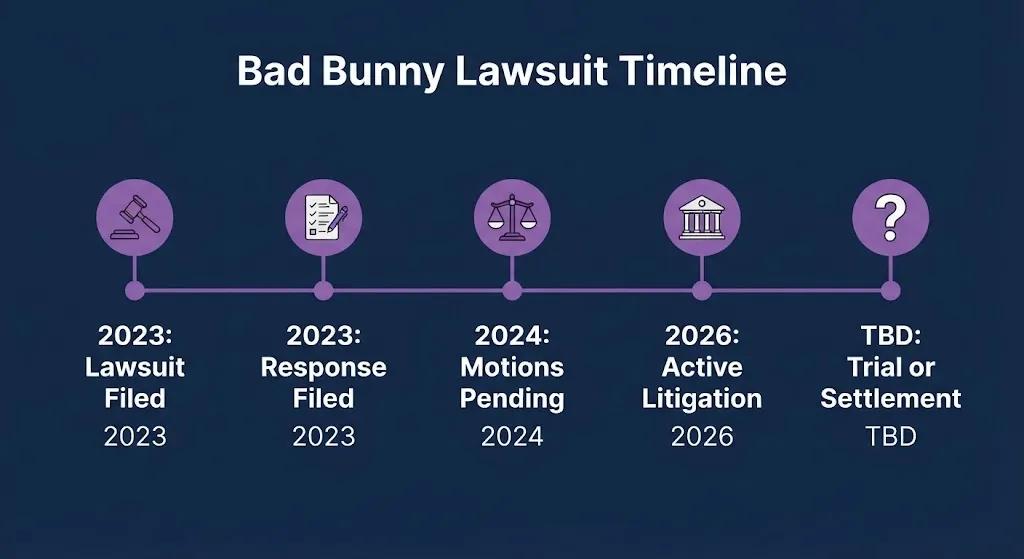
Here is the expected timeline for the Bad Bunny lawsuit based on the current posture and standard litigation progression:
Early to Mid 2026: Court rules on pending motions, including any dismissal attempts.
Mid to Late 2026: Discovery proceeds with depositions and document production.
Late 2026 to Early 2027: Summary judgment motions may be filed by either side.
2027: Trial could begin if no settlement is reached.
Ongoing: Settlement negotiations may occur at any stage.
This timeline is an estimate. Puerto Rico court schedules vary, and high-profile cases often experience delays.
The most significant near-term event is the court’s ruling on pending motions. That ruling will determine whether the case proceeds to discovery or ends early.
Frequently Asked Questions
Is Bad Bunny being sued?
Yes, Bad Bunny is both a plaintiff and defendant in multiple legal matters, but his most publicized case is one he filed.
Who is Bad Bunny suing?
Bad Bunny is suing Carliz De La Cruz Hernández over unauthorized use of a voice recording.
How much is Bad Bunny suing for?
Bad Bunny seeks $40 million in damages in the De La Cruz Hernández case.
What is the Bad Bunny lawsuit about?
The lawsuit is about rights to a voice recording and alleged business interference.
Has the Bad Bunny lawsuit settled?
No settlement has been confirmed as of January 2026.
Where was the Bad Bunny lawsuit filed?
The case was filed in the Court of First Instance in San Juan, Puerto Rico.
Is the Bad Bunny lawsuit a class action?
No, it is an individual lawsuit between two parties.
When will the Bad Bunny lawsuit go to trial?
No trial date has been set, and the case may not reach trial before 2027.
Bad Bunny’s legal battles show that even the most successful artists face complex disputes over rights, money, and personal history. The voice recording case will likely continue through 2026 and beyond.
The next significant development will be the court’s ruling on pending motions. Watch the Puerto Rico court docket for updates.