Kia Lawsuit 2026: Engine Settlement, Class Action Status, and Claim Deadlines
Quick Answer:
- Kia engine lawsuits are real, with settlements covering Theta II and other defective engines across multiple model years.
- Payouts vary by claim type, including repair reimbursements, replacement costs, and diminished value compensation.
- Deadlines vary by settlement, with some still open and others closed to new claims.
Kia has faced a wave of engine defect litigation spanning more than a decade. The core claim: certain Kia engines failed prematurely, sometimes causing fires or complete engine seizure.
If you own or owned a Kia with engine problems, you may qualify for compensation. The most important fact: multiple settlements exist, but each has its own rules, deadlines, and covered vehicle list.
This article covers what is verified about the Kia engine settlements, class action status, payout ranges, and how to file. One surprising detail: Kia and parent company Hyundai have paid billions in combined settlements and penalties related to engine defects.
The Facts
| Case | Multiple class action settlements and ongoing litigation |
| Status | Settlements approved, some claims still open |
| Fund Size | Varies by settlement, collectively over $1 billion |
| Est. Per Person | Varies by claim type and vehicle |
| Claim Deadline | Varies by settlement |
| Administrator | Kia Settlement Administrator |
| Proof Needed | Vehicle ownership, repair records, recall notices |
Is the Kia Engine Lawsuit Real?
The Kia engine lawsuit is real, with multiple settled class actions and ongoing litigation as of January 2026.
The litigation began after thousands of Kia owners reported premature engine failures. The affected engines included the Theta II, Nu, and Gamma engine families used across many Kia models.
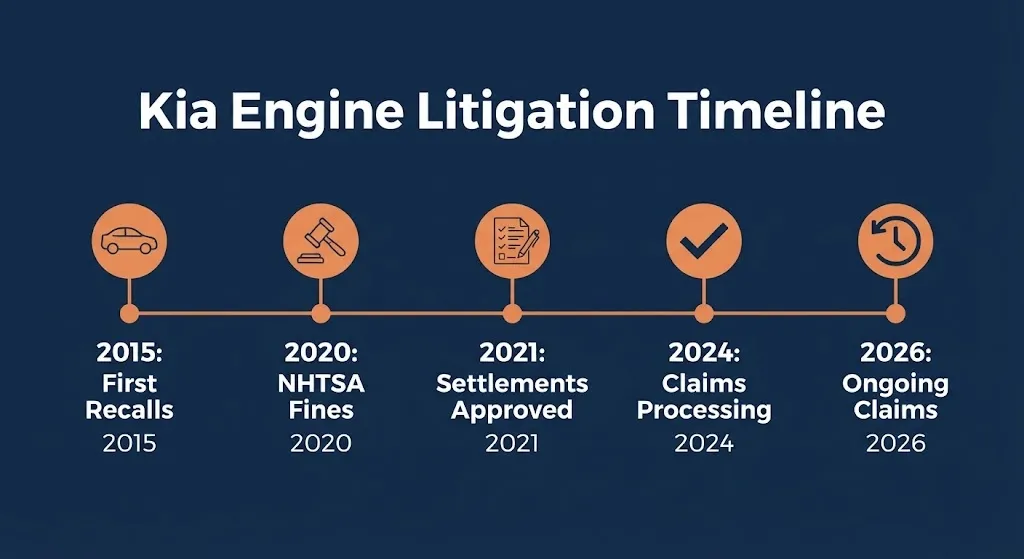
The National Highway Traffic Safety Administration opened investigations into Kia and Hyundai engine failures. Recalls followed, covering millions of vehicles.
Class action lawsuits followed the recalls. Plaintiffs alleged that Kia knew about the engine defects but failed to disclose them promptly and failed to provide adequate remedies.
Settlements have been approved in several cases. The settlements provide compensation for repairs, replacements, towing, rental cars, and in some cases, diminished value.
Ongoing litigation continues for newer vehicles and additional engine types not covered by earlier settlements.
The litigation is not one single case. It is a series of class actions and individual lawsuits consolidated in various courts.
Key Takeaway: The Kia engine litigation is real, with approved settlements and ongoing cases covering different vehicles and model years.
How Much Is the Kia Engine Settlement Per Person?
Kia engine settlement payouts vary by claim type, ranging from a few hundred dollars to over $10,000 depending on the vehicle and circumstances.
The settlement structure is complex. Payouts depend on what happened to your vehicle, what you paid, and whether you still own the car.
Here is the typical payout range table:
| Claim Type | Typical Range |
| Engine repair paid out of pocket | $1,000 to $5,000+ |
| Engine replacement paid out of pocket | $3,000 to $10,000+ |
| Towing and rental reimbursement | $100 to $1,000 |
| Diminished value after repair | $500 to $3,000 |
| Total loss due to engine failure | Varies by vehicle value |
These ranges come from settlement documents and reported claims data. They are not guarantees. Your specific payout depends on your documentation and the settlement terms.
The settlements reimburse actual expenses in most cases. If you paid nothing because Kia covered the repair under warranty, your payout may be limited to other categories like diminished value.
Some settlements include lump sum payments for specific circumstances. For example, owners who sold their vehicles at a loss after engine problems may qualify for a set amount.
Reality Check: No one can guarantee a specific Kia settlement amount. Any service that promises a fixed payout without reviewing your repair records and settlement eligibility is not credible. Filing a claim through the official administrator is free.
Who Qualifies for the Kia Engine Settlement?
You may qualify for the Kia engine settlement if you owned or leased a covered vehicle that experienced engine failure or related problems.
The covered vehicle list is the critical first step. Each settlement identifies specific models and model years. Common covered vehicles include:
- Kia Optima with Theta II engines (2011 to 2019 model years)
- Kia Sorento with Theta II engines (2012 to 2019 model years)
- Kia Sportage with Theta II engines (2011 to 2019 model years)
- Kia Soul with Nu engines (certain model years)
- Kia Forte with certain engine types
The exact list varies by settlement. Check the official settlement website for the specific covered vehicle list.
The problem must be engine-related. Covered issues typically include engine seizure, engine fire, connecting rod bearing failure, and related engine damage.
You must have documentation. Repair records, recall notices, and proof of ownership establish your eligibility.
Timing matters. The engine failure must have occurred within a certain mileage and time period specified in the settlement.
Not every Kia owner qualifies. If your engine worked fine, or your problem was unrelated to the covered defects, you are not eligible.
Key Takeaway: Covered vehicle, engine-related problem, and documentation are the three essential qualification factors.
How to File a Kia Engine Settlement Claim
Filing a Kia engine settlement claim requires submitting documentation through the official settlement administrator.
Here is the step-by-step process:
- Check the official settlement website to confirm your vehicle is covered.
- Gather repair records, receipts, and proof of ownership.
- Complete the claim form online or download the paper version.
- Submit documentation showing the engine problem and what you paid.
- Include proof of any recall notices or warranty work.
- Track your claim status through the settlement administrator.
- Respond promptly to any requests for additional information.
The process is similar to filing a complex warranty claim. You need documentation, patience, and attention to deadlines.
Do not pay anyone to file your claim. The official process is free. Third-party services that charge fees add no value.
The deadline matters. Late claims are rejected. Check the specific deadline for your settlement.
Some settlements have closed to new claims. If the deadline passed, you may still have options through individual litigation or newer settlements.
Key Takeaway: File through the official administrator, keep your documentation, and do not miss the deadline.
What Is the Kia Class Action Lawsuit About?
The Kia class action lawsuit alleges that Kia sold vehicles with defective engines that failed prematurely and created safety risks.
The core allegation is that manufacturing debris left in the engine during production restricted oil flow. The restricted oil flow caused premature bearing wear, engine seizure, and in some cases, engine fires.
Plaintiffs claim Kia knew about the defect through warranty data and internal testing but failed to disclose it. They allege the company issued insufficient recalls and failed to compensate owners adequately.
The lawsuits assert claims for breach of warranty, consumer protection violations, and fraud. The legal theories vary by state and specific case.
The defect affected millions of vehicles. The Theta II engine, developed jointly by Hyundai and Kia, was the primary culprit. The Nu and Gamma engines also had issues.
The National Highway Traffic Safety Administration fined Hyundai and Kia $210 million in 2020 for delaying recalls related to the engine defects. The fine was one of the largest in agency history.
The class actions followed the regulatory action. Settlements now provide compensation to affected owners.
Key Takeaway: The lawsuits allege Kia knew about manufacturing defects but delayed disclosure and adequate remedies.
What Kia Models Are Affected by the Engine Lawsuit?
The Kia engine lawsuit covers multiple models, primarily those with Theta II, Nu, and Gamma engines.
The most commonly affected models include:
| Model | Engine | Typical Years |
| Kia Optima | Theta II 2.0L and 2.4L | 2011 to 2019 |
| Kia Sorento | Theta II 2.4L | 2012 to 2019 |
| Kia Sportage | Theta II 2.4L | 2011 to 2019 |
| Kia Soul | Nu 1.8L and 2.0L | 2012 to 2019 |
| Kia Forte | Nu 2.0L | 2014 to 2018 |
The exact covered vehicles vary by settlement. Some settlements cover only certain trim levels or production dates.
The VIN determines eligibility. Your vehicle identification number identifies the engine type and production date. The settlement administrator uses the VIN to verify coverage.
If you are unsure whether your vehicle is covered, check the official settlement website. Enter your VIN for a definitive answer.
The newer Smartstream engines have separate litigation. Not all Kia engine problems are covered by the existing settlements.
Key Takeaway: Theta II, Nu, and Gamma engines in popular Kia models are the primary focus of the litigation.
What Is the Kia Theta II Engine Settlement?
The Kia Theta II engine settlement is a class action resolution covering vehicles with defective Theta II engines that experienced premature failure.
The settlement covers specific Kia models with Theta II 2.0-liter and 2.4-liter engines. The covered vehicles include certain Optima, Sorento, and Sportage models.
The settlement provides several types of compensation:
- Reimbursement for out-of-pocket engine repairs
- Reimbursement for engine replacement costs
- Towing and rental car reimbursement
- Compensation for total loss vehicles
- Extended warranty coverage for future engine issues
The settlement also includes a lifetime warranty extension for the engine short block in covered vehicles. This warranty covers future engine failures related to the defect.
The settlement fund is substantial but not unlimited. Claims are paid from the fund until exhausted or the deadline passes.
The settlement received final court approval. Claims processing is ongoing for eligible owners.
Key Takeaway: The Theta II settlement provides reimbursement, extended warranty, and compensation for multiple claim types.
What Is the Kia Engine Fire Lawsuit?
The Kia engine fire lawsuit is a separate class action addressing vehicles that caught fire due to engine defects.
The fire claims stem from the same root cause: manufacturing debris causing oil flow restriction. The restricted oil flow creates excessive heat and friction. In severe cases, the engine seizes or catches fire.
The fire lawsuits allege that Kia failed to warn owners about the fire risk and failed to issue timely recalls. Some fires occurred while vehicles were parked, destroying homes and property.
Settlements in the fire cases provide compensation for vehicle damage, property damage, and in some cases, personal injury.
The fire settlements are separate from the engine failure settlements. If your vehicle caught fire, you may qualify for different compensation.
The National Highway Traffic Safety Administration investigated hundreds of fire complaints. Multiple recalls addressed fire risks in affected vehicles.
The fire litigation continues for some model years not covered by existing settlements.
Key Takeaway: Engine fire claims are separate from engine failure claims and may provide compensation for broader damages.
What Is the Kia Soul Engine Lawsuit?
The Kia Soul engine lawsuit addresses premature engine failure in Kia Soul models equipped with Nu engines.
The Kia Soul is one of Kia’s most popular models. The Nu engine used in many Soul models experienced similar issues to the Theta II, though less severe in some cases.
The Soul lawsuits allege that the Nu engine suffered from excessive oil consumption and premature bearing wear. Some owners reported complete engine failure at relatively low mileage.
A class action settlement was reached covering certain Kia Soul model years. The settlement provides:
- Engine repair and replacement reimbursement
- Reimbursement for rental cars and towing
- Compensation for inconvenience
- Extended warranty coverage
The specific model years covered vary by settlement terms. Typical coverage includes 2012 to 2019 Kia Soul models with 1.8-liter or 2.0-liter Nu engines.
The excessive oil consumption issue is notable. Some owners reported adding a quart of oil every 1,000 miles or less.
Key Takeaway: Kia Soul owners with Nu engines may qualify for compensation under separate settlement terms.
Is There a Kia Engine Settlement for 2026?
There are ongoing Kia engine settlements with active claims processing in 2026, though some older settlements have closed to new claims.
The Theta II settlement continues to process claims for eligible owners. The lifetime warranty extension remains in effect for covered vehicles.
Newer settlements may open as litigation progresses. Ongoing cases involving newer engine types and model years continue through the court system.
The exact status of each settlement varies. Some have paid out millions in claims. Others are still in the early stages of claims processing.
The best way to determine your eligibility is to check the official settlement website for your specific vehicle and model year.
Do not assume a settlement exists for your vehicle just because you have engine problems. Verify coverage through official sources.
Key Takeaway: Some settlements are still accepting claims, while others have closed, and new settlements may emerge as litigation continues.
What Happens Next for Kia Litigation in 2026?
Here is the expected timeline for Kia litigation developments in 2026:
Throughout 2026: Claims processing continues for active settlements.
Early to Mid 2026: New settlement negotiations may occur in ongoing cases.
Mid 2026: Potential class certification rulings in newer cases.
Late 2026: Court rulings on pending motions in ongoing litigation.
Ongoing: Extended warranty claims process through Kia dealerships.
This timeline is an estimate. Litigation schedules change based on court rulings and settlement negotiations.
The most important action for Kia owners is checking settlement eligibility now. Deadlines pass, and late claims are rejected.
Frequently Asked Questions
Is there a class action lawsuit against Kia?
Yes, multiple class action lawsuits and settlements exist for Kia engine defects.
How do I know if my Kia is covered?
Check the official settlement website and enter your VIN for definitive coverage information.
What Kia engines are defective?
Theta II, Nu, and Gamma engines are the primary focus of the litigation.
How much will I get from the Kia settlement?
Payouts vary by claim type, ranging from a few hundred dollars to over $10,000.
What is the deadline to file a Kia claim?
Deadlines vary by settlement, with some still open and others closed.
Can I still file a Kia engine claim in 2026?
Possibly, depending on your vehicle, model year, and the specific settlement.
Is there a Kia engine recall?
Yes, multiple recalls cover affected engines, and recall repair remains available.
What should I do if my Kia engine failed?
Gather repair records, check recall status, and file a claim if you qualify.
If you own a Kia with engine problems, check the official settlement website today. Enter your VIN and verify coverage before deadlines pass.
The most important action is checking eligibility now. Settlement deadlines are firm, and late claims receive nothing.