VA Compensation Calculator 2026: Rates, Eligibility, and How to Estimate Your Payment
Quick Answer:
- The VA compensation calculator is a real tool provided by the Department of Veterans Affairs to estimate monthly disability payments.
- Payment amounts depend on your disability rating, dependents, and special circumstances like loss of limb or aid and attendance.
- There is no deadline to use the calculator, but filing your claim promptly protects your effective date.
The VA disability compensation system pays monthly benefits to veterans with service-connected disabilities. The amount depends primarily on your disability rating, which ranges from 0 to 100 percent in 10 percent increments.
If you are a veteran trying to understand what you might receive, the VA compensation calculator is a useful starting point. But the calculator is only as accurate as the information you enter.
This article covers verified 2026 rates, how the calculator works, eligibility factors, and what the calculator does not tell you. One surprising detail: the difference between a 90 percent and 100 percent rating can exceed $1,500 per month for a single veteran.
The Facts
| Case | VA Disability Compensation Program |
| Status | Active, payments issued monthly |
| Fund Size | Federally appropriated annually |
| Est. Per Person | Varies by rating and dependents |
| Claim Deadline | No deadline, effective date protection applies |
| Administrator | Department of Veterans Affairs |
| Proof Needed | Service records, medical records, nexus evidence |
Is the VA Compensation Calculator Accurate?
The VA compensation calculator is accurate if you enter the correct disability rating, dependent information, and special circumstances.
The calculator uses the official VA disability compensation rate tables. These tables are published annually after the cost-of-living adjustment takes effect.
The 2026 rates reflect a cost-of-living adjustment applied to the 2025 rates. The adjustment is tied to the Social Security cost-of-living increase.
What the calculator cannot do is determine your disability rating. That requires a VA claim decision based on medical evidence and service records.
Many veterans use the calculator incorrectly by guessing their rating. A wrong rating input produces a wrong payment estimate.
The calculator also cannot account for every special circumstance. Some situations require manual calculation by a VA representative.
Use the calculator as an estimate, not a guarantee. Your actual payment depends on your official rating decision.
Key Takeaway: The calculator is accurate for what it does, but it cannot determine your rating or account for every special circumstance.
How Much Does VA Disability Pay in 2026?
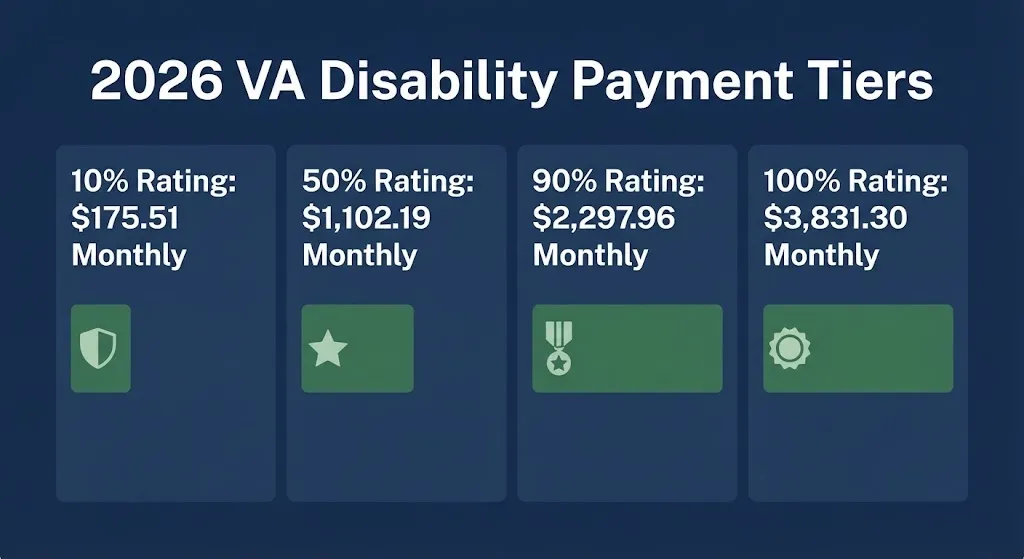
VA disability pay in 2026 starts at $175.51 monthly for a 10 percent rating and increases to over $4,000 monthly for a 100 percent rating with dependents.
The payment scale is progressive. Higher ratings produce higher payments. The relationship is not linear, meaning a 100 percent rating pays substantially more than double a 50 percent rating.
Here is the 2026 monthly payment table for a veteran with no dependents:
| Rating | Monthly Payment |
| 10% | $175.51 |
| 20% | $347.00 |
| 30% | $537.42 |
| 40% | $774.05 |
| 50% | $1,102.19 |
| 60% | $1,395.93 |
| 70% | $1,759.49 |
| 80% | $2,044.89 |
| 90% | $2,297.96 |
| 100% | $3,831.30 |
These figures are from the VA’s published 2026 rate tables. They apply to veterans without dependents. Adding a spouse, children, or parents increases the monthly amount.
The jump from 90 percent to 100 percent is significant. The $1,533.34 difference reflects the VA’s recognition that total disability creates far greater financial need than partial disability.
Reality Check: No one can guarantee you a specific rating. Rating decisions depend on medical evidence, not on what you believe you deserve. Any service promising a 100 percent rating is misleading you.
Who Qualifies for VA Disability Compensation?
You may qualify for VA disability compensation if you are a veteran with a current medical condition connected to your military service.
Three elements are required. First, you must have a current diagnosed medical condition. Second, you must have an in-service event, injury, or exposure that could have caused the condition. Third, you need a medical opinion linking the condition to the in-service event.
The connection between the condition and service is called a nexus. The nexus is the most common reason claims fail.
Certain conditions are presumed connected to service. Veterans who served in specific locations during specific periods may qualify for presumptive service connection for conditions like certain cancers, respiratory illnesses, and diabetes.
The PACT Act, signed in 2022, expanded presumptive conditions for veterans exposed to burn pits and other toxins. The expansion continues to affect claims in 2026.
You do not need to be totally disabled to receive compensation. Even a 10 percent rating produces a monthly payment.
The effective date of your claim matters. The VA typically sets the effective date as the date it received your claim. Filing sooner means benefits start sooner if approved.
Key Takeaway: A current diagnosis, an in-service event, and a medical nexus are the three required elements for service connection.
How to Use the VA Compensation Calculator
Using the VA compensation calculator requires entering your disability rating, dependent information, and any special circumstances.
Here is the step-by-step process:
- Determine your combined disability rating from your VA decision letter.
- Visit the VA disability compensation rates page.
- Select the current year from the rate table options.
- Enter your combined rating percentage.
- Enter your dependent information, including spouse, children, and parents.
- Indicate any special circumstances like aid and attendance or loss of use.
- Review the calculated monthly payment amount.
The calculator does not require personal identifying information. It works based on the data you enter.
If you do not yet have a rating, you cannot accurately use the calculator. You can view the rate tables to see potential amounts at different rating levels.
The comparison to a mortgage calculator is apt. The output is only as good as the inputs, and it does not approve your loan.
What Is the VA Disability Rating System?
The VA disability rating system assigns a percentage from 0 to 100 percent to reflect how much a service-connected condition impairs your earning capacity.
The rating percentage represents the average impairment in earning capacity. A 0 percent rating is service-connected but produces no monthly payment. A 100 percent rating represents total disability.
The rating schedule assigns specific percentages to specific conditions. For example, a knee condition might rate 10, 20, or 30 percent depending on range of motion limitations.
Multiple conditions are combined using a formula, not simple addition. The VA’s combined ratings table accounts for the whole person approach. Two 50 percent conditions do not equal 100 percent. They combine to 75 percent, which rounds to 80 percent.
The rating system is complex. Many veterans work with Veterans Service Organizations or attorneys to ensure accurate ratings.
You can appeal a rating decision. The appeals process has specific deadlines, typically one year from the decision date for most appeal paths.
Key Takeaway: The rating system is complex, and combined ratings use a formula that is not simple addition.
What Special Circumstances Increase VA Disability Pay?
Several special circumstances increase VA disability pay beyond the base rate for your rating.
Special monthly compensation applies in specific situations:
- Loss or loss of use of a hand, foot, or other extremity
- Loss of vision in one or both eyes
- Need for aid and attendance from another person
- Being housebound due to service-connected conditions
- Loss of reproductive organ
- Total deafness
Special monthly compensation is paid in addition to or instead of the regular disability compensation, depending on the specific circumstance.
Aid and attendance is one of the most significant additions. A veteran needing regular help with daily activities may receive an additional amount that can exceed $1,000 monthly.
Dependents also increase the payment. A spouse adds a set amount based on your rating. Children add additional amounts. Dependent parents add more.
The exact amounts for special circumstances appear in the VA’s published rate tables. They are updated annually with the cost-of-living adjustment.
Key Takeaway: Special monthly compensation and dependent allowances can add hundreds or thousands to your monthly payment.
What Is the PACT Act and How Does It Affect VA Claims?
The PACT Act is a 2022 law that expanded VA disability benefits for veterans exposed to burn pits, Agent Orange, and other toxins.
The law added more than 20 new presumptive conditions. A presumptive condition means the VA assumes service connection if you served in qualifying locations during qualifying periods.
Qualifying locations include Iraq, Afghanistan, Somalia, and other countries where burn pits were used. The law also expanded Agent Orange presumptions for veterans who served in additional locations.
The PACT Act created a one-year special enrollment period that has since closed. Veterans can still file claims under the expanded presumptions.
The law has led to a significant increase in approved claims. The VA reported processing over 1 million claims under the PACT Act within two years of enactment.
If you served in a qualifying location and have a condition on the presumptive list, you may qualify for service connection without proving a specific exposure event.
The list of presumptive conditions includes many cancers, respiratory conditions, and other illnesses. Check the VA’s PACT Act information for the full list.
Key Takeaway: The PACT Act makes it easier for exposed veterans to receive service connection for certain conditions.
What Happens After You File a VA Claim?
After you file a VA claim, the VA reviews your evidence, may schedule a compensation and pension exam, and issues a rating decision.
The process has several stages:
- Claim received and logged into the VA system
- Initial review for required information
- Evidence gathering, including military records and medical records
- Compensation and pension exam if needed
- Rating decision issued
- Payment begins if approved
- Appeal options if denied
The timeline varies. Some claims resolve in months. Complex claims can take a year or longer.
The compensation and pension exam is often the most critical step. The examiner assesses your condition and provides an opinion on service connection. The opinion heavily influences the rating decision.
You can track your claim status online through the VA’s claim status tool.
The effective date matters for back pay. If approved, the VA pays from the effective date, which is typically the date the claim was filed. This means delayed decisions can result in substantial retroactive payments.
Key Takeaway: The claim process involves multiple stages, and the compensation and pension exam is often the deciding factor.
What Is the VA Claims Backlog in 2026?
The VA claims backlog remains a challenge in 2026, though processing times have improved from peak levels.
The backlog refers to claims pending for more than 125 days. The number fluctuates based on claim volume and staffing.
The PACT Act created a surge in claims that strained the system. The VA hired additional staff and implemented technology improvements to address the surge.
Processing times vary by claim type. Original claims for presumptive conditions often move faster than appeals.
The VA publishes performance data on its website. The data shows average processing times for different claim types.
Expedited processing exists for certain veterans. Veterans who are terminally ill, homeless, or in financial hardship may qualify for priority processing.
The comparison to waiting for a tax refund applies here. The system eventually processes your claim, but the exact timeline depends on complexity and caseload.
Key Takeaway: The backlog persists, but processing times vary by claim type, and priority processing exists for veterans in crisis.
What Happens Next for VA Disability in 2026?
Here is the expected timeline for VA disability developments in 2026:
Early 2026: Continued PACT Act claim processing with expanded outreach.
Mid 2026: Potential regulatory updates affecting rating criteria for certain conditions.
Late 2026: Preliminary work on the 2027 cost-of-living adjustment.
Ongoing: Appeals modernization continues through the Board of Veterans’ Appeals.
Throughout 2026: Monthly payment distribution on the first business day of each month.
The most important date for veterans is the date they file their claim. Filing sooner protects the effective date and maximizes potential back pay.
Frequently Asked Questions
Is the VA compensation calculator free?
Yes, the VA compensation calculator is free and available on the VA website.
How much does a 100 percent VA disability pay in 2026?
A 100 percent rating pays $3,831.30 monthly for a veteran with no dependents.
What is the minimum VA disability payment?
The minimum payment is $175.51 monthly for a 10 percent rating in 2026.
Can I use the VA calculator without a rating?
Yes, you can view rate tables for all rating levels, but your estimate depends on accurate information.
Does the VA calculator include dependents?
Yes, the calculator adjusts for spouse, children, and dependent parents.
Is VA disability compensation taxable?
No, VA disability compensation is not subject to federal or state income tax.
When are VA disability payments issued?
Payments are issued on the first business day of each month.
Can I still file a claim under the PACT Act?
Yes, PACT Act claims remain open, though the special enrollment period has closed.
If you are a veteran, use the VA compensation calculator to estimate your potential payment. But remember that the calculator is only as good as your rating information.
The most important action is filing your claim. The effective date you protect by filing now is worth more than any estimate you can calculate.