Trulicity Lawsuit 2026: No Settlement Yet, NAION Vision Loss Claims Move Forward
Quick Answer
- Is it legit? Yes. Trulicity NAION claims are part of a federal MDL in Philadelphia. No settlement yet.
- How much? Not yet determined. No settlement fund exists. Compensation depends on injury severity and causation evidence.
- Key deadline? No universal deadline. Statute of limitations varies by state, typically two to three years from diagnosis.
If you took Trulicity for type 2 diabetes and later lost vision in one eye, you may have legal options. But here’s the honest update: there is no Trulicity settlement in 2026. No fund. No claim form. No payout date. What exists is a growing body of lawsuits consolidated into federal multidistrict litigation, moving through early pretrial stages with no end in sight.
The cases center on a condition called non-arteritic anterior ischemic optic neuropathy, or NAION. Sometimes called an “eye stroke,” NAION happens when blood flow to the optic nerve gets blocked . The damage is typically permanent because optic nerve tissue does not regenerate . Plaintiffs allege Eli Lilly knew or should have known about this risk and failed to warn patients and doctors adequately .
This article explains exactly where the litigation stands, who may qualify to file, what compensation could look like, and why causation will be the central battle in every case.
The Facts
| Case | GLUCAGON-LIKE PEPTIDE-1 RECEPTOR AGONISTS (GLP-1 RAS) PRODUCTS LIABILITY LITIGATION |
|---|---|
| Court | U.S. District Court for the Eastern District of Pennsylvania |
| Case Number | MDL No. 3163 (vision loss), MDL No. 3094 (gastrointestinal) |
| Status | Active pretrial litigation. No settlement. No trials held. |
| Fund Size | Not yet confirmed. No settlement fund exists. |
| Est. Per Person | Not yet determined. Depends on injury severity and causation. |
| Claim Deadline | No universal deadline. State statutes of limitations apply. |
| Administrator | Not yet appointed. |
| Proof Needed | Confirmed NAION diagnosis, Trulicity use history, medical records |
Is There a Trulicity Settlement in 2026?
No. There is no Trulicity settlement as of September 2026. No global settlement has been reached, and no trials have taken place .
The Trulicity vision loss claims are part of MDL No. 3163, a federal consolidation in the Eastern District of Pennsylvania. Roughly 146 cases are pending in that MDL . The larger GLP-1 MDL for gastrointestinal injuries, MDL No. 3094, holds about 3,800 cases involving drugs like Ozempic, Wegovy, Mounjaro, and Trulicity .
Judge Karen S. Marston presides over both MDLs. She took over in June 2024 after the original judge, Gene E.K. Pratter, died . The litigation is now in its expert discovery and causation phase. Bellwether trials are expected in late 2026 into 2027 .
Key Takeaway: No Trulicity settlement exists. The litigation is in early pretrial stages. Any settlement, if one comes, is more likely a 2027 or later event.
How Much Could You Get from a Trulicity Lawsuit?
You cannot get any money from a Trulicity lawsuit right now because no settlement fund exists and no court has awarded damages. Any website promising a payout or estimating a specific dollar amount is not giving you verified information.
If a settlement or trial verdict eventually happens, compensation would depend on several factors:
| Compensation Category | What It Covers |
|---|---|
| Medical Bills | Hospital stays, eye exams, treatments |
| Lost Wages | Income missed during illness or recovery |
| Pain and Suffering | Physical and emotional distress |
| Future Medical Costs | Ongoing vision care needs |
| Loss of Enjoyment | Reduced quality of life |
The value of any individual claim would depend on injury severity, documented losses, and the strength of the causation evidence linking Trulicity to the vision loss . NAION is typically permanent, which means the damages could be substantial if causation is proven .
Reality Check: No one texts you settlement money first. Filing a claim in any drug litigation is always free. Third-party “claim helpers” charging fees to file Trulicity claims are unnecessary and likely predatory. There is no Trulicity settlement to claim.
Who May Qualify for a Trulicity Lawsuit?
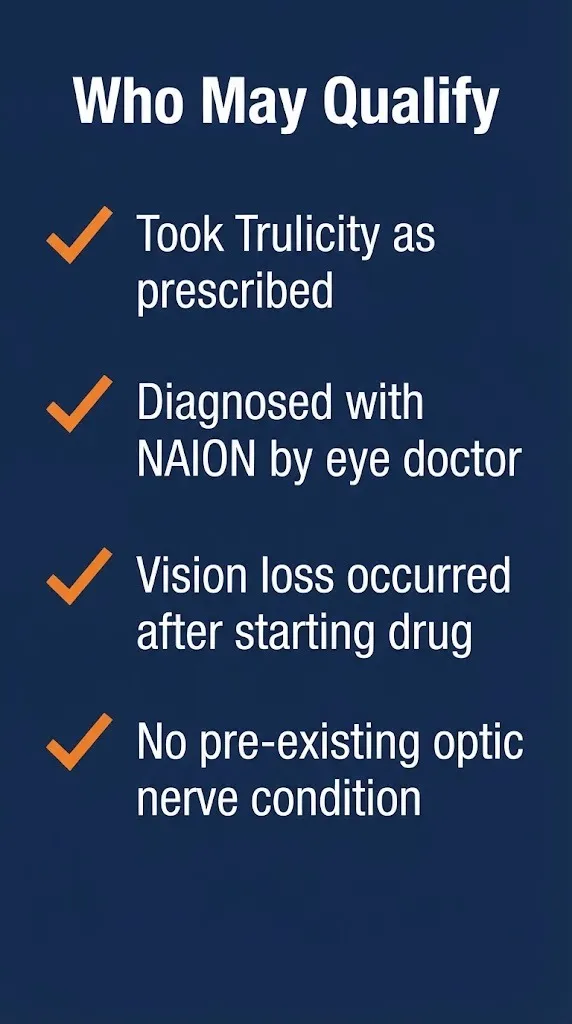
You may qualify for a Trulicity lawsuit if you took Trulicity and were later diagnosed with NAION or a similar optic nerve injury, especially if you had no history of eye problems before starting the medication .
A confirmed diagnosis from an eye care provider is generally needed to move forward with a claim . The key eligibility factors include:
- Trulicity use: You were prescribed and took dulaglutide as directed
- NAION diagnosis: An eye doctor confirmed non-arteritic anterior ischemic optic neuropathy
- Timing: The vision loss occurred after you started taking Trulicity
- No prior history: You had no pre-existing optic nerve condition or unexplained vision problems
Other serious side effects linked to Trulicity in the broader GLP-1 litigation include gastroparesis, intestinal obstruction, acute pancreatitis, gallbladder disease, and kidney injury . Those claims fall under MDL No. 3094, not the vision loss MDL.
How Do You File a Trulicity Vision Loss Claim?
Filing a Trulicity lawsuit starts with documenting your medical history and consulting with a lawyer who handles pharmaceutical injury cases. The process moves through several stages.
Here are the steps:
- Confirm your NAION diagnosis. Get records from your eye doctor showing the diagnosis and the date it occurred.
- Gather Trulicity prescription records. Pharmacy records and medical notes should show when you started and stopped the drug.
- Document your losses. Collect medical bills, lost wage records, and any evidence of how the vision loss affected your life.
- Consult a pharmaceutical injury attorney. These cases involve complex medical causation evidence and are best handled by lawyers with MDL experience.
- File a short-form complaint. If your case qualifies, it will be added to MDL No. 3163 in the Eastern District of Pennsylvania.
- Participate in discovery. Your medical records and expert testimony will be exchanged with Eli Lilly’s legal team.
- Await bellwether outcomes. The first trials will shape settlement values and strategy for all pending cases.
What Is NAION and Why Is It Central to These Lawsuits?
NAION stands for non-arteritic anterior ischemic optic neuropathy. It is a sudden, typically permanent form of vision loss caused by interrupted blood flow to the optic nerve .
The condition is sometimes called an “eye stroke.” Symptoms include sudden vision loss, often in one eye, blurred vision, dark spots in the visual field, and permanent visual impairment . Unlike diabetic retinopathy, which is usually painless, NAION can be painful for some patients .
The legal theory in these cases is failure to warn. Plaintiffs argue that Eli Lilly and other manufacturers knew or should have known about the NAION risk and did not adequately disclose it on the drug label before patients started treatment . Trulicity’s label does mention diabetic retinopathy, but warnings for diabetic retinopathy were not added until February 2020 . The label does not explicitly warn about NAION.
Why Is Causation the Central Legal Battle?
Causation is the most difficult part of any pharmaceutical injury case. To succeed, plaintiffs must generally show that Trulicity caused the NAION, not some other underlying condition.
Eli Lilly and other manufacturers argue that conditions like vision loss and gastrointestinal dysfunction can be caused independently by diabetes, obesity, vascular disease, or pre-existing conditions that many GLP-1 patients already have . The defense will point to the plaintiff’s medical history and risk factors.
Plaintiffs, in turn, rely on emerging research and expert medical testimony to establish the connection. The MDL is currently in the expert and causation phase, where both sides are presenting scientific evidence about whether GLP-1 drugs can cause NAION . The outcome of this phase will shape how every individual case proceeds.
Key Takeaway: Causation is the make-or-break issue. Medical records and expert testimony will determine whether any individual case succeeds.
What Is the Statute of Limitations for a Trulicity Lawsuit?
The statute of limitations for a Trulicity lawsuit varies by state and by the nature of the claim. Most states have a two-year or three-year window for product liability and personal injury claims .
The clock typically starts when you knew or should have known about the injury and its connection to the drug. For NAION cases, that usually means the date of diagnosis. If you were diagnosed with NAION after taking Trulicity, do not wait to investigate your options. Evidence gets harder to collect over time, and the deadline can bar your claim entirely .
What Happens Next in the Trulicity Litigation?
Expected late 2026: Bellwether trial selection begins in the GLP-1 MDLs. The first trials will test the strength of the causation evidence .
Expected 2027: If bellwether trials produce plaintiff verdicts or significant settlements, global settlement discussions could accelerate. If defendants win, litigation may continue case by case.
Ongoing: Expert discovery and causation hearings continue in MDL No. 3163. No trial date has been set for Trulicity vision loss cases specifically.
No deadline for you: There is nothing to file and no date to calendar for a payout. Watch for any court-approved settlement notice if one is announced.
Frequently Asked Questions
Is there a Trulicity settlement?
No. There is no Trulicity settlement as of September 2026. The vision loss claims are in MDL No. 3163, and no global resolution has been reached.
How much can I get from a Trulicity lawsuit?
Nothing has been determined. No settlement fund exists, and no verdicts have been reached. Compensation would depend on injury severity and causation evidence.
Can I still file a Trulicity lawsuit?
Yes. You can file a claim if you took Trulicity and were diagnosed with NAION. There is no universal claim deadline, but state statutes of limitations apply, typically two to three years from diagnosis.
What is NAION and how is it connected to Trulicity?
NAION is non-arteritic anterior ischemic optic neuropathy, a sudden and usually permanent form of vision loss. Plaintiffs allege Trulicity and other GLP-1 drugs may increase the risk of NAION and that the label did not adequately warn patients.
Is Trulicity a high-risk medication?
Trulicity carries a boxed warning for thyroid C-cell tumors. It is also linked to pancreatitis, gallbladder issues, and gastrointestinal problems. The NAION risk is the subject of ongoing litigation .
Do I need a lawyer to file a Trulicity claim?
Yes, in practice. Pharmaceutical injury cases involve complex medical evidence and MDL procedures. Most lawyers handle these cases on a contingency-fee basis, meaning you pay nothing unless they recover compensation.
What other side effects are linked to Trulicity?
Gastroparesis, intestinal obstruction, acute pancreatitis, gallbladder disease, acute kidney injury, and thyroid tumors have all been cited in lawsuits or listed on the drug label .
How long will the Trulicity litigation take?
The GLP-1 MDLs are expected to move slowly. Bellwether trials are set for late 2026 and 2027. A global settlement, if one comes, is more likely in 2027 or later.