Mesothelioma Litigation 2026: Asbestos Lawsuit Guide for Patients and Families
Quick Answer
- Mesothelioma litigation is real, well-established, and includes both individual lawsuits and asbestos bankruptcy trust fund claims.
- Settlement amounts for mesothelioma cases have historically ranged from $1 million to $2.4 million on average, depending on diagnosis, exposure history, and defendants.
- Statutes of limitations vary by state, typically one to three years from diagnosis, making the filing timeline the single most urgent factor for any patient or family.
Mesothelioma litigation is the legal process by which people diagnosed with mesothelioma, an aggressive cancer caused almost exclusively by asbestos exposure, seek financial compensation from the companies responsible for that exposure. Tens of thousands of cases have been filed in U.S. courts over the past five decades. New cases continue to be filed in 2026 because the disease has a latency period of 20 to 50 years, meaning people exposed to asbestos in the 1970s, 1980s, and 1990s are still receiving diagnoses today.
If you or someone in your family has just received a mesothelioma diagnosis, the legal clock started on the day of that diagnosis in most states. You do not need to know exactly where or when the asbestos exposure occurred before contacting a mesothelioma attorney. The exposure investigation is part of the legal process itself.
This article covers every major track of mesothelioma litigation: individual lawsuits, asbestos trust fund claims, veterans’ claims, wrongful death suits, and the statutes of limitations that govern all of them. One fact that surprises most families: a single patient can file claims against multiple defendants and multiple trust funds simultaneously, which is why average recoveries are as high as they are.
The Facts
| Detail | Verified Information |
|---|---|
| Case Type | Individual personal injury and wrongful death lawsuits |
| Status | Active and ongoing; new filings every month in 2026 |
| Asbestos Trust Funds | More than 60 active bankruptcy trusts in the U.S. |
| Est. Average Settlement | $1 million to $2.4 million (historically verified range) |
| Trial Verdict Range | $5 million to $20 million or more in some jurisdictions |
| Statute of Limitations | 1 to 3 years from diagnosis (varies by state) |
| Veterans’ Path | VA disability claims run parallel to civil litigation |
| Proof Needed | Pathology report, employment records, exposure history |
What Is Mesothelioma Litigation
Mesothelioma litigation is the legal pursuit of financial compensation by patients or their families against companies that manufactured, distributed, or negligently used asbestos-containing products. It is not one single lawsuit or class action. It is a category of legal action that encompasses thousands of individual cases filed every year across the United States.
Unlike a typical product defect class action where one settlement covers all consumers, mesothelioma cases are almost always filed as individual lawsuits. This is because each patient’s exposure history, diagnosis, prognosis, and financial losses are unique. A shipyard worker in Louisiana has a completely different case than a school teacher in New York, even if both were exposed to the same brand of insulation.
The litigation targets the companies that made or used asbestos products, not the asbestos mineral itself. Defendants have included insulation manufacturers, shipbuilders, mining companies, brake pad manufacturers, boiler companies, and talc suppliers. Many of these companies went bankrupt under the weight of liability and established court-supervised asbestos trust funds to pay future claims.
How Much Is a Mesothelioma Lawsuit Worth
The average mesothelioma lawsuit settlement has historically ranged from $1 million to $2.4 million, based on data from mesothelioma legal reporting organizations and court disclosures. Trial verdicts, when cases go before a jury, have reached $5 million to $20 million or more, though not every verdict survives appeal at those amounts.
Your specific case value depends on several factors:
| Factor | How It Affects Value |
|---|---|
| Diagnosis type | Pleural mesothelioma vs. peritoneal affects life expectancy calculations |
| Age at diagnosis | Younger patients with longer projected lost income may receive more |
| Number of defendants | More responsible companies means more potential recovery sources |
| State of filing | Some states are more favorable venues than others |
| Exposure documentation | Stronger paper trail leads to faster, higher settlements |
| Medical expenses | Documented treatment costs are added directly to damage calculations |
| Lost wages and benefits | Both past and projected future income are calculated |
Asbestos trust fund claims are separate from lawsuit settlements and pay on a different schedule. Individual trust payment percentages vary by trust but range from roughly 1 percent to 100 percent of the “scheduled value” for each disease category. A trust’s payment percentage is published in its Trust Distribution Procedures.
Key Takeaway: Mesothelioma compensation is not one check from one source; most patients and families recover money from multiple lawsuits and multiple trust funds simultaneously.
Who Qualifies for a Mesothelioma Lawsuit
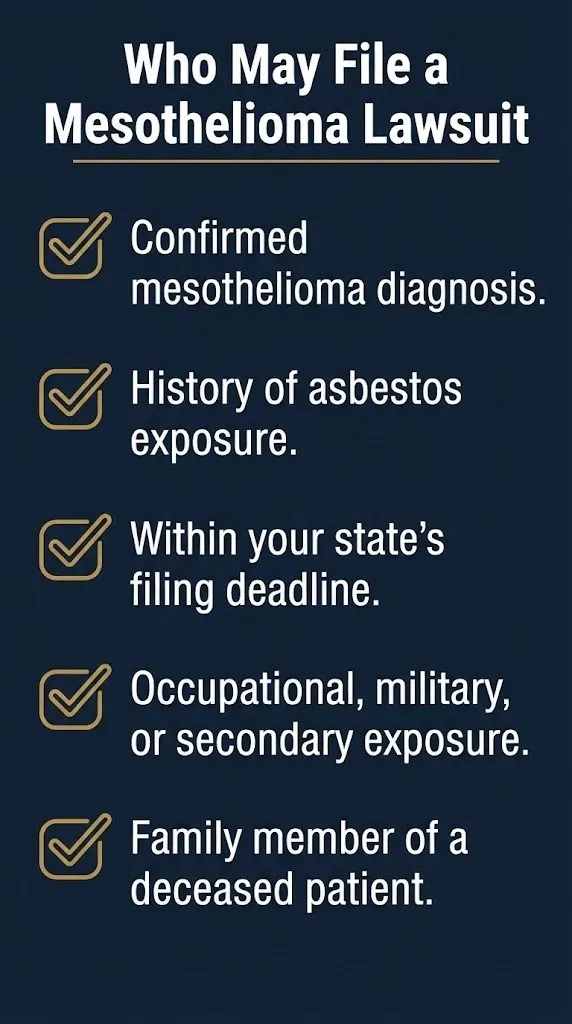
You may qualify for a mesothelioma lawsuit if you have a confirmed pathological diagnosis of malignant mesothelioma and a documented history of asbestos exposure at some point in your life. Family members of a patient who has died may qualify to file a wrongful death lawsuit in the patient’s place.
Qualifying criteria generally include:
- A biopsy-confirmed diagnosis of pleural, peritoneal, or pericardial mesothelioma
- A history of occupational, secondary, or environmental asbestos exposure
- Exposure that occurred at least partially in the United States (for U.S. claims)
- Filing within the statute of limitations for your state
Occupations with documented high exposure rates include:
- Shipyard workers and Navy veterans
- Insulation installers and pipe fitters
- Boilermakers and steamfitters
- Electricians and plumbers
- Construction workers who handled drywall or floor tiles
- Automotive mechanics who worked with brake pads or gaskets
- Factory workers at asbestos product manufacturing plants
Secondary exposure claims also exist. If a family member washed the work clothes of someone with occupational exposure, they may have inhaled asbestos fibers and can file their own claim. These “bystander” or “take-home” exposure cases are well-recognized in U.S. courts.
What Is the Statute of Limitations for a Mesothelioma Lawsuit
The statute of limitations for a mesothelioma lawsuit is typically one to three years from the date of diagnosis, and it varies by state. This is the single most time-sensitive piece of information in this article. Missing the deadline means permanently losing the right to sue, regardless of how strong your case is.
| State | Statute of Limitations (from diagnosis) |
|---|---|
| California | 1 year |
| Texas | 2 years |
| New York | 3 years |
| Florida | 2 years |
| Pennsylvania | 2 years |
| Illinois | 2 years |
| Louisiana | 1 year |
| Ohio | 2 years |
These figures reflect the general personal injury statute for each state. Mesothelioma-specific rules may differ slightly. Wrongful death claims often have their own separate deadline, which runs from the date of death rather than the date of diagnosis. If the patient has already passed, the family’s clock starts over with its own countdown.
Think of the statute of limitations like a boarding pass: it has an expiration time printed on it, and no amount of having the right ticket gets you on the plane if you miss the gate.
Reality Check: You do not need to pay anything upfront to hire a mesothelioma attorney. Every legitimate mesothelioma law firm works on contingency, meaning they take a percentage of your recovery only if they win. Any firm asking for an upfront retainer for a mesothelioma case should raise a serious red flag. Trust fund claims filed directly through an attorney also cost you nothing out of pocket before recovery.
How to File a Mesothelioma Lawsuit
Filing a mesothelioma lawsuit begins with gathering your medical and occupational records, then retaining a mesothelioma attorney who will manage the actual court filings on your behalf. You do not file the lawsuit yourself.
Here are the steps in the typical process:
- Obtain a confirmed pathology report from your oncologist or pulmonologist showing the mesothelioma diagnosis.
- Begin documenting your work history, listing every employer and job site from your entire career.
- Contact a mesothelioma attorney for a free consultation (most offer this immediately after diagnosis).
- Allow the attorney’s investigation team to identify which companies supplied or used asbestos at your job sites.
- The attorney files your personal injury lawsuit in the appropriate court jurisdiction.
- Separately, the attorney files claims against any qualifying asbestos bankruptcy trust funds.
- Defendants receive service and the discovery process begins, during which both sides exchange evidence.
- Most cases settle before trial; your attorney negotiates the settlement amounts with each defendant.
The average time from filing to first settlement payment is six months to one year for straightforward cases. Litigation against solvent defendants (companies still in business) can take one to three years if a settlement is not reached quickly.
What Are Asbestos Bankruptcy Trust Funds
Asbestos bankruptcy trust funds are court-created funds established by companies that went bankrupt due to massive asbestos liability. As of 2026, more than 60 active trusts exist in the United States, holding an estimated $30 billion in combined assets set aside specifically for asbestos victims.
When a company goes bankrupt because of asbestos claims, the bankruptcy court requires it to set up a trust before it can reorganize. The trust takes over all future asbestos liability from the company. This means you cannot sue that specific company in civil court anymore. Instead, you file a claim directly with the trust using its published Trust Distribution Procedures.
Major trusts that have paid mesothelioma and asbestos disease claims include funds established by companies such as:
- Johns-Manville (now the Manville Personal Injury Settlement Trust)
- W.R. Grace (now the WRG Asbestos PI Trust)
- Armstrong World Industries Asbestos Personal Injury Settlement Trust
- Owens Corning Fibreboard Asbestos Personal Injury Trust
- Babcock and Wilcox Asbestos Personal Injury Settlement Trust
Each trust has its own payment percentage, its own list of qualifying diseases, and its own documentation requirements. You can file against multiple trusts if you were exposed to products from multiple bankrupt companies.
Key Takeaway: Asbestos bankruptcy trust funds operate separately from civil lawsuits, and a single mesothelioma patient may file claims with dozens of trusts while simultaneously pursuing litigation against solvent defendants.
Mesothelioma Lawsuit vs. Asbestos Trust Fund Claim: What Is the Difference
A mesothelioma lawsuit is a civil claim filed in court against companies that are still operating and have assets. An asbestos trust fund claim is an administrative filing made directly to a trust established by a bankrupt company. Both can run simultaneously, and both can result in money paid to you or your family.
The key differences:
| Factor | Civil Lawsuit | Trust Fund Claim |
|---|---|---|
| Who you file against | Solvent (operating) companies | Bankrupt companies via their trusts |
| Where you file | State or federal court | Directly with the trust administrator |
| Timeline | 6 months to 3 years | 3 to 6 months on average |
| Payment amount | Negotiated or jury-decided | Scheduled value x payment percentage |
| Attorney involvement | Required | Strongly recommended |
| Can you do both? | Yes, simultaneously | Yes, simultaneously |
Most mesothelioma attorneys pursue both tracks at the same time. This is standard practice and is legally permitted. Being paid by a trust does not reduce your lawsuit recovery, and vice versa, in most jurisdictions.
Veterans and Mesothelioma Litigation: A Separate Track
Veterans diagnosed with mesothelioma have a third legal track available to them: VA disability benefits. The U.S. Department of Veterans Affairs recognizes mesothelioma as a service-connected disability for veterans who were exposed to asbestos during military service. This applies most commonly to Navy veterans, who worked in ships heavily insulated with asbestos materials.
A VA disability claim runs entirely separately from civil litigation. Filing for VA benefits does not prevent you from also filing a lawsuit and trust fund claims. Many veterans pursue all three paths simultaneously.
VA mesothelioma benefits include:
- Monthly disability compensation at the 100 percent disability rating
- VA healthcare coverage for treatment
- Dependency and Indemnity Compensation (DIC) for surviving spouses and dependents
The VA claims process requires a nexus letter from a physician connecting your mesothelioma diagnosis to your military asbestos exposure. VA claims do not require an attorney, though a Veterans Service Officer (VSO) can assist with the filing at no cost.
Asbestosis Lawsuit vs. Mesothelioma Lawsuit: Are They the Same
An asbestosis lawsuit and a mesothelioma lawsuit share the same legal foundation (asbestos exposure caused the illness) but they are distinct legal claims with different compensation levels. Asbestosis is a chronic, non-cancerous lung disease caused by inhaling asbestos fibers. It is serious and debilitating, but it is not cancer.
Mesothelioma is a cancer, and courts and trust funds treat it as the most severe asbestos-related disease category. This is reflected directly in the money:
| Disease | Average Compensation Range |
|---|---|
| Mesothelioma | $1 million to $2.4 million (settlement average) |
| Lung cancer (asbestos-related) | $1 million to $2 million |
| Asbestosis | $100,000 to $300,000 (varies widely) |
| Pleural plaques/thickening | $25,000 to $100,000 |
These are historical averages from legal reporting and trust fund disclosure documents. Your specific case may fall above or below these ranges. If you have an asbestosis diagnosis and later develop mesothelioma or asbestos-related lung cancer, you can file new claims for the cancer diagnosis even if you previously settled an asbestosis claim.
Key Takeaway: An asbestosis diagnosis and a mesothelioma diagnosis are two separate legal events, each with its own claim rights, and a prior settlement for one does not close the door on the other.
Mesothelioma Wrongful Death Lawsuit: What Families Need to Know
A mesothelioma wrongful death lawsuit is filed by surviving family members after a patient dies from the disease. In most states, the right to sue passes to the patient’s estate or to specific family members defined by state law. Eligible survivors typically include a spouse, children, or other financial dependents.
A wrongful death case recovers different types of damages than a personal injury case:
- Loss of companionship and consortium
- Funeral and burial expenses
- Medical expenses incurred before death
- Lost future income the deceased would have earned
- Pain and suffering the deceased experienced before death
The wrongful death statute of limitations runs from the date of death, not the date of diagnosis. This means families may have a new filing window even if the patient never pursued a lawsuit while alive. The exact deadline depends on your state.
If the patient filed a personal injury lawsuit before death, that case does not disappear. It is typically converted to a wrongful death or survival action and continues through the estate. An attorney can explain which claims survive and which must be refiled under your specific state’s law.
How to Find the Companies Responsible for Asbestos Exposure
Identifying which companies are responsible for your asbestos exposure is the job of your mesothelioma attorney’s investigative team, not yours. You provide the work history. They do the research. This is a critical distinction that most online articles gloss over.
Your job is to document:
- Every employer you worked for, from first job to retirement
- Every job site, including contractor assignments and temporary placements
- The type of work you performed at each site
- Any products you remember handling, including brand names if possible
- Any co-workers who may have witnessed the same exposure conditions
Attorneys use a combination of historical industrial records, union membership databases, product identification databases, and deposition testimony from prior cases to match your work history to specific asbestos product manufacturers.
In some cases, military service records, Social Security Administration work history reports, and union pension fund records are subpoenaed to help reconstruct an exposure history going back 40 or 50 years.
Mesothelioma Litigation Update 2026: What Has Changed
Mesothelioma litigation in 2026 reflects several ongoing shifts in the legal environment. First, the number of surviving defendants (solvent companies still facing litigation) has shrunk as more companies have settled their global asbestos liabilities or gone bankrupt. This concentrates active litigation among fewer, larger corporate defendants.
Second, talc-related mesothelioma cases have grown significantly. Johnson and Johnson’s attempts to resolve its talc-asbestos liability through a controversial “Texas Two-Step” bankruptcy strategy were rejected by federal courts. This means talc exposure cases against J&J and similar defendants are back in active civil litigation in 2026.
Third, trust fund payment percentages have been adjusted downward at some trusts as claim volumes have increased faster than projected. This is not unusual over the long run of a trust’s life. Attorneys who specialize in mesothelioma track these percentage changes and factor them into case strategy.
Fourth, plaintiffs in 2026 benefit from improved mesothelioma diagnostics and biomarker research. Earlier, more confirmed diagnoses mean more patients are filing while they are still well enough to participate in depositions, which strengthens cases considerably.
How Long Does a Mesothelioma Lawsuit Take
A mesothelioma lawsuit typically takes six months to three years to resolve, depending on the complexity of the case, the number of defendants, and whether it goes to trial. Most cases settle before trial, often within the first year.
Factors that speed up resolution:
- Clear, well-documented work history
- Strong medical records and a confirmed pathological diagnosis
- Cooperative defendants willing to negotiate early
- Filing in a jurisdiction known for efficient mesothelioma case management
Factors that slow resolution:
- Disputed exposure history requiring extensive discovery
- Multiple defendants each pointing at the others
- Defendants who choose to fight rather than settle
- Court backlogs in some jurisdictions
Trust fund claims are typically faster, resolving in three to six months if documentation is complete. Because trust fund claims run in parallel to civil suits, you may begin receiving trust fund payments well before your lawsuit settles.
Key Takeaway: The fastest money in mesothelioma cases often comes from trust fund claims, which can pay out in months, while civil lawsuit settlements may take a year or longer.
What Proof Do You Need for a Mesothelioma Lawsuit
To support a mesothelioma lawsuit, you need medical proof of your diagnosis and occupational proof of your asbestos exposure. Your attorney builds the second category; you start by providing the first.
Core documents to gather immediately:
- Pathology or biopsy report confirming malignant mesothelioma
- All imaging reports (CT scans, PET scans, X-rays)
- Treatment records from your oncologist and any surgical procedures
- Social Security work history or personal employment records
- Union membership cards or pension fund records
- Military service records (Form DD-214 for veterans)
- Tax returns listing employers over your career
Documents that support exposure claims (if available):
- Old pay stubs, W-2 forms, or employment contracts
- Photographs from job sites
- Names and contact information of former coworkers
- Product names or manufacturer names remembered from the job site
You do not need all of these documents before calling an attorney. You need a diagnosis and a rough work history. The attorney’s team handles everything else.
What Happens Next
- Now: If a diagnosis has been received, consult a mesothelioma attorney immediately to preserve your statute of limitations window.
- Within 30 to 60 days: Attorney’s investigative team completes exposure history research and identifies defendants.
- Expected 2 to 4 months: Lawsuit filed in appropriate jurisdiction; asbestos trust fund claims filed simultaneously.
- Expected 6 to 12 months: First trust fund payments may arrive; settlement negotiations begin with civil defendants.
- Expected 1 to 3 years: Civil lawsuit resolved by settlement or trial verdict; final payments distributed.
Frequently Asked Questions
What is the average payout for a mesothelioma lawsuit?
The average mesothelioma settlement has historically ranged from $1 million to $2.4 million.
Trial verdicts have reached $5 million to $20 million or more in some cases, though not all survive appeal.
Individual payouts depend on diagnosis type, number of defendants, exposure history, and state of filing.
Can I file a mesothelioma lawsuit if the company is bankrupt?
Yes, you file a claim against the company’s asbestos bankruptcy trust fund instead of the company itself.
More than 60 active trusts exist in the U.S. and continue to pay claims in 2026.
You can file trust fund claims and civil lawsuits against other defendants at the same time.
How long do I have to file a mesothelioma lawsuit?
The statute of limitations is typically one to three years from the date of diagnosis, depending on your state.
California allows one year; most other states allow two to three years.
Wrongful death claims have a separate deadline running from the date of death.
Do I need a lawyer to file a mesothelioma claim?
You need an attorney to file a civil mesothelioma lawsuit in court.
Trust fund claims can technically be filed without one, but the documentation requirements are complex.
Mesothelioma attorneys work on contingency, meaning no upfront cost to you.
Can family members file a mesothelioma lawsuit after a patient dies?
Yes, surviving family members can file a wrongful death lawsuit after the patient passes away.
Eligible plaintiffs typically include spouses, children, and financial dependents.
The wrongful death statute of limitations runs from the date of death in most states.
What is the difference between mesothelioma and asbestosis for legal purposes?
Mesothelioma is a cancer caused by asbestos and receives the highest compensation category in trust fund schedules.
Asbestosis is a chronic non-cancerous lung disease and receives lower scheduled compensation amounts.
If you had an asbestosis settlement and later develop mesothelioma, you can file a new claim for the cancer.
Can veterans file mesothelioma claims through the VA and also sue in civil court?
Yes, VA disability claims and civil mesothelioma lawsuits are completely separate legal tracks.
Filing for VA benefits does not reduce or bar your civil lawsuit recovery.
Many veterans pursue VA benefits, civil lawsuits, and trust fund claims all at the same time.
What is the “Texas Two-Step” bankruptcy in mesothelioma litigation?
The Texas Two-Step is a corporate strategy where a company creates a subsidiary to absorb all asbestos liability and then files that subsidiary into bankruptcy.
Federal courts rejected Johnson and Johnson’s use of this strategy, returning those talc-related mesothelioma cases to civil court.
As of 2026, this strategy remains legally contested and is being watched closely by mesothelioma attorneys.
Mesothelioma is one of the few diseases where a diagnosis triggers an immediate, time-sensitive legal right. The statute of limitations in your state is not a suggestion. Contact a mesothelioma attorney before spending time gathering documents on your own. The consultation is free, and the clock is already running.
The most important date in your case is the one printed in your diagnosis report. From that date, your state gives you one to three years to act. Every week spent waiting is a week closer to permanently losing the right to file.