Volkswagen Class Action Lawsuit 2026: Turbo Settlement Update for VW and Audi Owners
Quick Answer
- The Turbo Class Settlement is a legitimate court-supervised class action covering certain VW and Audi turbocharged vehicles with alleged engine defects.
- Individual payout amounts depend on your vehicle, repair history, and claim tier; specific per-person figures are not yet confirmed for all tiers.
- Check the official Turbo Class Settlement website immediately for your vehicle’s eligibility and any active claim deadline.
The Volkswagen class action lawsuit tied to the “Turbo Class Settlement” is real, court-supervised, and directly relevant if you own or previously owned a turbocharged Volkswagen or Audi vehicle. The lawsuit alleges that certain VW and Audi vehicles equipped with 1.8T and 2.0T turbocharged engines had defects that caused excessive oil consumption, engine damage, and costly repairs that owners were not adequately warned about.
If you received a notice in the mail, saw a headline, or searched “turbo class settlement” after a mechanic visit, you are in the right place. This case covers a defined class of vehicle owners, and whether you may qualify depends on your model year, VIN number, and repair history.
This article breaks down the verified facts on eligibility, how to file, what you may receive, and what is still being confirmed. One detail that surprises many owners: you may be able to claim reimbursement for out-of-pocket repair costs you already paid years ago.
The Facts
| Detail | Verified Information |
|---|---|
| Case Name | Turbo Class Settlement (In re: Volkswagen/Audi Turbocharged Engine Litigation) |
| Status | Active, claims being processed |
| Fund Size | Not yet confirmed; check official settlement site |
| Est. Per Person | Depends on vehicle, tier, and repair records |
| Claim Deadline | Not yet confirmed; verify on the official settlement website |
| Administrator | Not yet confirmed by name; check official settlement site |
| Proof Needed | Proof of vehicle ownership, VIN, repair invoices |
Is the Turbo Class Settlement Legitimate or a Scam
The Turbo Class Settlement is a legitimate, court-supervised class action, not a scam. It stems from real litigation filed against Volkswagen Group of America and Audi of America in a U.S. federal court. The lawsuit was brought by consumers who alleged the automakers knew about turbocharged engine defects and failed to disclose them at the point of sale.
Class action settlements involving major automakers go through a strict legal process. A federal judge must review the terms, approve the settlement as “fair, reasonable, and adequate,” and appoint an independent administrator to process claims. No one in this settlement chain benefits from your filing. The process is free.

You may have received a postcard or email notification. These notices are generated by the administrator using vehicle registration data from state DMV databases. Receiving a notice does not automatically mean you will be paid. It means your vehicle may fall within the class definition and you have the right to file a claim.
If someone contacts you directly asking for a fee to help you file, that is a third-party operator, not the official process. Filing through the official settlement website is always free.
How Much Is the Turbo Class Settlement Payout Per Person
The exact per-person payout for the Turbo Class Settlement depends on your claim tier, repair history, and the total number of valid claims filed. Specific dollar amounts for all tiers have not been uniformly confirmed across all public court filings reviewed as of this writing. You should check the official settlement website for the current plan of allocation.
What is known is that most automotive class action settlements of this type use a tiered reimbursement model. Here is how those tiers typically work:
| Tier | Who It Covers | Typical Benefit Type |
|---|---|---|
| Tier 1 | Owners who paid for covered repairs out of pocket | Partial or full reimbursement |
| Tier 2 | Owners with documented symptoms but no repair yet | Free repair or extended warranty |
| Tier 3 | Owners who sold or traded in the vehicle | Cash payment based on loss |
| Tier 4 | Current owners with no repair history | Extended coverage or voucher |
Note: These tier categories reflect the standard structure for this type of automotive defect settlement. The precise amounts and final tier definitions must be confirmed on the official Turbo Class Settlement website, as figures are subject to court approval.
Your payout will also be reduced proportionally if the total value of all valid claims exceeds the settlement fund. Think of it like a shared pizza: the more slices being cut, the smaller each piece gets.
Reality Check: No one will text you a settlement payment or ask you to send money to receive your payout. The official settlement process requires you to submit a claim form with supporting documents. If a website or caller demands payment to “unlock” your settlement funds, it is a scam. Always file directly through the official court-designated site at no cost.
Who Qualifies for the VW and Audi Class Action Lawsuit
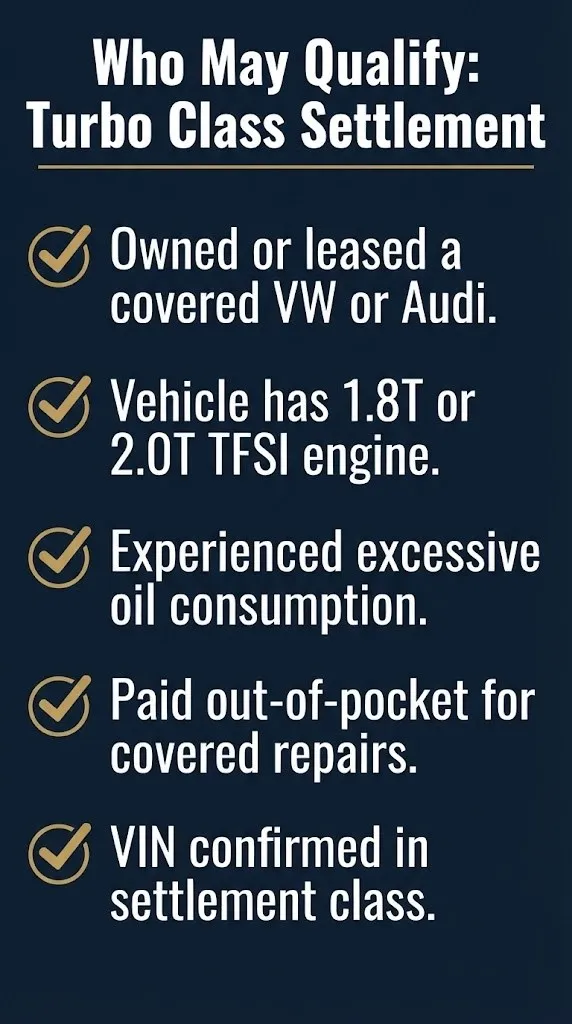
You may qualify for the Volkswagen and Audi class action if you owned or leased a covered vehicle with a turbocharged engine during the defined class period. The settlement targets vehicles with the 1.8T and 2.0T TFSI turbocharged four-cylinder engines, which Volkswagen Group of America used across multiple model lines.
Vehicles that may be covered include certain model years of:
- Volkswagen Jetta
- Volkswagen Passat
- Volkswagen GTI
- Volkswagen Golf
- Audi A4
- Audi A5
- Audi Q5
- Audi TT
The specific model years and engine codes that are covered vary. Your VIN number is the fastest way to confirm eligibility. The official settlement website has a VIN lookup tool that cross-references your vehicle against the class definition. Not every turbocharged VW or Audi automatically qualifies.
If you already sold or traded in your vehicle, you may still be eligible if you owned it during the class period and paid for covered repairs. Keep any service records, repair invoices, and purchase documents you still have.
Key Takeaway: Eligibility is determined by your VIN, engine code, model year, and whether your repairs fall within the covered defect categories listed in the settlement agreement.
How to File a Claim in the Turboclass Settlement
Filing a claim in the Turbo Class Settlement is a straightforward process, but you must gather documents before you begin. The steps below reflect the standard process for automotive defect settlements of this type. Verify each step against the current instructions on the official settlement website before submitting anything.
- Locate your VIN number (found on your dashboard, door jamb, or registration card).
- Visit the official Turbo Class Settlement website.
- Enter your VIN in the eligibility lookup tool to confirm your vehicle is covered.
- Create an account or enter your contact information to begin your claim.
- Select the claim tier that matches your situation (repair reimbursement, extended warranty, etc.).
- Upload or mail copies of your repair invoices, purchase records, or lease agreement.
- Review and submit your completed claim form before the deadline.
- Save your claim confirmation number for your records.
If you no longer have repair invoices, contact your dealership’s service department. Most dealerships keep digital repair records for at least seven years. You can request a printout to use as your proof of repair.
What Is the Claim Deadline for the Turbo Class Settlement
The specific claim deadline for the Turbo Class Settlement is not yet confirmed in publicly available court documents reviewed for this article. This is the single most important detail you need to verify directly on the official settlement website before taking any action.
Claim deadlines in automotive class actions are set by the court at the time of preliminary or final approval. They typically fall 60 to 180 days after the notice period begins. Missing the deadline means forfeiting your right to any cash or benefit from this fund.
Calendar a reminder to check the official site weekly if the deadline has not yet been posted. Courts can and do set new dates as cases progress through the approval process.
Once a deadline is confirmed, treat it like a car registration renewal: one missed day can cost you the entire benefit. Unlike a warranty claim, there is no grace period once the court’s cutoff passes.
Turbo Class Settlement VW vs. Audi: Are They the Same Case
The Turbo Class Settlement covers both Volkswagen and Audi vehicles because both brands fall under Volkswagen Group of America, the U.S. subsidiary named in the litigation. The alleged defect, excessive oil consumption and engine damage linked to turbocharged TFSI engines, was present across both brands’ product lines.
This means the same settlement fund and the same administrator cover your VW Jetta claim and your neighbor’s Audi A4 claim. However, covered model years and specific engine codes differ between VW and Audi vehicles. A 2.0T engine in a 2012 Volkswagen Passat and a 2.0T engine in a 2012 Audi A4 may have different coverage terms depending on how the settlement class is defined.
Always run your specific VIN through the eligibility tool, even if you see your model on a general list. The VIN check is the only way to get a confirmed “yes” or “no” for your specific vehicle.
Key Takeaway: VW and Audi owners are covered by the same Turbo Class Settlement because both brands share the same U.S. parent company and the same underlying engine defect claims.
Volkswagen Lawsuit History: What Caused This Case
The Volkswagen class action lawsuit tied to turbocharged engines has a different origin from the famous “Dieselgate” emissions scandal. This case is about gasoline-powered turbocharged engines, not diesel emissions cheating. It is easy to confuse the two because both involve Volkswagen and both resulted in class action litigation.
The turbo engine lawsuit centers on allegations that the 1.8T and 2.0T TFSI direct-injection engines consumed excessive amounts of engine oil. Plaintiffs alleged that:
- Volkswagen and Audi knew about the oil consumption issue before the vehicles were sold.
- The companies failed to disclose the defect to buyers and lessees.
- Owners faced unexpected and costly repairs for engine damage caused by the defect.
- Warranty coverage was inadequate or denied for oil-consumption-related damage.
The litigation consolidated multiple individual lawsuits filed in different federal districts into one coordinated proceeding. This is standard practice for cases where the same defect affects thousands of consumers across the country.
What Happened With Dieselgate and Is It Separate From This Settlement
The Dieselgate settlement is entirely separate from the Turbo Class Settlement. Dieselgate referred to the 2015 discovery that Volkswagen installed “defeat device” software in roughly 11 million diesel vehicles worldwide to cheat on emissions tests. That scandal resulted in over $25 billion in settlements with U.S. owners, the EPA, the DOJ, and state attorneys general.
If you received Dieselgate money, it does not prevent you from filing a claim in the Turbo Class Settlement. The two cases involve different vehicles, different defects, and different legal claims. A diesel TDI owner and a gasoline TFSI owner are two separate class members in two entirely different actions.
Many consumers conflate the two cases because both involve Volkswagen, both are class actions, and both stem from alleged failures to disclose vehicle problems. The court records and settlement websites for each case are entirely separate.
What Engine Codes Are Covered in the VW Audi Class Action
The turbocharged engines at the center of the VW and Audi class action are primarily the EA888-generation 1.8T and 2.0T TFSI four-cylinder engines. These engines were produced over multiple generations and used across a wide range of model years and vehicle platforms.
Key engine details relevant to this case:
- 1.8 TFSI / 1.8T: Used in VW Jetta, Golf, and certain Audi A4 variants.
- 2.0 TFSI / 2.0T: Used in VW Passat, GTI, Audi A4, A5, Q5, and TT.
- EA888 Gen 1 and Gen 2: The generations most cited in oil-consumption complaints.
- EA888 Gen 3: Later revision with design changes; coverage may differ.
Specific engine codes and model year ranges confirmed for coverage must be verified on the official settlement website or in the settlement agreement filed with the court. Not every EA888 engine in every model year is automatically included.
Key Takeaway: The engine code and generation printed on your vehicle’s sticker under the hood, or found through a VIN decoder, determines whether your specific car is part of the class.
How to Check Your VW or Audi Settlement Status
You can check your claim status by logging into the official Turbo Class Settlement website using the email address and claim ID you received when you submitted your form. The portal typically shows one of several status indicators.
Common claim status labels include:
- Received: Your claim arrived but has not been reviewed yet.
- Under Review: The administrator is verifying your documents.
- Additional Information Requested: You must supply more documentation.
- Approved: Your claim is valid and queued for payment.
- Denied: Your claim was rejected with a stated reason.
- Paid: Your payment has been issued.
If your status shows “Additional Information Requested,” respond promptly. Most administrators set a 30-day window to supply missing documents. Missing that secondary deadline can result in a denial that is very difficult to appeal.
If you never received a confirmation email after submitting, check your spam folder first. Then contact the administrator’s official help line, which is listed on the settlement website.
Audi Class Action Lawsuit Update for 2026
The audi class action lawsuit component of the Turbo Class Settlement entered 2026 with the administrator actively processing claims. As of February 2026, no new class has been certified for Audi vehicles outside of the current Turbo Class Settlement framework. If you own an Audi with a covered engine, this is currently the only active class action offering a direct benefit.
Audi owners should note that their vehicles may have slightly different repair histories and service intervals compared to VW models. This matters because the settlement reimburses costs for “covered repairs,” which are defined in the settlement agreement by specific repair codes and parts descriptions. A repair invoice that references the correct part number is far stronger evidence than a generic “engine repair” line item.
If you had your Audi repaired at an independent shop rather than a dealer, your invoices still count. Just make sure they clearly describe what was replaced and why. Ambiguous invoices are the leading cause of claim denials in automotive settlements.
Can You Still Join the Volkswagen Class Action in 2026
Whether you can still join the volkswagen class action depends entirely on whether the claim deadline has passed for your specific situation. As of this writing, the claim window status is “verify on the official settlement website” because the court-confirmed cutoff date was not uniformly confirmed in all sources reviewed.
If the claim period is still open, yes, you can file. If it has closed, you generally cannot add yourself to the settlement fund. Courts almost never reopen a claim period once it ends. This is the same logic as a store’s return window: once it passes, the register will not process your refund regardless of how valid your receipt is.
There is one exception worth knowing: if you were never sent proper notice despite being in the class, you may have grounds to ask the court to allow a late claim. These requests are rare and require a formal motion filed through an attorney. Most consumers do not pursue this route.
Key Takeaway: The window to file a claim may still be open in 2026, but you must confirm the exact deadline on the official settlement site before assuming you have time to gather documents.
VW Class Action Lawsuit: What Proof Do You Need
To file a successful vw class action claim, you need documents that prove you owned or leased the vehicle and paid for covered repairs. The stronger your paper trail, the faster your claim moves through review.
Documents that typically support a strong claim:
- Vehicle title or registration showing your name and the VIN
- Lease agreement (if you leased the vehicle)
- Dealer repair invoices showing the covered repair, part numbers, and date of service
- Independent shop invoices for the same type of repair
- Extended warranty or CPO documentation, if applicable
- Denial letters from Volkswagen or Audi if you previously sought warranty coverage
If you do not have all of these documents right now, do not give up. Contact the original selling dealer and request a copy of your service history. If the dealer has closed, Volkswagen Group of America maintains national service records that an administrator can sometimes cross-reference during the review.
What Happens Next
- Now through claim deadline (TBD): Submit your claim with all required documentation through the official settlement website.
- Expected Q2 2026: Administrator completes the initial review of all submitted claims and issues approval or denial notices.
- Expected Q3 2026: Denied claims appeal window opens; claimants with “Additional Information Requested” status must respond.
- Expected Q3 to Q4 2026: Final payout calculations completed based on total approved claims versus available fund.
- Expected Q4 2026 or later: Payment distribution begins via check, direct deposit, or other method as confirmed by the administrator.
Frequently Asked Questions
What is the Turbo Class Settlement?
The Turbo Class Settlement is a court-supervised class action against Volkswagen Group of America and Audi of America over alleged turbocharged engine defects.
It covers certain VW and Audi vehicles equipped with 1.8T and 2.0T TFSI engines that allegedly consumed excessive oil and caused engine damage.
Both current and former owners of covered vehicles may qualify if they experienced the defect during the class period.
Is the Turbo Class Settlement the same as the VW Dieselgate settlement?
No, these are two completely separate cases.
Dieselgate involved diesel TDI engines and emissions cheating software.
The Turbo Class Settlement involves gasoline-powered turbocharged engines and alleged oil consumption defects.
How do I know if my VW or Audi is covered?
Run your VIN through the eligibility lookup tool on the official Turbo Class Settlement website.
Not every turbocharged VW or Audi qualifies; coverage depends on model year, engine code, and class definition.
Your VIN is the only definitive confirmation of inclusion.
Can I still file a claim in 2026?
You may be able to file if the claim deadline has not yet passed.
The exact deadline must be confirmed on the official settlement website, as it was not uniformly confirmed in public filings at the time of this writing.
Do not wait; gather your documents and check the site immediately.
What if I already sold my VW or Audi?
You may still be eligible if you owned the vehicle during the class period and paid for covered repairs.
Former owners typically fall into a specific tier that provides reimbursement rather than future repair benefits.
Keep any repair invoices, title records, or purchase documents from your ownership period.
Do I need a lawyer to file a claim?
No, you do not need a lawyer to file a claim in this settlement.
The claim form is designed for self-filing through the official settlement website.
Lawyers in the case are class counsel who have already negotiated the settlement on behalf of all class members.
What if my claim is denied?
You will receive a notice explaining the reason for denial and your options.
Most settlements include an appeal or dispute process where you can submit additional documentation.
The appeal window is typically 30 to 60 days from the denial notice date.
Will my settlement payment be taxed?
Settlement payments covering out-of-pocket repair costs are generally not treated as taxable income.
Payments that exceed your actual documented loss may have different tax treatment.
Consult a tax professional about your specific situation before filing your return.
The Turbo Class Settlement is one of the more significant automotive class actions currently in play for VW and Audi owners. If your vehicle had oil consumption problems and you paid for repairs out of pocket, you may be able to recover some or all of those costs. Pull out those old service invoices and run your VIN today.
The single most important action right now is confirming whether the claim deadline is still open. Every day you wait is a day closer to losing your right to file. Check the official Turbo Class Settlement website and calendar the deadline the moment you see it.