Dallas Trust Litigation Attorney 2026: Fees, Deadlines, and What Texas Law Actually Lets You Recover
Quick Answer
- Is it legit: Yes, trust litigation is a real legal practice area in Dallas County probate courts, governed by the Texas Trust Code.
- How much: No settlement fund exists. Attorney fees run roughly $225 to $650 per hour for contested trust litigation, based on published firm ranges.
- Deadline: Texas breach of fiduciary duty claims generally carry a two-year or four-year limitations period depending on the claim type, and the clock can start when the misconduct becomes apparent.
If you searched for a Dallas trust litigation attorney, you probably just discovered that a trustee, executor, or family member is handling money that was supposed to benefit you, and something looks wrong. Maybe the accountings stopped coming. Maybe distributions dried up with no explanation. Or maybe you are the trustee, and a beneficiary just threatened to sue you.
Here is the first thing to understand: there is no settlement administrator, no claim form, and no payout fund for this search term. Trust litigation is a courtroom process, not a class action claims desk. The money at stake is whatever the trust holds, and the fight is over whether a fiduciary mishandled it.
This article covers what Dallas trust litigation actually costs in 2026, which Texas deadlines matter, what remedies a probate court can order, and how to tell whether you need a litigator or just a demand letter.
The Facts
| Item | Verified Detail |
|---|---|
| Practice Area | Trust litigation, fiduciary litigation, probate disputes |
| Governing Law | Texas Trust Code (Texas Property Code), Texas Estates Code |
| Typical Courts | Dallas County statutory probate courts, district courts |
| Attorney Fees (Litigation) | Published ranges: $225 to $425/hr (individual Dallas litigators); $375 to $650/hr (boutique litigation firms) |
| Fee Model | Hourly and retainer, standard for contested trust matters; not contingency |
| Consultation | Some Dallas firms offer free initial consultation; others charge $150 to $300 |
| Settlement Fund | None. No class action or consumer payout exists. |
| Claim Deadline | No claim form deadline. Court deadlines depend on the specific case. |
Is Dallas Trust Litigation Legit or a Scam?
Dallas trust litigation is legitimate and routine in Dallas County probate courts. The scam risk sits elsewhere: in anyone who tells you a “trust settlement payout” is waiting and asks for a fee to release it.

Trust disputes are filed under the Texas Trust Code and heard in statutory probate courts, which Dallas County has. Beneficiaries sue trustees for breach of fiduciary duty, failure to account, self-dealing, and failure to distribute. Trustees sue beneficiaries to defend their conduct or enforce no-contest clauses. These are ordinary court filings with case numbers, judges, and dockets .
The scam version looks different. Nobody legitimately texts you about trust money. No court-appointed administrator cold-calls beneficiaries about a “Dallas trust settlement.” If someone asks for payment before you see a court document, that is the fraud, not the trust.
Key Takeaway: Real trust litigation starts with a court petition and a case number. Any “trust payout” that starts with a text or a fee request is not a lawsuit.
How Much Does a Dallas Trust Litigation Attorney Cost in 2026?
Dallas trust litigation attorneys charge hourly, typically $225 to $425 per hour for individual litigators and $375 to $650 per hour for established boutique firms handling contested trust matters . Retainers are standard.
One published Dallas firm profile lists trust litigation hourly rates at $375 to $650, with a free intake call and a written quote before engagement . Another attorney listing shows a typical consultation fee of $150 to $300 and an hourly range of $225 to $425 for trusts and estates litigation in Dallas .
Contingency fees are rare in trust litigation. Unlike a car accident case, trust disputes often involve ongoing relationships, court-ordered accountings, and remedies that are not just money damages. That makes hourly billing the norm.
The total cost depends on how far the case goes. A demand letter and a negotiated accounting might cost a few thousand dollars. A contested trustee removal hearing with discovery, forensic accounting, and a trial can run well into six figures. That is the honest range, and any attorney who promises a cheap, guaranteed outcome is selling something else.
| Fee Type | Published Range (Dallas, 2026) |
|---|---|
| Consultation | $0 to $300 |
| Hourly (individual litigator) | $225 to $425 |
| Hourly (litigation boutique) | $375 to $650 |
| Contingency | Rare in trust disputes |
| Retainer | Case-specific, typically required upfront |
What Triggers a Dallas Trust Lawsuit?
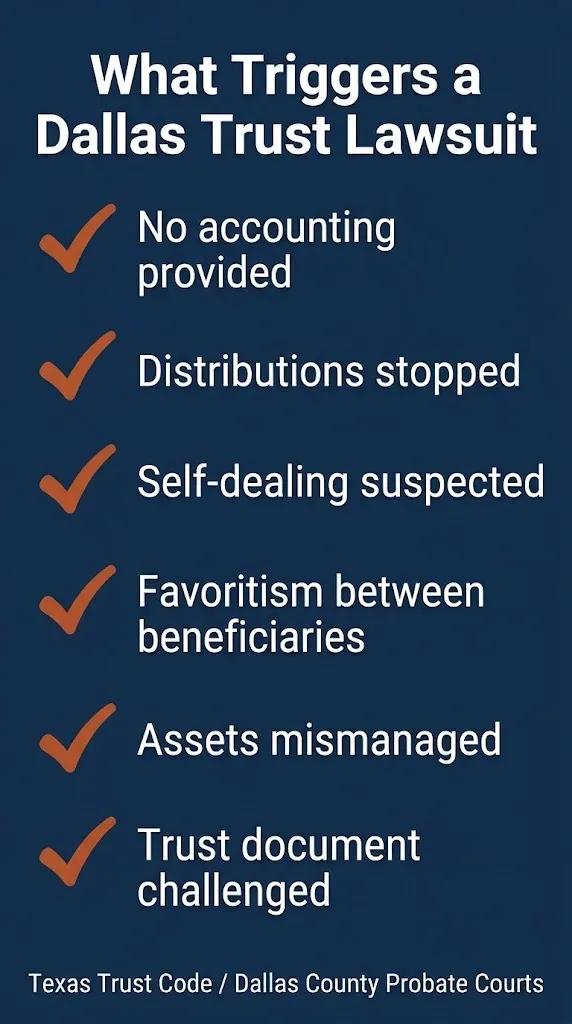
A Dallas trust lawsuit usually starts with one of six behaviors by a trustee or executor: no accounting, no distribution, self-dealing, favoritism, asset mismanagement, or a challenge to the trust document itself.
The Texas Trust Code imposes specific fiduciary duties on trustees. Those include the duty of loyalty, the duty to account, the duty of full disclosure, the duty to keep accurate records, and the duty to make trust property productive . When a trustee violates any of these, a beneficiary can petition a Dallas County probate court for relief.
Ford + Bergner, a Dallas and Houston fiduciary litigation firm, lists the common triggers: breach of fiduciary duty, self-dealing, failure to distribute, lack of accounting, mismanagement of assets, and conflicts of interest . Staubus, Blankenship, Legere and Walker, a Dallas firm, adds favoritism toward one beneficiary over another and refusal to distribute without legitimate excuse to that list .
The pattern is consistent across Dallas firms. Trustees get sued when they stop communicating and start benefiting themselves.
Key Takeaway: The most common trust lawsuit in Dallas is not about a stolen fortune. It is about a trustee who stopped providing accountings and stopped explaining decisions.
What Can a Dallas Probate Court Order in a Trust Dispute?
A Dallas probate court can order a trustee to account, restore assets, pay damages, forfeit compensation, or be removed entirely. The court’s authority under the Texas Trust Code is broad.
Under Texas Property Code § 114.001, a trustee who breaches the trust is chargeable with any damages resulting from that breach . Dallas probate courts can compel the trustee to perform neglected duties, restrain the trustee from further harmful actions, remove the trustee and appoint a successor, order restoration of misappropriated assets, and surcharge the trustee for financial harm .
The Dallas firm Staubus adds remedies that beneficiaries often overlook: the court can deny the trustee’s compensation entirely, award actual and punitive damages, order a detailed accounting, and place the trust under court supervision . In cases involving a trust’s interest in a partnership or LLC, the litigation can expand to include claims against the entity’s managers, not just the trustee .
Attorney’s fees are another lever. Texas courts have wide latitude to award attorney’s fees to beneficiaries who had to sue to enforce their rights . That does not mean fees are guaranteed, but it changes the cost calculus for a beneficiary weighing whether to file.
Reality Check: No one texts you trust money first. Filing a trust lawsuit in Dallas costs money upfront, and no court orders a trustee to pay you before you have a case number and a judge. If someone offers a “trust settlement release fee,” that is the scam.
How Do You File a Trust Lawsuit in Dallas County?
Filing a trust lawsuit in Dallas County means petitioning a statutory probate court, serving the trustee, and building a record that ties the trustee’s conduct to a specific fiduciary duty. The steps below are the general sequence, not legal advice for your specific case.
- Gather the trust document and any accountings you have. Without the trust terms, you cannot show what the trustee was required to do.
- Request a formal accounting in writing. This creates a dated record that the trustee refused or complied.
- Document specific transactions or omissions. Vague suspicion does not survive a hearing. Dates, amounts, and missing distributions do.
- Consult a Dallas trust litigation attorney about jurisdiction. Dallas County statutory probate courts handle these cases, but the specific court and filing requirements matter.
- File the petition. The petition states the breach, the remedy sought, and the factual basis.
- Serve the trustee. The clock on the trustee’s response starts here.
- Prepare for a temporary injunction hearing if assets are at risk. Dallas courts can freeze trust activity while the case proceeds.
- Consider mediation. Dallas probate courts often encourage alternative dispute resolution, and many trust disputes settle before trial .
The timeline varies. An accounting dispute might resolve in months. A trustee removal with contested facts can take a year or more.
What Texas Deadline Decides Your Trust Claim?
The most important deadline in a Texas trust dispute is the statute of limitations, which is generally two years for some fiduciary claims and four years for others, and the clock often starts when the misconduct is discovered or should have been discovered.
Texas courts treat breach of fiduciary duty as a tort in some contexts, which can trigger a two-year limitations period, while other trust claims carry a four-year window . The discovery rule can delay the start date when the fiduciary’s misconduct is inherently undiscoverable, but that rule has limits. Once the misconduct becomes apparent, the beneficiary has a duty to investigate and file .
This is the deadline that ends cases before they begin. A beneficiary who waited five years because “the trustee was family” can lose the claim even if the conduct was clearly wrong. A Dallas trust litigation attorney’s first job is often to determine whether the claim is still alive.
Do not treat any deadline in this article as your deadline. Limitations analysis depends on the specific claim, the specific conduct, and when you knew or should have known. That is a fact question a court decides, not a formula.
| Claim Type | General Texas Limitations Period |
|---|---|
| Breach of fiduciary duty (tort framing) | 2 years (with discovery rule issues) |
| Certain trust and contract claims | 4 years |
| Fraudulent transfer | 4 years |
| Specific case deadlines | Set by the court, not this article |
What Happens Next in a Dallas Trust Dispute?
The next stages in a Dallas trust dispute follow a predictable sequence: demand and accounting request, petition and service, temporary relief, discovery, mediation, and trial if no settlement holds.
Now to 30 days: Demand letter and formal accounting request. Some trustees respond. Most do not, at first.
30 to 90 days: Petition filed in Dallas County probate court. Service on the trustee. Temporary injunction hearing if assets are being moved.
3 to 9 months: Discovery. Depositions, document production, forensic review of trust accounts. This is where the cost climbs.
6 to 12 months: Mediation. Dallas probate courts often push for it, and many trust disputes resolve here .
12 months and beyond: Trial or final settlement. A contested trustee removal can go to trial. An accounting dispute usually does not.
The variable is not the law. It is how much the trustee fights and how much the trust can afford to spend on the fight.
Frequently Asked Questions
Can a beneficiary sue a trustee in Dallas without a lawyer?
Yes, but it is risky. Trust litigation involves specific pleading requirements, deadlines, and evidentiary rules. A beneficiary representing themselves can easily miss a limitations window or fail to state a claim the court can act on.
How much does a Dallas trust litigation lawyer cost upfront?
Most require a retainer before work begins. Published hourly rates run $225 to $425 for individual litigators and $375 to $650 for boutique firms. Some offer free consultations, others charge $150 to $300.
How long does a Dallas trust lawsuit take?
An accounting dispute can resolve in months. A contested trustee removal with discovery and trial can take a year or more. Mediation often shortens the timeline.
Can I recover attorney’s fees from the trustee in Texas?
Texas courts have broad discretion to award attorney’s fees to beneficiaries who had to sue to enforce trust rights. It is not automatic, and the court considers the equities and the trustee’s conduct.
What is the difference between a trust contest and a trust dispute?
A contest challenges the validity of the trust itself, often on capacity or undue influence grounds. A dispute challenges how the trustee is administering a valid trust. Both are heard in Dallas probate courts, but the evidence and remedies differ.
Does Dallas County have a special court for trust cases?
Dallas County has statutory probate courts that handle trust and estate litigation. The specific court assignment depends on the case and the county’s docketing rules.
What if the trustee already spent the money?
The court can enter a judgment against the trustee personally, order restoration, and in some cases award punitive damages. Recovery depends on whether the trustee has assets to collect from.
Trust litigation in Dallas is not a payout program. It is a court process with a clock. If a trustee has stopped accounting, stopped distributing, or started benefiting from trust assets, the limitations period may already be running.
Find the trust document. Request the accounting in writing. Calendar the date you sent that request. Then talk to a Dallas trust litigation attorney about whether the claim is still alive and whether the cost of the fight makes sense against what the trust holds.