Appellate Litigation in 2026: What It Is, How It Works, and Why the Record Is Everything
Quick Answer
- Appellate litigation is not a second trial; it is a review of the trial record for legal errors that affected the outcome .
- You generally cannot introduce new evidence or call witnesses; the appeal is decided on briefs and the lower court record .
- The deadline to file a notice of appeal is strict and short, often 30 days from the judgment in civil cases, and missing it can end the appeal before it starts .
You are searching for appellate litigation because a case you care about ended badly, and you want to know whether a higher court can fix it. The first thing to understand is that an appeal is not a do-over. The appellate court does not re-weigh evidence or decide who was more credible. It asks a narrower question: did the trial judge or jury make a legal mistake that changed the result . That distinction shapes everything about how appeals are won and lost.
The number that matters most is not a settlement figure but a deadline. In Texas, for example, a notice of appeal in a civil case must generally be filed within 30 days after the judgment is signed, or 20 days if the appeal is accelerated . Miss that window, and the appellate court has no jurisdiction to hear the case at all.
This article explains the appellate process step by step, the difference between harmless and reversible error, how oral argument actually works, and the mistakes that kill appeals before a judge ever reads the brief.
The Facts
| Item | What to Know |
|---|---|
| What It Is | Review of a trial court’s legal rulings, not a new trial |
| New Evidence | Not allowed; the appellate court reviews the existing record |
| Standard of Review | Legal errors reviewed de novo; factual findings reviewed for clear error |
| Key Filing | Notice of appeal, often due 30 days after judgment in civil cases |
| Main Documents | Opening brief, answer brief, optional reply brief |
| Oral Argument | Discretionary in many courts, time-limited, often 15 to 30 minutes per side |
| Possible Outcomes | Affirm, reverse, vacate, or remand for further proceedings |
Is Appellate Litigation Real or Just a Second Bite at the Apple?
Appellate litigation is real, but it is not a second bite at the apple in the way most people imagine. The appellate court’s job is to correct errors of law, not to second-guess the facts. If the jury believed one witness over another, that is generally final. If the judge admitted evidence that the law says should have been excluded, and that mistake likely changed the outcome, the appellate court can reverse .
The “second bite” myth causes real harm because it leads people to file appeals without a legal error to point to. An appeal that argues “the jury got it wrong” or “the other side lied” will fail unless it identifies a specific legal ruling that was incorrect. The appellate court does not have a transcript of the truth. It has a transcript of the trial, and it reads that transcript against the law .
Key Takeaway: Appellate litigation is about legal error, not factual disagreement, and an appeal without a specific legal error is an appeal that loses.
How Much Does Appellate Litigation Cost?
Appellate litigation costs money, and the amounts are not set by any court rule because attorney fees are negotiated between lawyer and client. What the rules do control is the cost of the record. The appellant must order the transcript and compile the record on appeal, and those costs are real and often substantial. The filing fees vary by court, and the briefs themselves take significant attorney time .
The bigger cost driver is the complexity of the record. A short trial produces a short transcript. A multi-week trial with dozens of exhibits produces a record that takes weeks to assemble and hundreds of hours to review. That is why appellate budgets can exceed trial budgets in cases with a small damages claim but a large legal issue.
Not yet determined for any specific case until the scope of the record and the legal issues are assessed.
Who Can File an Appellate Lawsuit?
Only a party who lost in the trial court can file an appeal, and only after a final judgment in most cases. The party who files is called the appellant, and the party defending the judgment is the appellee . You cannot appeal a case you won just because you are unhappy with the reasoning. You must be aggrieved by the judgment.
There are exceptions to the final judgment rule. Interlocutory appeals are allowed in some circumstances, such as when a trial court denies a motion to dismiss on immunity grounds or when a constitutional question is dispositive . But those exceptions are narrow, and most appeals wait until the trial court has finished.
| Party | Role in Appeal |
|---|---|
| Appellant | Filed the appeal; argues the trial court erred |
| Appellee | Defends the judgment; argues the trial court was correct |
| Amicus Curiae | Third party offering perspective on the legal issue |
What Are the Steps in the Appellate Process?
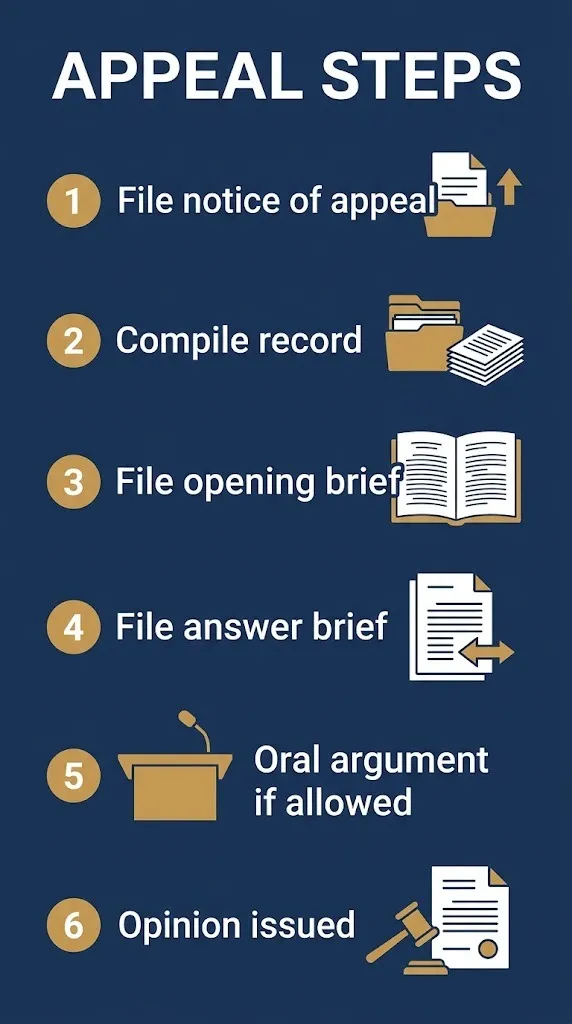
The appellate process follows a fixed sequence: notice, record, briefs, oral argument, and decision. The notice of appeal starts the clock and defines the scope of the appeal . The record on appeal is then compiled, including the transcript, exhibits, and the trial court’s orders. The opening brief lays out the appellant’s legal arguments and cites the record and the law. The answer brief responds, and a reply brief may follow .
Oral argument is optional and often discretionary. In the Colorado Supreme Court, each side gets 30 minutes; in the Colorado Court of Appeals, each side gets 15 minutes . Many cases are decided on the briefs alone. After argument, the judges conference and vote, and the majority assigns one judge to write the opinion .
Here is the sequence in numbered form:
- Notice of appeal is filed within the deadline .
- Record on appeal is compiled and transmitted.
- Opening brief is filed by the appellant .
- Answer brief is filed by the appellee .
- Reply brief is filed if the appellant chooses.
- Oral argument is held if the court allows it .
- Opinion is issued, affirming, reversing, or remanding .
What Is the Difference Between Harmless Error and Reversible Error?
The difference between harmless error and reversible error is whether the mistake likely changed the outcome. Not every legal error justifies a new trial. If the judge made a minor mistake that had no bearing on the verdict, the appellate court will call it harmless error and let the judgment stand. If the mistake was significant enough to affect the result, it is reversible error and the judgment can be overturned .
This distinction is why appellate lawyers spend so much time on the record. The argument is not just “the judge was wrong.” It is “the judge was wrong, and here is exactly how that wrong ruling changed what the jury heard and what the jury decided.” A brief that skips that second step is a brief that invites an affirmance.
Key Takeaway: Reversible error requires a showing that the mistake mattered, and the record is the only place to prove it.
How Does Oral Argument Work in Appellate Court?
Oral argument is a structured conversation with the judges, not a speech, and its purpose is to clarify the issues in the briefs and answer the court’s questions. Attorneys are forbidden from reading at length from their briefs, and they are limited to arguments raised in the briefs unless the court permits otherwise . The appellant usually goes first and may reserve time for rebuttal.
The most important skill in oral argument is not eloquence. It is listening to the judges’ questions and answering them directly. Questions are not interruptions; they are signals about what the court is worried about . An attorney who dodges a question or keeps returning to a prepared script loses credibility with the panel.
Key Takeaway: Oral argument is won by answering the judges’ actual questions, not by reciting the brief.
What Happens If You Miss the Notice of Appeal Deadline?
Missing the notice of appeal deadline is usually fatal because the deadline is jurisdictional. In Texas, a pro se appellant filed a notice of appeal after the deadline, and the court of appeals dismissed the case for want of jurisdiction despite giving him an opportunity to explain the delay . The court noted that it is not authorized to alter the time for perfecting an appeal in a civil case.
This is one of the few areas of law where there is almost no forgiveness. The deadline is set by rule, not by a judge’s discretion, and a late notice deprives the appellate court of power to act. If you are considering an appeal, the first thing to confirm is the exact deadline in your jurisdiction and the date the judgment was entered.
What Happens Next
Immediate: Confirm the date of the final judgment and the exact notice of appeal deadline in your jurisdiction.
Within days: Order the trial transcript and begin identifying the specific legal rulings you will challenge.
Before the brief is due: Confirm the record is complete and that every issue you plan to raise was preserved at trial.
Oral argument: Prepare to answer the court’s questions, not to repeat the brief.
Decision: The appellate court will affirm, reverse, or remand, and the losing party may seek further review.
Frequently Asked Questions
What is appellate litigation in simple terms?
Appellate litigation is the process of asking a higher court to review a trial court’s decision for legal errors, based on the existing record rather than new evidence .
Can I introduce new evidence on appeal?
No. Appellate courts do not hear witnesses or accept new evidence; they review the record created in the trial court .
How long do I have to file an appeal?
The deadline varies by jurisdiction, but in Texas civil cases the notice of appeal is generally due 30 days after the judgment is signed, or 20 days if the appeal is accelerated .
What is the difference between an appellant and an appellee?
The appellant files the appeal and argues the trial court erred. The appellee defends the judgment and argues the trial court was correct .
Do appellate courts always hold oral argument?
No. Many cases are decided on the written briefs alone, and oral argument is discretionary in many courts .
What happens if the appellate court finds an error?
It can reverse the judgment, vacate it, or remand the case to the trial court for further proceedings, which may include a new trial .
Can I appeal a case I already won?
No. Only a party who is aggrieved by the judgment can appeal, and you generally cannot appeal a favorable outcome just because you disagree with the reasoning .