Litigation Attorney Software 2026: Pricing, Features, and How to Choose
Quick Answer
- Litigation attorney software means practice management, case management, and AI tools that run a law firm.
- Pricing spans $49 per user per month for basics up to custom six-figure annual contracts for AI platforms.
- The critical buying deadline is not a claim date but your renewal window, because annual contracts lock you in.
Litigation attorney software is a category of legal technology that helps law firms manage cases, documents, billing, and increasingly, AI-assisted legal work. There is no settlement fund, no claim form, and no payout deadline for this term.
The confusion comes from search engines mixing consumer lawsuit content with legal software marketing. If you are a lawyer or firm administrator, the question is not “do I qualify” but “which platform fits my practice and budget.”
This article breaks down the verified pricing ranges, the feature categories that matter for civil litigation, the major vendors competing for your firm’s contract, and the exact steps to evaluate them. One detail most buying guides skip: Clio has held the #1 market presence ranking on G2 for nine consecutive years, which tells you how entrenched the incumbent is .
The Facts
| Category | Legal Process, Software Buying Guide |
|---|---|
| Market | Legal practice management software, global |
| Pricing Range | $49 to $300+ per user per month, custom enterprise pricing above that |
| Key Vendors | Clio, Filevine, MyCase, Smokeball, Eve, Harvey, DISCO, RunSensible |
| Primary Buyers | Solo practitioners, small firms, plaintiff firms, litigation boutiques |
| Decision Deadline | Renewal cycles, typically annual contracts |
| Proof Needed | Demo, trial, and reference checks, not claim forms |
Is Litigation Attorney Software Legit or a Scam?
Litigation attorney software is a legitimate, mature market with publicly traded companies, tier-1 venture backing, and millions of users. It is not a scam, but the pricing opacity in some segments is a real problem.
DISCO is a publicly traded company on the NYSE under the ticker LAW . Clio reports over 400,000 legal professionals across 130+ countries use its platform . Eve Legal raised $163 million from Andreessen Horowitz, Spark Capital, Lightspeed, and Menlo Ventures at a $1 billion+ valuation . These are verifiable companies with real products.
The scam risk in this market is not fraudulent vendors. It is custom pricing that hides the real cost until you are deep into a sales conversation. Eve Legal, for example, is demo-gated with no public pricing . CARET Legal and Filevine also use “pricing available upon request” language in comparison listings .
That is not illegal, but it makes comparison shopping harder. Third-party estimates place comparable AI platforms at $100 to $300 per user per month, but you cannot verify that without a sales call .
How Much Does Litigation Attorney Software Cost in 2026?
Litigation attorney software costs between $49 and $300+ per user per month, with enterprise AI platforms priced on custom annual contracts that are not publicly disclosed. The exact cost depends on firm size, feature tier, and contract length.
Verified pricing data from vendor listings and review platforms shows the range:
| Platform | Starting Price | Pricing Model | Notes |
|---|---|---|---|
| Smokeball | $49/month | Per user | Entry-level, small firm focus |
| 8am MyCase | $50/month | Per user | Mid-tier practice management |
| MyCase | $49/month | Per user | Entry-level, client portal included |
| LEAP | ₹99/month | Per user | Regional pricing, India listing |
| Eve Legal | Custom, quote only | Demo-gated | Third-party estimate $100-$300/user/month |
| Filevine | Pricing on request | Custom | No public starting price |
| CARET Legal | Pricing on request | Custom | No public starting price |
The pattern is clear. Entry-level practice management has transparent pricing around $49 to $50 per user per month. AI-heavy litigation platforms and enterprise case management suites hide pricing behind sales calls.
RunSensible offers a different model: per-seat annual pricing for its Forms product, with a bundle option that saves 15% when combined with its Execute tier .
Not yet determined for many AI platforms because vendors will not publish rates. Ask for a written quote before you schedule a demo.
Reality Check: No vendor should charge you a “setup fee” for a demo or a trial. Legitimate software companies offer free trials or sandbox environments. If a salesperson demands payment before you can see the product, walk away.
What Features Matter Most in Litigation Attorney Software?
The features that matter most in litigation attorney software are case management, document management, calendaring with court deadlines, billing, and client intake. AI features are increasingly important but should not be the primary buying criterion for most firms.
For civil litigation specifically, the non-negotiable features are:
- Matter and case management: Centralized case files with all contacts, notes, and documents linked.
- Court deadline calendaring: Automated CPR-compliant deadline tracking and reminders .
- Document management: Storage, search, version control, and e-signatures.
- Time and billing: Time capture, invoice generation, trust accounting, and payment processing.
- Client intake and CRM: Lead tracking, conflict checks, and automated intake workflows .
- Reporting and analytics: Matter pipeline, fee earner performance, and revenue dashboards.
AI features are the fastest-growing category. Harvey provides document review, drafting, legal research, and workflow creation, with integration into Microsoft 365 and LexisNexis . Eve Legal offers an AI Auditor that scans active caseloads nightly to flag missed case value, including potential TBIs and overlooked mass tort eligibility .
A 2026 ABA article breaks legal AI into three groups: general-purpose models (ChatGPT), point solutions (single-task tools), and all-in-one platforms (Eve, Harvey) . The ABA warns that courts have flagged AI-fabricated citations in roughly 1,600 cases, and the duty to verify falls on the lawyer .
Key Takeaway: The core litigation software features are case management, calendaring, documents, billing, and intake, while AI is a growing add-on that demands verification, not blind trust.
What Is CRM Software for Civil Litigation?
CRM software for civil litigation is a client relationship management tool that tracks leads, automates intake, and manages the pipeline from first inquiry to retained client. It is separate from case management, which handles active matters.
Clio describes its legal CRM as handling “the process of turning enquiries into retained clients” . The key functions include:
- Lead capture from web forms, phone calls, and referrals
- Conflict checks before engagement
- Automated intake forms with e-signatures
- Follow-up scheduling and reminders
- Pipeline reporting showing conversion rates and revenue sources
The distinction matters because many firms buy case management first and later realize they need CRM for the intake side. Clio Grow is its CRM product; Clio Manage is its case management product . RunSensible bundles CRM with case management, document automation, and billing in one platform .
If your firm relies on referrals and word of mouth, a dedicated CRM may be less urgent than calendaring and document management. If you spend on marketing and want to track ROI, CRM is essential.
What Is the Best Software for Litigation in 2026?
There is no single best software for litigation. The right choice depends on firm size, practice area, budget, and whether you need AI-heavy tools or straightforward practice management.
The major contenders based on verified data:
| Platform | Best For | Key Strength | Pricing Visibility |
|---|---|---|---|
| Clio | General practice, all sizes | #1 market presence, 400,000+ users | Transparent tiers |
| Filevine | Plaintiff and litigation firms | Deep case management, LOIS AI | Custom pricing |
| Eve Legal | Plaintiff firms, AI-first | Full lifecycle AI, nightly case audits | Demo-gated |
| Harvey | BigLaw, complex litigation | AI document review, research, drafting | Enterprise custom |
| DISCO | eDiscovery-heavy litigation | All-inclusive eDiscovery and AI platform | Per GB pricing |
| Smokeball | Small firms, solo practitioners | Transparent $49/month entry price | Public starting price |
| RunSensible | Civil litigation, forms automation | 54,000+ court forms, AI-guided filing | Per-seat annual |
| MyCase | Small to mid-size firms | Client portal, document sharing | Public starting price |
DISCO announced an all-inclusive platform in February 2026 that bundles eDiscovery, Cecilia AI, deposition management, and timelines at a single per-GB price with no ingest fees .
Harvey is used by leading law firms for “summarising massive volumes of datasets and navigating bundles,” according to Chambers reviews .
How Do You Choose Litigation Attorney Software?
Choosing litigation attorney software requires a structured evaluation, not a single demo. The process should take two to four weeks for most firms and involve multiple stakeholders.
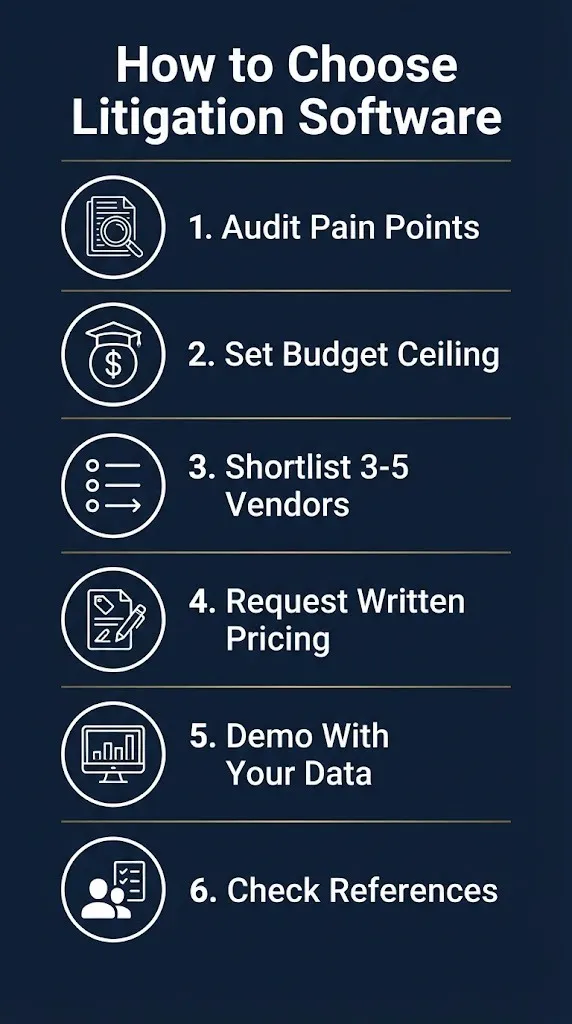
Here is the step-by-step process:
- Audit your current pain points. Identify the one or two workflows that cost you the most time or money.
- Set a budget ceiling. Include per-user costs, implementation fees, training, and integration expenses.
- Shortlist three to five vendors. Match platform strengths to your practice area.
- Request written pricing. Do not accept “we’ll discuss on the call” as an answer.
- Run a demo with your own case data. Ask vendors to show your workflow, not their canned demo.
- Check integrations. Confirm compatibility with your email, document management, and accounting tools.
- Request references. Talk to firms of similar size and practice area.
- Negotiate the contract. Ask about annual vs. monthly, cancellation terms, and data portability.
The ABA recommends checking HIPAA and SOC 2 compliance, data-training policy, medical-record depth for plaintiff work, and error-catching capability before buying AI tools .
Clio reports 300+ integrations and a SOC 2 Type 2 certification . Filevine has a “no refunds” policy that one reviewer called out after wasting $2,000 on an unsuitable system, a reminder to read contract terms carefully .
What Happens Next in the Litigation Software Market?
The litigation software market is moving toward all-in-one AI platforms and transparent pricing, with consolidation expected through 2027.
Expected Q4 2026: More vendors announce all-inclusive platforms similar to DISCO’s February 2026 launch, bundling eDiscovery, AI, and case management .
Expected 2027: AI agent capabilities become standard, not premium, as platforms like Eve expand autonomous task execution across the case lifecycle .
Expected 2027-2028: Pricing transparency increases as buyers push back on demo-gated quotes. Some vendors may adopt DISCO’s per-GB model for eDiscovery .
Ongoing: Courts continue issuing guidance on AI verification duties, with ABA Formal Opinion 512 placing responsibility on the lawyer for AI errors .
The market is advancing “beyond basic matter tracking toward integrated platforms that combine workflow automation, billing, compliance, analytics, secure collaboration, client portals, and AI-enabled assistance,” according to a 2026 Research and Markets report .
Frequently Asked Questions
How much does litigation attorney software cost?
Entry-level practice management starts at $49 to $50 per user per month, while AI-heavy platforms and enterprise case management suites use custom pricing estimated at $100 to $300+ per user per month .
What is the best software for civil litigation?
There is no single best option. Clio leads in market presence, Filevine and Eve serve plaintiff firms, Harvey serves BigLaw, and DISCO specializes in eDiscovery .
Do I need CRM software for my law firm?
You need legal CRM if you invest in marketing, track leads from multiple sources, or want automated intake and conflict checks. Solo firms relying on referrals may prioritize case management first .
Is AI legal software safe for confidential client data?
Safety depends on the vendor. Confirm HIPAA and SOC 2 compliance, check the data-training policy, and verify the vendor does not train models on your client data .
What is the difference between case management and practice management?
Practice management covers the full firm operation: billing, accounting, CRM, and reporting. Case management focuses on matter-specific tasks, documents, calendaring, and case notes .
How long does implementation take?
Setup time varies. Eve Legal reports 2 to 4 weeks including Blueprint training . Smaller practice management platforms can deploy in days for basic configurations.
Do these platforms integrate with Outlook and QuickBooks?
Most major platforms integrate with Microsoft 365, Outlook, and QuickBooks Online. Clio reports 300+ integrations; Filevine and MyCase list Microsoft and QuickBooks among their core connections .
What should I check before signing an annual contract?
Check cancellation terms, data portability guarantees, refund policy, per-user limits, and whether AI features cost extra. Filevine’s no-refund policy has drawn criticism from users .