Workers’ Compensation Benefits: 2026 Rates, Payments, and New York State Updates
Quick Answer
- Workers’ compensation benefits are legally required in all 50 states and cover medical care plus partial wages.
- Average workers’ comp settlements range from $2,000 to $40,000, with New York rates varying by injury type.
- You must report a workplace injury promptly, usually within 10 to 30 days depending on your state.
Workers’ compensation benefits are payments and services you receive when you are injured or become ill because of your job. The system is designed to cover your medical bills and replace part of your lost income while you recover.
If you work in New York or any other state, these benefits are not optional for your employer. They are a legal requirement, and the rates and payment amounts follow set formulas.
This guide covers how workers’ compensation pay works in 2026, what the current rates are, and specifically how New York State handles its workers’ compensation payments.
A surprising verified detail: New York State has some of the highest workers’ compensation rates in the country, driven by its statutory benefit levels and cost of living adjustments built into the law.
The Facts
| System | State workers’ compensation programs, including New York State |
| Who Is Covered | Most employees, not independent contractors |
| Benefits Provided | Medical care, wage replacement, disability payments, vocational rehab |
| NYS Maximum Weekly Benefit | Set annually by the New York State Workers’ Compensation Board |
| Claim Reporting Deadline | 30 days in New York for most injuries |
| Payment Start | Within 14 days of claim approval in most states |
| Average Settlement | $2,000 to $40,000 nationally, higher for severe injuries |
Are Workers’ Compensation Benefits Real and Legally Required?
Yes, workers’ compensation benefits are real and mandatory in all 50 states.
Employers must provide workers’ compensation insurance coverage for their employees. This is not a voluntary benefit like a 401(k) match or a wellness program.
The system is no-fault. You do not need to prove your employer was careless to receive benefits. You only need to show the injury or illness is work-related.
New York State has one of the oldest workers’ compensation systems in the country. Its Workers’ Compensation Board oversees claims, sets rates, and resolves disputes.
If your employer does not carry required coverage, you may still receive benefits through a state uninsured employers fund. You may also have a separate legal claim against the employer.
Key Takeaway: Workers’ compensation is a legal right for most employees, not a favor from your employer.
How Much Do Workers’ Compensation Payments Actually Pay?
Workers’ compensation pay replaces a portion of your wages, not your full paycheck.
Most states pay between 60 and 66.67 percent of your average weekly wage while you cannot work. That is the standard wage replacement rate.
Here is a general breakdown of payment types:
| Payment Type | What It Covers |
| Temporary total disability | You cannot work at all during recovery |
| Temporary partial disability | You can work but earn less due to restrictions |
| Permanent partial disability | You have a lasting impairment but can still work |
| Permanent total disability | You cannot return to any work |
| Death benefits | Paid to surviving dependents |
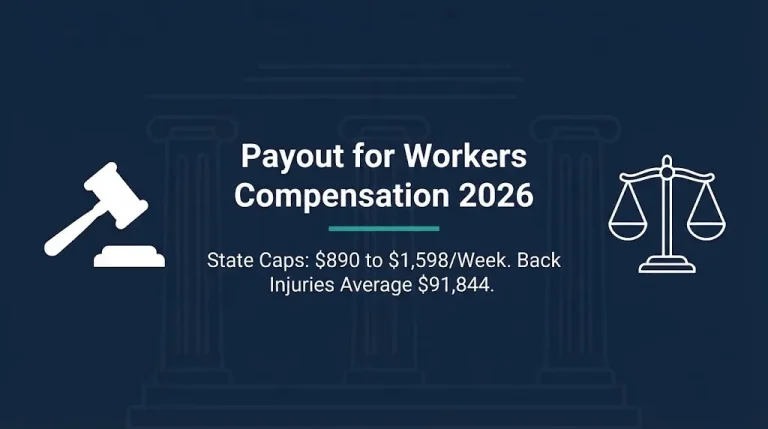
The exact amount depends on your state, your wages, and the severity of your injury. There are minimum and maximum weekly payment amounts in every state.
What Are the Current Workers’ Compensation Rates in New York State?
New York State workers’ compensation rates are set annually and vary by job classification.
The New York Compensation Insurance Rating Board establishes the base rates employers pay for coverage. Those rates differ by industry and job type.
For injured workers, the key rate is the maximum weekly benefit amount. The New York State Workers’ Compensation Board sets this figure each year based on the state’s average weekly wage.
Here is what New York claimants should know about rates:
- Maximum weekly benefit is set at two-thirds of the state average weekly wage
- Rates increase annually on July 1
- Benefit amounts are calculated from your own average weekly wage over the prior year
- Minimum weekly benefit applies for low-wage workers
If you are injured in 2026, your payment is based on the rate in effect on your injury date, not the current year’s rate.
What Is the Average Workers’ Comp Settlement in 2026?
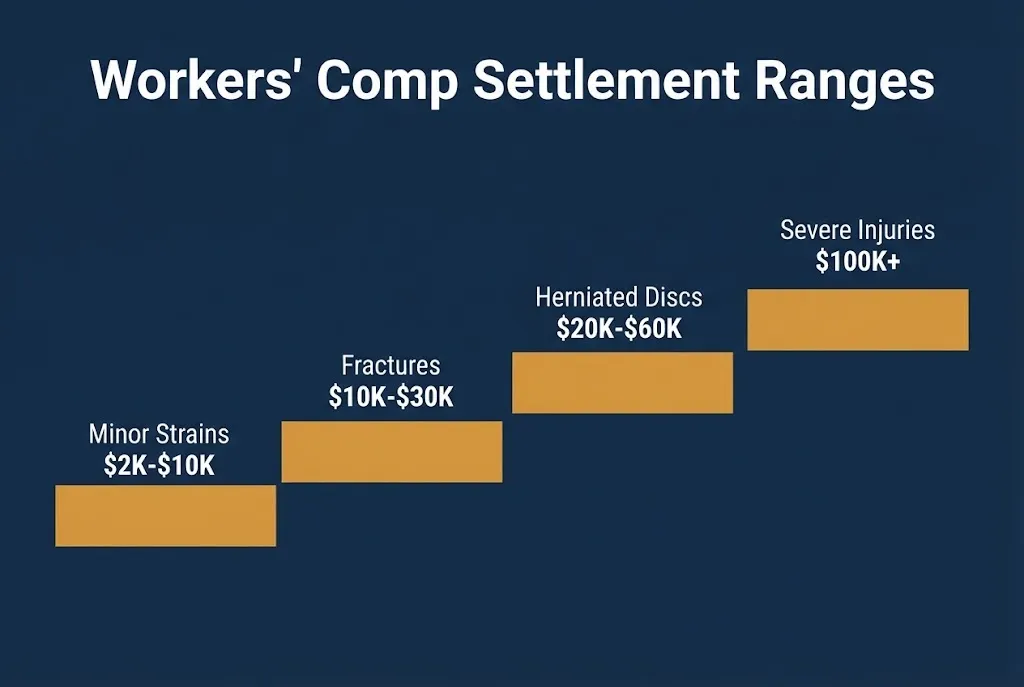
The average workers’ comp settlement nationally falls between $20,000 and $40,000, according to industry data.
That average includes everything from minor strain settlements under $5,000 to catastrophic injury settlements exceeding $250,000.
Here is a typical settlement range table:
| Injury Type | Settlement Range |
| Strains, sprains, contusions | $2,000 to $10,000 |
| Simple fractures | $10,000 to $25,000 |
| Herniated discs | $20,000 to $60,000 |
| Rotator cuff tears | $25,000 to $75,000 |
| Knee injuries requiring surgery | $20,000 to $65,000 |
| Spinal fusions | $50,000 to $150,000 |
| Traumatic brain injuries | $100,000 to $500,000+ |
New York settlements trend higher than the national average because the state’s benefit rates are higher and medical costs in New York are elevated.
Reality Check: No insurance adjuster is required to offer you a fair settlement on the first try. Their job is to close claims cheaply. Your job is to document everything and understand what your claim is actually worth before you sign anything.
How Do You Qualify for Workers’ Compensation Benefits?
You may qualify if you are an employee who suffered an injury or illness arising out of and in the course of employment.
Here are the 5 qualification criteria:
- You must be an employee, not an independent contractor.
- Your injury must be work-related, meaning it happened while doing your job.
- You must report the injury to your employer within the state deadline.
- You must seek medical treatment and follow your doctor’s restrictions.
- Your employer must carry workers’ compensation insurance or be legally required to do so.
Some states exclude certain worker categories. Farm workers, domestic workers, and seasonal employees may be excluded in some jurisdictions.
If you are misclassified as an independent contractor, you may still qualify for benefits. Misclassification is a common employer tactic to avoid paying for coverage.
Key Takeaway: Employee status matters. If your employer controls how, when, and where you work, you likely qualify as an employee regardless of what your pay stub says.
How to File a Workers’ Compensation Claim in New York State
Filing in New York follows a specific process. Missing a step can delay or deny your benefits.
Here are the 7 steps to file a New York workers’ compensation claim:
- Report the injury to your supervisor in writing within 30 days.
- Seek medical treatment from a provider authorized by the Workers’ Compensation Board.
- Complete Form C-3, the Employee Claim form, and file it with the Board.
- Your employer files Form C-2, the Employer’s Report of Injury.
- Your doctor files Form C-4, the Doctor’s Initial Report.
- The Board assigns a case number and reviews the claim.
- You receive a decision on compensability and begin receiving payments if approved.
You can file online through the New York State Workers’ Compensation Board’s eCase system.
What Are the Benefits of Workers’ Compensation for Employees?
Workers’ compensation provides four core benefits to employees.
First, medical care. Your employer’s insurance pays for all reasonable and necessary medical treatment for your injury. That includes doctor visits, surgery, medication, and therapy.
Second, wage replacement. You receive a portion of your lost wages while you cannot work.
Third, disability payments. If your injury leaves you permanently impaired, you receive compensation for that permanent loss.
Fourth, vocational rehabilitation. If you cannot return to your old job, the system may pay for retraining.
There is also a fifth benefit that people overlook: protection from retaliation. Filing a claim is a legal right, and employers who fire you for filing face separate legal liability.
How Long Do Workers’ Compensation Payments Last?
Payment duration depends on your injury classification and your state’s laws.
Temporary disability payments continue until you reach maximum medical improvement or return to work. That could be weeks, months, or years.
Permanent partial disability payments follow a schedule. Each body part has a set number of weeks of benefits in most states.
Here is a sample of scheduled benefits for selected body parts:
| Body Part | Typical Weeks of Benefits |
| Hand | 150 to 250 weeks |
| Arm | 200 to 300 weeks |
| Leg | 200 to 300 weeks |
| Foot | 100 to 200 weeks |
| Eye | 100 to 200 weeks |
Total disability payments may continue for life in the most severe cases.
What Is the Difference Between Workers’ Compensation Pay and a Lawsuit Settlement?
Workers’ compensation pay is an administrative benefit. A lawsuit settlement is a legal resolution.
With workers’ compensation, you do not sue your employer. You file a claim. An insurance adjuster or state board determines your benefits.
A lawsuit settlement can come from a third-party claim. If someone other than your employer caused your injury, like a defective product manufacturer or a negligent contractor, you may sue them separately.
Third-party lawsuits can recover damages workers’ compensation does not cover. Pain and suffering, full lost wages, and punitive damages are available in a lawsuit but not in workers’ compensation.
Key Takeaway: Workers’ compensation pays benefits on a schedule. A lawsuit can pay damages beyond that schedule if you have a viable third-party claim.
What Happens If You Are Injured at Work in New York State?
New York has specific rules that differ from other states.
You must report the injury within 30 days. Your employer must file a report within 10 days of learning about your injury.
New York requires employers to post a notice of workers’ compensation coverage in the workplace. If they do not, you still have rights.
The Board will assign a judge to your case if there is a dispute. Hearings are held at district offices throughout the state.
New York also has a special fund for reopened cases. If your injury worsens years later, you may be able to reopen your claim and receive additional benefits.
How Do Workers’ Compensation Insurance Rates Work for Employers?
Employers pay premiums based on their industry classification and claims history.
High-risk industries like construction and manufacturing pay higher rates. Office-based businesses pay lower rates.
New York rates are set by the New York Compensation Insurance Rating Board and approved by the state Department of Financial Services.
An employer’s claims history affects their experience modification factor. More claims mean higher premiums.
This is why some employers discourage workers from filing claims. They are trying to protect their insurance costs, not your health.
Key Takeaway: Employer pressure to avoid filing a claim is about their bottom line, not your best interest. File the claim.
What Are Common Reasons Workers’ Compensation Claims Are Denied?
Denials happen for specific, predictable reasons.
Here are the 6 most common denial reasons:
- Late reporting, missing the state deadline.
- Disputed cause, the employer claims the injury did not happen at work.
- Pre-existing condition, the insurer blames an old injury.
- Intoxication or drug use at the time of the injury.
- Misclassification, the employer claims you are an independent contractor.
- Missing medical evidence, no doctor’s report linking the injury to work.
You can appeal any denial. The appeal process varies by state but generally involves a hearing before an administrative judge.
What Should You Do If Your Workers’ Compensation Check Is Late?
Late payments are common. You have rights.
Contact your claims adjuster first. Document the date, time, and what was said. If the delay continues, file a complaint with your state’s workers’ compensation board.
In New York, you can request a hearing if payments are unreasonably delayed. The Board can impose penalties on insurers that fail to pay on time.
Do not simply wait. Delays often resolve faster when the insurer knows the Board is involved.
What Happens Next After You File a Workers’ Compensation Claim?
Here is the typical timeline after filing:
- Day 1 to 30: You report the injury and file your claim.
- Day 14 to 30: The insurer approves or denies the claim.
- Month 1 to 6: You receive medical treatment and wage benefits.
- Month 6 to 18: You may reach maximum medical improvement.
- After MMI: Settlement negotiations or a permanency award.
- Final: Claim closes or a formal settlement is approved by the Board.
Timelines vary by state and injury severity. New York claims can take longer due to Board hearing schedules.
Frequently Asked Questions
What is the maximum workers’ compensation rate in New York for 2026?
The maximum weekly benefit is set at two-thirds of the state average weekly wage.
The exact figure updates annually on July 1.
How long does workers’ compensation pay in New York?
Payments continue until you reach maximum medical improvement or return to work.
Permanent disability payments follow a schedule based on your impairment rating.
Can I choose my own doctor for a workers’ compensation injury in New York?
New York allows you to choose an authorized provider from the Board’s list.
Your employer’s insurer must cover treatment from Board-authorized medical providers.
What is the average workers’ comp payout for a back injury?
Back injury settlements typically range from $20,000 to $60,000.
Spinal fusions and permanent restrictions push settlements higher.
Do I have to pay taxes on workers’ compensation benefits?
No, workers’ compensation benefits are generally exempt from federal and state income taxes.
This applies to weekly payments and lump sum settlements.
Can I be fired while on workers’ compensation in New York?
You cannot be fired for filing a claim or being on workers’ compensation.
Retaliation is illegal, but your employer can still terminate you for legitimate business reasons.
What if my workers’ compensation claim is denied in New York?
You can appeal by requesting a hearing before a Workers’ Compensation Law Judge.
The appeal process is free and you can represent yourself or hire an attorney.
How much does a workers’ compensation lawyer cost in New York?
New York workers’ compensation lawyers typically charge a contingency fee.
The fee is usually 15 percent of your recovery and only applies if you win.
If you are injured at work, file the claim immediately. The deadlines are short and the system rewards quick, documented action.
The most important number is your state’s reporting deadline. In New York, that is 30 days. Miss it and you may lose everything.