When Will Workers’ Comp Offer a Settlement in California in 2026? The Timeline Nobody Explains
Quick Answer
- Insurers typically offer settlement after you reach Maximum Medical Improvement and receive a permanent disability rating.
- There is no legal deadline forcing an offer, and a case can settle at almost any stage if both sides agree.
- After a judge approves the settlement, the carrier must pay within 30 days or face a penalty.
Workers’ comp in California does not send you a settlement offer on a calendar date. The system waits for your medical condition to stabilize, then calculates what your injury is worth under a permanent disability schedule that has not been updated since 2014 . If you are waiting for a check, the first question is not “when will they offer,” it is “have I reached Maximum Medical Improvement yet.”
That single milestone, usually shortened to MMI, is the gate. Until your treating doctor or a Qualified Medical Evaluator declares you permanent and stationary, the insurer has no rating to settle against. Once that rating exists, negotiations can start, and the typical case runs 12 to 18 months from injury to resolution .
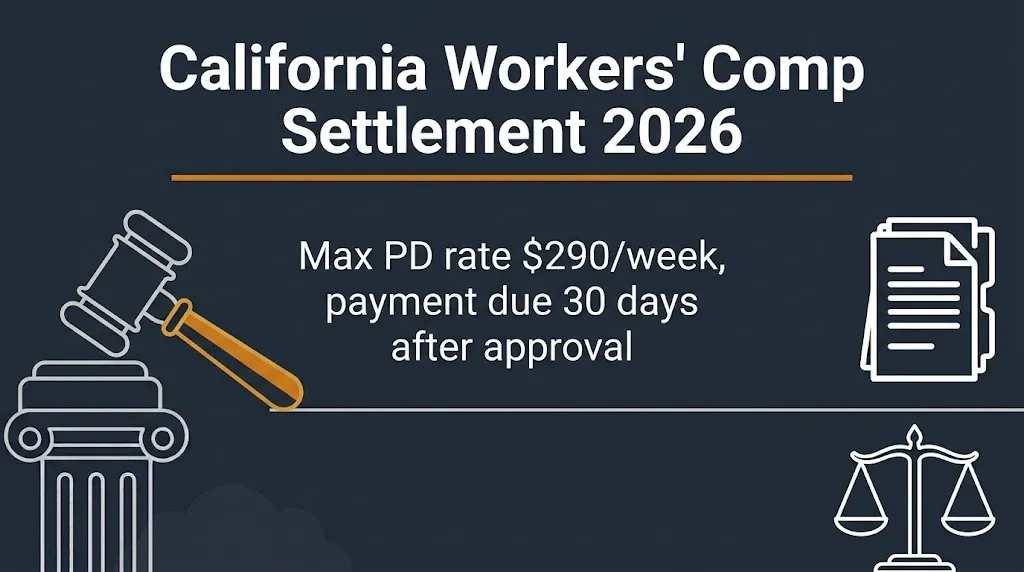
This article covers the actual triggers, the two settlement types that pay differently, what a rating is worth in 2026 dollars, and what to do when the offer never comes. One number to hold onto: for injuries on or after January 1, 2014, the maximum weekly permanent disability rate is $290, and that figure is frozen by statute .
The Facts
| Item | Verified Detail |
|---|---|
| Settlement Trigger | Maximum Medical Improvement plus a permanent disability rating |
| Settlement Types | Compromise and Release (lump sum) or Stipulated Award (ongoing payments) |
| 2026 Max PD Rate | $290 per week for injuries on or after 1/1/2014 |
| 2026 Max TTD Rate | $1,764.11 per week |
| Payment Deadline | 30 days after WCAB approval under Labor Code §5814 |
| Late Penalty | Up to 25% of the late amount, capped at $10,000 |
| Typical Timeline | 12 to 18 months average, 4 to 9 months after MMI |
Is a workers’ comp settlement in California automatic or do you have to ask?
A workers’ comp settlement in California is not automatic. No statute requires the insurer to offer one, and no deadline forces an offer by a certain date. The settlement happens when both sides agree, usually after MMI and a rating.
That surprises injured workers who expect a check to arrive once treatment ends. The system does not work that way. The insurer controls its own evaluation timeline, and some carriers wait for you to request a settlement conference or file for a hearing.
If you are unrepresented, the insurer may approach you with an offer once your doctor declares you permanent and stationary. If you are represented, your attorney typically initiates the settlement discussion after reviewing the medical reports. Either way, the offer is a negotiation, not an entitlement triggered by a date.
How long after Maximum Medical Improvement does a settlement offer come?
A settlement offer usually comes 4 to 9 months after you reach Maximum Medical Improvement, once the permanent disability rating is finalized and both sides have reviewed it. The MMI date itself does not start a clock.
Here is the verified sequence. After MMI, you still need a QME or AME evaluation, which typically takes 45 to 120 days . Once that report issues, negotiations begin within 30 to 60 days in a straightforward case. If the rating is agreed and there is no apportionment dispute, the settlement can be reached and approved within 60 to 120 days of the QME report .
Contested ratings add months. Apportionment fights, disputed body parts, and depositions all push the timeline out. A case that looks simple at MMI can run past two years if the insurer challenges the rating.
What is the difference between a Compromise and Release and a Stipulated Award?
A Compromise and Release pays one lump sum and usually closes your future medical care, while a Stipulated Award pays biweekly benefits and keeps future medical open. The two documents resolve your case in opposite ways.
A Compromise and Release, often called a C&R, is a negotiated dollar amount that settles all claims arising from the injury, including future medical. Once a judge approves it, the case is final and you cannot reopen it even if your condition worsens . The lump sum can be higher than the chart value because you are giving up future rights.
A Stipulated Award, or “stips,” is based on an agreed permanent disability rating. You receive payments every two weeks, and your future medical care stays open for the accepted injury. The case remains technically open, and you can petition to reopen for new and further disability within five years of the injury date under Labor Code §5410 .
Key Takeaway: A C&R trades your future medical care for cash today, and that trade is the single most consequential decision in a California workers’ comp case.
How much is my California workers’ comp settlement worth in 2026?
Your California workers’ comp settlement is worth your permanent disability rating multiplied by the statutory weekly rate, plus any unpaid temporary disability and the value of future medical care if you settle by C&R. The maximum weekly PD rate in 2026 is $290 for injuries on or after January 1, 2014.
The rating translates into weeks of payments, and the weeks-per-point scale is non-linear. A higher rating is worth disproportionately more per percentage point .
2026 California PD values at the $290 maximum weekly rate:
| PD Rating | Weeks of Payments | Scheduled Value |
|---|---|---|
| 5% | 15.00 | $4,350 |
| 15% | 50.50 | $14,645 |
| 30% | 131.00 | $37,990 |
| 50% | 271.25 | $78,663 |
| 70% | 433.25 | $125,643 plus life pension |
| 80% | 593.25 | $172,043 plus life pension |
Those numbers are the statutory schedule. A C&R can include more for future medical, disputed issues, and litigation risk. It can also include less if the insurer believes the rating is overstated. The scheduled value is the floor for negotiation, not the ceiling.
Reality Check: No one calls you to say a settlement is waiting. The insurer does not owe you an offer on a schedule, and any third party charging a fee to “release” California workers’ comp funds is not legitimate. The only real process runs through the WCAB and an approved settlement document.
What triggers a settlement offer in a California workers’ comp case?
The main trigger is a permanent disability rating from a QME or AME after you reach Maximum Medical Improvement. Secondary triggers include a request for a mandatory settlement conference, a trial date, or the insurer’s own desire to close the file.
Here are the verified events that commonly move a case toward an offer:
- MMI declared: Your condition is stable and unlikely to change.
- Permanent disability rating issued: The number that anchors negotiation.
- Deposition completed: The insurer has your testimony on record.
- Discovery closed: Both sides know the medical and wage evidence.
- Mandatory Settlement Conference scheduled: A WCAB judge pushes the parties to resolve.
- Trial date set: The insurer faces the risk of a judge deciding the rating.
The insurer has an incentive to settle before trial if the rating is uncertain. It also has an incentive to wait if it believes the rating is inflated. The trigger is leverage, not kindness.
What if the insurer never offers a settlement?
If the insurer never offers a settlement, you can force the issue by requesting a mandatory settlement conference or filing a Declaration of Readiness to Proceed with the WCAB. The Board can set the case for a settlement conference or trial.
An unrepresented worker has the same right to file a DOR as an attorney. The form asks the WCAB to schedule a hearing on the unresolved issues. At that hearing, a judge will ask both sides why the case has not settled and may pressure the carrier to make an offer.
The delay itself is not necessarily a violation. The carrier is allowed to investigate and dispute. But if the carrier has accepted the claim, has the medical reports, and simply refuses to engage, the WCAB can move the case to trial and decide the rating itself.
How long does it take to get the settlement check after approval?
The settlement check must arrive within 30 days of the WCAB judge’s approval order under Labor Code §5814. If the carrier misses that deadline without good cause, a penalty of up to 25% of the unpaid amount applies, capped at $10,000 .
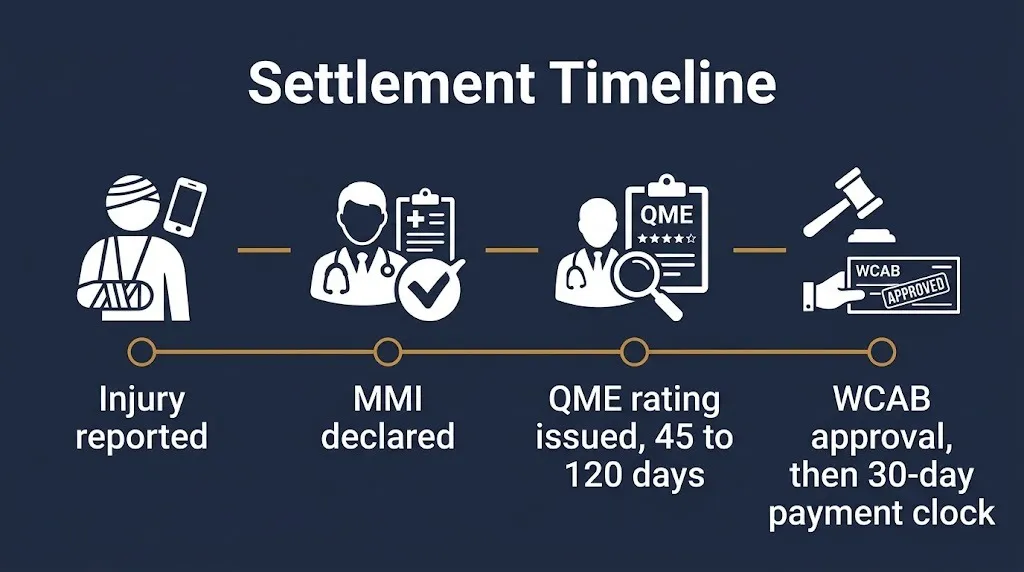
The 30 days runs from the judge’s signature, not from the date you signed the settlement document. That gap matters. A case signed in April may wait weeks for the Order Approving to issue, and the payment clock does not start until it does .
If the carrier files a Petition for Reconsideration, payment is generally stayed while the petition is pending. The WCAB has 60 days to act on the petition, and if it does not act, the petition is deemed denied and the 30-day clock restarts . Most reconsideration petitions on approved settlements are delay tactics, but they are legal delay tactics.
What happens next in your California settlement?
The next stages depend on where you are in treatment. Here is the verified sequence most cases follow:
If you are still treating: Continue treatment and document every symptom. MMI comes when your doctor says it comes.
After MMI: Request the QME or AME evaluation if it has not happened. The report takes 45 to 120 days.
After the rating: Negotiation begins. If you are represented, your attorney handles the demand.
If no agreement: File a Declaration of Readiness to Proceed to force a settlement conference.
After approval: The carrier has 30 days to pay. If it misses, the penalty clock starts.
The one date to calendar is not a settlement date. It is your next medical evaluation. Everything in the system flows from the rating that evaluation produces.
Frequently Asked Questions
How long does it take to get a workers’ comp settlement in California?
The average case takes 12 to 18 months from injury to resolution. After you reach Maximum Medical Improvement, expect another 4 to 9 months before a check arrives.
Can I settle my workers’ comp case before I reach MMI?
It is possible in minor cases, but generally not advisable. Settling before MMI means you do not know your final rating or future medical needs, and a C&R closes the case permanently.
Does the insurance company have to offer me a settlement?
No. California law does not require the insurer to make a settlement offer. You can force a hearing by filing a Declaration of Readiness to Proceed if the carrier refuses to engage.
What is the maximum permanent disability rate in California for 2026?
The maximum weekly permanent disability rate is $290 for injuries on or after January 1, 2014. That rate has been frozen by statute and did not increase with the 2026 SAWW adjustment.
How much is a 30% permanent disability worth in California?
At the $290 maximum weekly rate, a 30% rating equals 131 weeks, or $37,990 in scheduled permanent disability indemnity.
What happens if the insurance company pays my settlement late?
Under Labor Code §5814, you can seek a penalty of up to 25% of the late amount, capped at $10,000. The 30-day clock starts when the WCAB judge signs the approval order.
Can I reopen my case after a Compromise and Release?
Generally no. A C&R closes all aspects of the claim, including future medical, and cannot be reopened even if your condition worsens. A Stipulated Award can be reopened within five years of the injury.
Your next move is to check your medical reports for the words “permanent and stationary” or “Maximum Medical Improvement.” If they are not there yet, the settlement clock has not started. If they are, ask your attorney or the claims adjuster in writing when the QME report will be completed, because that report, not a calendar date, is what triggers the offer.