Workers Compensation for Contractors in 2026: Rules, Rates, and the 1099 Trap
Quick Answer
- Workers comp for contractors is required in nearly every state once you have W-2 employees, and the rules tighten for construction trades.
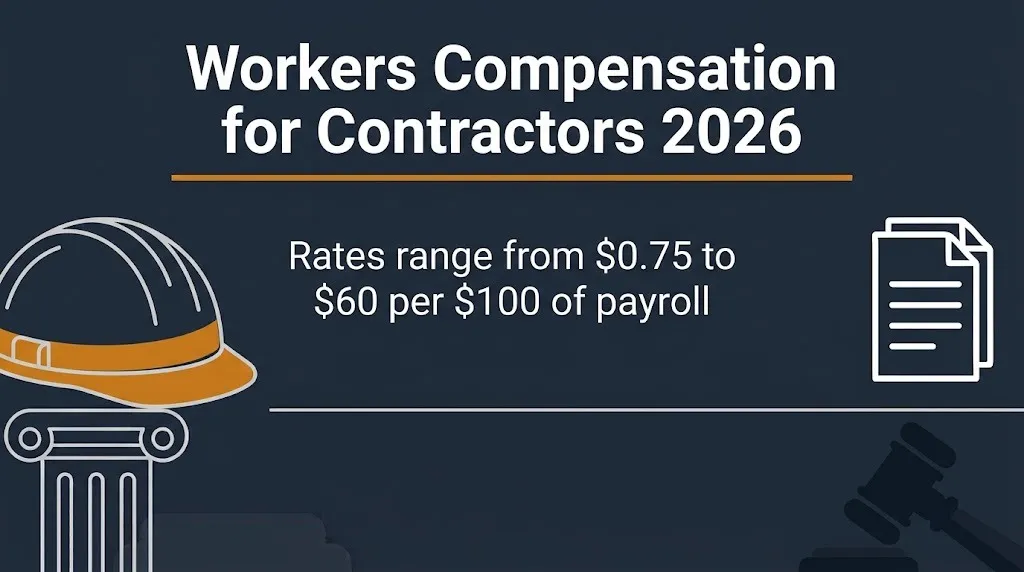
- Rates run from under $1 to over $60 per $100 of payroll depending on your class code, with roofing at the top.
- The deadline that matters most is your state’s employee threshold, which in construction can be as low as one worker.
Workers compensation for contractors is the insurance that pays medical bills and partial lost wages when a worker gets hurt on the job, and it is mandatory for any contractor with employees in almost every state. The problem is not the coverage itself. It is the classification decision that comes before you ever buy a policy.
You may be a solo electrician who just hired a helper. Or a general contractor who has been paying crews as 1099 subs for years. Either way, the state’s definition of employee, not your contract label, decides whether you need coverage and who pays when someone gets hurt. In California, that threshold is one employee . In Texas, private employers can opt out of workers comp entirely, but doing so opens you to lawsuits .
This article breaks down what contractors actually pay in 2026, which trades carry the steepest rates, how the 1099 subcontractor trap works, and what happens when a ghost policy fails to cover the person who gets hurt. One number to keep in mind: roofing class code 5551 can run $20 to $60 per $100 of payroll, while electrical sits at $3 to $6 .
The Facts
| Item | Verified Detail |
|---|---|
| System Type | State-regulated, no-fault employer insurance |
| Coverage Trigger | W-2 employees, threshold varies by state (as low as one in CA) |
| 2026 Rate Range | Roughly $0.75 to $60 per $100 of payroll, by class code |
| Highest-Risk Trade | Roofing, class 5551, $20 to $60 per $100 |
| Lowest-Risk Example | Clerical, well under $1 per $100 |
| 1099 Subcontractor Rule | Truly independent subs carry their own policy; misclassified subs become your liability |
| Penalty for No Coverage | Daily fines, stop-work orders, personal liability for injury costs |
| State Fund States | Washington, Ohio, and others use monopolistic state funds |
Is workers compensation for contractors real or a scam?
Workers compensation for contractors is real, state-mandated, and enforced through audits, fines, and stop-work orders. It is not a product you can skip because you call your crew subcontractors.
The scam angle here is different from a fake settlement. The risk is self-inflicted exposure. Contractors sometimes buy a ghost policy, which is a valid policy that covers nobody because the only person on it has opted out . It satisfies a certificate requirement on paper. It does nothing when a worker gets hurt.
State regulators and carriers audit payroll and classification routinely. If an audit finds you paid workers as 1099 subs who were functionally employees, you owe back premiums plus penalties, and the injury claim lands on you . The coverage gap is not a paperwork problem. It is personal liability for medical bills and lost wages.
How much does workers comp cost for contractors in 2026?
Workers comp for contractors costs between roughly $0.75 and $60 per $100 of payroll in 2026, depending almost entirely on your trade classification and your state. The spread inside construction is enormous.
Class codes drive the rate. A clerical employee in your office might cost well under $1 per $100 of payroll. A roofing crew can cost $20 or more per $100 . The published rates are advisory loss costs, not final insurer rates, and your experience modifier adjusts them up or down .
2026 workers comp rate ranges by trade:
| Trade | Class Code | Approx. Rate per $100 Payroll |
|---|---|---|
| Roofing | 5551 | $20 to $60 |
| General Contractor | 5403 | $5 to $12 |
| HVAC and Plumbing | 5183 | $4 to $8 |
| Electrical | 5190 | $3 to $6 |
| Clerical Office | Varies | Under $1 |
These are national reference ranges. California, New York, and New Jersey run roughly double the rate of Texas, Georgia, and Arizona for the same code . A small crew of two or three field employees often budgets several hundred dollars a month for coverage .
Key Takeaway: The class code on your policy is the biggest lever on your workers comp cost, and misclassification in either direction creates audit exposure.
Who qualifies for workers comp as a contractor?
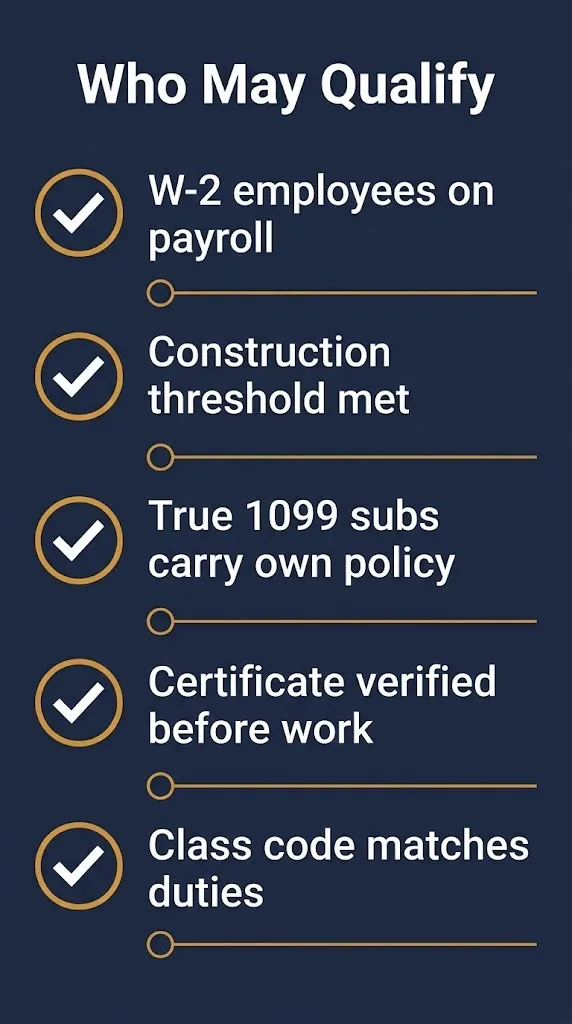
You qualify for workers comp as a contractor if you are an employee of the hiring business, not a true independent contractor. The label on your 1099 does not decide it. The facts of the working relationship do.
Most states apply a control test. If the hiring party sets your hours, provides your tools, directs how you do the work, and treats you as part of the regular crew, you look like an employee . California applies the stricter ABC test, which makes independent contractor classification difficult in many construction roles . New York presumes workers are employees unless the business proves otherwise .
Sole proprietors and single-member LLCs with no employees are usually not required to cover themselves in most states . But if you work with your hands on job sites, opting out means no wage replacement and no medical coverage for your own injury. Your health insurance may exclude work-related injuries.
Reality Check: A signed 1099 and a waiver form do not override state classification law. If a worker is hurt and the state decides they were an employee, the waiver is unenforceable and you owe benefits retroactively .
How do you file a workers comp claim as a contractor?
You file a workers comp claim as a contractor by reporting the injury to your employer or your own carrier if you are covered, seeking authorized medical care, and completing the state claim form. The process is the same as any employee claim, but the classification fight often comes first.
If you are a subcontractor whose hiring contractor disputes your status, the claim may start as a dispute over whether you were an employee. Document everything that shows control: who set your schedule, who provided tools, how you were paid.
Steps for a covered contractor or crew member:
- Report the injury in writing to the supervisor or carrier immediately, within your state’s deadline.
- Get medical care from an authorized provider, and keep every record.
- Complete the state claim form your employer or carrier provides.
- Preserve evidence of your work relationship if classification is disputed.
- Follow the carrier’s instructions for independent medical exams if requested.
- Appeal a denial through your state workers compensation board within the deadline.
What happens if you work without workers comp as a contractor?
If you work without required workers comp as a contractor, you face daily fines, stop-work orders, personal liability for the injured worker’s medical bills and lost wages, and in some states, loss of your legal defenses if you are sued .
The penalties are state-specific and escalate quickly. Many states issue fines per day of noncompliance. Some shut down jobsites until you produce a certificate of insurance. If an uninsured worker is injured, you pay the medical bills and wage replacement out of pocket .
The exposure compounds when you use uninsured subcontractors. If your sub has no coverage and their worker gets hurt, your insurer may treat that worker as your employee at audit, and you pay premium for them retroactively . If the injury is serious, the claim can exceed the premium by a wide margin.
Does a general contractor need to cover subcontractors?
A general contractor does not automatically cover subcontractors under its own policy, but it can become liable for them if they are uninsured or misclassified. The GC’s policy generally does not extend to independent subcontractors .
This is why general contractors require certificates of insurance from every sub before work begins. The certificate should list workers comp, not just general liability. A sub can have flawless general liability and zero workers comp, which leaves the GC exposed the moment a sub’s worker is injured .
The enforcement gap is the certificate at kickoff. Coverage can lapse mid-project, and nobody calls to tell you. The protection is a certificate verified before every payment, tied to the pay application . For a multi-month job, an audit clause in the subcontract lets you request updated certificates at any point.
What is a ghost policy and does it actually cover anyone?
A ghost policy is a workers comp policy that covers nobody because the only person on it has opted out, usually a sole proprietor with no employees who needs to satisfy a certificate requirement. It has a narrow legitimate use and a wide illegitimate one .
The legitimate use is a one-person operation with no employees that genuinely needs to show a certificate to a general contractor. The policy exists, the owner is excluded, and nobody is actually covered because nobody else works there.
The illegitimate use is a contractor with real workers who buys a ghost policy as a cost-cutting substitute. If one of those workers is injured and determined to be an employee, the ghost policy offers nothing. The contractor faces the same personal liability as if they had no policy at all . Some states have moved to restrict ghost policies specifically because of this misuse.
What are the most common workers comp class codes for contractors?
The most common workers comp class codes for contractors are 5551 for roofing, 5403 for general contractors, 5183 for HVAC and plumbing, and 5190 for electrical. The code determines your rate per $100 of payroll, and getting it wrong creates audit risk.
Class codes are assigned based on the actual work performed, not the job title. A project manager who spends most of the day in the office may qualify for a clerical code. A project manager who regularly walks job sites and directs field work likely falls under the construction code .
Dual-duty employees are a common source of misclassification. If an employee does both office work and field work, the highest-rated duty usually governs unless you have accurate time records to split the payroll . Without those records, the auditor applies the higher rate to the whole paycheck.
Key Takeaway: Verify every class code against actual job duties and payroll allocation before your audit, because the correction after an audit comes with back premiums and penalties.
How does a contractor verify and fix a wrong class code?
A contractor verifies a wrong class code by comparing the policy declarations page against actual job duties, payroll records, and the official code descriptions. The fix happens before the audit, not after.
Start with the declarations page and list every code. Then document what each employee actually does in a normal week, not what the job title says. Match that to the NCCI Scopes Manual or your state bureau’s equivalent .
Verification steps:
- Pull the policy declarations, employee roster, and payroll records by job function.
- List every assigned class code and the employees under it.
- Document actual duties, equipment, and work locations for each position.
- Compare the code phraseology to the actual work, including exclusions and standard exceptions.
- Build a comparison chart showing current code, actual duties, correct code, and action needed.
- Request the policy correction from your carrier with documentation before the audit.
Multi-state operations complicate this because the same job can be classified differently in different states . Confirm whether your state uses NCCI or an independent bureau, and apply that bureau’s rules.
What happens next for contractors in 2026?
The next stages depend on your state and your current coverage status. Here is the sequence most contractors face:
Immediately: Confirm your state’s employee threshold for construction and whether your current policy matches your actual payroll and duties.
Before your next audit: Verify class codes and payroll allocation, and correct any mismatches with your carrier.
Before hiring any sub: Collect a current certificate of insurance listing workers comp, and confirm it does not expire mid-project.
Expected late 2026: State rate filings and bureau loss cost changes take effect, which can move your premium at renewal.
Ongoing: Track certificate expirations and gate payments on active coverage for every subcontractor.
If you are a sole proprietor who has been operating without coverage, the calculation is not just legal compliance. One serious injury on a jobsite can cost more than a decade of premiums, and general liability will not fill the gap .
Frequently Asked Questions
Do contractors need workers comp if they have no employees?
Most states do not require coverage for a true solo contractor with no employees, but a few high-risk trades require it regardless. Many general contractors also require a certificate before letting you on site.
Can I use a 1099 subcontractor instead of workers comp?
Only if the subcontractor is genuinely independent, with their own tools, schedule, and insurance. If you control their work, the state may reclassify them as an employee and hold you liable for their injury.
What happens if I don’t carry workers comp and a worker gets hurt?
You can be personally liable for medical bills, lost wages, and penalties. Many states also issue daily fines and stop-work orders until you produce coverage.
Does a general contractor’s policy cover subcontractors?
No. Subcontractors are separate businesses and need their own coverage. The GC’s policy generally does not extend to them, which is why certificates are required.
What is the cheapest workers comp for a small contractor?
A solo owner with no employees in a state that allows self-exclusion may pay only a minimum premium. Once you hire field employees in a high-risk trade, the rate is driven by class code and payroll.
Can I waive workers comp for myself as an owner?
In many states, corporate officers and LLC members can file an exclusion form to opt out. If you work with your hands, opting out means no coverage for your own injury.
How much does workers comp cost for a roofing contractor?
Roofing is the highest-rated trade in most states, with rates around $20 to $60 per $100 of payroll. A small crew can pay several thousand dollars a year or more.
Check your state’s workers compensation board website today and confirm two things: your employee threshold and your current class codes. If either is wrong, fix it before the audit letter arrives, because the correction after the fact costs more than the premium ever would.