Workers Compensation for Electricians in 2026: What Pays, What Doesn’t, and How to File
Quick Answer
- Workers comp for electricians is real and covers medical bills plus a portion of lost wages, but it is not a lump-sum jackpot.
- Most states pay about two-thirds of your average weekly wage, capped by a state maximum that varies widely.
- The deadline to report an injury is often 30 days or less, so report in writing immediately.
Workers compensation for electricians is the employer-funded insurance that pays your medical bills and part of your lost income after a job-related injury, regardless of who was at fault. In 2026, electricians remain a high-risk class, rated under NCCI code 5190, and the system still pays wage replacement at roughly 66.67% of your average weekly wage in most states .
If you got shocked, burned, or fell on a job site, you likely have a claim. The number that matters most is not a national average. It is your state’s maximum weekly benefit, because that cap decides what you actually receive. In California, the temporary disability rate can reach over $1,100 weekly for higher earners; in Mississippi, the maximum is far lower .
This article covers what electricians actually collect, how the filing steps work in 2026, what to do if you are misclassified as a 1099 contractor, and why the biggest money in electrical injuries often comes from a third-party claim, not the workers comp check itself. One detail that surprises many electricians: falls from ladders cause more lost-time claims than electrical contact does .
The Facts
| Item | Verified Detail |
|---|---|
| System Type | State-run, no-fault employer insurance |
| Common Class Code | NCCI 5190 for inside electrical work |
| Typical Wage Replacement | About 66.67% of average weekly wage, tax-free |
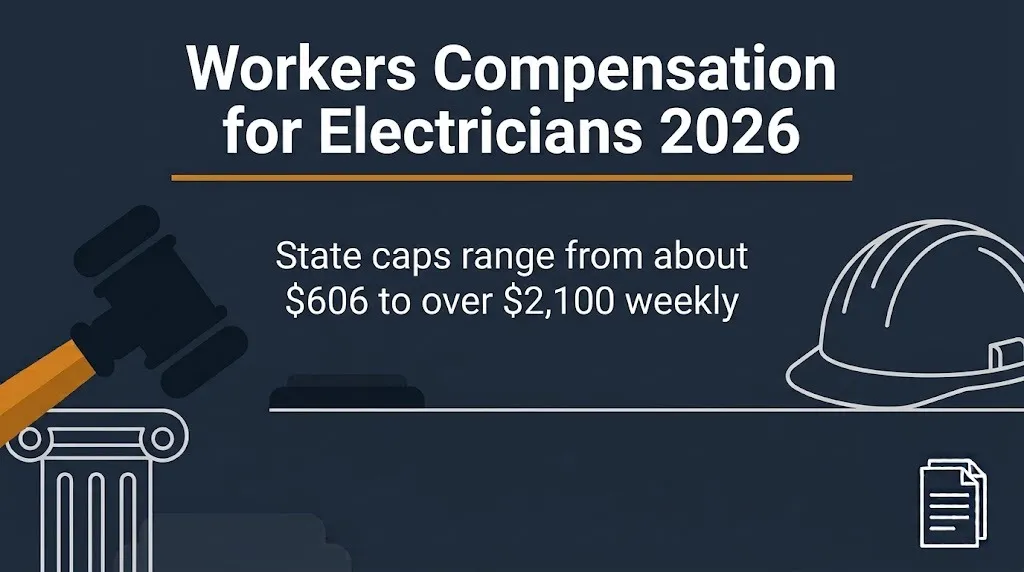
| Benefit Cap | Varies by state, from roughly $606 to over $2,100 weekly |
| Report Deadline | Often 30 days or less, varies by state |
| Claim Form | State-specific, often DWC-1 in California |
| Third-Party Claim | Possible against manufacturers, GCs, or property owners |
| Administrator | State workers compensation board or commission |
Is workers compensation for electricians real or a scam?
Workers compensation for electricians is real, state-regulated, and mandatory for most employers with employees. It is not a class action settlement, and no one should text you offering a workers comp payout.
The confusion usually comes from search results mixing up two different things. One is the workers comp claim you file with your employer’s insurer after an injury. The other is a third-party lawsuit against a manufacturer or general contractor. The first is routine and no-fault. The second requires proving negligence and can pay pain and suffering.
If someone contacts you claiming to process a “workers comp settlement” for electricians as a group, that is not how the system works. Claims are individual and tied to a specific injury date and employer.
How much does workers comp pay electricians?
Workers comp for electricians pays medical costs plus a wage replacement rate that is usually two-thirds of your average weekly wage, subject to your state’s maximum. It does not pay pain and suffering, and it does not pay a fixed national amount.
The actual check depends on three variables: your average weekly wage, your state’s maximum compensation rate, and whether you are temporarily totally disabled, temporarily partially disabled, or permanently impaired. Most states use 66.67%, though a few use different formulas .
Wage replacement examples based on state caps:
| State | Approx. 2026 Max Weekly Benefit | What It Means for You |
|---|---|---|
| California | Over $1,100 weekly for higher earners | High earners get closer to full two-thirds |
| New York | Around $1,318 weekly | Higher cap than many states |
| Texas | Around $1,203 weekly, using 70% rate | Slightly higher percentage, lower cap |
| Mississippi | Around $606 weekly | Low cap hits even moderate earners |
| Iowa | Over $2,100 weekly | One of the highest caps nationally |
These figures are state maximums, not what every electrician gets. If your average weekly wage is $900, two-thirds is $600, and you get $600 unless your state cap is lower . If you earn $2,000 weekly in a low-cap state, you still get the cap, not $1,333.
Key Takeaway: Your workers comp check is calculated from your own wage records and your state’s cap, so two electricians with the same injury in different states can receive very different amounts.
Who qualifies for workers comp as an electrician?
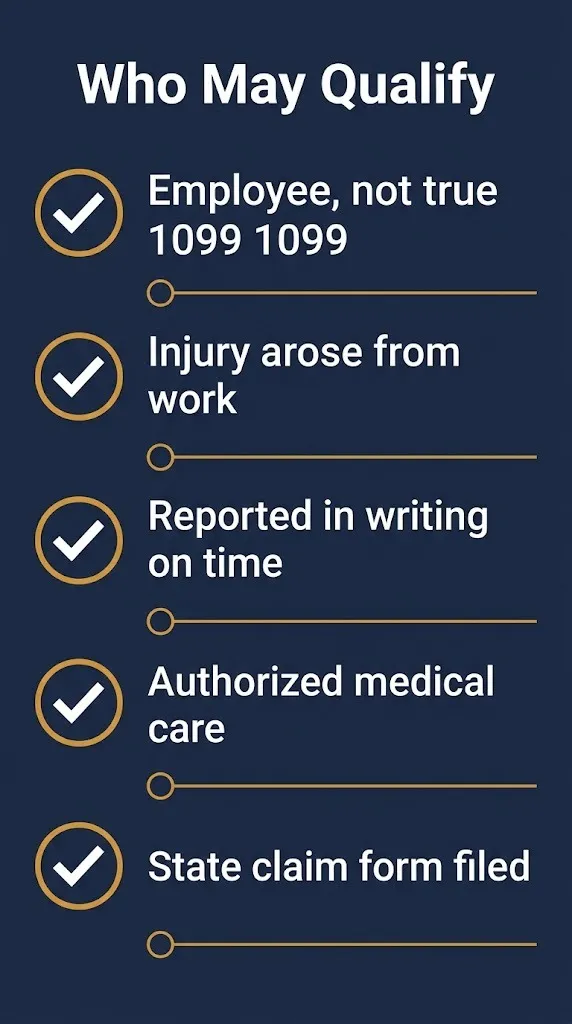
You qualify for workers comp as an electrician if you are an employee and your injury arose out of and in the course of your job. Apprentices under registered programs are covered from day one under the contractor’s policy, not the apprenticeship sponsor .
The harder question is whether you are legally an employee. Many electricians work as 1099 subcontractors. In construction, several states presume workers are employees unless the hiring entity can prove otherwise. New York, for example, treats electricians as presumed employees in construction, making it hard for a contractor to claim you are a true independent contractor .
If you are labeled a 1099 contractor but the company controls your schedule, provides your tools, or pays you hourly, you may be misclassified. That matters after an injury because a true independent contractor is generally not covered by the hiring company’s workers comp policy. If you are reclassified as an employee, you may qualify for benefits .
How do you file a workers comp claim as an electrician?
You file a workers comp claim by reporting the injury to your employer in writing, seeking authorized medical care, and completing your state’s claim form. The exact steps vary, but the sequence is consistent across most states.
Here is the general process, using California’s requirements as a verified example where noted:
- Report the injury to your supervisor in writing immediately, and no later than your state’s deadline (California requires notice within 30 days) .
- Seek medical care from an authorized provider; California requires the employer to authorize treatment within one day of receiving your claim .
- Complete the state claim form, such as California’s DWC-1, which your employer must provide within one working day .
- Keep copies of every document, including photos, witness names, and wage stubs.
- Follow the insurer’s instructions for independent medical exams if requested.
- If the claim is denied or benefits are cut off, file an appeal with your state’s workers compensation board within the deadline (California gives one year to file with the Appeals Board) .
Do not skip the written report. A verbal notification to a foreman can disappear. A text message or email creates a timestamp.
What if my employer says I am a 1099 contractor?
If your employer says you are a 1099 contractor and denies workers comp, you may still have a claim if the facts show you were actually an employee. The 1099 label alone does not decide your legal status.
In construction, the presumption often runs against the hiring company. New York treats electricians as presumed employees, and the employer must prove independent contractor status to avoid coverage . Colorado applies a similar substance-over-form test: if the hiring entity controls how you work, you are likely an employee regardless of the paperwork .
Reality Check: A 1099 form does not automatically block a workers comp claim, and a workers comp denial is not the final word. But you must challenge the classification through your state’s process, usually with evidence of control, tools, schedule, and payment method. A denial letter is a deadline, not a dead end.
What is the average settlement for an electrician injury?
There is no verified national average settlement for electrician workers comp claims because settlements are state-specific and highly fact-dependent. Workers comp settlements are not the same as personal injury verdicts, and most resolve through benefit formulas, not jury awards.
Publicly available ranges from claims data give a rough picture. Arc flash and electrical burn settlements in the moderate range often run $100,000 to $200,000, with severe burns covering more than 20% of body surface area routinely exceeding $250,000, and catastrophic or fatal cases reaching seven figures . Those figures likely include third-party claims or severe permanent disability cases, not routine temporary disability checks.
For a typical lost-time injury without permanent impairment, the value is the medical bills plus temporary disability payments. That can be modest. The larger numbers appear when there is a permanent impairment rating, a catastrophic injury, or a viable third-party defendant.
Key Takeaway: The big electrician injury numbers you see online usually involve third-party claims or catastrophic permanent disability, not the standard workers comp wage replacement check.
Can electricians sue someone other than their employer?
Yes, electricians can sometimes sue a third party even though workers comp bars lawsuits against the employer. The most common third-party defendants are equipment manufacturers, general contractors, property owners, and other subcontractors whose negligence contributed to the injury.
Workers comp is no-fault and generally replaces your right to sue your employer. But it does not shield everyone else on the job site. If a defective breaker failed, a general contractor removed a safety cover, or a property owner left an energized panel exposed, a third-party claim may exist .
Third-party claims can pay damages that workers comp does not: pain and suffering, full lost earnings, and loss of future earning capacity . Your workers comp carrier will likely assert a lien on any third-party recovery, but the net result can still exceed workers comp alone.
This is the single biggest financial decision an injured electrician faces. A workers comp claim handles the medical bills. A third-party claim, when the facts support it, addresses the career damage that workers comp ignores.
What are the most common electrician injuries in 2026?
The most common electrician injuries in 2026 are falls, electrical contact injuries, repetitive strain, and eye or hearing damage. Falls from ladders are the top lost-time injury, ahead of electrical contact itself .
Arc flash and electrical burns are the most severe. They can cause internal damage, cardiac arrhythmia, nerve injury, and hearing loss from the blast . These injuries often produce delayed symptoms, which is why the statute of limitations in some states starts when the connection between your symptoms and the shock is medically established, not on the date of the shock .
Repetitive strain claims, including rotator cuff and elbow injuries from pulling wire, account for nearly a quarter of long-tenure electrician claims . Those claims build slowly and are easier for insurers to dispute as pre-existing conditions.
How long does a workers comp claim take for an electrician?
A workers comp claim for an electrician can take weeks for initial acceptance and months to years if disputed or litigated. Medical treatment usually starts before the claim is formally accepted, because most states require prompt authorization.
The insurer typically has a window to accept or deny. In California, the insurer has 90 days to accept or deny, and if it does not deny, the claim is presumed valid . Disputes over causation, impairment rating, or independent medical exam findings can extend the timeline significantly.
If you reach maximum medical improvement with a permanent impairment rating, the case may settle or proceed to a permanent disability rating. If you cannot return to electrical work, vocational retraining benefits may apply. California, for example, offers a supplemental job displacement voucher of up to $6,000 for retraining or tools .
What happens next in your claim?
The next stages depend on your state and whether your claim is accepted, denied, or disputed. Here is the typical sequence:
Immediately: Report the injury in writing and get authorized medical care.
Within weeks: The insurer accepts or denies the claim and begins or disputes wage replacement.
Within months: You reach maximum medical improvement and receive an impairment rating, if any.
Expected later: If disputed, a hearing before your state’s workers compensation board or commission.
Expected settlement or appeal: Resolution through settlement, award, or appeal, with timing varying by state.
For a Schedule A or third-party claim, the timeline is separate and usually longer. The workers comp claim should proceed regardless, because medical bills do not wait for a lawsuit.
Frequently Asked Questions
Does workers comp cover electricians?
Yes, in nearly every state, employers must carry workers comp for electrician employees. Apprentices are covered from day one under the contractor’s policy.
How much does workers comp pay for an electrician injury?
Most states pay about two-thirds of your average weekly wage, tax-free, up to a state maximum. The cap varies from roughly $606 to over $2,100 weekly depending on your state.
Can I get workers comp if I am a 1099 electrician?
Possibly, if you can prove you were actually an employee despite the 1099 label. Construction workers are often presumed employees, and the hiring company must prove otherwise.
Do I need a lawyer for a workers comp claim?
Not always for a straightforward claim. If your claim is denied, you are misclassified, or you have a permanent impairment, a lawyer can help with the appeal and valuation.
Can I sue my employer for an electrical injury?
Generally no, because workers comp is the exclusive remedy against your employer. You may be able to sue third parties like manufacturers, general contractors, or property owners.
What is the deadline to report an electrician injury?
Deadlines vary by state. California requires written notice within 30 days, but some states are shorter. Report immediately and in writing to protect your claim.
Does workers comp pay for pain and suffering?
No. Workers comp pays medical bills and wage replacement, not non-economic damages. A third-party claim is the path to pain and suffering damages if negligence applies.
Your next move is simple: if you were injured on a job site, report it in writing today and keep a copy. Then find your state’s workers compensation board website and check the current maximum weekly benefit rate for 2026. That number, not a national average, is what your claim is actually worth.