Is a Workers Comp Settlement Taxable in 2026? The IRS Rule, the Big Exceptions, and What Actually Gets Reported
Quick Answer
- Workers’ comp settlements are generally not taxable under IRC Section 104(a)(1) when paid for job-related injuries or illness .
- The exemption applies to lump sums, periodic payments, and structured settlements, but lost wages, interest, and punitive damages may be taxable .
- If your settlement was not approved by your state workers’ compensation board, the entire payment could become taxable .
If you just settled a workers’ compensation claim, you are probably wondering whether the IRS will take a cut. Here is the verified truth: most workers’ comp settlements are completely tax-free under federal law. The IRS explicitly excludes “amounts received under workmen’s compensation acts as compensation for personal injuries or sickness” from your gross income .
That exemption covers the core purpose of workers’ comp: compensating you for a workplace injury or illness. It applies whether you get a lump sum, weekly checks, or a structured settlement paid over years.
But the exemption is not automatic in every situation. The way the settlement is documented, approved, and allocated determines whether the IRS treats it as tax-free income or taxable wages. This article breaks down the exact rules, the situations that trigger taxes, and the paperwork you need to protect yourself.
The Facts
| Taxable? | Generally no, under IRC § 104(a)(1) for job-related injury or illness |
| Applies To | Lump sums, periodic payments, structured settlements, death benefits |
| Key Requirement | Payment must be made under a state workers’ compensation act or similar statute |
| What’s Taxable | Interest on delayed payments, lost wages, punitive damages, and some SSDI offsets |
| Reporting | Most workers’ comp payments do not generate a W-2 or 1099 |
Is a Workers Comp Settlement Taxable?
No, a workers comp settlement is generally not taxable if it is paid under a state workers’ compensation act for a job-related injury or illness . Internal Revenue Code Section 104(a)(1) excludes these amounts from gross income entirely.
The exclusion covers the full range of workers’ compensation benefits: weekly indemnity payments, a lump-sum settlement that resolves your claim, scheduled loss awards for permanent injuries, and death benefits paid to surviving family members .
Because these amounts are excluded from income, most injured workers do not receive a W-2 or 1099 for their workers’ comp benefits, and there is generally nothing to report on a federal tax return .
The key phrase in the statute is “under workmen’s compensation acts.” That means the payment must flow from a state workers’ compensation system. A settlement that resolves a personal injury lawsuit outside the workers’ comp system follows different tax rules .
Is a Lump Sum Workers Comp Settlement Taxable?
No, a lump sum workers comp settlement is generally not taxable, and the lump-sum structure does not change the tax treatment . The IRS exclusion applies to “amounts received” regardless of whether they arrive weekly or in one payment.
This is where people often get confused. They assume a large one-time payment must be taxable. It is not, as long as the payment compensates you for a workplace injury or illness under your state’s workers’ compensation law.
The lump-sum versus periodic distinction matters for a different reason. In a structured settlement, the full amount of each periodic payment is excluded because you never have actual or constructive receipt of the lump sum invested to generate those payments .
With a lump sum, you receive the money directly. The exclusion still applies, but you need documentation showing the payment is workers’ comp compensation and not something else.
Key Takeaway: The IRS does not care whether your workers’ comp settlement is a lump sum or periodic payments; both are excluded under Section 104(a)(1) if paid for a job-related injury.
What Part of a Workers Comp Settlement Is Taxable?
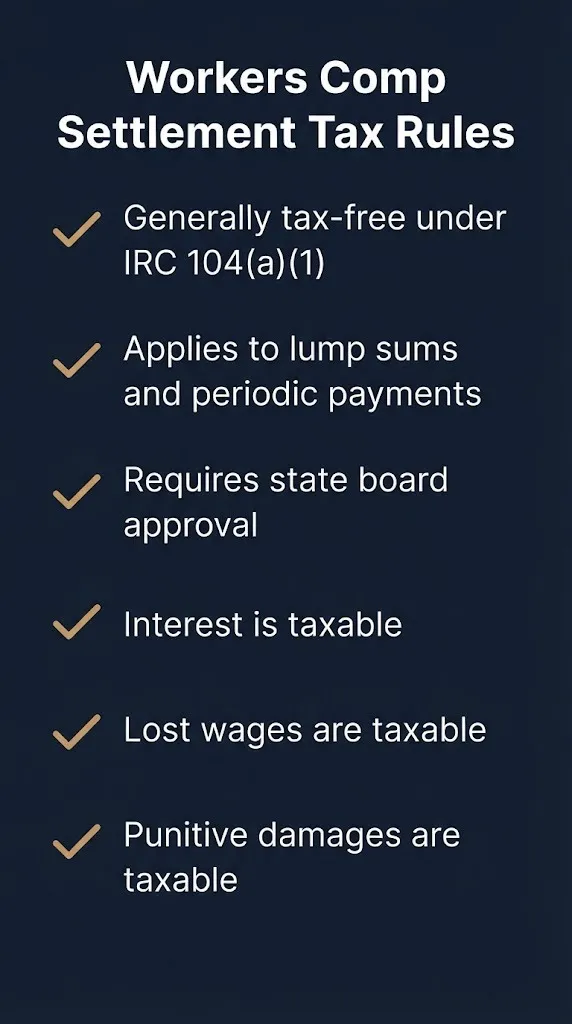
Certain parts of a workers comp settlement can be taxable even when the core payment is not. The three main exceptions are interest, lost wages, and punitive damages .
Interest on delayed payments is taxable. If your case took a long time to resolve and the settlement includes interest accrued during the delay, that interest portion is treated like investment income .
Lost wages are generally taxable because they replace income you would have earned. In the Simpson case, $12,500 allocated to lost wages was already reported as income, and the Tax Court did not disturb that treatment .
Punitive damages are almost always taxable. Section 104(a)(2) explicitly excludes punitive damages from the physical injury exclusion, and the same logic applies to workers’ comp settlements that include a punitive component .
The IRS looks at what the payment replaced. If it replaced wages, it is taxable. If it compensated you for physical injury or sickness, it is not .
The Simpson v. Commissioner Trap: When a Settlement Becomes Taxable
A settlement that resolves workers’ compensation claims can become fully taxable if it was not approved by your state’s workers’ compensation board . This is the single most important trap for injured workers.
In Simpson v. Commissioner, the Tax Court ruled that a $250,000 settlement was not excludable under Section 104(a)(1) because it was not submitted for approval to the California Workers’ Compensation Appeals Board as required by state law .
The parties intended to settle workers’ comp claims. The attorney testified that the settlement amount was calculated based on workers’ comp disability benefits. But because the agreement was not WCAB-approved, it did not qualify as a payment “under workmen’s compensation acts” .
The court did allow 10% of the $98,000 allocated to physical injuries to be excluded under Section 104(a)(2), the separate exclusion for personal physical injury damages . But that was a partial rescue, not a full exemption.
The lesson is straightforward: if your settlement is meant to resolve a workers’ comp claim, make sure it is properly approved by the state board. Otherwise, you risk the IRS taxing the entire amount.
Reality Check: A settlement labeled “workers’ comp” is not automatically tax-free. If it was not approved through your state’s workers’ compensation system, the IRS can treat the entire payment as taxable income, and you may owe thousands in back taxes and penalties .
How Social Security Disability Offsets Affect Your Taxes
If you receive both workers’ comp and Social Security Disability Insurance (SSDI), the interaction can make part of your workers’ comp taxable . This is a quirk in how the two systems offset each other.
The combined benefits generally cannot exceed 80% of your average pre-injury earnings. When workers’ comp offsets your SSDI payment, the offset amount is treated as Social Security benefits for tax purposes .
Social Security benefits can be taxable depending on your total income. So the portion of workers’ comp that caused the SSDI reduction may become taxable as part of your Social Security benefits, even though it originated as workers’ comp .
This does not mean the workers’ comp payment itself is taxable. It means the offset mechanism can shift the tax treatment of the SSDI portion. If you receive both benefits, review the numbers carefully with a tax professional.
How to Report a Workers Comp Settlement on Your Tax Return
In most cases, you do not report a workers comp settlement on your tax return at all . The payment is excluded from gross income, and there is no line on Form 1040 for it.
You also generally will not receive a W-2 or 1099 for workers’ comp benefits . If you do receive a 1099, review it carefully. The payer may have misclassified the payment.
If your settlement includes taxable components, such as interest or lost wages, those amounts need to be reported. The payer may issue a 1099-INT for interest or include lost wages on a W-2 .
The Simpson case shows what happens when the reporting is wrong. The Simpsons excluded the full $250,000 settlement, but the Tax Court found that a portion was taxable because the settlement was not WCAB-approved .
If you receive an IRS notice questioning your workers’ comp exclusion, gather your settlement agreement, the state board approval, and any documentation showing the allocation between physical injury compensation and other components.
What Evidence Do You Need to Prove Tax-Exempt Status?
The burden falls on you to prove the settlement qualifies for the Section 104(a)(1) exclusion. The strongest evidence includes:
- The settlement agreement itself, showing it resolves workers’ compensation claims.
- The state workers’ compensation board’s approval order.
- Documentation showing the payment was for a job-related injury or illness.
- A breakdown of any taxable components like interest or lost wages.
The settlement agreement should explicitly state that it is resolving a workers’ compensation claim and reference the state statute. If the agreement is ambiguous, the IRS may look at the intent of the parties .
The WCAB approval is the critical piece. Without it, the settlement does not qualify as a payment “under workmen’s compensation acts,” regardless of what the parties intended .
What Happens Next for Workers Comp Taxes?
The tax treatment of workers’ comp settlements is not changing in 2026. Section 104(a)(1) remains in effect, and the IRS continues to exclude these payments from gross income .
Ongoing: The IRS will continue processing tax returns where workers’ comp settlements are properly excluded. No new reporting requirements are expected.
If you receive a notice: The IRS may question a workers’ comp exclusion if the payment was reported on a 1099 or W-2. Gather your documentation and respond promptly.
If your settlement was not board-approved: The Simpson precedent suggests the IRS may challenge the exclusion. Consider consulting a tax professional before filing.
Frequently Asked Questions
Is a workers comp settlement taxable in 2026?
No, workers’ comp settlements are generally not taxable under IRC Section 104(a)(1) if paid for a job-related injury or illness .
Is a lump sum workers comp settlement taxable?
No, lump sum workers comp settlements are not taxable. The exclusion applies regardless of whether you receive one payment or periodic payments .
What part of a workers comp settlement is taxable?
Interest on delayed payments, lost wages, and punitive damages are generally taxable, even when the core workers’ comp settlement is excluded .
Do I need to report a workers comp settlement on my tax return?
No, in most cases you do not report workers’ comp settlements on your tax return because they are excluded from gross income .
What happens if my workers comp settlement was not approved by the state board?
If your settlement was not approved by your state’s workers’ compensation board, the IRS may tax the entire payment, as happened in Simpson v. Commissioner .
Does workers comp affect Social Security taxes?
If you receive both workers’ comp and SSDI, the offset amount may be treated as Social Security benefits, which can be taxable depending on your total income .
How do I prove my settlement is tax-exempt?
You need the settlement agreement, the state workers’ compensation board approval, and documentation showing the payment was for a job-related injury .
Will I get a 1099 for a workers comp settlement?
No, you generally will not receive a W-2 or 1099 for workers’ comp benefits because they are excluded from income .