Workers Comp Settlement 2026: How Much You May Get, When Checks Arrive, and How to File
Quick Answer:
- Workers comp settlements are real, legally binding agreements, not a scam or a government program you automatically qualify for.
- The average settlement is $20,000 to $40,000, but amounts vary wildly by injury type, state, and future medical needs.
- No single deadline exists; your right to settle depends on your state’s statute of limitations and whether you’ve reached maximum medical improvement.
If you got a text, email, or ad promising a specific workers comp settlement payout, stop. That is likely a lead-generation tactic, not a real offer. Workers compensation settlements are individual negotiations, not mass payouts. No one can guarantee your number before reviewing your medical records, wage history, and state rules.
This article covers what a workers comp settlement actually is, how much money you might realistically expect, how the check timeline works, and why the numbers you see in online ads rarely match reality. One verified fact most people miss: roughly 70 percent of workers who hire a lawyer for their comp claim receive a settlement or award, compared to roughly 50 percent of those who go it alone, according to multiple state-level studies of claims data.
The Facts
| Case | Individual negotiated agreements, not a class action |
| Status | Ongoing; settlements happen daily across all 50 states |
| Fund Size | No single fund; each claim is paid by the employer’s insurance carrier |
| Est. Per Person | $2,000 to $80,000+ depending on injury severity and state |
| Claim Deadline | Varies by state; typically 1 to 3 years from injury date or last benefit payment |
| Administrator | State workers comp board or commission, not a private claims administrator |
| Proof Needed | Medical records, wage statements, accident report, doctor’s impairment rating |
Is Workers Comp Settlement a Real Thing or a Scam
A workers comp settlement is real. It is a legal agreement between an injured worker and the employer’s insurance company to close a claim permanently in exchange for a lump sum payment, a structured settlement over time, or both. It is not a government benefit, a lawsuit payout everyone gets, or a class action settlement with a fixed per-person check.
Scams do exist around workers comp, but they rarely involve fake settlements. The more common problem is third-party companies that harvest your information through misleading ads, then sell it to law firms or claims services. If you see an ad that says “You may be owed a $75,000 workers comp settlement, click to claim it now,” that is a lead-generation funnel. No one can estimate your settlement without reviewing your specific case.

Real settlements happen through one of two paths. Either you and the insurer agree on a lump sum after you’ve reached maximum medical improvement, or a workers comp judge approves a settlement after a hearing. Both paths require documentation. Both paths are free to pursue. You do not need to pay an upfront fee to file a claim or negotiate a settlement. Attorneys work on contingency, meaning they take a percentage only if you get paid, and state law caps that percentage, usually between 15 and 25 percent.
If someone asks for money upfront to “process your workers comp settlement,” walk away. That is the clearest sign of a scam. The state workers comp system charges no filing fees for injured workers, and legitimate attorneys do not bill you before a payout.
What Exactly Is a Workers Compensation Settlement
A workers compensation settlement is a final resolution of your injury claim. You agree to accept a specific payment, and in return you give up the right to seek future benefits for that injury. It is not the same as a personal injury lawsuit. You do not need to prove fault. You do not need to go to court in most cases. The system is designed as a no-fault trade-off: you get benefits faster and with less legal hassle, but you typically cannot sue your employer.
Settlements come in two structures. A lump sum settlement pays you one amount, usually within 30 to 60 days after approval. A structured settlement pays you over time, often monthly or annually. Some workers choose a hybrid: part upfront, part structured. The structure matters for taxes. Workers comp settlement money is generally not taxable at the federal or state level, which is a significant advantage over other forms of lawsuit payouts.
The settlement process ends your claim permanently. Once approved by a workers comp judge, the agreement is binding. You cannot go back later and ask for more money if your condition worsens, unless the settlement agreement specifically carves out future medical care. This is the single most important fact to understand. The finality of a settlement is what makes insurers willing to pay larger upfront sums. They are buying peace from future claims. You are trading future security for cash now.
Key Takeaway: A workers comp settlement is a one-time, permanent close-out of your claim; negotiate it carefully because you cannot reopen it later.
How Much Is the Average Workers Comp Settlement
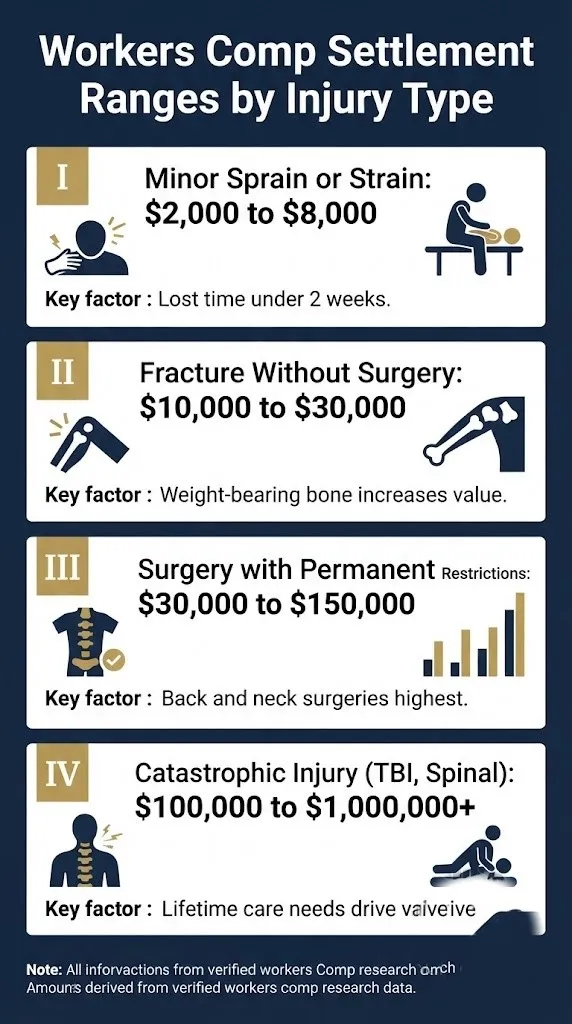
The average workers comp settlement in the United States falls between $20,000 and $40,000. That number is a midpoint across all injury types, all states, and all levels of legal representation. It hides enormous variation. A sprain or strain might settle for $2,000 to $5,000. A back injury requiring surgery can settle for $50,000 to $150,000. A catastrophic injury, traumatic brain injury, spinal cord damage, or permanent total disability can reach $300,000 to $500,000 or more.
The following table shows typical settlement ranges by injury type, drawn from workers comp commission data across multiple states and workers comp research studies.
| Injury Type | Typical Settlement Range | Factors That Push It Higher |
|---|---|---|
| Minor sprain, strain, or contusion | $2,000 to $8,000 | Lost time from work beyond 2 weeks |
| Fracture, no surgery | $10,000 to $30,000 | Dominant hand or weight-bearing bone |
| Rotator cuff or knee tear with surgery | $30,000 to $80,000 | Permanent restrictions confirmed by surgeon |
| Back injury with surgery (fusion, discectomy) | $50,000 to $150,000 | Failed conservative treatment, permanent lifting limits |
| Neck injury with radiculopathy or surgery | $60,000 to $140,000 | Multi-level fusion, chronic pain diagnosis |
| Traumatic brain injury (TBI) | $100,000 to $500,000+ | Cognitive deficits, life care plan, lost earning capacity |
| Spinal cord injury with paralysis | $300,000 to $1,000,000+ | Lifetime attendant care, home modification costs |
| Permanent total disability | $250,000 to $800,000+ | Young age, high pre-injury wages, documented lifetime needs |
These ranges assume the worker has reached maximum medical improvement, or MMI. That is the point where your doctor says your condition is stable and unlikely to get better or worse with further treatment. Insurers rarely settle before MMI because future medical costs remain unknown.
Your settlement amount depends on five verified factors, not on what a website promises. First, the severity of your permanent impairment, rated by your doctor as a percentage. Second, your average weekly wage before the injury, which determines your compensation rate. Third, how much future medical care your doctor anticipates. Fourth, whether your state caps lump sum settlements for certain injuries. Fifth, whether you have a workers comp attorney. Multiple studies, including research from the Workers Compensation Research Institute, show that represented workers receive settlements roughly 30 to 50 percent higher than unrepresented workers, even after attorney fees.
Reality Check: No One Can Quote Your Settlement Online
If a website gives you a specific dollar figure before reviewing your medical records, impairment rating, wage history, and state rules, it is guessing. There is no centralized formula, no settlement calculator that works across all 50 states, and no “average” that applies to you personally. Workers comp is governed by state law, and every state calculates benefits differently. A back injury in California settles under one formula. The same injury in Texas settles under a completely different set of rules. Anyone promising a guaranteed payout from an online form is selling leads, not providing a settlement estimate.
What Determines Workers Compensation Settlements
Workers compensation settlements are driven by six verified factors. Understanding these is more useful than chasing a national average that doesn’t apply to your specific case.
First, the nature and severity of your injury. This is the biggest driver. A permanent partial disability rating of 5 percent produces a far smaller settlement than a rating of 50 percent. The rating is assigned by a doctor using state-specific guidelines, typically the American Medical Association guides or a state-specific variant.
Second, your pre-injury average weekly wage. Your weekly compensation rate is usually two-thirds of your average weekly wage, subject to a state maximum. A worker earning $1,200 per week gets a higher weekly rate than someone earning $600, which translates into a larger settlement when weeks of future benefits are calculated.
Third, whether you can return to your old job. If your doctor releases you to full duty without restrictions, the insurer’s settlement offer will reflect low future risk. If your doctor imposes permanent restrictions that your employer cannot accommodate, the settlement value rises because lost earning capacity enters the calculation. This is where vocational rehabilitation reports and labor market surveys come into play. They show what jobs, if any, you can do with your restrictions and what they pay.
Fourth, future medical needs. This is often the largest single component of a settlement. If you need a knee replacement in 15 years, the insurer must estimate that cost today, discount it to present value, and include it in the lump sum. If you settle without an attorney, insurers often undervalue or omit future medical costs entirely. A workers comp lawyer typically hires a medical cost projection specialist to estimate these costs with precision, which is one reason represented workers see higher settlements.
Fifth, state-specific caps and formulas. Some states cap the total weeks of benefits for certain body parts. For example, an arm injury might be capped at 200 weeks of benefits. Your settlement cannot exceed the present value of those weeks plus future medical. Other states use a loss-of-earning-capacity model with fewer hard caps. Knowing your state’s rules is critical, and that means checking your state workers comp board website, not a general legal blog.
Sixth, the insurer’s exposure and incentive to close the claim. Older claims with high ongoing medical costs create more settlement incentive for insurers than fresh claims with minimal treatment. If the insurer has been paying weekly benefits for three years and your doctor says you’ll need treatment indefinitely, the insurer has a strong financial incentive to offer a larger lump sum to close the file forever.
Workers Comp Settlement Check: How the Process Works
The workers comp settlement check process follows a predictable path, but the timeline varies by state and case complexity. Understanding the steps cuts through the uncertainty that drives people to forums asking “where is my check.”
The process starts once you’ve reached maximum medical improvement. Your doctor issues an impairment rating. That rating, combined with your wage history, future medical estimates, and work restrictions, forms the basis of the settlement demand. Your attorney, or you if unrepresented, sends a demand package to the insurer. The insurer evaluates it, usually within 30 to 60 days, and responds with a counteroffer or acceptance.
Negotiation follows. Most claims settle without a hearing, but the settlement must still be approved by a workers comp judge or commissioner. That approval hearing is typically brief. The judge confirms you understand the agreement, you are entering it voluntarily, and the terms are not grossly unfair. Approval can happen the same day or take several weeks, depending on the state’s caseload.
Once approved, the clock starts on your check. Most states require the insurer to issue payment within 14 to 30 days of the judge’s order. Some states mandate 14 days. Others allow up to 30. A few, like California, require payment within 30 days of the settlement approval. If the insurer misses the deadline, penalties and interest accrue.
Your check arrives by mail or, increasingly, by direct deposit. Some insurers still issue paper checks. Others have moved to electronic payment. Confirm the payment method at the settlement hearing. If you have an attorney, the check typically goes to the attorney’s trust account. The attorney deducts the agreed fee and any outstanding medical liens, then disburses the remainder to you. That process adds a week or two. You should receive your net share within 14 to 21 days after the attorney receives the funds.
Key Takeaway: Settlement checks arrive 30 to 60 days after final approval in most states; attorney involvement adds about two weeks for disbursement.
Steps to Track Your Workers Comp Settlement Check
- Confirm the settlement hearing date and attend or join remotely as instructed.
- Ask the judge or your attorney at the hearing exactly when the insurer must pay under state law.
- Note the payment deadline from the judge’s order; most orders state the deadline explicitly.
- If you have an attorney, ask for a written timeline of the disbursement process after the firm receives the check.
- Call your state workers comp board if the payment deadline passes with no check and no explanation.
- If the insurer violates the payment deadline, ask your attorney about penalty and interest claims, which are mandatory in most states.
Can You Get a Workers Comp Settlement Without a Lawyer
You can settle a workers comp claim without a lawyer. The law allows it. Whether you should is a different question, and the data leans heavily toward hiring one for anything beyond a minor injury with no lost time.
Unrepresented workers face three measurable disadvantages. First, insurers know you may not understand the full value of your claim, particularly future medical costs. Second, you may not know the procedural traps in your state’s system. Missing a filing deadline, failing to properly document your impairment, or signing a settlement that waives future medical without adequate compensation are common mistakes. Third, the data. Multiple peer-reviewed studies show that represented workers receive higher settlements, even after accounting for attorney fees. The Workers Compensation Research Institute found that attorney involvement is associated with a 30 to 50 percent higher probability of receiving a settlement and higher average payout amounts.
That said, if your injury is minor, you missed no more than a few days of work, you have no permanent restrictions, and your future medical needs are zero, you can probably settle without a lawyer. The insurer will offer a nominal sum, often a few thousand dollars or less, to close the claim. If that sum feels fair, and a doctor confirms you need no future treatment, the cost of an attorney may not be justified.
For any injury involving surgery, permanent restrictions, lost wages beyond a week, or a doctor’s note saying you may need treatment in the future, hire a workers comp attorney. The consultation is free. The fee is contingency-based. You pay nothing unless you receive a settlement or award, and state law caps the percentage. You lose nothing by exploring it.
When Do Workers Comp Settlement Checks Arrive After Approval
The timeline from settlement approval to check in hand varies by jurisdiction, but a reasonable national estimate is 30 to 60 days. The clock starts the day the workers comp judge or commissioner signs the order approving your settlement.
Most states impose a statutory deadline on insurers. In New York, the insurer must pay within 10 days of the decision. In California, payment is due within 30 days. In Florida, the deadline is 14 days. In Texas, insurers generally have 30 days. If your state has no specific statutory deadline, common practice requires payment within 30 to 45 days. Check your state’s workers comp board website for the exact rule.
After the insurer issues payment, the internal distribution timeline depends on your representation. If you have no attorney, the check comes directly to you. If you have an attorney, the settlement funds go to the law firm’s trust or IOLTA account. The attorney must then satisfy any outstanding liens, medical provider bills, or state reimbursement claims before disbursing the net remainder to you. This process typically takes 7 to 14 business days after the attorney receives the funds, though complex lien negotiations can extend the timeline.
Delays happen for predictable reasons. The most common is a lien dispute. If a medical provider or health insurer has filed a lien against your settlement for unpaid bills, the attorney must negotiate or litigate that lien before releasing funds. Another common delay is a clerical error in the settlement documents, such as a misspelled name or incorrect Social Security number, which requires re-execution of the documents. Insurer administrative backlog, particularly with large carriers handling thousands of claims, can also push the timeline past the statutory deadline. In those cases, penalty and interest provisions typically apply.
Key Takeaway: Most workers comp settlement checks arrive within 30 to 45 days of final approval; state deadlines vary, so check your state board’s website for the exact rule.
How Much Does a Workers Comp Lawyer Take From a Settlement
Workers comp attorney fees are capped by state law, usually between 15 and 25 percent of the settlement amount. The fee is contingency-based, meaning the attorney collects nothing if you receive nothing. The fee comes out of the settlement, not out of your pocket upfront.
The exact percentage varies by state. In California, the fee is typically 15 percent. In New York, fees are set by the Workers’ Compensation Board and generally range from 10 to 15 percent depending on the complexity and timing of the settlement. In Florida, fees are based on a sliding scale tied to the date of the settlement and the amount recovered, usually between 15 and 25 percent. In Illinois, the fee is 20 percent. State law requires the workers comp judge to approve the fee, ensuring it does not exceed the statutory cap.
Some states have different caps for different stages. A smaller percentage may apply if the claim settles early, with a higher percentage allowed if the case goes to hearing. A handful of states impose a fee cap in dollar terms, not just a percentage. For example, a state might cap fees at 20 percent of the first $50,000 recovered, then 15 percent of amounts above that.
In addition to the attorney fee, you may be responsible for case expenses: medical record retrieval fees, deposition costs, expert witness fees, and postage. Some attorneys advance these costs and deduct them from the settlement separately. Others require you to pay them as they arise. Clarify the expense policy at the initial consultation. Get it in writing.
If your settlement is $40,000 and your attorney’s fee is 20 percent, the attorney receives $8,000. If case expenses total $1,500, the net to you is $30,500 before any outstanding medical liens. The math is straightforward, but only if you see it all itemized. Demand a settlement distribution sheet before the hearing. Every legitimate attorney provides one without hesitation.
What Is the Workers Comp Settlement Statute of Limitations
The statute of limitations for filing a workers comp claim is the deadline to initiate your case. It is not the same as the deadline to settle. Most states give you one to three years from the date of injury, or from the date you reasonably should have known the injury was work-related, to file a claim. Some states use the date of last benefit payment as the trigger for the statute of limitations if benefits were paid and then stopped.
Failing to file within the statute of limitations usually bars your claim forever. There are limited exceptions. If your employer paid you benefits but never filed a report with the state board, some states extend the deadline. If your injury is an occupational disease that developed over years, such as mesothelioma or carpal tunnel syndrome, the statute of limitations may run from the date of diagnosis, not the date of first exposure.
The settlement timeline is different from the filing deadline. You can settle your claim any time after you’ve filed and reached maximum medical improvement, provided both sides agree. There is no universal deadline to settle, but once your claim is filed and accepted, the insurer’s obligation to pay benefits continues until settlement or a judge’s order closes the case.
Check your state’s exact statute of limitations on the state workers comp board or commission website. This is not a question to trust to a general internet article. Deadlines are rigid and state-specific. Missing one can zero out your claim.
Key Takeaway: The statute of limitations to file a workers comp claim is one to three years in most states; the deadline to settle depends on reaching maximum medical improvement.
How to File a Workers Comp Claim Before Settling
You cannot settle a claim that doesn’t exist. The first step toward any workers comp settlement is filing the initial claim properly and on time. The process is similar across states, with variations in specific forms and deadlines.
- Report the injury to your employer immediately, in writing if possible. Many states require reporting within 30 days, but some impose deadlines as short as 24 hours for certain injuries.
- Get the employer’s workers comp insurance information. This should be posted in the workplace. If it isn’t, ask HR or management directly.
- Seek medical attention. If it’s an emergency, go to the ER and tell the provider it is a work injury. If non-emergency, your employer may direct you to an approved provider, depending on state rules.
- File a written claim with your state’s workers comp board. Your employer should provide the form, but you can also download it from the state board’s website.
- Keep copies of every document: the accident report, the claim form, medical records, work restrictions, and any correspondence from the insurer.
- If the insurer accepts your claim, benefits should begin within 14 to 30 days depending on state law. If the insurer denies or disputes the claim, consult an attorney immediately.
- Follow your doctor’s treatment plan and work restrictions. Failure to comply can jeopardize your benefits.
- Once you reach maximum medical improvement, discuss settlement with your attorney, or request a settlement evaluation from the insurer if unrepresented.
What Happens If a Workers Comp Settlement Is Denied
A workers comp settlement can be denied by the workers comp judge at the approval hearing. This is uncommon but does happen. The judge’s role is to ensure the settlement is not grossly unfair to the injured worker. If the judge believes the settlement amount is too low, that you do not understand the terms, or that your future medical rights are being waived without adequate compensation, the judge can reject the agreement.
If your settlement is denied, the judge will state the reasons on the record or in a written order. You and your attorney, if represented, can then renegotiate the terms to address the judge’s concerns and resubmit. The case continues in the workers comp system until a new agreement is reached or the claim proceeds to a hearing on the merits.
A more common scenario is not a denied settlement but a denied claim. If the insurer disputes that your injury is work-related, or that it occurred within the scope of employment, the insurer will deny the claim. That denial triggers a right to a hearing before a workers comp judge. You will need medical evidence, witness statements if available, and often an attorney to navigate the hearing process. If the judge rules in your favor, benefits commence and settlement negotiations can begin. If the judge rules against you, an appeal is possible in most states, though the timeline is lengthy.
Key Takeaway: A settlement denial by a judge is rare and fixable; a claim denial by the insurer requires a hearing and, ideally, an attorney.
What Happens Next
Workers comp settlements follow a predictable timeline from injury to check. Here are the next stages if your claim is active and you haven’t yet settled.
- Maximum Medical Improvement (MMI): Your doctor declares you stable. This is the trigger for settlement negotiations.
- Impairment Rating: Your doctor assigns a permanent impairment percentage, which anchors the settlement value.
- Demand Package: Your attorney sends a formal settlement demand to the insurer with all supporting documentation.
- Negotiation Period: Expect 30 to 90 days of back-and-forth before an agreement is reached, longer for complex cases.
- Settlement Hearing: A workers comp judge reviews and approves the agreement, usually within 30 days of filing the settlement papers.
- Payment: The insurer issues payment within 14 to 30 days of the judge’s approval order, depending on state law.
- Disbursement: If you have an attorney, the net proceeds are disbursed to you within 7 to 14 business days after the attorney receives the check.
Frequently Asked Questions
Is workers comp settlement money taxable
Workers comp settlement money is generally not taxable at the federal or state level.
This includes lump sum settlements, structured settlements, and weekly benefit payments.
If you also receive Social Security Disability Insurance, an offset may reduce one of the benefits, but the comp settlement itself is tax-free.
Do I have to accept the insurer’s first settlement offer
You are never required to accept the first offer.
Insurers often open low, assuming negotiation.
The first offer is typically 30 to 50 percent below what the insurer expects to pay in final settlement.
Can I get a workers comp settlement if I quit my job
You can usually still settle your workers comp claim after quitting, provided the injury occurred during employment.
Quitting does not automatically forfeit your right to a settlement.
However, if you quit while on light duty restrictions the employer could accommodate, it may complicate your claim.
How long does a workers comp settlement take from start to finish
From demand to payment, the settlement process typically takes 2 to 6 months.
Complex injuries with large future medical components can take longer.
The biggest timeline variable is how quickly both sides agree on future medical costs and impairment value.
What happens to my medical care after I settle
In most full and final settlements, you give up the right to future medical care for the injury.
Some settlements are structured as compromise and release, closing medical rights.
Other settlements leave future medical care open while closing the wage-loss portion of the claim.
Can I reopen a settled workers comp claim
Reopening a settled claim is extremely difficult and rarely successful.
You would need to prove fraud, duress, or a fundamental mistake in the settlement agreement.
In virtually all cases, a settlement is permanent and final.
Does workers comp pay for pain and suffering
Workers comp does not pay for pain and suffering.
That is the trade-off of the no-fault system.
You give up pain and suffering damages in exchange for faster, guaranteed benefits regardless of who caused the injury.
What is the highest workers comp settlement on record
Individual catastrophic injury settlements have reached into the millions, particularly for spinal cord injuries, brain injuries, and permanent total disability with high lifetime care costs.
There is no single public record of the highest settlement because most are confidential.
Public data shows that permanent total disability claims in high-wage occupations can exceed $1 million in some states.
Workers comp settlements are real, individual, and driven by facts specific to your case. The best move you can make right now is to confirm your state’s statute of limitations, verify the status of your claim with the state board if you’ve already filed, and schedule a free consultation with a workers comp attorney if your injury involves surgery, permanent restrictions, or significant lost time. No website or online calculator can tell you what your settlement is worth. Only a detailed review of your medical records, wage history, and state law can do that.
Check your state workers compensation board website for exact deadlines, forms, and claim status